Staying the course: Merz in Kyiv
On 4 October, German Chancellor Friedrich Merz (CDU) paid his second visit to Kyiv, where he met Ukrainian President Volodymyr Zelensky. He was accompanied by the Federal Minister for Economic Affairs and Energy Minister, Katherina Reiche (CDU) and a delegation of German business representatives. Merz and Zelensky took part in a German-Ukrainian business forum, during which 15 agreements worth a total of €6.5 billion were signed (the Ukrainian authorities put their value at €8.5 billion; see table).
At a joint press conference, Merz announced a new military support package worth around €1 billion, including long-range weapons, interceptor drones and satellite technology. He also pledged €350 million for the purchase of generators and electricity substations, as well as repairs to Ukraine’s energy infrastructure. At the same time, he stressed that further financial support for Kyiv would depend on rule-of-law and anti-corruption reforms. He urged Russia to engage in talks and peace negotiations, stressing that Ukraine, Germany and Europe want peace but that it cannot be imposed on them. Merz also declared his support for Ukraine’s swift accession to the EU.
The visit to Kyiv signals that Germany intends to maintain its support for Ukraine despite the Chancellor’s difficult domestic position, the AfD’s and the Left’s victories in the latest local elections and the intensification of Russian hostile activity targeting Germany. At the same time, Merz’s government hopes to further develop the strategic partnership concluded with Kyiv in April this year. Cooperation between the two countries’ defence industries is a key pillar of this partnership.
Commentary
- Germany will maintain its support for Ukraine despite the risk of an intensification of Russian sabotage operations in Germany and elsewhere in NATO. During a hearing before the Bundestag’s Oversight Panel, Martin Jäger, head of the Federal Intelligence Service (BND), warned of a possible ‘violent confrontation’ between Germany and Russia. According to media reports, from January to the end of August this year, the Federal Criminal Police Office recorded 165 suspected cases of sabotage in Germany, including ‘espionage incidents not involving drones’, as well as 747 suspicious drone flights, including over military infrastructure. Around 1,300 such flights were reportedly recorded in 2025. Signs of intensified Russian subversive activity are also prompting tougher political rhetoric. A recent example was Merz’s statement that “Russia is currently pursuing revisionist, imperial expansion.”
- The CDU/CSU–SPD government’s pledge to maintain its policy towards Ukraine and Russia is particularly significant in light of the pro-Russian AfD’s gains in this year’s state elections. The AfD opposes further military assistance to Kyiv and accuses Merz’s government of failing to make sufficient diplomatic efforts to open a dialogue with Russia. The Chancellor’s visit to Kyiv was also intended to reassure Germany’s European partners that support for Ukraine will continue despite these pressures.
- At the same time, the German government is making clear that it is willing to talk to Russia. On the sidelines of the UN General Assembly in New York in September, German Foreign Minister Johann Wadephul (CDU) met his Russian counterpart Sergei Lavrov. The meeting reportedly amounted to little more than an exchange of positions, which commentators interpreted as evidence of Russia’s lack of willingness to enter into negotiations.
- For domestic political purposes, Merz is seeking to emphasise that support for Ukraine is not merely a one-sided form of assistance, but also an investment that will bring direct benefits to the German economy. Germany’s defence industry is already benefiting from Ukrainian experience, particularly in the drone sector. Berlin also wants to develop long-range strike capabilities in cooperation with Ukraine. According to an Infratest dimap survey conducted in September this year, 42% of respondents (+3 percentage points compared with December 2024) consider Germany’s military support for Kyiv excessive, 38% (+2 percentage points) regard it as appropriate and 14% (-4 percentage points) as insufficient. Reluctance to provide support is significantly higher in the eastern states (54%) than in the western ones (39%). Public backing is also gradually weakening in non-military areas. According to the 2025 Deutsch-Polnisches Barometer survey, 55% of Germans supported taking in refugees from Ukraine, compared with 45% of Poles. This was down from 79% of Germans and 77% of Poles immediately after the Russian invasion in March 2022. By 2025, 28% of Germans opposed taking in Ukrainian refugees, compared with 11% of Poles.
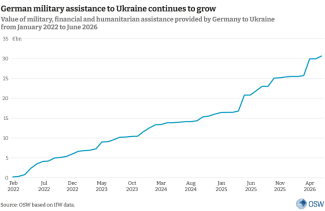
- Germany remains nominally the largest European provider of assistance to Ukraine. According to the Kiel Institute for the World Economy (IfW), between January 2022 and June 2026 Germany provided around €30.63 billion in aid, equivalent to 0.9% of its 2021 GDP. Of this, €24.9 billion was military assistance, part of which has yet to be delivered, €4.07 billion was humanitarian aid and €1.66 billion financial assistance (see chart). In its draft budget for 2027, the government has allocated €11.6 billion for military support to Kyiv. Under its financial plan for 2028–2030, the CDU/CSU–SPD coalition intends to spend €8.5 billion annually for this purpose.
Table. Agreements signed during Friedrich Merz’s visit to Kyiv on 4 October 2026
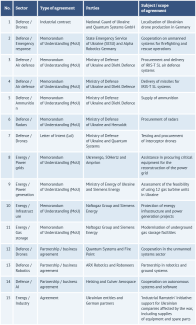
Source: OSW based on Ukraine Not Only Receives Assistance but Also Buys from Germany, Co-Produces with Germany, and Shares Experience – President at the Ukrainian-German Business Forum, 4 October 2026, president.gov.ua.