The Russians are launching an attack along the border with Poland. Day 1665 of the war

Reports of Russian forces withdrawing to the Zherebets River line north of Lyman have been confirmed. This has eliminated the encirclement of Sloviansk from the north and has relatively levelled the front line. Most of the territory of the former breach has returned to Ukrainian control, though the Russians still maintain a broad bridgehead on the western bank of the river. According to some sources, the defenders also managed to carry out a series of successful counterattacks in the north-eastern part of Kharkiv Oblast, thereby averting the threat of their forces being encircled.
The Russians have captured part of the territory between the breaches made so far west of Pokrovsk, east of Dobropillia and west of Kostiantynivka, thereby limiting the potential threat posed by Ukrainian counterattacks. The flanking of Druzhkivka has intensified, whilst the invading forces have not achieved much success in Dobropillia or in Mykolaivka, which borders Sloviansk to the east. On 11 September, Russian guided aerial bombs destroyed the railway bridge connecting the eastern and western parts of Sloviansk (the road bridges had previously been destroyed).
Russian forces have entered the centre of Orikhiv, which is currently the scene of fighting. According to some sources, Mala Tokmachka, which neighbours Orikhiv to the east, has also come under their control. They have also made slight advances in the western part of Zaporizhzhia Oblast, where they have recaptured some positions in the Stepnohirsk area, as well as in the border regions north of Kharkiv, where their capture of Kozacha Lopana has been confirmed.

On 12 and 13 September, the Russians carried out massive attacks, striking targets continuously for dozens of hours. According to the Ukrainian Air Force Command (UAFC), they deployed a total of 1,325 drones and drone decoys, as well as small Banderol cruise missiles, of which the defenders neutralised 1,157. On 12 September, Ukraine was also struck by 23–30 Russian ballistic and cruise missiles, of which, according to the UAFC, eight were shot down, whilst OSINT sources put the figure at between one and two. The main targets were industrial facilities, warehouses, energy, rail and port infrastructure, and petrol stations. According to the State Border Guard Service of Ukraine (SBGSU), during the attacks on the Lviv, Rivne and Volyn oblasts, Russian air attack assets were receiving signals from transmitters deployed in Belarus.
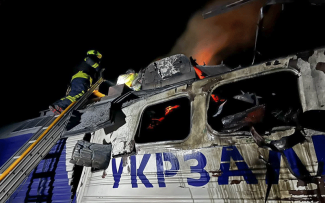
On 12 September, Russian missiles once again struck the already damaged and partially non-operational metallurgical complexes in Kryvyi Rih and Zaporizhzhia. According to some sources, steelworks in Dnipro and Kamensk in Dnipropetrovsk Oblast were also attacked again. In Dnipro, Russian missiles struck three times within 24 hours. One person was killed there and 18 were injured. Two people were killed each in Kryvyi Rih and Zaporizhzhia, where four people were also reported injured. In Odesa, damage was caused, amongst other things, to a block of flats, resulting in 28 people being injured, including a child. According to Ukrzaliznytsia, the most severe strikes on railway infrastructure took place in Fastiv in Kyiv Oblast and in Lutsk in Volyn Oblast, where the attack lasted several hours. Damage to facilities was also reported in other parts of Kyiv Oblast, as well as in the Odesa, Rivne, Poltava and Zhytomyr oblasts (in Zviahel, two people were killed and, amongst other things, a plant belonging to the Polish company Cersanit was damaged, leading to the suspension of production). In the evening, a power substation in Mykolaiv was hit, cutting off electricity to part of the city.
On 13 September, Russian drones struck Yahodyn, right on the border with Poland, damaging a locomotive on the Kyiv–Warsaw train and a petrol station at the border crossing. A further four petrol stations were hit in Zhytomyr Oblast, whilst damage to railway infrastructure occurred in Ternopil and the Lviv and Vinnytsia oblasts. Damage was also reported from the Khmelnytskyi, Ivano-Frankivsk and Kyiv oblasts. In Odesa, another block of flats was hit, resulting in two deaths and 26 people injured, including a child. The rescue tug ‘Sapfir’ was also damaged. A further 24 people, including two children, were injured in Odesa Oblast, where, amongst other things, the 330 kV Usatove substation, which supplies the port, was damaged.
The Russians have intensified their attacks on petrol stations in Kyiv, whilst in Kyiv Oblast, warehouses remain their main target. Between 9–11 and 15 September, six petrol stations in the capital were damaged; office buildings were also targeted (on 11 September, the same building in Podil was attacked twice). On 9 September, a drone struck a block of flats, killing one person and injuring 17 others. In Kyiv Oblast, Bila Tserkva was attacked three times (on 8, 9 and 15 September). On 11 September, a Russian drone struck an ammunition depot in Hostomel, which, unlike the two previously destroyed arsenals in Kyiv Oblast, was located in an uninhabited area. On 10 September, Ruslan Shostak, co-owner of the Ukrainian retail chains EVA and Varus and chairman of the Terwin corporation, summarised that Ukraine had lost 50% of its largest warehouses (Classes A and B), and as much as 68% in Kyiv Oblast– 1.5 million m2 of floor space (2.1 million m2 in total across Ukraine), with as much as 900,000 m2 lost in 2026.
Ukrainian port infrastructure remains a constant target of Russian attacks. From the evening of 8 September until the morning of 15 September, Odesa Oblast and the city of Odesa were attacked every day except 11 September. At least five vessels were damaged, including, on 10 September, a ‘foreign-flagged’ tugboat on which two Azerbaijani seamen were killed and a further two were injured. The day before, the Starokozachi crossing on the border with Moldova was hit. According to OSINT sources, between 13 and 15 September, Russian guided aerial bombs struck the bridge in Zatoka – which had been closed to pedestrian traffic – on several occasions. On 9, 10 and 15 September, Mykolaiv came under attack, with the first strike on the city’s port being a massive assault (the Russians used several dozen bombs, drones and missiles, including two Iskander-M ballistic missiles). In total, at least six people were killed and 28 injured in the city.
Russia continues to attack towns in the immediate rear of the front line. Besides the concentrated attacks on 12 and 13 September, the cities most frequently targeted were Kharkiv (8, 10, 11 and 15 September) and Zaporizhzhia (9, 10, 11 and 15 September). In Sumy, on 9 and 10 September, the same shopping centre was attacked twice (two people were killed and 20 were injured in the first attack). Dnipro was attacked four times on 10 September; furthermore, damage to facilities in that city (including the American food processing plant Oleina) occurred on 9 and 11 September. Kremenchuk was attacked on 9 September, whilst Kryvyi Rih and Pavlohrad were attacked on 10 and 14 September. As a result of strikes on a shopping centre and a warehouse in Pavlohrad on 10 September, five people were killed and 67 were injured, including children. Furthermore, on 10 September, Russian drones attacked Khmelnytskyi, and a day later, Ovruch in Zhytomyr Oblast. According to the UAFC, between the evening of 8 September and the morning of 15 September, the Russians deployed a total of 2,139 unmanned aerial vehicles, of which 1,860 were neutralised. Excluding the missile strike on 12 September, at least three further ballistic missiles struck Ukraine.

On 9 September, a Ukrainian drone set another range record by striking a refinery in Novy Urengoy in the Yamalo-Nenets Autonomous Okrug, nearly 3,000 km away. A fire broke out at the facility, as it did at the refineries attacked on 11 September in Saratov, on 13 September in Slavyansk-on-Kuban in Krasnodar Krai and in Nizhnekamsk in Tatarstan, and on 15 September in Syzran in Samara Oblast. According to the General Staff of the Armed Forces of Ukraine, a processing plant and a section of pipeline were damaged in Saratov. In addition, an Ozon logistics centre there was hit. On 12 September, Ukrainian drones caused a fire at the Tolyattikauczuk chemical complex in Samara Oblast. On the same day and on 15 September, the Ukrainians struck industrial facilities in Taganrog in Rostov Oblast. In the second attack, an Ozon warehouse in the same area was also targeted. The attacks on the refinery in Volgograd and the chemical plant in Berezniki in Perm Krai on 11 September most likely failed to achieve their objectives. Following damage sustained on 6 September, the refinery in Ryazan suspended operations, as reported by Reuters four days later.
On 9 and 10 September, the Black Sea cities of Novorossiysk, Sochi and the occupied Sevastopol were the targets of massive attacks, as was the Caspian Sea city of Makhachkala. In Novorossiysk, a fuel oil terminal was damaged and, according to the General Staff of the Armed Forces of Ukraine, the large landing ship ‘Pyotr Morgunov’, the frigate ‘Admiral Essen’ and the minesweeper ‘Zheleznyakov’ were also hit. According to local reports, four people were killed and 29 injured as a result of the strikes and falling debris in the port area. Sochi was also attacked by surface drones, causing explosions and fires along the quays. 28 were injured, including two children. In Sevastopol, a Mangust-class patrol boat is reported to have been damaged. In Makhachkala, strikes were reported in the commercial port area. A further attack on Sochi took place on 14 September and, according to the General Staff of the Armed Forces of Ukraine, an S-400 radar station was damaged. According to Russian data from 10 September, for the first time in several weeks, the Ukrainians used over 1,000 drones in a single day in attacks on Russia and the territories it occupies (1,030 unmanned aerial vehicles and 3 unmanned surface vessels were reportedly neutralised).
Robert Brovdi “Magyar”, Commander of the Unmanned Systems Forces, presented further summarised information on the effects of attacks on energy infrastructure in the occupied territories and on Russian shipping. As part of Operation ‘Crimea Shutdown’, 25 ‘energy hubs’ were hit between 1 and 9 September, bringing the total to 374 since the operation began on 6 July. Meanwhile, during Operation MoLoCHKa from 1 to 11 September, 16 ships were struck, whilst in August Ukrainian drones struck 54 Russian vessels, and in July “206+9”.
According to information from Ukrainian Military Intelligence (HUR) dated 9 September, officers from this service hacked into the network of the Moscow Institute of Thermal Technology and obtained data on Russian ballistic missile programmes. HUR gained access to the company’s organisational structure, current and future projects, and a list of the employees and management of companies belonging to the group. The Institute is involved in the Yars, Topol-M, Bulava, Iskander-M and Oreshnik programmes.

Russian hackers used Claude artificial intelligence models for operations against Ukrainian state institutions, the military and drone manufacturers. This information comes from an Anthropic report, which describes a campaign attributed to the Midnight Blizzard group, linked to the Russian Foreign Intelligence Service. The attackers are said to have used AI for phishing, account takeovers, infecting devices via hotel networks and analysing stolen data. The hackers scanned the systems of more than 20 Ukrainian state institutions. The drone sector was a separate target – the email accounts of at least two manufacturers of unmanned aerial vehicle components were hacked, and a manufacturer of military drones was attacked.
The Security Service of Ukraine (SBU) reported that it had foiled an assassination plot against the popular activist and veteran Hennadiy Druzenko, which had been prepared by the Federal Security Service (FSB). On 10 September, the SBU detained a 19-year-old resident of Mykolaiv, whom the FSB is alleged to have recruited via the internet. According to investigators, the suspect had been monitoring the victim’s daily routine and travel routes, had collected a pistol with ammunition and a silencer from a hiding place, and had planned to carry out the assassination during the target’s morning walk.
On 15 September, the SBU announced the discovery of a group suspected of planning terrorist attacks. A former deputy head of the State Emergency Service (name withheld) was reported to be among its members. The group was allegedly planning, amongst other things, to blow up a construction crane in Chernihiv, which could have collapsed onto a residential building and cars, thereby causing numerous casualties, as well as a bomb attack on the building of the territorial recruitment centre (TRC) in the Ivano-Frankivsk region.
Ukrainian foreign intelligence has warned that Russian services may be planning terrorist attacks at premises used during the State Duma elections in the occupied parts of the Donetsk, Luhansk, Kherson and Zaporizhzhia oblasts. The blame for these attacks is to be pinned on Ukraine, which would serve to justify further repression against the local population.

On 8 September, the 36th meeting of the Contact Group of countries supporting Ukraine took place (in a hybrid format) with President Volodymyr Zelensky in attendance. During the meeting, Defence Minister Yevhen Khmara and Commander-in-Chief of the Armed Forces of Ukraine (AFU) Mykhailo Drapatyi presented the ‘War Plan’ – according to which the Armed Forces of Ukraine operate – to their partners for the first time. Furthermore, it was announced that Germany would supply PAC-2 GEM-T missiles from the Bundeswehr’s stock for the Patriot air defence system, as well as AIM-7 air-to-air missiles and 155 mm ammunition, whilst the Netherlands would invest 250 million euros in the purchase of unmanned systems for the AFU.
On 10 September, Canadian Prime Minister Mark Carney and President Zelensky signed a Declaration on a 100-year strategic partnership. Under this declaration, Canada has committed to continuing all initiatives providing military, humanitarian, economic and political support to Ukraine. Furthermore, the two countries will establish a long-term partnership in the defence industry – covering the joint production of unmanned systems, counter-drone systems, electronic jamming systems and ammunition – supported by research and technology transfer. Furthermore, Canada will allocate 350 million Canadian dollars (253 million US dollars) for the purchase of anti-aircraft missiles for the Patriot air defence systems and missiles for F-16 fighter jets, which will be transferred to Ukraine. It was also revealed that 21 Ukrainian pilots are currently undergoing initial training in Canada, after which they will travel to Sweden for advanced training on JAS 39 Gripen fighter jets.

A specialised recruitment centre for foreigners and stateless persons is to be established within the National Guard, as announced on 10 September by the Minister of the Interior, Ivan Vyhovskyi. A draft of the relevant regulation is to be submitted to the government for approval in the near future; the aim is to speed up the recruitment of foreign nationals into contract service with the National Guard.
A special regime applicable during martial law has been introduced along Ukraine’s border with Russia and Belarus. Since 12 September, restrictions have been in place there on free entry, stay, residence and movement, as well as on carrying out work unrelated to defence or border protection. The State Border Guard Service justified this measure by the need to minimise the risk of reconnaissance and sabotage activities.
The SBU and the National Police reported that they had dismantled five corruption schemes designed to evade mobilisation and facilitate illegal departure from Ukraine. On 8 September, 11 people were detained in connection with this case. According to investigators, the fees for these services reached $22,000 per person. The largest group operated in Lviv Oblast and is believed to have utilised the cooperation of individuals linked to military medical commissions, medical facilities, military units and the Territorial Defence Forces to obtain fictitious grounds for exemption from service or removal from the register.
To date, 8,823 prisoners of war and 903 civilians have returned to Ukraine from Russian captivity. This was announced on 14 September by Dmytro Lubinets, the Verkhovna Rada’s Commissioner for Human Rights. In addition, 2,573 children have been successfully repatriated.

The Russian command is reportedly seeking to mobilise as many as 800,000 people and is increasingly supplementing its own forces with foreign nationals and soldiers from North Korea. This was reported by the head of the Main Intelligence Directorate of the Ministry of Defence of Ukraine (HUR), Oleh Ivashchenko, in an interview with the British newspaper The Times. He estimated the army’s capacity to simultaneously accommodate new recruits at between 300,000 and 500,000. According to Ivashchenko, Russia has already recruited over 28,000 foreigners, and there are around 8,000 North Korean soldiers in Kursk Oblast, a figure that could rise to around 50,000.