Amending Hungary’s Constitution to dismantle Fidesz’s grip on power
Following its victory in the April 2026 parliamentary elections and the securing of a constitutional majority, Péter Magyar’s government began implementing one of its key campaign pledges: to restore the rule of law and dismantle the institutional legacy of Fidesz’s 16 years in power. The first symbolic step came in June, when Parliament amended Hungary’s Constitution to introduce, retroactively, an eight-year term limit for the office of prime minister, effectively preventing Viktor Orbán from returning as head of government. A much broader package of reforms followed with the adoption of the 17th constitutional amendment on 13 July. It covers the country’s highest state institutions, the judiciary and the rules governing the application of cardinal laws. The most significant measures include the early termination of President Tamás Sulyok’s term of office and the introduction of term limits for members of parliament. This is the most far-reaching constitutional reform since the adoption of the current Fundamental Law in 2011. Its purpose is to dismantle the institutional framework and personnel arrangements underpinning the system created by Fidesz. The amendments have sparked controversy over the limits of permissible changes to the existing constitutional order and the proper way to restore rule of law standards.
Fidesz’s institutional and personnel legacy
Magyar’s government argues that sweeping reform is necessary because even its decisive election victory and constitutional majority have not given it the tools to control the country’s key political processes or deliver its promised reforms. In its view, 16 years of Fidesz rule has reshaped Hungary’s constitutional framework in a way that prevents meaningful political change even after the party has left office. The government therefore describes the 17th amendment as a constitutional ‘reset’, intended to dismantle the institutional framework and personnel arrangements that have entrenched the previous governing camp’s influence and create the conditions for restoring the rule of law. Against this backdrop, the removal of President Tamás Sulyok, who has been in office since 2024, carries particular symbolic significance. Magyar accuses him of failing to fulfil his constitutional role as guardian of the Constitution by allowing violations of the rule of law and civil liberties during Orbán’s time in office. The fact that Sulyok was elected indirectly by Parliament, rather than by popular vote, combined with his relatively low approval ratings (around 70% of respondents support his removal), has made it easier for the government to portray him as a politician without a strong public mandate. Before submitting the bill to Parliament, Magyar repeatedly called on Sulyok to resign voluntarily.
The long terms of office granted to the heads of key judicial and oversight institutions were one of the pillars of the Orbán system (see Table 1 in the Appendix). Although these were formally intended to guarantee institutional stability, they also helped entrench the influence of officials appointed by Fidesz for many years. Another key feature of the system was the extensive use of cardinal laws, which require a two-thirds parliamentary majority to be adopted. After 2010, their scope expanded considerably. The Constitution provides for around 35 areas to be regulated by cardinal laws, covering not only constitutional matters but also a broad range of public policy issues, from family policy to taxation. As a result, a government with only a simple parliamentary majority would be unable to introduce changes in these areas.
TISZA’s reform package
The most far-reaching changes concern the country’s highest state institutions and the judiciary. The amendment terminates the president’s term of office before its expiry and provides for Parliament to elect a new head of state for a transitional period, until a new constitution enters into force or for a maximum of five years. It also restores the rules governing the Constitutional Court that were in force before 2012. Under the new provisions, the Court’s judges will once again elect their president from among themselves, the upper age limit of 70 for judges has been reinstated, resulting in the termination of the mandates of four current judges, including the Court’s president, and judicial terms have been reduced from 12 to nine years, with no possibility of re-election. At the same time, the amendment removes restrictions on the Constitutional Court’s power to review the constitutionality of legislation relating to public finances. It also changes the appointment procedures for the President of the Supreme Court (Kúria) and the President of the National Office for the Judiciary (OBH), strengthening the role of judges in the nomination process and shortening their terms of office from nine to six years.
The second pillar of the reform is to narrow the scope of matters regulated by cardinal laws, which require a two-thirds parliamentary majority. This includes areas such as tax policy, public finances, the management of state assets and agricultural land transactions. The amendment also abolishes the Budget Council’s power to veto the state budget in order to limit its ability to influence the new government’s policies. This is intended to prevent a situation in which Fidesz appointees on the Council could block the adoption of the budget and, as a consequence, lead to the dissolution of Parliament, which the president is entitled to do if the budget has not been adopted by the end of March in a given year.
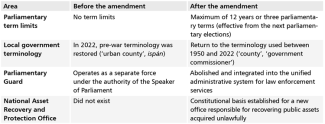
Among the remaining changes, the most significant is the introduction of a 12-year limit, equivalent to three parliamentary terms, on serving as a member of parliament. The measure will apply from the next parliamentary elections but will also take previous parliamentary service into account. Another important change is the introduction of constitutional provisions establishing the National Asset Recovery and Protection Office (NVVH), which will be responsible for identifying and recovering public assets acquired or used unlawfully.
Controversy over the amendment: do the ends justify the means?
Supporters of the 17th amendment argue that it fulfils the promise of far-reaching political system change after 16 years of Fidesz rule. They also contend that several of its provisions strengthen institutional independence while limiting the powers of the current governing majority. They point in particular to the restoration of the Constitutional Court’s right to elect its own president, the removal of restrictions on the Court’s authority to review budgetary and tax legislation, and the stronger role given to judges in appointing the leadership of the judiciary. Another key element of the reform, according to its supporters, is the establishment of the National Asset Recovery and Protection Office, which, if effective, could become a lasting tool in the fight against corruption.
Critics, by contrast, focus primarily on the speed of the legislative process and the limited period for public consultation, even though the government presents the amendment as a transitional measure before the adoption of a new constitution. The greatest controversy concerns the removal of the president through the early termination of his term of office. Some commentators argue that if such a mechanism can be used against the head of state, it could also be used in future to shorten the terms of other constitutional officeholders, such as the Prosecutor General or the President of the State Audit Office. The introduction of term limits for members of parliament has also attracted criticism. Opponents point out that such a measure has no equivalent in other EU member states and restricts the right to stand for election.
Critical assessments have also been issued by such institutions as the Hungarian Helsinki Committee (HHC), the Rule of Law Clinic at Central European University (CEU) and Human Rights Watch. These organisations agree that restoring the rule of law and reversing the changes introduced under Fidesz are legitimate objectives. At the same time, they argue that pursuing these goals must not come at the expense of fundamental constitutional principles. In their view, terminating the incumbent president’s mandate through a one-off amendment to the Fundamental Law undermines the principles of legal certainty and the protection of fixed terms for constitutional officeholders. They warn that it creates a precedent that would allow parliamentary majorities to shorten terms of office arbitrarily. They also stress that even officials responsible for weakening the rule of law should be held accountable through existing constitutional mechanisms, rather than through provisions designed for specific individuals.
Fidesz has also protested against the amendment, organising demonstrations and portraying it as an act of ‘constitutional revenge’ and an attempt to use the government’s constitutional majority to eliminate political opponents. Under the new term limits, 22 of Fidesz’s 52 current MPs will be unable to stand for re-election because they are serving at least their third parliamentary term. The amendment has also been criticised by President Sulyok himself, a constitutional lawyer who served as President of the Constitutional Court before becoming head of state. Under the constitutional procedure, he has five days after the amendment’s adoption to sign it. If he refuses to promulgate it or refers it to the Constitutional Court for review, the government has announced that it will initiate proceedings to remove him from office.
Prospects
The package goes beyond a standard constitutional amendment. Magyar’s government argues that restoring the rule of law requires dismantling the mechanisms that have entrenched the previous governing camp’s influence. It also maintains that it has a clear democratic mandate to do so, having secured a two-thirds parliamentary majority. The paradox, however, is that this process relies on tools similar to those for which Fidesz was criticised for years: using a constitutional majority to introduce rapid, ad hoc constitutional changes. The government describes these measures as temporary and has pledged to adopt a new constitution following broad public consultations, in contrast to the approach taken under Fidesz. Nevertheless, the measures adopted, particularly the early removal of senior state officials before the expiry of their terms, create a precedent that could in future be used by any government with a constitutional majority. The final assessment of the 17th amendment will depend largely on the further course of Hungary’s political system reforms. Its significance also extends beyond domestic politics, as the views of the EU institutions, the Venice Commission and international organisations working on the rule of law will influence efforts to rebuild trust between Budapest and its EU partners. For Magyar’s government, this will be a test of whether its declared commitment to restoring the rule of law is seen as consistent with European constitutional standards.
Appendix. Comparison of the legal framework before and after the 17th amendment to Hungary's constitution
Table 1. Highest state institutions and the judiciary
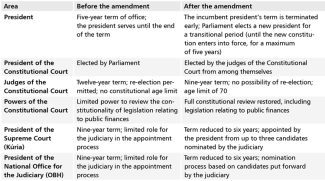
Table 2. Constitutional changes and the dismantling of mechanisms entrenching the Fidesz system

Table 3. Other changes
|
|