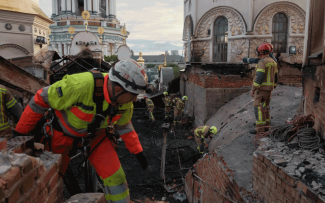
The Kyiv Pechersk Lavra in flames. Day 1574 of the war

Russian forces continued their advance on most fronts, making the greatest gains at Kostiantynivka and on its flanks. According to some sources, they have taken control of most of the town centre and its western districts. The Russians drove the defenders from further positions around Kupiansk, east of the Oskil River, and captured more towns in the border regions of the Kharkiv and Sumy oblasts. They also advanced towards the strategic town of Pysaryvka, less than 15 km north of Sumy, which came under fire from field artillery. Ukrainian forces have resumed attacks on the border between the Kharkiv and Donetsk oblasts, where their objective appears to be to relieve the pressure on the forces defending Lyman and, if conditions permit, to cut off the Russians around Sviatohirsk. Ukraine also launched counter-attacks in Dnipropetrovsk Oblast and the western part of Zaporizhzhia Oblast.

On 15 June, the Russians carried out another massive air strike on Kyiv. Damage and fires occurred in over 50 locations across all districts of the city. Five people were killed and 30 were injured (including two children). As a result of damage to power transmission lines, 140,000 customers were left without electricity. NASA FIRMS satellite imagery confirmed that the main targets were the Kyiv-based companies Analitprylad, Burevisnyk, Mayak, Radar and Unmanned Technologies, the No. 410 Aircraft Repair Plant, and a factory building at Zhuliany Airport, where fires broke out. In addition, the largest terminal at Nova Poshta and the Dovzhenko Film Studio were destroyed. The latter’s premises likely housed an assembly plant or warehouse for FP-1 drones, as suggested by photographic evidence. Damage to industrial facilities and warehouses was also reported in Kyiv Oblast and in Kharkiv and Dnipro. In total, 11 civilians were killed and 53 injured across Ukraine (including 5 and 13 in Kharkiv, respectively).
The Uspensky Cathedral within the historic Kyiv Pechersk Lavra complex was among the buildings damaged as a result of the Russian attack on Kyiv – part of its roof was burnt down. The relatively minor damage suggests that it was caused by falling debris. Both sides used the fire at the Lavra as a weapon in the information war, blaming the other side for either deliberately targeting or knowingly exposing the UNESCO World Heritage Site to damage. The Russian narrative regarding the downing of an interceptor missile from the Patriot system may have been prompted by photographs and footage published by local observers, as pointed out by Yuriy Ihnat, spokesperson for the Ukrainian Air Force Command (UAFC). He once again appealed for people not to disseminate material showing the effects of enemy strikes.
The attack cast doubt on the credibility of the official account regarding the effectiveness of Ukraine’s air defences, which proved to be extremely at odds with estimates from OSINT sources. According to the UAFC, 60 of the 70 missiles fired by the Russians were aimed at Kyiv, with 50 reportedly shot down. Around ten missiles struck Kharkiv and Dnipro that day; nevertheless, Ihnat described the attack on the Ukrainian capital as the largest to date involving ballistic missiles. However, AMK Mapping – the leading pro-Ukrainian group analysing Russian air strikes – reported that the invaders had used 74 missiles, of which only 14 were shot down. In its view, this was the lowest interception rate achieved by Ukrainian air defences “for some time”. This reportedly came after several months of “fairly successful” work to improve their effectiveness. There was a stark discrepancy regarding the Zircon hypersonic missiles – according to the UAFC, the defenders shot down five out of six of them, whilst AMK Mapping estimated that only one in ten was intercepted. Discrepancies between the statements of the Ukrainian military and the assessments of researchers have always existed, but they have never been so large.
Russia continued to strike Ukrainian rear areas in border and frontline regions, with Kharkiv being the target of the highest number of attacks. From the evening of 9 June until the morning of 16 June, the city was attacked at least six times (the situation was relatively calm on 12 and 13 June). On 10 June, as many as 26 strikes were recorded, mainly in the industrial area. Critical infrastructure, transport and logistics facilities in Mykolaiv (12, 13 and 14 June) and Zaporizhzhia (12, 13 and 15 June) were also heavily targeted. The Russians struck Odesa (off the coast, two general cargo ships flying the flags of Barbados and Panama were targeted) and Sumy on 10 June, and Dnipro on 14 and 15 June. Furthermore, on 11 June, Konotop in Sumy Oblast was the target of a massive attack, during which a locomotive depot was damaged and part of the town was cut off from electricity and gas supplies. On 13 June, the targets were railway infrastructure in Zhytomyr Oblast and a bridge over the Dniester River in the town of Maiaky in Odesa Oblast. According to the UAFC, during the period in question, the Russians deployed a total of 1,504 attack drones, of which 1,375 were neutralised. Including data from other sources (the General Staff, regional military administrations), they also used 79 or 81 missiles, of which 50 are reported to have been shot down (all on 15 June in Kyiv Oblast).

On 9 June, Bulgarian Defence Minister Dimitar Stoyanov stated that his country had no plans for further donations of arms and military equipment to Ukraine. At the same time, it was emphasised that commercial sales of military equipment and armaments will continue as normal. To date, Bulgaria has provided 13 aid packages with a total value of approximately 70 million euros.
On the same day, the leaders of the Nordic-Baltic Eight (NB8) and the President of Ukraine, Volodymyr Zelensky, met in Tallinn. Latvia and Ukraine signed a defence cooperation agreement, which will enable the faster implementation of Ukrainian expertise within the Latvian armed forces and commits Riga to continuing its support for Kyiv over the next 10 years. The Norwegian government has announced that it will allocate 1.2 billion Norwegian kroner (110 million euros) towards the development and procurement of unmanned maritime vehicles for Ukraine. It aims to deliver at least 200 of these systems by the end of the year.
Also on 9 June, the German Ministry of Defence, in response to a parliamentary question, stated that in 2025 it had signed a multi-year contract worth 240 million euros to procure satellite imagery for Ukraine from the US company Planet Labs.
On 12 June, the director of the US company Bell Textron Ukraine announced that negotiations were underway between the governments of Ukraine and the United States regarding the sale of AH-1Z and/or UH-1Y helicopters under the Foreign Military Sales programme. The sources of funding for this purchase were not disclosed.
On 15 June, the Ukrainian Navy announced that it had received its third Alkmaar-class (Tripartite) minehunter from the Netherlands and that the vessel had been renamed ‘Henichesk’. The handover took place as part of the Coalition for Maritime Capabilities. Until the war with Russia ends, the vessel will remain in the UK, where two Ukrainian Sandown-class minehunters – the ‘Chernihiv’ and the ‘Cherkasy’ – and two Alkmaar-class vessels – the ‘Mariupol’ and the ‘Melitopol’ – are already stationed.
Also on 15 June, Ukraine and France signed an agreement to establish a joint grant programme for the development of defence technologies, designed to support innovation. Its annual budget is set at 20 million euros.

Ukrainian forces carried out further attacks on Russian critical infrastructure. As a result of the strikes, operations were halted at the main facilities of the Kuibyshev refinery in Samara (10 June) and the TANEKO refinery in Nizhnekamsk, Tatarstan (12 June). Damage was also confirmed at the Tolyattikauchuk chemical plant in Togliatti, Samara Oblast (12 June), the Tamanneftegaz oil terminal in Volna, Krasnodar Krai (13 June) and the Temp fuel depot in Rybinsk, Yaroslavl Oblast (14 June). In addition, fires were reported at the Vtorovo pumping station in Vladimir Oblast and the VNIIR-Progress plant in Cheboksary, Chuvashia (10 June), the Afipsky refinery in Krasnodar Krai (11 June), the TAIF-NK refinery in Nizhnekamsk (12 June), processing plants and a pumping station in Kotovo in Volgograd Oblast and a terminal in Temryuk in the Krasnodar Krai (13 June), as well as the Palkino pumping station in Yaroslavl Oblast and the Azot chemical complex in Novomoskovsk in Tula Oblast (14 June). On 16 June, the Moscow refinery was struck – where, according to the Security Service of Ukraine, the main processing facility was damaged – as well as the Poltavskaya fuel depot in Krasnodar Krai, where a fire broke out on the premises.
The Ukrainians struck the land links with Crimea, damaging the Chonhar Bridge and the bridge between Henichesk and the Arabat Spit. The attacks took place on 11, 13 and 15 June and, at the first location, a pontoon crossing set up temporarily whilst the bridge was being repaired was also targeted. Following strikes on the ‘Novorossiya’ route in previous weeks, these were the latest to disrupt supplies to occupied Crimea. Sevastopol was also attacked (on 11 June; according to Ukrainian military sources, a Neptune cruise missile struck a facility producing maritime drones), Simferopol (12 June, with targets including a local combined heat and power plant) and Armiansk (13 June, where, according to Robert Brovdi ‘Madyar’, commander of the Ukrainian Unmanned Systems Forces, the Crimean Titan plant was damaged).
On 9 June, a bomb attack took place in Balashikha, near Moscow, in which, according to unofficial Ukrainian and Russian sources, Colonel Damir Davydov, head of the department for the supply of rocket and artillery ammunition at the Main Rocket and Artillery Directorate of the Ministry of Defence, was killed. The attack took place a few hundred metres from the site of the assassination of Yaroslav Moskalik, deputy head of the Main Operational Directorate of the General Staff of the Russian Federation (see ‘Russia pushes Ukrainian forces out of Russian territory. Day 1161 of the war’).
On 12 June, in Shchapovo, near Moscow, an assassination attempt was made on Andrei Pinchuk, the former ‘minister of state security’ of the so-called Donetsk People’s Republic. According to media reports, an explosive device was concealed in a parcel handed to him. Pinchuk reportedly managed to take cover before the explosion and sustained only minor injuries.

On 10 June, the head of the Ukrainian Police, Ivan Vyhivskyi, announced that, since the start of 2026, six attempted assassinations of Ukrainian military personnel, commissioned by the Russian security services, had been recorded. Only one of these was successfully prevented. According to Vyhivskyi, Russia is increasingly using young women to carry out these assassinations; their task is to track down soldiers via dating sites and social media and make contact with them under the pretence of a social gathering. During these meetings, the soldiers are given alcohol laced with methadone.

Soldiers of the Armed Forces of Ukraine (AFU) who have been mobilised to date and who do not wish to sign contracts will continue to serve until a general demobilisation is announced. Mstyslav Banik, Deputy Minister of Defence, announced this and further details of the reform of the AFU manning system on 15 June. To be eligible for early discharge from service, it is necessary to sign one of the new types of contract: a basic contract (24 months’ service), a combat contract (14 months) or an infantry-assault contract (ten months), available from 15 June. The previously announced monthly pay of 460,000 hryvnias will be the maximum amount, whilst the average pay for a soldier in an infantry unit will be 300,000 hryvnias, and the lowest pay in support units may be as low as 30,000 hryvnias. Soldiers will be eligible for additional payments for taking a prisoner of war (100,000 hryvnias) and for the confirmed killing of an enemy in direct combat (15,000 hryvnias). This phasing out of service will not apply to officers, and their contracts will be concluded for a period of at least two years. The right to recruit deserters (according to Banik, 80 of them have expressed they are willing to return to service since 12 June) has been granted to the 50 most effective ‘combat subunits’ of the SZU (Banik mentioned, amongst others, the 3rd Assault Brigade and the 93rd Mechanised Brigade ‘Kholodny Yar’).
On 12 June, Defence Minister Mykhailo Fedorov announced the general principles of the reform of the Ukrainian Armed Forces’ manning system, including the intention to fill 30–50% of posts in assault and infantry units with foreign nationals (for more details, see ‘Ukrainian Armed Forces pin hopes on foreign recruits’).

On 12 June, Vladimir Putin signed a decree increasing the number of military posts in the Armed Forces of the Russian Federation to 1,510,000. Compared with the previous decree increasing the size of the army, the current increase is modest, amounting to 7,350 military posts. The number of civilian posts remains unchanged; it has stood at 889,130 since 2017. The Russians had planned to increase the size of the army to 1.5 million soldiers by December 2022 and, at least formally, they reached this level in September 2024. At the start of the full-scale aggression, the number of military posts in the Russian Armed Forces stood at 1,013,628. Putin also stated that the Russian army grouping in the zone of the so-called ‘special military operation’ numbers over 700,000 soldiers. This would suggest that its strength has remained unchanged since at least September 2025. In January this year, the Commander-in-Chief of the Ukrainian Armed Forces, General Oleksandr Syrskyi, estimated the figure at 715,000 soldiers. Ukrainian estimates also include the Rosgvardiya contingent carrying out occupation duties, which has remained at a level of 35,000 soldiers for at least a year.

On 11 June, President Zelensky issued a decree implementing a new Counter-Terrorism Strategy. Unlike the previous document from 2019, the new strategy places greater emphasis on multidimensional threats from Russia. Terrorist operations, including acts against the civilian population, critical infrastructure and commercial supply chains, have been identified as tools used alongside military operations. Threats such as cyber-terrorism, hacking attacks on state registers and digital management systems, and the recruitment of minors for terrorist and subversive activities via the internet have also been taken into account.
On 15 June, the Ukrainian Human Rights Ombudsman, Dmytro Lubinets, reported that 486 Ukrainian women – both soldiers and civilians – are currently being held captive by Russia. He had previously stated that the number of military personnel released from Russian captivity to date exceeds the number of those who remain in Russian prisons. Since the start of the full-scale war, 9,048 people have returned to Ukraine from Russian captivity.
On 12 June, Olena Kolobrodova, a representative of the Ukrainian Ombudsman for Social and Economic Rights, reported that, as a result of the war, the number of people with disabilities had increased by around 600,000. There are currently around 3.4 million such people in Ukraine, including around 231,000 children. Kolobrodova noted that, once the armed conflict ends, this figure may rise further as military personnel return from the front line. She also emphasised that, since the start of the full-scale invasion of Ukraine, over 1,200 healthcare facilities have been damaged or destroyed, which further hinders access to treatment.

According to data from the Eastern Human Rights Defence Group – a Ukrainian independent non-governmental organisation – Russia has conscripted at least 88,000 residents of the temporarily occupied territories into the war against Ukraine. These estimates are based on data from a Russian bank, which reported that 88,000 ‘SVOi’ electronic cards had been issued in these areas. These cards are intended for individuals with the status of combatants serving in Russian armed formations and combine the functions of an ID card, a payment card and a means of accessing state benefits and concessions. This data comes from one of the few open sources enabling an estimate of the extent to which the local population has been drawn into Russian military operations.