37 hours of Russian air strikes on Ukraine. Day 1518 of the war

The Russians have made further territorial gains in Donetsk Oblast, but these have not led to any overall change in the situation. They have most likely finally driven the defenders out of Hryshyne, north-west of Pokrovsk, and partially levelled the frontline east of Sloviansk; however, they are still unable to break through the Ukrainian defences around Rai-Oleksandrivka. According to Ukrainian sources, Russia’s forces have begun moving reinforcements to the northern outskirts of Pokrovsk and Myrnohrad, but there is no consensus on whether this is preparation for an intensified offensive or is intended to ensure the smooth rotation of attacking units in the direction of Dobropillia.
Russian forces continued to expand their bridgeheads in the regions of the Kharkiv and Sumy oblasts bordering Russia, which Ukraine has so far been unable to effectively counter. Ukrainian sources provide reassurances that this is not about encircling Sumy (which has not yet occurred), but about the construction of a buffer zone, previously announced by the Russians, several kilometres deep from the border. The defenders have not ceased to apply pressure on Russian positions in the western part of Zaporizhzhia Oblast, where Stepnohirsk remains the main theatre of operations.

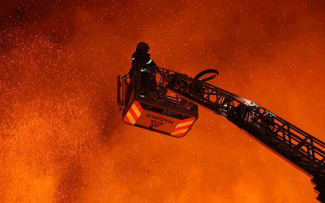
On 15 April, the Russians carried out another massive daytime air strike which, combined with two night-time strikes, lasted 37 hours. The targets were energy, industrial and transport infrastructure. Among other things, facilities at two technical universities and the Dnepropress plant in Dnipro were damaged (on 15 and 16 April respectively), the Motor Sich plant in Zaporizhzhia (on the night of 14–15 April), chemical plants and a 330 kV substation in Sumy (15 April), as well as the Kvazar and Mayak plants in Kyiv and the Mikron plant, port infrastructure and a container ship flying the Nauru flag in Odesa (16 April). According to the Ukrainian Ministry of Internal Affairs, 15 people were killed and over 100 injured; however, fragmentary reports from the hardest-hit cities – Dnipro, Odesa and Kyiv – indicate that 20 people were killed in those cities alone. Damage to infrastructure was also reported from Bila Tserkva, Kharkiv, Cherkasy, Chernihiv, Izmail, Sumy and the Mykolaiv and Poltava oblasts. In these regions, the damage was primarily to energy infrastructure. According to a statement from the Ukrainian Air Force Command (UAFC), during the aforementioned 37 hours, Russia deployed nearly 1,000 drones and 50 missiles. Dmytro Pletenchuk, a spokesperson for the Ukrainian Navy, described the number of drones used during the night of 15–16 April in the attack on Odesa as a record high. Ukraine reportedly neutralised 87 of them.
The attacks on port infrastructure carried out by the Russians since the beginning of 2026 have led to a further decline in cargo throughput, as reported by the Ukrainian Sea Ports Authority on 20 April. In the first quarter of 2026, it stood at 21 million tonnes, whereas in the corresponding period of 2025 it was 23 million tonnes, and it was 27.8 million tonnes in 2024. Since the start of this year, individual ports have reportedly been attacked on average every five days. A total of 193 port facilities and 25 ships have been damaged. In addition to the concentrated attack on 15–16 April, port infrastructure in the Odesa Oblast was also attacked over the following two days (in addition to the aforementioned targets, the port of Pivdennyi was also targeted). In turn, the period from 19 to 21 April was one of the few longer lulls since the start of 2026, during which no new strikes were recorded.
On 17 and 18 April, Russia carried out a series of devastating attacks on energy infrastructure in Chernihiv Oblast. The damage forced the suspension of operations at the Chernihiv combined heat and power plant, and further strikes on the Chernihiv and Nizhyn substations led to a local blackout – 380,000 customers were left without power. Ukrainian energy and logistics infrastructure was also targeted in the other border and frontline regions. Russian drones struck again in, among others, Zaporizhzhia (17, 18 and 20 April), Kharkiv (19 and 20 April), Chernihiv (19 April), Mykolaiv (19 and 20 April), Kryvyi Rih (20 April) and Sumy (21 April). According to the UAFC, from the evening of 14 April to the morning of 21 April, Ukraine was attacked by a total of 1,895 enemy drones, including at least 1,050 ‘Shaheds’ (Ukraine did not provide data for 16 April), of which 1,714 were reportedly neutralised. The Russians are also thought to have used 52 missiles, of which 32 were shot down (mostly cruise missiles used on 15 and 16 April). According to the Ukrainian military, given the growing shortage of missiles for air defence systems, over 50% of enemy aerial targets are neutralised by electronic warfare measures.

On 18 April, Crimea was the target of a massive attack, and Russian landing ships were hit in Sevastopol. On the day of the attack, the Security Service of Ukraine (SBU) reported that the vessels “Azov” and “Yamal” (Project 775) and a third unidentified vessel, most likely the anti-sabotage cutter “Grachonok” were struck, and a day later, Ukrainian Military Intelligence (HUR) reported damage to the landing ships “Yamal” and “Nikolai Filchenkov” (Project 1171). Both Ukrainian services attributed the success to their subordinate units, namely the “Alpha” Special Operations Centre and the “Prymary” special unit, respectively. Available information suggests that the ships did not sustain serious damage; nevertheless, the attack was the first in nearly two years in which a large Russian vessel was hit in the Crimean region. It also confirms that the base in Sevastopol is still being used by the Russian fleet (ships undergo mainly inspections and repairs there). The most serious consequence of the attack on the peninsula was a fire at the fuel depot in Sevastopol. The SBU and HUR also reported damage to radar stations on the peninsula, and on 20 April, the General Staff announced that a fuel depot in Hvardiiske had been hit.
On 16 and 20 April, Ukrainian drones struck the Rosneft refinery in Tuapse in Krasnodar Krai, causing a fire in the fuel tanks (a second attack took place after the first had been extinguished). On 16 April, the port was also hit, and some of the vessels awaiting refuelling were relocated to Novorossiysk. On 18 April, refineries in Novokuybyshevsk and Syzran in Samara Oblast, a fuel depot in Tikhoretsk in Krasnodar Krai, and the port of Vysotsk in Leningrad Oblast were attacked (according to the Ukrainian General Staff, the Lukoil terminal there was hit), and a day later, the port of Yeysk in Krasnodar Krai. Fires broke out on these sites, but no significant damage was confirmed, as was the case with the attack on the chemical plant in Sterlitamak, Bashkortostan, on 15 April. A fire broke out and factory buildings were damaged at the Atlant Aero plant in Taganrog, which manufactures unmanned aerial vehicles; it was struck by Ukrainian drones on 19 April. On 18 April, in an attack on targets in Russia and in the occupied territories, the Ukrainians again deployed a significant number of unmanned aerial vehicles – at least 568 (this is the number of neutralised UAVs reported by the Russian Ministry of Defence).
On 17 April, President Volodymyr Zelenskyy signed two decrees approving decisions by Ukraine’s National Security and Defence Council to impose sanctions on 121 Russian commanders responsible for missile attacks on Ukraine, as well as nine Russian religious figures who support Russia’s aggression. The sanctions target, among others, commanders of long-range aviation, the navy, and missile and artillery forces, as well as figures associated with the Russian Orthodox Church who publicly justify the war and incite violence against Ukrainians.

On 15 April, the Security Service of Ukraine announced the arrest of a resident of Kramatorsk, the deputy headmistress of a local school, suspected of passing information to the FSB regarding the deployment of the Armed Forces of Ukraine (AFU) in the city. A day later, the SBU detained a taxi driver in Odesa suspected of guiding Russian strikes on the city. On 17 April, a shop assistant was arrested in Odesa Oblast on similar charges. On the same day, the Prosecutor General’s Office announced that indictments had been filed against six residents of Donetsk Oblast for passing information to the Russian services regarding the deployment of Ukrainian troops, equipment, ammunition depots, fortifications, and artillery and air defence positions. On 20 April, the SBU announced the arrest near Kyiv of an FSB collaborator suspected of involvement in preparing a series of Russian missile and drone attacks on thermal power stations in Kyiv and Kyiv Oblast.
On 15 April, Reuters reported that the Russian intelligence services had carried out a cyberattack in Ukraine. Between September 2024 and March 2026, hackers had access to over 170 email accounts belonging to Ukrainian prosecutors and investigators. The main targets of the operation were Ukrainian law enforcement officers, but the attacks also affected representatives of NATO countries and the Balkans. The aim was most likely to obtain information on investigations concerning Russian spies and collaborators.
On 20 April, the SBU announced the dismantling in Zhytomyr of a bot farm used by Russia to conduct disinformation operations against Ukraine. The arrested owner of the premises was alleged to have sold over 3,000 fake Telegram accounts registered to Ukrainian mobile numbers to Russia each month. The profiles were used by Russian intelligence services to spread disinformation about the Ukrainian army and the internal situation in Ukraine, as well as to send fake private messages.

On 14 April, during German-Ukrainian intergovernmental consultations in Berlin (see ‘Germany–Ukraine intergovernmental consultations: security as the foundation of a strategic partnership’), German Defence Minister Boris Pistorius announced a €4 billion support package for Ukrainian air defence. This will include 36 launchers for the IRIS-T SL system (it has not been specified whether these are the SLS or SLM variants) and hundreds of missiles for these and for Patriot systems (presumably older PAC-2 GEM-T variants). In addition, Germany will allocate €300 million to the development of Ukrainian long-range strike systems. On the same day, the American company RTX (Raytheon) signed a contract with the German Ministry of Defence to supply Ukraine with PAC-2 GEM-T missiles for Patriot systems, worth $3.7 billion. This will take place as part of previously announced aid packages.
On 14 April, during President Zelensky’s visit to Oslo, Ukraine and Norway signed a joint declaration on deepening cooperation in the field of defence and security, which will enable Norwegian companies to develop the licensed production of Ukrainian unmanned systems.
On 15 April, the 34th meeting of the Ukraine Defense Contact Group in Ramstein-format took place. NATO Secretary General Mark Rutte stated that member states plan to allocate a total of $60 billion in aid to Kyiv this year. The UK has announced that it will supply Ukraine with at least 120,000 unmanned systems of various types this year. Norway will allocate $560 million to equip Ukrainian Defence Forces brigades with drones and $150 million to strengthen Ukrainian logistics. The Netherlands will provide €248 million “for drones”. Canada will allocate $15 million to the NSATU (NATO Security Assistance and Training for Ukraine) fund, $42 million to a Czech initiative for the purchase of ammunition, and $17 million for engineering equipment. Belgium will contribute €75 million to the Czech initiative, a further €75 million to the German air defence initiative, and €85 million to the drone coalition. Lithuania has pledged $39 million for the Czech initiative. Under the US arms procurement mechanism – the so-called Prioritised Ukraine Requirements List (PURL) – Luxembourg will allocate $29 million, Lithuania $29 million, and Estonia $13 million.
US Secretary of Defence Pete Hegseth did not attend the meeting; he was represented by Under-Secretary for Policy Elbridge Colby. He stated that further support for Ukraine under the PURL initiative should not rely on a large US contribution and requires growing European involvement, including in its own production capabilities.
On 15 April, during President Zelensky’s visit to Rome, Ukraine and Italy signed an agreement on the exchange of expertise regarding the use of unmanned systems. A day later in The Hague, Ukraine and the Netherlands signed a declaration on commencing work on drafting a comprehensive intergovernmental agreement on cooperation in the joint development of unmanned systems. During the meeting, it was announced that in June 2026 the Netherlands will formally hand over an Alkmaar-class minehunter to Ukraine, as had been announced back in 2025.

Deputy Head of HUR Vadym Skibitsky estimated Russia’s monthly production of Iskander ballistic missiles at 60 units, as reported by the Financial Times on 17 April. Russia is also said to have increased its capacity to deploy them. Taking into account earlier HUR reports, this would mean that Iskander production has increased tenfold (from six per month at the start of 2023). Meanwhile, according to other reports, three new brigades have been formed in which these missiles constitute the main armament (the number of missile brigades in the Russian Armed Forces has risen to 16). Skibitsky also reported that the current strength of the Russian force stands at 680,000, plus 20,000 strategic reserves deployed to the occupied territories.
On 17 April, the governor of Leningrad Oblast announced an urgent call-up of reservists to protect the oil terminals in Ust-Luga and Primorsk due to the threat of attacks by Ukrainian drones. Reservists are being offered three-year contracts and the opportunity to join mobile fire groups tasked with engaging aerial targets.

On 15 April, the General Staff of the Armed Forces of Ukraine announced the establishment of the ARES (Allied Reform and Expert Support) Military Expert Council under the Commander-in-Chief, which will serve as an advisory body. Its task is to facilitate the exchange of Ukrainian and international experience for the development of the armed forces, support the transformation of the army, and implement systemic changes in military management. It is headed by British General Richard Shirreff. The council also includes military personnel and experts from partner nations, including former CIA Director David Petraeus and high-ranking representatives from Canada, Germany, Slovakia and Norway.
On 15 April, the Ministry of Defence announced the launch of a new model for conducting combat operations. It is based on drone-assault subunits using unmanned aerial and ground systems to carry out infantry operations. According to the ministry, this solution is intended to increase the effectiveness of combat operations and reduce casualties.
On 16 April, the Russian Ministry of Defence threatened European countries involved in the production of drones for Ukraine with “unpredictable consequences”. The statement referred to agreements signed in recent weeks regarding cooperation between European and Ukrainian manufacturers of unmanned aerial vehicles. It was stated that these actions are leading to an “escalation of the military-political situation” and the transformation of these countries into “strategic bases for Ukraine”. The ministry also published the addresses and names of companies in 11 European countries, including Poland, as well as in Turkey and Israel, which were alleged to be involved in the production of drones or their components for Ukraine. The statement, backed by threats from Dmitry Medvedev, Deputy Chairman of the Russian Security Council, should be interpreted as a Russian information operation aimed at deterring Ukraine’s partner states from continuing their defence industry cooperation.

On 18 April, a 58-year-old veteran opened fire on a street in Kyiv, before barricading himself inside a supermarket with hostages. Seven people were killed and more than ten were injured. The terrorist was killed during an operation by a special police unit. He was a Ukrainian citizen born in Moscow and a retired military officer. There is as yet no information to suggest that the attack was inspired by the Russian security services.