Israel’s war with Hezbollah in Lebanon: one month on
The war between Israel and Lebanon-based Hezbollah, which began on 2 March, continues to escalate. Israel has been striking targets in southern and eastern Lebanon, as well as the group’s strongholds in the southern districts of Beirut. The attacks have targeted military sites and infrastructure such as bridges, but also civilian objects, including residential buildings and medical facilities.
Since 16 March, a ground operation has also been under way in southern Lebanon. Israeli evacuation orders, which now cover 15% of Lebanese territory, have triggered a wave of internal displacement affecting around 1.2 million people, or 22% of the country’s population. Israel has declared its intention to maintain indefinite control over southern Lebanon as a ‘buffer zone’. In this context, it has been demolishing towns and villages located along the border strip, while stating that refugees from the south will not be able to return. As early as the first week of the conflict, the Lebanese government offered Israel direct talks on ending the war – potentially the first such talks between the two countries, which have formally remained at war since 1949. However, this proposal was not pursued.
The war has been unfolding in the shadow of the US-Israeli attack on Iran, but it is linked to that theatre due to Hezbollah’s alliance with Tehran. Israel entered the conflict expecting that Hezbollah’s weaker position following the previous confrontation (2023–24), and the ongoing crisis in Iran, would allow it to further degrade the group’s capabilities, while unofficially realising that its complete destruction was not feasible. Israel is also seeking to push Hezbollah physically away from its borders. It intends to achieve this by occupying southern Lebanon on a long-term basis, removing the Shia population, and destroying critical infrastructure, thereby effectively replicating the modus operandi employed in the Gaza Strip. The Israeli government is clearly not interested in strengthening Lebanon’s official authorities or its statehood. This aligns with Israel’s broader policy towards the surrounding region, which has also been applied to Syria and the Palestinian Authority, and is characterised by a lack of interest in political dialogue or the political stabilisation of these areas.
Historical background
The armed confrontation between Israel and Hezbollah dates back to the early 1980s, when the organisation was established – with ideological, financial, and military support from Iran, as well as political and logistical backing from Syria – as a Shia political and military force opposing Israel’s occupation of southern Lebanon. That occupation began in 1978 and was significantly expanded four years later following a full-scale Israeli invasion targeting Palestinian groups operating in Lebanon.
Over the next four decades, Hezbollah – rooted in the Shia community, which comprises around 30% of the country’s population – has operated within Lebanon both as a recognised political actor, represented in parliament since 1992, and as a non-state actor engaged in armed conflict with Israel and supported by Iran.
Following the withdrawal of Israeli forces from Lebanon in 2000, after 22 years of occupation, the confrontation between the two sides shifted to a low-intensity conflict involving border incidents and occasional exchanges of fire. A major escalation occurred in 2006, when Israel launched another short-lived incursion into Lebanon.
In subsequent years, the conflict remained limited in scope. Hezbollah gradually expanded its military capabilities, partly through the involvement of its fighters in the Syrian civil war on the side of Bashar al-Assad’s regime, while Israel sought to curb the transfer of weapons from Iran. From Israel’s perspective, the steady expansion (both quantitative and qualitative) of Hezbollah’s rocket arsenal posed a significant threat. In 2023, the group was estimated to possess between 130,000 and 150,000 projectiles of various types, although media reports on this issue generally originated from Israeli sources.
The beginning of the current phase of the confrontation
The current phase of the confrontation began in the autumn of 2023. On 8 October – the day after Hamas attacked southern Israel, triggering heavy Israeli retaliatory air strikes on the Gaza Strip – Hezbollah began shelling northern Israel in an act of solidarity with the Palestinian group. In the following months, as a result of these attacks and Israeli counter-strikes, between 60,000 and 90,000 Israelis were evacuated from the north of the country, including from the Syrian Golan Heights under Israeli occupation, while between 100,000 and 200,000 Lebanese were displaced from southern Lebanon.
As the conflict progressed, Israel dictated the scale of the confrontation and showed little interest in bringing it to an end. According to data from ACLED, which monitors armed conflicts, Israel accounted for over 80% of the more than 10,000 strikes exchanged between Israel and Hezbollah from 8 October 2023 to 20 September 2024. During these hostilities, Israel regularly used incendiary munitions containing white phosphorus, including in populated areas (see: ‘Israel used U.S.-supplied white phosphorus in Lebanon attack’).
A turning point came in the autumn of 2024. Israel inflicted heavy military, personnel, and consequently, political losses on Hezbollah by carrying out successful intelligence operations – including detonating explosive devices placed in pagers and handheld radios used by Hezbollah members – eliminating the organisation’s key leaders, most notably its head Hassan Nasrallah, conducting large-scale strikes, and launching a limited ground intervention.
This led to a ceasefire negotiated with the involvement of countries such as the United States and France, which entered into force in late November 2024. Over the following 15 months, Hezbollah adhered to the agreement, at least in terms of halting its attacks, while Israel routinely violated it by continuing to strike both Hezbollah-linked targets and civilian sites. Between November 2024 and November 2025, UNIFIL (the UN peacekeeping mission stationed in southern Lebanon since 1978) recorded around 10,000 ceasefire violations, “with almost all of them originating from the Israeli side”. According to the Lebanese government, during this period Israel killed around 500 Lebanese, including both Hezbollah members and civilians. Israeli strikes also continued at the beginning of the year. Furthermore, Israel did not fully withdraw its forces from Lebanese territory and continued to maintain control over several outposts in the border area.
The heavy losses inflicted on Hezbollah by Israel since October 2023 have weakened the group’s position on Lebanon’s domestic political scene. This has made it possible to fill the presidency, which had been vacant for more than two years due to Hezbollah’s obstruction, to appoint a new prime minister, and to initiate the gradual process of consolidating the crisis-stricken state and restoring central government control.
Current situation
Hezbollah resumed its shelling of Israel on 2 March in response to the US-Israeli attack on Iran, the group’s ideological and military patron, and in particular to the killing of Iran’s Supreme Leader, Ali Khamenei. The Lebanese government condemned Hezbollah’s decision as unlawful and contrary to the state’s interests and declared the group’s armed activity illegal, although it lacks the capacity to enforce it.
Israel was prepared for the resumption of its conflict with Hezbollah and responded with an immediate escalation of air strikes. On 4 March, it issued evacuation orders covering the entirety of southern Lebanon up to the Litani River, as well as southern Beirut. Two weeks later, it launched a ground operation, which currently involves elements of at least four Israeli divisions (the 91st, 146th, 162nd, and 210th).
Israel’s modus operandi in Lebanon exhibits a number of similarities to its conduct in Gaza. These include depopulating large areas through evacuation orders, destroying towns and villages, adopting very high thresholds for acceptable civilian collateral damage and routinely targeting civilian infrastructure, including healthcare facilities and medical personnel. According to the World Health Organisation, 52 medical staff members were killed in the first month of the war. As in the Gaza Strip, Israel has justified these attacks by alleging that Hezbollah uses medical infrastructure for military purposes, but has failed to provide any evidence to support these claims, even when requested by the Israeli press. According to Lebanon’s Ministry of Health, Israeli strikes have killed approximately 1,300 people to date, a figure which likely includes Hezbollah members.
Israel’s ground operation is progressing slowly, and its forces continue to operate within a few kilometres of the border. The Litani River, which Israeli Defence Minister Israel Katz has vowed to reach, lies approximately 25 km north of the border. Hezbollah also retains the capability to carry out rocket attacks on northern Israel. Owing to the high effectiveness of Israel’s air defence systems, these strikes have not caused significant losses; however, the constant alerts have had a substantial impact on daily life in Israel.
Prospects – a war without end
The war against Hezbollah forms part of a broader Israeli policy, crystallised after the attack on 7 October 2023, aimed at establishing military hegemony in the Middle East. Benefiting from de facto unconditional and seemingly inexhaustible political and military support from the United States, Israel has been engaged in continuous war on several fronts for nearly two and a half years. In the case of Iran from the outset, and with regard to Hamas and Hezbollah from a certain point onwards, this has been a war of choice rather than necessity. Its objective is to deprive Israel’s adversaries of even hypothetical capabilities to threaten it, regardless of the constraints of international law or civilian casualties.
Israel is aware that it cannot definitively defeat any of these actors, even with US support. Consequently, it has been waging war on a continuous basis, escalating the extent of damage (both military and civilian) inflicted on its adversaries and preventing them from reorganising. In this mode of warfare, every measure becomes permissible, and the war itself effectively never ends, as there is no specific, attainable objective.
The only constraints on the continuation of military operations are the availability of US support, the domestic political mandate, the resilience of the Israeli economy, and the capacity of the Israeli armed forces. Since the first two of these parameters are not under threat, and the latter two are not sufficiently strained to prompt a change in policy, Israel can be expected to continue its operations and, in the case of Lebanon, even intensify them.
From the perspective of the government in Beirut and a number of other regional capitals, Israeli policy poses a serious threat to efforts to normalise the situation in Lebanon. As such, it also presents a challenge for the EU, which has an interest in stabilising the eastern Mediterranean, partly to facilitate the return of refugees and prevent new waves of displacement.
Map. Israeli offensive in Lebanon
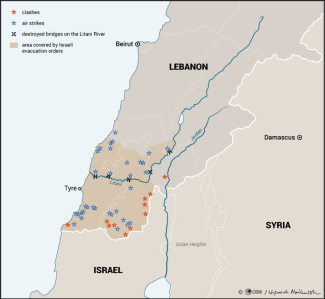
Source: author’s own compilation based on media reports.