The SPD’s defeat in the Rhineland-Palatinate election will intensify tensions within the German federal government
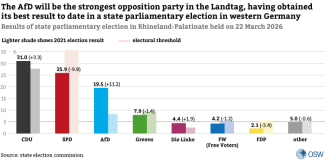
In the election to the Rhineland-Palatinate state parliament (Landtag) held on 22 March, the CDU emerged victorious with 31% of the vote (+3.3 percentage points compared with the 2021 result). The governing SPD came second with 25.9% (–9.8 pp), recording its worst result in the history of the federal state. The AfD placed third, receiving 19.5% of the vote (+11.2 pp). The Greens, who had previously been part of the governing coalition, also entered the Landtag with 7.9% (–1.4 pp). The FDP, a coalition partner, failed to surpass the 5% electoral threshold, obtaining 2.1% (–3.4 pp). Voter turnout was 68.5% (+4.2 pp).
A coalition between the CDU and the SPD is the most likely outcome, with all parties refusing to cooperate with the AfD. The loss of the minister-president’s office in a state governed by the SPD for 35 years will exacerbate the party’s crisis and weaken its dual leadership at the federal level: Vice-Chancellor and Federal Minister of Finance Lars Klingbeil, and Federal Minister of Labour and Social Affairs Bärbel Bas. At the same time, a hardening of the Social Democrats’ stance within the CDU/CSU–SPD coalition is to be expected, particularly regarding the social and economic reforms announced by Chancellor Friedrich Merz.
Commentary
- The SPD’s defeat will intensify tensions within the federal coalition. The Social Democrats will seek to emphasise their own demands in negotiations concerning the social and economic reforms announced by the government. This will provoke resistance from some CDU and CSU politicians, who advocate more far-reaching changes. This will be compounded by an internal leadership debate within the SPD, which is significantly weakening the position of the party’s co-leaders. Klingbeil has been criticised above all for failing to assume responsibility for the party’s defeat in the Bundestag election and subsequently consolidating full control in his own hands. A further criticism concerns the failure to deliver on electoral promises, including the announced tax reform intended to reduce the fiscal burden on the working-class electorate – which until recently constituted the SPD’s core support. An increasing share of voters – as demonstrated by both the Bundestag election and the two most recent state elections – no longer associate the SPD with clear policy proposals or a coherent political direction. Work on a new party programme was intended to address this (see ‘Leksykon niemiecki OSW’), however, this element of the SPD’s renewal following its defeat in the Bundestag election is also being pursued with insufficient determination, without visible results, and without a clear plan.
- The main reason for the SPD’s disappointing result is its low approval ratings at the federal level, which are reflected in its level of support in the regions. Despite enjoying greater recognition than his Christian Democratic rival and relatively positive assessments of his government’s performance, the incumbent minister-president, Alexander Schweitzer, failed to convince voters that the SPD is capable of addressing the most significant challenges facing the state. In the previous election in Rhineland-Palatinate, 36% of respondents attributed the highest level of competence in this regard to the SPD, whereas now only 24% do so (–12 pp). In the case of the CDU, the corresponding figure was 29% (+4 pp).
- The CDU owes its victory primarily to an effective campaign strategy focused on the party’s programme rather than its lead candidate. According to polls, for 48% of CDU voters it was the party’s policy proposals (including the introduction of a compulsory and free preparatory school year for all pupils), rather than the lead candidate (22%), that were decisive. At the same time, regarding the key campaign issues – the economy and education – voters rated the Christian Democrats’ competence higher than that of any other party. Moreover, the CDU is particularly strong in agricultural regions, which predominate in Rhineland-Palatinate. The party also benefited from the weakness of the SPD, from which it attracted 80,000 voters; its sustained lead in opinion polls over many months; and the crisis of the FDP, whose former voters most frequently shifted to the CDU (30,000). In addition, the party’s support base consists largely of older voters (aged over 60), who have traditionally supported the CDU and who recall the party’s dominance in the period 1947–1991.
- The AfD achieved its best result to date in all state parliamentary elections in western Germany in which it has participated and will become the largest opposition party in the state. Support for the party stems from acceptance of its programme rather than its appeal as a protest party against other political groupings: 65% of its voters supported it due to its policy positions, and only 13% because of its candidates. Moreover, the AfD is increasingly perceived as a highly competent party in addressing specific problems facing the state – 17% of voters attribute to it the highest level of competence in economic matters, and 14% in education. Despite the AfD’s victory among the youngest voters (21% among those aged under 25), the core of its electorate consists of individuals aged 35–59. The election results confirm that the AfD is drawing working-class voters away from the SPD – whereas in 2021 36% of manual workers voted for the Social Democrats and 18% for the AfD, these proportions have now reversed, with the AfD receiving 39% in this group and the SPD 21%. Furthermore, the AfD continues to be the most effective in mobilising former non-voters (66,000).