Massive Russian attacks on railway infrastructure. Day 1476 of the war

Russian troops continue their offensive operations in the area of Pokrovsk, Huliaipole and Kostiantynivka. According to reports from the Ukrainian command, resistance continues in the northern parts of Pokrovsk and Myrnohrad. However, Russia is said to have made progress northwest of the first of these towns, penetrating the northern part of the village of Hryshyne, where it is trying to gain a foothold among the buildings and develop a further offensive into the village.
At the same time, Russia is conducting intensive attacks in the vicinity of Udachne, where it is said to have grouped additional reserves. In the Kostiantynivka area, on 6 March, Russian troops damaged the dam of a retention reservoir near Molocharka and Novodmytrivka. The strike is a repeat of a similar operation carried out on the western side of Kostiantynivka (see ‘Slowdown in Russian advances on the front. Day 1469 of the war’), aimed at cutting off Ukraine’s logistical routes. Fighting continues in the southern part of the town.
The situation is tense in the Huliaipole area, where Russian forces are making progress to the south (taking control of Zaliznychne) and north of the city (reaching bridgeheads on the eastern bank of the Haichur River). At the same time, Ukrainian forces are reportedly continuing their attacks in the south-eastern part of Dnipropetrovsk Oblast. Ukraine is thought to have crossed its border and moved to the Novohryhorivka area (according to the head of the Main Operational Directorate of the General Staff, General Oleksandr Komarenko, Ukrainian troops have liberated almost the entire oblast).
There is a media campaign accompanying the Information provided by the military and political leadership, that more than 400 km2 of territory at the junction of the Dnipropetrovsk and Zaporizhzhia oblasts has been liberated from Russia (see ‘Russians advance towards Sloviansk and Kramatorsk. Day 1462 of the war’). This campaign highlights the achievements of the assault troops (the so-called Syrskyi units) in the counterattacks. In addition to boosting the morale of the army and the public, reports of the successes of these formations are also intended to counterbalance the increasingly frequent criticism of the huge losses they have suffered, mainly among newly mobilised recruits.

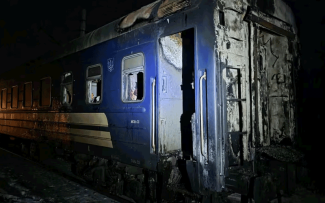
Russia is continuing its massive attacks on energy and transport infrastructure, primarily train depots. On 4 March, it struck a freight depot in Mykolaiv and railway infrastructure in the south of Odesa Oblast, including station buildings and rolling stock (one person was killed). A day later, they carried out a drone attack on a freight train, hitting the locomotive (two train drivers were injured). On 8 March, in Sumy Oblast, a Russian unmanned aerial vehicle attacked a passenger train with 200 passengers (no one was killed or injured).
On the same day, attacks on railway infrastructure were reported in the Rivne, Zhytomyr and Vinnytsia oblasts. During a massive attack on the night of 6 to 7 March, Russian drones damaged four railway substations in the Zhytomyr, Khmelnytskyi and Vinnytsia oblasts, as well as several bridges. The state railway carrier Ukrzaliznytsia reported that, since the beginning of March, 41 railway infrastructure facilities had been hit, 17 of which were rolling stock.
Russian troops continue to attack critical infrastructure and residential buildings. On the night of 6–7 March, they carried out another combined and massive strike using 480 drones and 29 missiles, including Zircon hypersonic anti-ship missiles, Iskander-M ballistic missiles and Kalibr cruise missiles. The main targets of the attacks were Kyiv, Kharkiv, and the Zhytomyr, Khmelnytskyi, and Chernivtsi oblasts. Among other targets, a multi-storey building in Kharkiv was hit, killing 11 people (including two children) and injuring at least 15. The Dniester Hydroelectric Power Plant in Novodnistrovsk in Chernivtsi Oblast, near the border with Moldova was also targeted.
On the same day, the Russian army also attacked port infrastructure in Odesa Oblast, causing a fire in grain warehouses (on 4 March, a Russian drone attacked a Panamanian-flagged ship carrying corn near Odesa). Air strikes were also carried out on energy infrastructure facilities in Vinnytsia, Zhytomyr, Kharkiv and other oblasts.
In Kyiv, heat supplies were disrupted as a result of successive hits on Kyiv Heat and Power Plant No. 5 – over 1,900 residential buildings in the capital were left without heating. Taking into account the effects of previous attacks, almost 3,000 buildings are currently without heating. In total, according to Ukrainian sources, from the evening of 3 March to the morning of 10 March, the Russians used 1,376 drones, including 860 Shaheds, and 33 manoeuvrable and ballistic missiles. Ukraine declared that it had destroyed 1,210 unmanned aerial vehicles and 19 missiles.

On 3 March, a fire broke out in the Mediterranean Sea near Malta, and a day later the Arctic Metagaz, a ship belonging to the so-called Russian shadow fleet, sank. The vessel was reportedly attacked by Ukrainian naval drones launched off the coast of Libya. The entire 30-member Russian crew was rescued. This was the first attack on a ship carrying liquefied natural gas (LNG). On the morning of 4 March, Ukrainian drones attacked the Uralchem chemical plant in Kirovo-Chepetsk in Kirov Oblast, and on 7 March they attacked oil storage facilities in the city of Armavir in Krasnodar Krai, where one of the fuel tanks was destroyed.
On 5 March, the General Staff of the Armed Forces of Ukraine confirmed damage to two frigates of the Russian Black Sea Fleet – the Admiral Essen and Admiral Makarov – as a result of an attack by Ukrainian drones on 2 March. Data on possible damage to other Russian ships is currently being analysed.

On 5 March, a female collaborator of the Russian services was detained in Donetsk Oblast while preparing an operation to blow up one of the recruitment centres of the Armed Forces of Ukraine (AFU). The woman was supplied with an improvised explosive device by an unmanned aerial vehicle, which she was intending to place in a rubbish container at the entrance to the premises. The Russian special services planned to detonate the bomb remotely, while the recruit would flee to Russia via third countries.
On 6 March, the Security Service of Ukraine (SBU) announced that a Russian agent who was preparing an assassination attempt on a Ukrainian soldier had been detained in Kyiv. The man intended to place one improvised explosive device under the victim’s car and another nearby after the emergency services arrived. The SBU foiled the plot by monitoring the Telegram network. It was through this network that a resident of Sloviansk in Donetsk Oblast, who was also detained by the SBU, is thought to have informed his Russian handlers about the location of Ukrainian troops.
In a statement published on 6 March, the Ukrainian Parliament’s Human Rights Commissioner, Dmytro Lubinets, condemned another case of the kidnapping and deportation by the Russians of 19 residents of a village in Sumy Oblast. He called on Russian Human Rights Commissioner Tatyana Moskalkova to clarify the matter, stating that “these actions constitute a clear violation of international humanitarian law”. This is latest in a series of these incidents in recent months: in December last year, Russian soldiers forcibly deported about 50 Ukrainian citizens from Sumy Oblast to Russia.
On 7 March, the Prosecutor General’s Office announced the sentencing of three Bukovina residents to 15 years’ imprisonment for setting fire to railway relay stations. The three men, aged 18-21, were recruited by the Russian services via the Telegram messenger app. They are thought to have received financial benefits for carrying out acts of sabotage. Two days later, the SBU announced the sentencing of two more Ukrainian citizens who received the same punishment for participating in similar acts of sabotage in Vinnytsia Oblast.

On 5 and 6 March, Russia and Ukraine exchanged 500 prisoners each through the mediation of the United States and the United Arab Emirates. Among those released from Ukraine are soldiers, including members of the Territorial Defence Forces, as well as officers of the National Guard and the State Border Guard Service of Ukraine. Some of them had been held captive since 2022. According to Lubinets, a significant number of them are suffering from serious health problems caused by the harsh conditions of their stay in Russian prisons. According to him, 6,922 Ukrainians have been released from captivity since the start of Russia’s full-scale invasion.

On 4 March, Vladimir Putin signed a decree increasing the size of the Russian army. This is another legal act concerning the expansion of the Russian Armed Forces, following the one signed in September 2024. Under the new regulations, the Russian army will grow to 2,391,770 soldiers. Of these, 1,502,640 will be on active duty, which is 2,640 more soldiers than previously.
On 5 March, Ukrainian Defence Minister Mykhailo Fedorov announced that in three months – from December to March – the Ukrainian Armed Forces had eliminated 92,475 Russian soldiers, most of them (88,898) using unmanned aerial vehicles. The rest were eliminated by artillery forces. Fedorov noted that in February alone, 27,313 Russian soldiers were eliminated, despite fewer calendar days and limited enemy activity. This would mean an average of 975 Russians eliminated every day.
On 6 March South Korean Foreign Minister Cho Hyun announced that Ukraine had provided assurances that the two North Korean soldiers captured during the Ukrainian operation in Kursk Oblast would not be handed over to Russia or North Korea. The South Korean foreign minister added that preparations were underway to hand them over to the authorities in Seoul.