Germany: the Greens win the Baden-Württemberg state election
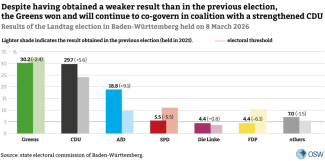
On 8 March, the Greens, who have governed Baden-Württemberg since 2011, won the election to the state parliament (Landtag) with 30.2% of the vote (2.4 percentage points down from their 2021 result). The Christian Democratic Union (CDU), which currently governs in coalition with the Greens, came second with 29.7% (+5.6 pp). The Alternative for Germany (AfD) also entered the Landtag, securing 18.8% of the vote (+9.1 pp). The Social Democratic Party (SPD) finished last with 5.5% (–5.5 pp). For the first time in the history of the state, liberals from the Free Democratic Party (FDP) failed to enter the parliament, receiving only 4.4% of the vote in what has traditionally been regarded as its political stronghold. Representatives of Die Linke also failed to pass the 5% electoral threshold, receiving 4.4% (+0.8 pp). Voter turnout was 69.6%, which was 5.8 percentage points higher than five years earlier. For the first time in this state, 16-year-olds were granted the right to vote. The election marked the beginning of a series of five state elections in Germany: on 22 March, voters in Rhineland-Palatinate will go to the polls, while elections will be held in September in Saxony-Anhalt, Mecklenburg-Vorpommern, Western Pomerania, and Berlin.
The Greens’ victory is above all a success for the party’s lead candidate, Cem Özdemir, who distanced himself from his own party during the campaign, presenting a more conservative course. He now has a chance to become the first state minister-president in the history of the Federal Republic of Germany with a migration background. The CDU’s weaker-than-expected result, and especially the disastrous outcome for the SPD, will lead both parties to harden their positions within the government of Friedrich Merz (CDU) and will make its work more difficult. The election will not alter the balance of power in the Bundesrat.
Commentary
- The Greens’ success stems primarily from Özdemir’s name recognition and from his campaign strategy of distancing himself from the federal leadership of his own party. His included his experience (see Appendix), a conservative electoral programme, and his pledge to continue the policies of the popular outgoing minister president Winfried Kretschmann (Greens). Özdemir advocated, among other things, maintaining the possibility of producing cars with internal combustion engines, supporting the key sectors of Baden-Württemberg’s economy (the automotive industry and mechanical engineering), and pursuing a relatively restrictive migration policy. This strategy helped the Greens make up the 14 points that separated them from the CDU as recently as five months ago. In doing so, they primarily attracted voters with the highest levels of education (45% of those with higher education voted for them), those under the age of 30 (29% – the highest share among all parties), and women (34%). Furthermore, Green voters indicated that the candidate himself had been the most important factor in their electoral choice.
- The Christian Democrats’ unexpected defeat is primarily attributable to an ineffective strategy, including the absence of concrete policy proposals and an underestimation of the Greens. The party was also harmed by the weak approval ratings of the Merz government – as many as 73% of Germans have a negative assessment of its performance. At the same time, the improvement in the party’s result (+5.6%) should be regarded as a clear achievement, reflecting voters’ belief in the Christian Democrats’ competence in economic matters (38% of citizens hold this view – the highest of any party). This, however, was not sufficient to maintain the party’s polling levels from the beginning of the campaign. Excessive self-confidence led to a defensive campaign strategy, which the Greens successfully exploited. They managed to convince voters that they too were capable of protecting jobs and stimulating economic growth – the central themes of the campaign (followed by education, healthcare, and migration issues). The CDU’s electorate is concentrated primarily among oldest voters (the party received 40% support from the over 70s). The Christian Democrats also succeeded in attracting 165,000 former Green voters and mobilising 130,000 previous non-voters. The CDU governed Baden-Württemberg continuously until 2011 and still dominates in rural areas.
- The AfD’s result confirms that the party is steadily gaining support in the affluent western federal states. Although its result doubled, it nevertheless fell short of expectations, as the party had hoped to secure more than 20% of the vote. The weaker outcome was influenced by a scandal involving allegations of nepotism and the employment of family members within the party’s structures. The AfD is increasingly becoming a party of the working class, drawing this electorate away from the SPD, which was supported by only 5% of manual workers, compared with 30% as recently as 2006; 37% of this group voted for the AfD. At the same time, voters’ choice of the AfD was determined primarily by its programme (as indicated by 65% of respondents), rather than by its candidates or due to protesting against other parties.
- The existing coalition between the Greens and the CDU will remain in power in the state parliament (all parties rule out the possibility of cooperating with the AfD). The election result will intensify tensions within the federal CDU/CSU–SPD coalition, and the government will increasingly be confronted with demands from the Christian Democrats to implement significant economic reforms – even against the wishes of the SPD. At the same time, the Social Democrats’ worst electoral result in the post-war period will strengthen their resistance to radical changes in social policy. The condition of the federal government will be determined by the upcoming state elections in Rhineland-Palatinate. If the SPD fails to retain the office of minister-president there and the CDU wins the election, this will trigger a debate on leadership within the Social Democratic Party and could lead to the destabilisation of the federal government.
Appendix. Biography of Cem Özdemir
Cem Özdemir (born 21 December 1965 in Bad Urach, Baden-Württemberg) is the child of Turkish Gastarbeiters (guest workers). He studied education. He is one of the most experienced German politicians and a representative of the pragmatic wing of the Greens (the Realo faction). He has been a member of the party since 1981. He served as a member of the Bundestag from 1994 to 2002 – as the first MP of Turkish origin – and again from 2013. During the 2004–2009 term he was a member of the European Parliament. From 2008 to 2018 he served as co-chair of the Greens. After the 2021 federal election he became Federal Minister of Food and Agriculture in the government of Olaf Scholz, and following the collapse of the SPD–Greens–FDP coalition he also assumed the office of Federal Minister of Education and Research for several months.