The E3 and the EU in response to the attack on Iran: reluctantly aligned with the US
Europe’s largest countries have declined to join the initial phase of the US-Israeli strikes against Iran. However, they have condemned the Islamic Republic’s disproportionate and ‘indiscriminate’ retaliatory campaign targeting countries in the Persian Gulf region. The E3 states – France, Germany, and the United Kingdom – addressed this issue in a special statement on 1 March, in which they reserved the right to undertake defensive action against Iranian missile launchers and drone launch sites in coordination with the US and regional partners. British and French air forces have participated in operations to intercept drones posing a threat to targets within the Gulf states.
On 28 February, French President Emmanuel Macron stated that France had been “neither informed nor involved in the US-Israeli attacks against Iran.” He called for intensified efforts to de-escalate the conflict through diplomatic channels, arguing that “no one believes that the issue of Iranian nuclear weapons, ballistic missiles, and regional destabilisation can be resolved through strikes.” At the initiative of France and Bahrain, the UN Security Council convened a special meeting.
On the day the operation began, UK Prime Minister Keir Starmer stated that his country was not taking part in the strikes against Iran. On 2 March, he told Parliament that he considered the attacks to be illegal. Earlier, he had also refused to allow British bases – likely referring to Diego Garcia in the Chagos Islands and RAF Fairford in the United Kingdom – to be used for the US attack. However, on 1 March he announced that British bases would be made available for US ‘defensive’ strikes targeting Iranian missile launchers.
German Chancellor Friedrich Merz called on the parties to return to diplomatic dialogue, while acknowledging that the efforts of the international community and the sanctions imposed had so far failed to alter the regime’s course. He stated that this was not the time to lecture allies and, “despite all doubts”, expressed support for most of the objectives of the US-Israeli operation, which Germany itself would not have been able to achieve. Foreign Minister Johann Wadephul has ruled out Germany’s participation in combat operations against Iran, stating that such involvement would only be possible if it became necessary to defend Bundeswehr units stationed in Jordan, Iraq, and Lebanon.
After an extraordinary online meeting of the EU’s foreign ministers, the EU member states issued a statement calling for the utmost restraint, the protection of civilians, and adherence to the principles of the UN Charter and international law. They condemned the retaliatory actions of the Iranian regime, its repression of its own citizens, and its nuclear and ballistic missile programmes. They also affirmed the EU’s commitment to safeguarding its interests and those of its citizens, underscoring the need to preserve freedom of navigation through the Strait of Hormuz. Several EU member states, in coordination with the High Representative, have announced plans to strengthen the EU’s ASPIDES military operation.
The leaders of Europe’s largest countries and EU institutions are concerned about the potential economic and political consequences of a protracted conflict with Iran. At the same time, they share the assessment of the risks arising from the destabilising capacity of the Iranian regime and seek to support their partners in the region, notably oil-exporting countries. This explains their limited criticism of the US-Israeli strikes and their involvement in efforts to protect the Gulf states.
Commentary
- Europe’s largest countries recognise that the US and Israel violated international law by launching their operation against Iran, but they have refrained from directly criticising Washington, viewing the regime in Tehran as a threat to their own interests and regional security. For years, France, Germany, the United Kingdom, and the EU pursued a diplomatic resolution to the dispute over Iran’s nuclear and ballistic programmes, culminating in the 2015 JCPOA agreement. More recently, however, they have acknowledged that they lack effective tools to exert pressure on the regime in Tehran or control its actions; consequently, last September they reinstated sanctions against Iran. For France and the UK, maintaining political, military and economic relations with the Sunni monarchies of the Persian Gulf, ensuring freedom of maritime navigation, and protecting their own citizens in the region play a particularly important role. In Germany’s case, an additional factor is a sense of special responsibility for Israel’s security. This explains a response focused on defending national interests, emphasising the destructive nature of the regime’s actions, and highlighting the rights of persecuted Iranians. At the same time, the E3 states fear that the US-Israeli air strikes are not backed by a realistic long-term plan to bring about regime change in Iran and build a new regional security architecture. This raises the risk of further destabilisation that, in the longer term, could result in economic and migratory consequences for Europe.
- A key factor prompting the E3 states to offer de facto support for US actions is Iran’s expansion of hostilities into the territory of neighbouring countries. While the US-Israeli attack is difficult to justify under international law, Iran’s retaliatory strikes against Europe’s partners in the region constitute an act of aggression in their own right. This gives the international community the right to respond in accordance with Article 51 of the UN Charter. European countries may use this as a pretext to neutralise – in line with the E3’s statement – targets in Iran that could pose a threat to freedom of navigation, oil infrastructure, their own bases in the region, and regional allies.
- Iran’s retaliation poses a direct threat to Europe’s economic interests, creating a dilemma as to whether to act within a coalition of the willing or to rely on EU instruments. Since 2024, the EU has conducted the EUNAVFOR ASPIDES naval operation in the region’s waters, involving three vessels (currently Italian, Greek, and French); its mandate has been extended until the end of February 2027. ASPIDES was originally tasked with protecting freedom of navigation in the Red Sea and around the Strait of Hormuz in response to attacks by Yemen’s Iran-backed Houthi rebels. However, the operation has been constrained by its limited mandate, which does not permit strikes against land-based targets. Forming a coalition of the willing among EU member states with the required capabilities, in cooperation with the US, the UK, and regional partners, could prove a more effective means of neutralising Iran’s retaliatory actions than assigning additional vessels to Operation ASPIDES. However, the statements by the E3 leaders indicate little political will to undertake such far-reaching steps.
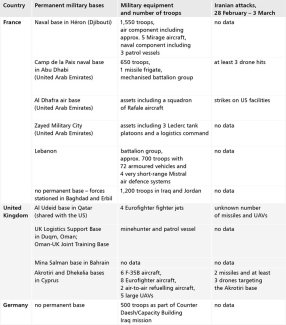
Appendix. Military presence of the E3 states in the Middle East