Snap elections in Kosovo: Kurti regains support
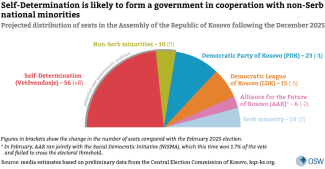
On 28 December, snap parliamentary elections were held in Kosovo, resulting in a victory for the left-wing Self-Determination coalition (Alb. Vetëvendosje). According to preliminary results, the bloc led by acting Prime Minister Albin Kurti secured 49.3% of the vote. The conservative Democratic Party of Kosovo (PDK) came second with 21%, followed by the centre-right Democratic League of Kosovo (LDK) with 13.6%. The Alliance for the Future of Kosovo (AAK), which, like the PDK, traces its roots back to the Kosovo Liberation Army (UÇK), also entered parliament with 5.7% of the vote. Under the electoral system, 20 of the 120 seats in the Assembly of the Republic of Kosovo are reserved for representatives of national minorities. Half of these will go to the Serb community, with the Belgrade-backed Serb List (which received 4.8% of the vote) guaranteed at least nine seats. Voter turnout stood at 45.4%, a decline of 1.1 percentage points compared with the February election. President Vjosa Osmani called the election following a second failed vote of confidence in the Vetëvendosje-led cabinet, which had achieved the best result in the February poll (see ‘Election in Kosovo: success for Albin Kurti and uncertain prospect for his continued rule’).
Self-Determination’s decisive victory is likely to enable it to form a single-party government and, as is customary, to cooperate with non-Serb minority representatives. The new cabinet will face the challenge of resolving the long-running political crisis that led to the early election.
Commentary
- The most likely scenario is that Kurti will form a government for the third time. Although the final election results will be announced in January, Self-Determination is expected to secure a majority in the most favourable configuration – through cooperation with non-Serb national minorities (or at least some of them). One of the new government’s immediate challenges will be to adopt a new budget law and ratify international agreements necessary to unlock funding from the EU’s Growth Plan for the Western Balkans, totalling approximately €882 million. The disbursement of these funds has been suspended due to the parliamentary deadlock. The scale of the crisis is underscored by the fact that the Speaker of the Assembly of Kosovo was elected only on the 58th attempt, and not a single piece of legislation was passed throughout 2025, paralysing the functioning of state institutions. The election of a president by the Assembly remains a pressing issue. Reaching an agreement with the opposition will be essential, as the vote requires a quorum of 80 MPs. The deadline for holding the vote is 5 March 2026. If a head of state is not elected by then, parliament will be dissolved again, increasing the risk of continued political instability.
- Vetëvendosje was the frontrunner in the election, but the scale of its victory has come as a surprise. The bloc won around 7 percentage points more than in February, which, according to preliminary projections, will give it 56 seats – eight more than in the previous term. In coalition with non-Serb minorities, this would amount to a majority of 66 out of 120 seats (see chart). The timing of the election worked in Self-Determination’s favour, allowing it to capitalise on support among citizens living abroad. The holiday period in Western Europe brought a large number of diaspora voters back to Kosovo. Moreover, the available results do not yet include votes from abroad, where the bloc led by Kurti is very popular. This group gives Vetëvendosje a strong chance of surpassing its record result from 2021. According to a UBO Consulting poll, as many as 62% of returning voters supported the party. Meanwhile, all major opposition parties saw a decline in support, which may reflect public frustration with their recent conduct. After Vetëvendosje’s first unsuccessful attempt to form a cabinet, the opposition failed to take advantage of the opportunity to create a broad coalition government, thereby deepening the institutional deadlock and leading to the snap election.
- As a charismatic leader, Kurti succeeded in convincing voters that his party offered the best chance of restoring stability and ending the political crisis. His campaign pledges to invest in defence may also have contributed to his support, as did – indirectly – the weakness of the opposition, which focused on criticising the prime minister and making unrealistic economic promises. Recent foreign policy successes may have played a more limited role. In December, the European Commission signalled its readiness to lift EU sanctions imposed on Pristina in 2023 following tensions involving the Serb minority in the north of the country (see ‘Unrest in northern Kosovo’). In addition, four more countries – Kenya, Sudan, Syria, and the Bahamas – recognised Kosovo’s independence this year, ending a stalemate that had persisted since 2020. While the main beneficiary of these diplomatic achievements has been President Osmani, who played a leading role in negotiations, she was elected with the backing of Self-Determination, and her party, Guxo (Dare), is part of Kurti’s bloc.