A devastating blow to Kyiv’s energy infrastructure. Day 1406 of the war

Russian forces have taken control of northern Myrnohrad, effectively ending months of fighting for the Pokrovsk conurbation. Groups of Ukrainian soldiers remain in the city, but they are unable to mount an organised defence. Some have surrendered, and others will most likely attempt to reach Ukrainian-controlled areas in the coming days. Fighting is ongoing north of the conurbation, and Ukrainian units are not limiting themselves to organising a defence but are attempting to counterattack. Particularly fierce clashes are reported in the village of Rodynske (according to some sources, it has already fallen under Russian control) on the main road from Pokrovsk via Dobropilia to Kramatorsk.
Russia continued its advance north and south-west of Siversk, seeking to outflank the enemy’s positions on the hills to the west of the city. Ukraine carried out a series of counterattacks, which enabled them to slow down the enemy’s advance in the area of the village of Sviato-Pokrovske, south-west of Siversk. Particularly heavy fighting is expected to take place for Dronivka, located north-west of it (according to some sources, Russia has already captured it). On 23 December, the General Staff of the Armed Forces of Ukraine presented the loss of Siversk as a planned withdrawal in order to organise the defence in better terrain conditions, but four days later, the commanders of the units defending the city (the 54th Mechanised Brigade and the 10th Mountain Assault Brigade) were dismissed. Russia managed to capture further areas in the arc north of Lyman, mainly in the vicinity of the road running from it to Siversk, but this did not change the situation atthe front.
Ukrainian forces resumed their attacks on Russian positions in the north-western part of Kupiansk, contributing to the collapse of their organised defence there. Most of the buildings in the town on the right (western) bank of the Oskil River are currently in the grey zone, and the primary goal of both sides is to destroy enemy logistics. Ukrainian sources emphasise that Russia is making extensive use of drones, with reports that there are more Russian drones than Russian soldiers involved in the fighting. Ukraine hopes that in the coming weeks they will be able to drive the Russians out of the western districts of Kupiansk. This is facilitated by the fact that Russia has failed to organise efficient logistics, and as a result, its control over the right-bank districts of the city has proved illusory.
There is conflicting information about how much of Huliaipole Russia has captured. Most likely, they have taken control of the city centre – on 25 December, they published a video from the headquarters of one of the defending battalions located there. The authenticity of the recording has been unofficially confirmed by Ukrainian military sources, and an investigation has been launched into the loss of position. Ukrainian observers point out that Russia’s rapid progress was facilitated by the disorganisation of communications between the brigades defending the city and the weakness of the command structure. The Ukrainians most likely control the western and south-western outskirts of Huliaipole, but according to DeepState, most of the city is in a grey zone, with groups of soldiers from both sides present “almost everywhere”.

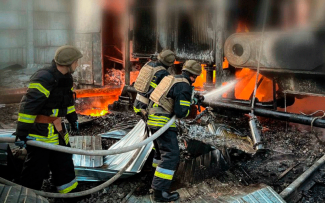
On 27 December, the Russians carried out one of the most devastating attacks on the energy infrastructure in Kyiv and Kyiv Oblast. The targets were primarily local thermal power plants – three in the capital and two in Bila Tserkva and Trypilska. The Kyiv Hydroelectric Power Plant in Vyshhorod and a substation in Brovary were also hit. According to preliminary data, there was a blackout on the left bank of Kyiv, and one-third of the capital was cut off from heating. Within 24 hours, power was restored to 748,000 customers in Kyiv and 347,000 in Kyiv Oblast, and power supplies to the right-bank districts of the capital were stabilised (i.e. the scheduled power cuts were restored). This means that, as a direct result of the attack, more than 1.1 million consumers were cut off from electricity. Due to systemic connections, part of Chernihiv Oblast was also affected. By noon on 29 December, heating had been restored to 400,000 homes in the capital. On 30 December, the Ukrainian Ministry of Energy decided that, due to the scale of the damage, it was not possible to restore the schedule of power cuts in left-bank Kyiv and part of Kyiv Oblast.
The targets also included the Kyiv Aviation Institute and the capital’s Zhuliany Airport (one of the main areas of deployment of Patriot systems). One person was killed and 32 were injured in Kyiv, while one person was killed and 14 were injured in the oblast. The Air Force Command (UAFC) of the Ukrainian army reported that Russia used 519 drones (including 300 “Shahed” strike drones) and 40 missiles (including ten Iskander-M and Kinzhal ballistic missiles) in the attack. According to the UAFC, 474 unmanned aerial vehicles (only 25 are thought to have hit their targets) and 29 missiles (including six ballistic missiles) were destroyed.
Energy infrastructure was one of Russia’s main targets in oblasts directly behind the front line during the holiday season. Among other things, they damaged thermal power plants in: Kherson (24 December and twice on 28 December; due to the inability to repair the facility, it ceased operations), Kharkiv (24 December) and Cherkasy (25 December), substations in Chernihiv and Korosten (24 December), Mykolaiv (26 December) and the Mykolaiv (29 December) and Chernihiv (30 December) oblasts. The Ministry of Energy announced that attacks on energy facilities, resulting in additional power, water and heating outages, occurred mainly in the Kharkiv (daily during the holidays), Kherson, Chernihiv, Dnipropetrovsk and Sumy oblasts. However, the number of strikes on energy infrastructure in Odesa Oblast (an attack on a substation was confirmed on 26 December) has decreased, but the oblast is still dealing with the effects of attacks from the previous weeks. On 24 December, DTEK reported that, as a result of the enemy’s attacks to date, 50% of electricity generation capacity had been damaged, and Ukrainians were without power for up to 20 hours a day. In some frontline regions, it is impossible to restore any supply from the national grid.
On 25 and 26 December, the Russians carried out further strikes on port infrastructure in the Odesa and Mykolaiv oblasts. Damage, including to industrial facilities, was reported in the Izmail and Odesa raions. South of Mykolaiv, a transhipment terminal and a Liberian-flagged ship moored there were damaged. The attack on the railway station in Kovel in Volyn Oblast (26 December) caused a significant, albeit temporary, disruption to traffic on the main railway line from Poland to Ukraine. The Russians also struck industrial facilities in Zaporizhzhia, including the Motor Sich plant (24 and 30 December), and gas extraction and storage infrastructure in the Chernihiv Oblast (24 and 26 December). According to the UAFC, from the evening of 23 December to the morning of 30 December, Russia used a total of 998 unmanned aerial vehicles (including 625 Shaheds) and 49 ballistic and cruise missiles. Ukraine declared that it had neutralised 816 drones and shot down 30 missiles.

Ukrainian drones attacked further enemy fuel and energy infrastructure facilities. On 24 December, they hit a synthetic rubber factory in Yefremov in Tula Oblast (a fire broke out on the premises) and a gas processing plant in Orenburg (the fire caused the plant to suspend operations). A day later, the targets were the Novoshakhtinsk refinery in Rostov Oblast (it was hit by Storm Shadow missiles, resulting in the suspension of operations) and the Temryuk oil port in Krasnodar Krai (two tanks with petroleum products burned down). On 28 December, the Syzran refinery in the Samara Oblast was hit, causing a fire on its premises.
The Ukrainian army continued its sabotage operations in occupied Crimea. Twice (on 24 and 28 December), their target was a warehouse of surface attack drones (as reported by the General Staff and the Unmanned Systems Forces of the Armed Forces of Ukraine, respectively). On 24 December, the Prymary military intelligence unit reportedly destroyed, among other things, an S-300 air defence system launcher (this information was reported by HUR two days later), and on 28 December, the Unmanned Systems Forces reportedly hit a radar station and a radar reconnaissance system control point. These reports have not yet been confirmed by other sources.

On 23 December, the commander of the 3rd Army Corps of the Armed Forces of Ukraine, Andriy Biletsky, stated that the reform of the brigades comprising the corps covers all areas of the units’ operations, but its key element is a change in the internal organisational culture. He noted that in some brigades, the Soviet model of relations between officers and enlisted soldiers persisted. As an example, he pointed to the 60th Independent Mechanised Brigade, where there were separate canteens for soldiers, officers and commanders. As part of the reform, the canteens’ menus and meal distribution rules were standardised. The commander admitted that some officers opposed the changes or neglected their duties. Such officers are assigned to reserve battalions or sent on combat missions as part of so-called officer patrols. Recently, similar decisions were made regarding officers of the 60th Brigade which, according to Biletsky, led to a change in their attitude towards their subordinates.
On 23 December, President Volodymyr Zelensky signed amendments to laws that extend the system of concessions for drone manufacturers. The new regulations allow the import of components for unmanned aerial vehicles without the need to pay customs duties and VAT, not only for the manufacture and repair of machines, but also for their modernisation. The changes are expected to reduce the cost of drone production, speed up the delivery of necessary parts and allow companies to invest more quickly in production.
Three days later, Andriy Pyshnyy, Governor of the National Bank of Ukraine, announced that domestic banks had concluded an agreement to grant a loan of 21.5 billion hryvnias (over $0.5 billion) to support defence industry companies. The consortium consists of six state-owned and private entities. According to Pyshnyy, loans of this type are currently among the most effective instruments for implementing large projects, as they allow for risk sharing and ensure stable financing on a large scale.
On 30 December, the Ukrainian border service announced that the highest number of attempts to leave the country illegally were recorded on the borders with Moldova and Romania. At the same time, in 2025, there was an increase in the number of these cases on the border with Belarus, where 1,400 people were detained throughout the year. According to service spokesman Andriy Demchenko, although the number of attempts has been gradually decreasing since autumn compared to the summer period, illegal border crossings continue to take place every day. The decline in their number is related, among other things, to deteriorating weather conditions, but even in winter, people risk their lives by crossing rivers or difficult-to-access mountainous areas to leave the country.

On 26 December, the Security Service of Ukraine (SBU) announced that it had prevented the assassination of a Ukrainian military intelligence officer. The suspect was detained in one of the capital’s institutions when he pulled out a gun and was about to open fire. The assassin was a 28-year-old citizen of one of the Central Asian countries. According to the findings of the services, he was recruited by the FSB abroad while looking to earn quick money through Telegram channels. He then came to Ukraine posing as a tourist. He was promised $50,000 for the assassination and so-called legalisation of his stay in one of the European Union countries. He faces life imprisonment.

The head of the Foreign Intelligence Service of Ukraine, Oleh Ivashchenko, announced that in December 2025, Russia had conscripted more than 150 foreigners from 25 countries into the army, and about 200 more were in the process of being prepared to be sent to the front. According to intelligence reports, the main areas of recruitment are post-Soviet countries and the so-called Global South. These include Belarus, Tajikistan, Uzbekistan, Cuba, Kenya and China. Earlier, Ukrainian services reported that the Russians had conscripted over 18,000 foreigners into the armed forces.
On 29 December, the Russian Ministry of Defence announced the end of the autumn conscription, which had been ongoing since 1 October. A total of 135,000 people were sent to active service (a total of 295,000 in 2025). The ministry assured that no conscripts had been sent to participate in the “special military operation”. On the same day, Putin signed a decree introducing year-round conscription of citizens for military service in 2026. According to the document, 261,000 people will be called up. Russian citizens aged 18 to 30 who are not in the reserve will be subject to recruitment. The new regulations stipulate that procedures related to spring and autumn conscription, including medical examinations, psychological and professional selection, and conscription commission meetings, will be conducted throughout the calendar year.

On 23 December, the Russian government announced long-term restrictions on internet access in annexed Crimea. The restrictions are to remain in place until the end of the “special military operation” and are intended to increase resistance to hostile digital attacks. They are part of a broader practice applied in the Russian Federation since spring 2025, when mobile internet began to be shut down or restricted, citing security concerns and protection against Ukrainian drone strikes.