The Russians are destroying infrastructure in Odesa oblast. Day 1399 of the war

Russia continues its attempts to push the Ukrainians out of the Pokrovsk conurbation, where the most conflicting information is coming from. According to the Ukrainian command, they still control the northern part of the city and maintain transport links with Myrnohrad. This is not confirmed by reports from the front, although due to the nature of the operations, it is most likely still possible for small groups of soldiers to move in and out of Myrnohrad, where fighting is ongoing in the northern part of the city. According to some sources, Russia has taken control of the village of Svitle, neighbouring it to the north-west, which was the last in the area to remain under their control. Fighting continues for Hryshyne, located north-west of Pokrovsk, which is blocking the Russians’ further advance towards Dobropillia. Russia has also become active west of the conurbation, where it crossed the border with Dnipropetrovsk Oblast in another location, attacking Novopidhorodne.
The Russians have consolidated their positions in the south-eastern part of Kostiantynivka, where they have reached the intersection of the Kramatorsk-Horlivka and Pokrovsk-Bakhmut roads, dividing the town into four unequal parts. The area east of the first and south of the second of these routes came under partial Russian control. They also resumed their offensive north and south-west of Siversk, forcing Ukraine to retreat from further areas along the road from that town to Lyman.
Fighting continues in the centre and on the western outskirts of Kupiansk, but the Ukrainians’ activity has decreased. After a wave of counterattacks last week, the northern part of the city remains under Russian control (according to the Ukrainian command, enemy soldiers have been blocked in Kupiansk). The Russians continued their offensive north of Borova, where they are seeking to cut off another part of the enemy’s forces east of the Oskil River. They also expanded their holdings south of Vovchansk, where, according to some sources, they captured Vilcha after several weeks of fighting.
Russian troops have entered the centre of Huliaipole, where fierce fighting is taking place, and have captured further areas to the south and north of the town. The western part of the city remains under Ukraine’s control. According to the Ukrainian website DeepState, problems with organising the defence are a consequence of disagreements between the units defending Huliaipole, which began when their own artillery targeted soldiers of the 102nd Territorial Defence Brigade. On the border between the Zaporizhzhia and Dnipropetrovsk oblast, the Russians crossed the Haychur River, and fighting continues for a bridgehead in the Harasymivka area. They also made progress in the vicinity of Stepnohirsk in the western part of Zaporizhzhia Oblast, where they reached the village of Lukianivske, located 5 km east of it.
On 20 December, Russian troops crossed the Russian-Ukrainian border in the Krasnopolskyi district of Sumy, but did not undertake any larger-scale operations. They entered the village of Hrabovske, from where 50 residents who had previously refused leave with the evacuation organised by the Ukrainian authorities were taken to Russian territory. According to the local command of the defence forces, fighting is ongoing in the village. According to some sources, the enemy also captured Vysoke, located north of it.

On 23 December, Russia carried out another massive attack on Ukraine’s energy infrastructure. According to the local energy ministry, the strike caused consumers in the Khmelnytskyi, Rivne and Ternopil oblasts an almost complete blackout, and partially deprived consumers in the Kharkiv, Chernihiv, Dnipropetrovsk, Donetsk, Vinnytsia and Zhytomyr oblasts of electricity. As a result of damage to substations securing the operation of nuclear power plants, the latter had to reduce production. Local sources also reported damage and power outages in the Lviv, Odesa and Sumy oblasts. According to the Ukrainian Air Force Command (UAFC), Russia used 635 unmanned aerial vehicles (including 400 “Shahed” strike drones) and 38 missiles in the attack, of which 587 and 34 were shot down or neutralised, respectively.
The Ukrainian energy sector remains one of the main targets of hostile drones. On 18 December, they damaged facilities in Kryvyi Rih, Cherkasy and Voznesensk in Mykolaiv Oblast (in the latter two, there were confirmed strikes on power substations). In the following days, the Ukrainian Ministry of Energy reported damage and related power, water and/or heating outages in the Dnipropetrovsk and Donetsk (19, 20 and 22 December), Odesa (19 and 22 December), Sumy (19 December), Zaporizhzhia (19 and 22 December), Kherson and Mykolaiv (20 December) and Zhytomyr (22 December) oblasts. As a result of the strike on 20 December, there was a blackout in Mykolaiv. Serious attacks on other facilities took place in Zaporizhzhia (35 people were injured on the night of 16–17 December) and Korosten in Zhytomyr Oblast (22 December, railway infrastructure and a freight train were damaged).
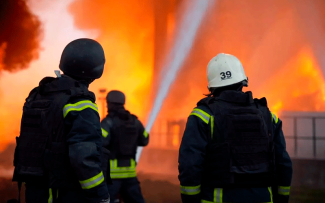
Russia has intensified its strikes on Odesa Oblast and is systematically destroying the local infrastructure. Since mid-December, there have been daily massive attacks on the region, and power and water outages have become permanent. On 18 December, enemy drones damaged a bridge over the Dniester in the village of Maiaky near the border with Moldova (on the M15 Odesa-Reni motorway, the main road from the regional capital to the west). This structure was also attacked on 19, 20 and 21 December, and traffic was restored by setting up a pontoon bridge (earlier, on 15 December, bridges leading south – in the gulf, on the Dniester estuary - and the railway bridge in Sarata – were damaged). The port of Pivdennyi, north-east of Odesa, was attacked three times: on 19 December, fuel tanks were damaged, eight people were killed and 27 were injured; on the night of 21–22 December, a fire broke out in containers; on the evening of 22 December, quay infrastructure and a ship moored there were damaged. In Odesa and its immediate vicinity, two power substations and a railway station were damaged (on the night of 18–19 December), as were port infrastructure (22 December), a substation and another facility belonging to DTEK, and warehouses (22 December). 120,000 consumers were left without electricity.
In response to the attacks in Odesa Oblast, on 20 December, President Volodymyr Zelensky announced the dismissal of the head of the Southern Air Command, General Dmytro Karpenko, and the strengthening of the region’s air defence. Given the real weakening of air defence in the south of the country, the change of command is purely symbolic. Between the evening of 16 December and the morning of 22 December, the UASF reported its lowest effectiveness to date in combating enemy UAVs. Of the 545 strike drones and their imitators used by the Russians, 372 were reportedly neutralised, with half of the 320 of the Shaheds Ukraine reported hitting their targets – 160. None of the five ballistic missiles were shot down.
The inability to ensure efficient transport of military aid from Romania through Odesa Oblast was confirmed by the decision of the NATO Security Assistance and Training for Ukraine (NSATU) mission to create a new logistics hub, from which deliveries will be directed through the western regions of Ukraine. On 21 December, Deputy Mission Commander General Maik Keller announced that the hub would be launched in January 2026. It is intended to support the largest facility of this type (in Rzeszów-Jasionka) and will be located at the 71st Romanian Air Force Base in Câmpia Turzii in Transylvania. The disadvantages of this location are: its considerable distance from Ukraine (at least 250 km) and poor road network. However, there is a rail connection, although the neighbouring country is accessed from the Zakarpattia Oblast.

Ukrainian drones struck a refinery in Slavyansk-on-Kuban (17 December) and the port of Taman in Volna (21 December). Fires broke out at both facilities in Krasnodar Krai, and in Volna, the port pipeline and two quays with moored ships were damaged (according to the Ukrainian General Staff, the fire also engulfed the tanks of the Tamanneftegaz terminal). On 19 December, a thermal power plant in Oryol was hit, resulting in the city being partially cut off from electricity and heating supplies. A power outage also occurred in Rostov-on-Don as a result of a high-voltage line being severed. Ukrainian drones also targeted the Togliattiazot plant in the Samara Oblast. On 23 December, drones attacked Budyonnovsk in Stavropol Krai, causing a fire in the local industrial zone.
On 18 December, Ukrainian unmanned aerial vehicles damaged the river tanker Valery Gorchakov river tanker in the port of Rostov-on-Don. The stern of the vessel sank to the bottom (the wheelhouse and engine room were hit), two crew members were killed and three were injured. A day later, the Security Service of Ukraine (SBU) reported an attack on the Qendil tanker, part of the “shadow fleet” flying the Omani flag. The incident took place in the Mediterranean Sea. The vessel was travelling without cargo and was reportedly seriously damaged. According to industry reports from 22 December, it continued its voyage to Aliağa in Turkey (where the SOCAR terminal is located).
The SBU presented new information about successful attacks on Russian military facilities and oil infrastructure. On 18 December, three radar stations (two Nebo-SVU and one S-400) and a MiG-31 interceptor fighter were reportedly damaged at Belbek airport in occupied Crimea. A day later, Lukoil’s drilling platform and an FSB Border Service patrol ship of the 22460 Okhotnik project (the name of the vessel was not disclosed) were reportedly hit in the Caspian Sea, and on 20 December, two Su-27 fighter jets were hit again at Belbek airport. On the night of 20–21 December, two fighter jets (Su-27 and Su-30) were also reportedly burned down as a result of an attack by Ukrainian military intelligence saboteurs (HUR). None of this information has been confirmed yet.
On 17 December, the Ukrainian Ministry of Foreign Affairs called on the governments of African countries and the local media to take systematic measures to stop Russian programmes recruiting residents of these countries to participate in the war against Ukraine. The proposed measures included issuing official warnings to citizens about Russian recruitment practices and taking legal steps to expose and punish those responsible. Earlier reports included the detention of individuals recruited by the Russian Federation in South Africa and court cases involving citizens of that country and Botswana involved in recruitment for the war on the side of the aggressor. It also mentioned that several South Africans had asked their government for help after finding themselves in the zone of military operations in Ukraine.
On 18 December, the SBU announced that since the beginning of the war, it had detained 68 Russian agents operating within the ranks of the Ukrainian Defence Forces. In 2025 alone, 19 of these “moles” were captured, ten of whom have already been convicted, including seven sentenced to 15 years’ imprisonment. They included an Air Force major who provided the enemy with airport coordinates, a Special Operations Forces unit commander who passed on combat plans behind the front line, and a self-propelled artillery squadron commander who provided secret information about the situation in the Kharkiv direction. Military counterintelligence also prevented the theft of 33.9 billion hryvnia (approximately $815 million) from defence funds and thwarted more than 270 attempts to illegally export weapons from frontline areas.
On 22 December, a vehicle belonging to 56-year-old General Fanil Sarvarov, head of the Operational Training Directorate of the General Staff of the Russian Armed Forces, who had participated in conflicts in Chechnya, Syria and Ukraine, exploded in Moscow. According to preliminary findings, an improvised explosive device had been placed under the chassis of the car, which detonated a few seconds after the car started moving. Sarvarov died as a result of his injuries. The investigation is being conducted by the Investigative Committee of the Russian Federation, and one of the theories points to the involvement of the Ukrainian special services in organising the attack.

In 2025, Kyiv may receive $45 billion from its Western partners, the most since the start of the full-scale aggression. This was announced on 16 December by Defence Minister Denys Shmyhal during a meeting of the Ramstein format contact group on military support for Ukraine. He also noted that in 2026 defence spending will amount to $120 billion, half of which will be covered by Ukrainian resources. The remaining $60 billion should be provided to Kyiv by its partners.
In 2026, Germany intends to transfer a large number of AIM-9 Sidewinder air-to-air missiles from its own stocks to Ukraine – they will be usable from aircraft and helicopters. This news was announced by German Defence Minister Boris Pistorius during a meeting of the Ramstein group. Canada will supply surplus items from its arsenals, including engines and components for AIM-7 and AIM-9 air-to-air missiles, and will also contribute $50 million to the “drone coalition”, as announced on 16 December by the country’s defence minister, David J. McGuinty. The following day, Norwegian Prime Minister Jonas Gahr Støre announced that €267.5 million would be allocated for purchases for Ukraine in the US. These funds will be used for air defence missiles, spare parts and ammunition for F-16 fighter jets.
Ukraine and Germany signed an agreement on the production of 200 Bohdana 155 mm howitzers on Mercedes-Benz Zetros truck chassis, with a total value of €750 million, Mr Shmyhal announced on 17 December. The two countries are also thought to have agreed on the supply of spare parts for Patriot systems, the purchase of Ukrainian drones for €200 million and the joint production of Ukrainian Linza unmanned aerial vehicles (in cooperation between the Ukrainian company Frontline Robotics and the German company Quantum Systems). The total value of all agreements is estimated at over €1.2 billion. Details, including the implementation timeframe and the possible contribution of German companies in the production of howitzers beyond the supply of chassis, have not been disclosed. Until now, the main partners have been the Czech Republic and Slovakia, and the gun was mounted on a Tatra truck chassis or, more often, delivered in a towed version.
On 18 December, US President Donald Trump signed a defence spending bill that provides for the possibility of spending $400 million in 2026 and 2027 under the Ukraine Security Assistance Initiative (USAI). The use of these funds remains at the discretion of the US Secretary of War. The document prohibits the Pentagon from treating weapons and military equipment previously contracted for Kyiv as its own stockpiles and obliges it to transfer them to Ukraine (for more details, see ‘US defence budget for 2026: Congress approves continued support for Ukraine and a military presence in Europe’).
On 19 December, Australia delivered the last batch of M1A1 Abrams tanks to Kyiv – 12 out of a total of 49 units. Prior to that, they underwent inspection and necessary repairs in Poland.

On 18 December, Vladislav Belbas, CEO of Ukrayinska Bronetekhnika, emphasised in an interview with the Biznes Tsenzor website that, despite the demand for domestic arms production, there is a lack of funds to finance it. He stated that defence companies are currently struggling with a shortage of orders. For example, the annual mortar production programme was already completed in June, and the order for armoured vehicles was completed more than a month earlier. The only contracts currently being implemented are those for ammunition. This means downtime despite existing production capacity. Belbas assessed that the state is not sufficiently effective in obtaining foreign financing for the defence sector. He announced that the budget for defence orders is approximately 620 billion hryvnia (approximately 12.5 billion euros), and that approximately 60 billion euros per year must be spent to meet all needs.
On 20 December, the head of HUR, Kyrylo Budanov, stated that the main reason for the mobilisation problems in Ukraine was a failed media campaign and that Russia’s influence on disrupting this process has been overstated. He pointed out that mistakes in internal and media communication allowed Moscow to “raise the temperature” around these issues. Poor organisational decisions were influenced by ill-considered actions by those responsible for mobilisation who, in order to ensure a high pace, did not take into account, for example, the poor health of conscripts.
On the same day, Roman Kostenko, Secretary of the National Security, Defence and Intelligence Committee of the Verkhovna Rada of Ukraine, reported that 80% of cases of unauthorised absence from military units occur during the soldiers’ stay in training centres. He noted that most of them do so in order to return to the rear or to support units, rather than to serve on the front line. On 23 December, Serhiy Babak, chairman of the parliamentary Committee on Education, Science and Innovation, announced that a review of the rules for admission to university and schools was planned. He stressed that education should not be a tool for avoiding military service. Work is also underway on a draft law according to which the right to defer mobilisation would only apply to those who are starting their studies for the first time and who are under 25 years of age. Deputy Minister of Education Mykola Trofymenko announced that the ministry is monitoring the situation through the Unified State Electronic Database on Education (EDBO). In the event of suspiciously high rates at a given institution, inspections are carried out, which may result in the expulsion of students and law enforcement action.

According to information published on 16 December by the independent newspaper The Moscow Times, Vladimir Putin has granted Russian occupation administrations in the Donetsk, Luhansk, Kherson and Zaporizhzhia oblasts the right to confiscate domiciles belonging to Ukrainian citizens who have left these areas due to the war. These powers will remain in force until 2030. According to the adopted regulations, premises deemed to have “signs of undeveloped property” may become state property and will be transferred to the Territorial Development Fund, which will obtain the right to rent or sell them. The criteria for classifying a property as “undeveloped” are to be determined directly by the occupying authorities.

On 16 December, the Verkhovna Rada of Ukraine adopted draft law No. 13347 on amendments to certain legal acts concerning the preparation of citizens for national resistance. It is intended to support the development of national-patriotic and defence awareness and the acquisition by residents of the knowledge and skills necessary to defend the state. To this end, citizen training centres are to be established, where citizens will undergo basic military training. There are plans to introduce regulations allowing for the operation of shooting ranges and practical firing exercises. Work on the bill shows that the authorities are not abandoning their policy of promoting widespread resistance among the population and are aware that a lasting end to the armed conflict with Russia seems unlikely in the near future.