Russians are getting closer to capturing Pokrovsk and Vovchansk. Day 1378 of the war
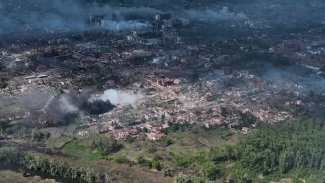

On 1 December, the Russians announced the capture of Pokrovsk in Donetsk Oblast and Vovchansk in Kharkiv Oblast. It is thought that the official report on this was received by Vladimir Putin the day before at one of the command posts of the Joint Forces Group, i.e. the grouping of the Armed Forces of the Russian Federation and the so-called other forces (mainly Rosgvardiya) operating in Ukraine. Unlike Moscow’s earlier declarations about the capture of Kupiansk in Kharkiv Oblast, the information about its capture of Pokrovsk and Vovchansk has been at least partially confirmed by reports from the front. The Ukrainian command denies the loss of both cities, but Ukrainian forces are now operating only on the northern outskirts of the former and the south-eastern outskirts of the latter, outside the area of dense urban development. According to Ukrainian sources, fighting is still ongoing in the northern part of Pokrovsk, and the (mostly forested) south-east of Vovchansk may still de facto remain in a grey zone (at the end of November, Russia was said said to control about half of the city).
Ukrainian forces remain in the northern part of Myrnohrad, but the area under their control has shrunk. According to some sources, it is still possible to supply them (alternative connections have been organised, according to statements by the command), and small groups of Ukrainian soldiers are moving on foot in both directions – from and to the city – under constant threat of enemy fire and drone attacks.
Russian troops have captured bridgeheads in the south-eastern part of Kostiantynivka and in Siversk. According to some reports, the fighting has reached the centre of the latter city (which is relatively small, with a pre-war population of 12,000). Russia has also expanded the area under its control south of Kostiantynivka and north and south of Siversk. The defenders, however, repelled attempts to capture a bridgehead in Lyman. The encirclement of this city has deepened – Russia is operating south of the main road connecting it with Siversk (to the east) and Kharkiv Oblast (to the west).
The Russians launched an offensive south of Vovchansk, where they reached the villages of Lyman (according to some sources, they have already captured it) and Vilcha. They have also become active in the south-eastern part of Kharkiv Oblst, where they are advancing towards Borova, the second most important transport hub on the Oskil River after Kupiansk. According to some sources, they have reached the village of Borivska Andriivka, less than 5 km north-east of Borova. However, the situation in the Kupiansk area has not changed significantly, with Russia still unable to take control of the south-eastern part of the city, while the Oskil River is hindering stable control over the western part.
Russia has entered Huliaipole, where fighting continues in the north. The Russians are separated from the city centre by the Haichur River, on which Ukrainian forces will most likely base their main defence. Further areas north of Huliaipole and east of the Haichur River have come under Russian control. Ukraine is holding out in Varvarivka and Dobropillia (according to some sources, the latter has already been captured by the invaders).
After the Russians took control of further towns on the road from Huliaipole to Pokrovske in Dnipropetrovsk Oblast, the situation with supplies for the defenders in the first of these towns became complicated. Currently, they have to use local roads (the route to the west is within the range of constant enemy drone activity). However, Ukrainian troops managed to regain control of the town of Ivanivka in Dnipropetrovsk Oblast.
The Ukrainians faced the loss of several cities of military significance and which are symbols of long-term defence by the end of the year. Until the end of 2024, Pokrovsk served as the main logistics hub for the defenders in the Donbas. Its capture opens up the possibility for the Russians to advance north (towards Kramatorsk and Sloviansk) and/or west (towards Pavlohrad and Dnipro) in terrain conditions that are much more favourable for the attackers than before. The fighting for Vovchansk has been ongoing since May 2024, and the city has been a symbol of the resistance to the enemy’s advance towards Kharkiv. The capture of this city, together with the highly probable capture of Kupiansk, will make it very difficult for Ukrainian forces to hold on to the north-eastern part of Kharkiv Oblast.
Siversk has symbolic significance – the defenders grouped around this city held their positions continuously since the fall of Bakhmut in mid-2023, and the defence only collapsed in recent months. The actual fall of Huliaipole in the coming weeks will confirm the loss of the north-eastern part of Zaporizhzhia Oblast by the Ukrainians and facilitate Russia’s advance towards the Dnipro River.

On 29 November, Russia carried out another massive air strike on Ukraine, targeting mainly the energy infrastructure in Kyiv and the Kyiv Oblast. Among other things, the capital’s high-voltage substation (750 kV), which is a key element of the electricity transmission infrastructure from the Khmelnytskyi Nuclear Power Plant, was hit, as were facilities in the Kharkiv, Chernihiv, Poltava and Sumy oblasts. Approximately 720,000 customers in Kyiv and Kyiv Oblast were cut off from electricity supplies. This makes the attack of 29 November one of the most severe for the capital and surrounding areas, especially as a number of other civilian facilities were also damaged. Two people were killed and 38 were injured (including a child) in Kyiv. In Kyiv Oblast, one person was killed and eight were injured. On the evening of 29 November, Russian drones struck Vyshhorod in Kyiv Oblast, injuring 19 people (including four children).
According to the Ukrainian Air Force Command, Russia used 596 strike drones and their imitators (including 350 armed “Shaheds”) and 36 missiles in the attack on 29 November. Ukraine was to neutralise 558 unmanned aerial vehicles and 19 missiles, including, for the second time in a row, all Iskander-M ballistic missiles attacking the capital, which indicates that a method of countering the Russian tactic of using these missiles has probably been developed (their use since spring this year has significantly hampered the Patriot systems’ ability to destroy Iskanders). However, they reported shooting down only one of the five Kinzhal hypersonic missiles.
Russia continued to destroy energy infrastructure in the regions directly behind the front line. Apart from the massive attack on 29 November, the Ukrainian Ministry of Energy and local authorities reported damage to facilities and resulting interruptions in the supply of electricity, water and heating in Kharkiv Oblast (26 November and 1 and 2 December), Donetsk Oblast (26 November and 2 December), Odesa Oblast (27 November and 2 December), Kherson Oblast (28 November and 1 December), Sumy Oblast (28 and 30 November), Dnipropetrovsk Oblast(1 and 2 December) and Chernihiv Oblast (2 December).
The most serious problems were caused by damage to the TES-5 thermal power plant in Kharkiv on 26 November, which resulted in heating being cut off for 100,000 customers. The attacks on Zaporizhzhia on the evening of 25 November (18 people were injured) and Dnipro on 1 December (four people were killed and 45 were injured) resulted in casualties. According to Ukrainian data, from the evening of 25 November to the morning of 2 December, Russia used a total of 1,173 strike drones and their imitators (including 710 “Shaheds”) and 44 ballistic and cruise missiles for the attacks. Ukraine declared that they had neutralised 991 unmanned aerial vehicles and shot down 19 missiles.

On 29 November, Ukrainian surface drones attacked two tankers used by Russia’s “shadow fleet” to circumvent sanctions off the Turkish coast, damaging both vessels. Flying the Gambian flag but manned by Russian crews, the Kairos and Virat were heading for Novorossiysk. The Security Service of Ukraine (SBU) claimed responsibility for the attack, which used modernised Sea Baby drones, and was jointly organised with the Ukrainian Navy. This is the first attack on a tanker used by Russia since August 2023. According to some sources, this move breaks the informal moratorium on not attacking civilian vessels at sea. The incident was criticised by the Turkish Ministry of Foreign Affairs. On 2 December, Turkish sources reported an attack on another tanker, this time flying the Russian flag – the Midvolga-2, which was transporting chemicals and sailing to Georgia.
Ukrainian drones attacked more enemy refineries: Novokuybyshevsk in Samara Oblast (27 November), Saratov (28 November) and plants located in Krasnodar Krai in Afipsky (29 November), Slavyansk-on-Kuban (30 November) and Tuapse (2 December). The Ukrainian General Staff reported that the Saratov and Afipsky refineries had been hit, causing fires on their premises. In November, a record number of Ukrainian strikes on Russian fuel infrastructure were recorded, as reported by Bloomberg on 2 December, citing sources in Russia and Ukraine. As a result, oil processing in the Russian Federation fell to 5 million barrels per day, while at the end of autumn it was usually 5.3–5.5 million barrels. The facilities within the range of Ukrainian drones previously accounted for 20% of domestic oil processing.
According to the Ukrainian General Staff, strikes were also successful against missile component manufacturing plants in Cheboksary, Chuvashia (26 November), a drone storage facility at Saky airport in occupied Crimea (28 November) and aircraft repair facilities in Taganrog (part of the Beriev complex, 29 November; the city was also targeted the day before), but there is no information on the effects of the attacks. On 27 November, a drone strike caused a fire in the barracks of the Chechen regiment of the Rosgvardiya Akhmat-Sever in Grozny, and on 2 December, at the Akhmat regiment base in Gudermes.
On 26 November, a Project 1171 Tapir landing ship was towed from the dock in Novorossiysk into the base (OSINT sources did not specify which of the two vessels of this type serving in the Black Sea Fleet was involved). Some sources claim that this may indicate damage sustained in the Ukrainian attack carried out 24 hours earlier.

The SBU counterintelligence service continues its extensive operation to curb the activities of Russian special services. On 28 November, an operation by an agent network in western Ukraine was foiled. During the operation, three people were detained who were preparing hiding places to store components for improvised explosive devices. According to the investigators’ findings, the FSB recruited a 20-year-old from Kharkiv and two minors from Rivne Oblast. Contact with them was established via Telegram, offering “easy money”. One of them was to collect components, including detonators, from designated hiding places and transport them to other locations. The Russian curators misled this person by claiming that he was transporting “radio antenna” components. A resident of Kharkiv, acting on enemy orders, travelled to the west of the country, where he was to obtain explosives from anti-personnel mines. The explosives were then collected by a 17-year-old and transported onwards in accordance with the instructions of the enemy services. The SBU emphasises that the operation prevented a real threat of terrorist attacks in the west of the country.

According to a report in the Financial Times on 30 November, Wang Dinghua, owner of the Chinese company Shenzhen Minghuaxin, which specialises in the manufacture of components for unmanned aerial vehicles, has acquired a 5% stake in the Russian company Rustakt. The company manufactures VT-40 FPV attack drones, widely used by Russia in the war against Ukraine. Shortly after the publication, the ownership data was removed from the official registers. Pavel Nikitin remained the main owner of Rustakt, controlling 95% of the shares. The entity is on the sanctions lists of Ukraine and the EU. The Chinese Foreign Ministry stated that it had no information about Wang’s involvement in the company and stressed that Beijing “has never supplied lethal weapons to any party to the conflict”.

Kyiv and Oslo signed an agreement on joint drone production, as announced on 30 November by Ukrainian Defence Minister Denys Shmyhal. The next step is to “quickly” launch a pilot production line in 2026 (its location has not been specified) and to work in parallel on increasing production capacity.
Ukraine has also concluded an agreement on joint drone production with the Netherlands, as announced on 1 December by Ruben Brekelmans, the Dutch Minister of Defence. This took place during his meeting with Shmyhal in Brussels. The Netherlands also announced that it would contribute €250 million to purchases for the Ukrainian army in the US under the PURL (Prioritised Ukraine Requirements List). This is the country’s second donation under this initiative – in August this year, the Dutch contributed €500 million.
On 2 December, the General Staff of the Polish Army announced that over 700 soldiers of the Armed Forces of Ukraine are currently participating in training carried out on Polish territory as part of the EU’s EUMAM Ukraine mission. The programme, run by instructors from Poland and France, comprises 16 specialist modules, ranging from basic courses to advanced training for commanders and specialist teams. At training grounds and training stations, participants hone the skills necessary on the modern battlefield.

On 30 November, the Foreign Intelligence Service of Ukraine stated that Putin had approved a new strategy for the Russian Federation’s national policy until 2036, based on the concept of Russia as a “civilisation state”. The document provides for the aggressive integration of the occupied territories, the accelerated Russification of the population, an expansion of propaganda activities, and a further subordination of the information space to the Kremlin. A key component of the strategy is the integration of the occupied oblasts: Donetsk, Luhansk, Zaporizhzhia and Kherson. Moscow plans to implement extensive propaganda programmes aimed at supplanting Ukrainian national identity, strengthening the dominance of the Russian language and consolidating an “all-Russian civic identity”. According to Ukrainian intelligence, these moves are part of an accelerated Russification and continuation of the policy of denationalisation in the occupied territories. The document also provides for counteracting the creation of ethnic minority enclaves, which may result in further restrictions on national and religious rights. The Ukrainian services warn that this is part of Moscow’s long-term strategy aimed at the permanent annexation of territories and their full political, cultural and linguistic integration.