Ukraine’s Black Sea attacks take a toll on Russia’s economy
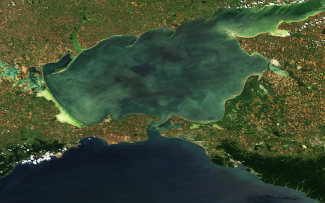
Since early June this year, Ukraine has stepped up drone attacks on Russian shipping in the Sea of Azov and the Black Sea, as well as on port infrastructure along the coast. This has severely curtailed the flow of Russian commodities through these waters, with the agricultural and oil sectors bearing the brunt of the losses. As a result, in August, Russian grain and crude oil shipments to foreign customers via ports in the Azov-Black Sea basin were more than 50% lower than a year earlier.
If the current constraints on overseas shipments persist, farmers’ incomes could fall significantly, potentially jeopardising the autumn sowing of winter crops in Russia. Moreover, a substantial decline in Russian and Ukrainian agricultural supplies to international markets, particularly grain and vegetable oils, could have an adverse impact over the longer term and drive up prices. A repeat of a food crisis similar to that of 2022 nevertheless appears unlikely. In the oil sector, meanwhile, the reduced ability to ship crude and petroleum products abroad is exacerbating the industry’s difficulties, reducing company revenues and undermining the industry’s ability to maintain previous levels of production and foreign sales.
Despite the economic costs, the Kremlin appears politically unwilling to conclude a new grain deal. At this stage, Vladimir Putin appears to regard a halt to mutual attacks on transport and energy infrastructure as disadvantageous. He sees the ability to inflict economic damage on Ukraine as crucial to gaining an advantage in the ongoing Russia-Ukraine war.
Intensification of Ukrainian drone attacks
Since early June, Ukrainian forces have stepped up missile and drone attacks on Russia, focusing primarily on critical and logistics infrastructure in the Sea of Azov and Black Sea region (see ‘A bridge too far? Ukraine’s operation to isolate Crimea’). The main objectives have been to disrupt logistics and supplies to occupied Crimea and put pressure on the Kremlin to end the war. As part of these operations, Ukrainian drones reportedly attacked at least 260 vessels in the Azov-Black Sea basin (see ‘Ukrainian advances north of Lyman. Day 1651 of the war’), including ships carrying Russian oil and grain for export.
In July, the attacks also damaged the Caspian Pipeline Consortium (CPC) terminal in Novorossiysk, through which Kazakh oil is exported, as well as tankers carrying Kazakh crude. Ukrainian operations led to severe restrictions on shipping through the Azov-Don Sea Canal and the Kerch Strait from mid-July, prompting the ports of Azov, Rostov-on-Don and Taganrog to suspend grain loading. In addition, one of the largest attacks on Novorossiysk, carried out on 12 August, damaged the Sheskharis oil terminal and two grain terminals. At one of the latter, a loading gallery was destroyed, and repairs could take several months. The city’s third operational grain terminal also suspended loading for security reasons.
At the same time, intensive Russian missile and drone attacks on Ukraine enabled Russian forces to halt cargo handling at Ukrainian Black Sea ports in mid-July (see ‘Ukraine: suspension of shipping to Black Sea ports and the associated risks’). These ports had been the main export route for Ukrainian grain, vegetable oils and metals.
Russia’s key export route disrupted
According to data from Russia’s Association of Commercial Sea Ports, terminals in the Azov-Black Sea basin accounted for 30% of cargo handled by Russian ports in 2025, or more than 265 million tonnes. These ports are particularly important to the Russian economy as an export route for agricultural commodities. They handle almost 80% of the country’s grain exports to global markets, equivalent to around 40 million tonnes in 2025, and 50–60% of its vegetable oil exports, or approximately 5.5–6.5 million tonnes. Importantly, Russia, alongside Ukraine, is among the world’s leading exporters of both wheat and sunflower oil, accounting for about 20% and more than 30% of international supplies, respectively.
The region’s ports, particularly Sheskharis, are also an important export route for Russian crude oil and petroleum products. In 2025, they accounted for around one-fifth of Russia’s total seaborne crude exports, equivalent to 0.8–1 million barrels per day (bbl/d). Russian terminals on this coast also handle a substantial share of the country’s fuel exports: in 2024, as much as 38% of the total was shipped via this route. The CPC terminal is also located near Novorossiysk and handles around 80% of Kazakhstan’s total crude oil exports.
Attacks trigger sharp fall in oil and fuel exports
Ukrainian strikes have severely disrupted operations at Russia’s Black Sea ports. Damage to infrastructure, coupled with growing risks to shipping, has reduced vessel traffic and pushed up freight and insurance costs. As a result, Russia exported just 310,000 bbl/d of crude oil through these ports in August, nearly 600,000 bbl/d less than in June.
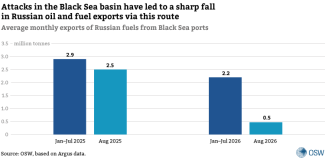
A similar downward trend is evident in exports of petroleum products via the Black Sea. This also reflects export bans imposed by the Russian government on diesel, in force since July this year, and petrol, in place since February. In August, Russia’s Black Sea ports shipped only negligible volumes of petroleum products, half of which consisted of high-sulphur diesel bound for Turkey, as this type of fuel is exempt from the restrictions.
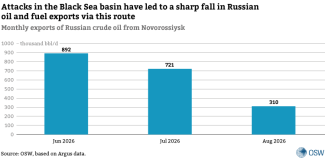
Ukrainian attacks have also affected Kazakhstan’s crude oil exports via the CPC terminal. According to the country’s energy minister, Yerlan Akkenzhenov, disruptions to loading operations at the facility have forced production cuts. As a result, the government in Astana has lowered its annual crude production forecast by 2%, to around 1.99 million bbl/d.
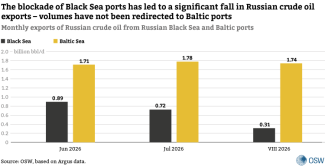
Reduced export capacity in the Black Sea has made it necessary to reroute crude oil and petroleum products to other ports, placing additional pressure on logistics networks, particularly Transneft’s pipeline system. Given the configuration of the pipeline network and the location of Urals crude production in Western Siberia, the Urals and Volga regions, the most straightforward alternative is to redirect the oil to Baltic ports, which have the largest handling capacity.
Data so far, however, suggest that Russia has been unable to establish an alternative route capable of compensating for the loss of export volumes resulting from Ukrainian attacks. The increase in exports through Baltic ports has been negligible, indicating limited scope to free up additional capacity in Transneft’s system at short notice. The already high level of exports through Baltic ports is likely to constrain the availability of pipeline capacity serving them. As for petroleum products, the current logistical difficulties are not critical, given the existing bans on diesel and petrol exports.
Disruption to Russia’s grain market
Damage to port infrastructure and vessels caused by Ukrainian attacks, coupled with the persistent threat of further strikes, has led to a sharp decline in Russian grain exports. The heightened risks have driven up freight and insurance costs for vessels prepared to carry Russian grain. According to estimates by Russian industry bodies, total exports fell to 1.6 million tonnes in July, half the five-year average for that month, and to approximately 1.8 million tonnes in August, 1.5 times lower year on year and the lowest level since 2010. Around 45% of Russia’s total grain output is exported, so the disruption has caused domestic wheat prices to fall sharply, by as much as 30% year on year, with similar declines for other grains.
At the same time, production costs have risen substantially, primarily because of the fuel crisis that has persisted in Russia for several months. This has pushed up diesel prices by around 20% year on year, according to official statistics, while farmers in some regions have had to pay 40–60% more. As a result, the profitability of crop production has fallen dramatically, with many farmers operating at a loss. Many are also unable to postpone grain sales until market conditions stabilise. Storage costs are very high, while producers need funds to repay loans and finance the sowing of winter crops. To support the sector, the government is considering intervention purchases of grain, logistics subsidies, extensions of loan repayment periods and a reduction in the wheat export duty to zero. However, these measures can provide only limited relief to producers.
Russia’s economic difficulties mount
The reduced capacity of ports in the Azov-Black Sea basin is exacerbating Russia’s economic difficulties, which have been mounting for almost two years (see ‘Russia’s economy: heading towards recession?’). These problems stem from the rising costs of the war and sanctions and, increasingly over the past year, from Ukrainian drone attacks (see ‘Ukrainian attacks pose a growing problem for the Russian economy’). Russia has very limited scope for overcoming the difficulties affecting a growing number of sectors of its economy.
Given the volume of crude traditionally exported via the Black Sea, it is impossible to reroute all of these shipments elsewhere. If the blockade persists, Russia will probably seek to offset at least some of the losses, but such efforts will still have repercussions across the oil and fuel sector.
The inability to export all the crude normally shipped through Novorossiysk and other ports in the Azov-Black Sea basin will therefore put further downward pressure on Russian oil production and refining. This comes on top of Ukrainian attacks on refineries, which have taken some of Russia’s refining capacity offline. Lower production and export volumes will, in turn, reduce revenues for both oil companies and the state budget.
The scope for rerouting grain exports via alternative maritime routes, such as the Baltic or Caspian Sea, or by rail is very limited, primarily because of infrastructure constraints. These include insufficient capacity along these routes and a shortage of silos and transshipment terminals. Moreover, the main buyers of Russian grain, including Egypt and Turkey, are located south of Russia, making alternative delivery routes more expensive.
Despite the sharp decline in Russian and Ukrainian grain exports, the response from international markets has so far been moderate. Global wheat prices have risen to their highest levels in three years, but remain almost 40% below those recorded during the 2022 crisis.
If the situation does not stabilise in the coming months, Russia’s domestic market is likely to face serious difficulties. Some farmers, particularly smaller producers, could go bankrupt. This would further concentrate agricultural production in the hands of large agro-industrial groups, many of which are controlled by members of Putin’s elite and may benefit from state support. The area under grain cultivation is also likely to shrink further, continuing a trend observed since 2024. Farmers are increasingly switching to more profitable oilseed crops, a trend that in turn risks putting downward pressure on prices in that market.
The Kremlin is not ready for talks
Although Ukrainian attacks have triggered a serious fuel crisis in Russia and could destabilise its agricultural market, Putin has shown no willingness to make concessions. In mid-August, the Kremlin rejected an initiative proposed by Turkey, the largest importer of Russian and Ukrainian grain, aimed at ensuring the safe export of agricultural commodities via the Black Sea. Since the outset of the full-scale war, the Kremlin has sought to impose a lasting blockade of Ukraine’s Black Sea ports, but has lacked the means to do so. In August 2023, Kyiv managed to establish an export corridor along this route independently of Russia, which operated successfully until July 2026 (see ‘Ukraine: the new Black Sea corridor is a success’). Putin remains determined to continue the war against Ukraine, as evidenced by the intensification of Russian missile and drone attacks on the country. The Kremlin appears to believe that it can prevail in a war of attrition and that a blockade of Ukrainian ports could help achieve this objective. It is also stepping up hostile activities against European countries, including sabotage and attempted drone attacks, in an effort to discourage their governments from continuing to support Kyiv. At the same time, growing Ukrainian drone activity on Russian territory is increasingly affecting the interests of the Kremlin elite and fuelling tensions within it. Meanwhile, Putin’s ability to compensate members of the elite for their losses is becoming increasingly limited.
Disruptions to Russian and Ukrainian grain exports have so far had only a limited impact on global markets. As a result, there is currently little international pressure on Putin to make concessions. Such pressure could emerge in the coming months if alternative supply routes prove insufficient. In that event, a shortfall in supply relative to global demand would lead to a significant increase in prices.