On a war footing
Contents
I. FRENCH SECURITY POLICY AFTER THE FALL OF THE IRON CURTAIN
II. CHANGES FOLLOWING RUSSIA’S FULL-SCALE INVASION OF UKRAINE
III. NATIONAL STRATEGIC REVIEW 2025: COLLECTIVE DEFENCE AS A PRIORITY
IV. DEFENCE SPENDING AND THE DEVELOPMENT OF THE FRENCH ARMED FORCES
APPENDIX 1. French strategic documents
APPENDIX 2. The French Armed Forces
MAIN POINTS
- After the end of the Cold War, France moved away from conventional deterrence and collective defence in favour of participation in overseas missions and operations conducted within NATO, the UN, the EU and bilateral arrangements in response to regional crises in the Balkans, the Middle East and sub-Saharan Africa. These strategic shifts – outlined in the white papers published in 1994, 2009 and 2013 – were accompanied by a profound transformation of the armed forces: the abolition of conscription, the accelerated introduction of a professional army from the late 1990s, the reliance on nuclear deterrence alone for territorial defence and the adaptation of the armed forces to expeditionary tasks.
- Between 1966 and 2009, France remained outside NATO’s military structures while maintaining political participation in the Alliance. It returned to full membership in 2009, aiming to enhance cooperation with its allies in combating international terrorism and maintaining peace in unstable regions of the world. Until 2022, France consistently called for NATO reform to better adapt the organisation to these tasks and to reduce the emphasis on collective defence (vis-à-vis Russia), which Paris at the time regarded as outdated.
- Until 2022, French politicians continued to engage in bilateral dialogue with Russia and sought to persuade their allies to adopt the idea of building a common European-Russian security architecture, the stability of which could potentially reduce Europe’s dependence on the United States for security. This approach remained unchanged, although successive French strategic documents, from 2009 onwards, highlighted an increasingly problematic evolution of Russia’s foreign policy from the perspective of European security interests.
- The process of adapting French security policy to the deteriorating international environment – particularly in the context of the fight against Islamist terrorism and the return of great power rivalry – began with the presidency of Emmanuel Macron, when his government halted the decline in defence spending and launched a programme to modernise the armed forces. In the 2017 Strategic Review of Defence and National Security – the principal document containing an analysis of threats and priorities in the state’s security policy – France still stopped short of explicitly identifying a military threat from Russia and China, maintaining its focus on external operations in Africa while planning to expand its military presence in the Mediterranean and the Indo-Pacific.
- Russia’s full-scale invasion of Ukraine provided the impetus to accelerate reforms in French security policy. The 2022 National Strategic Review clearly highlighted a radical shift in the strategic environment in Europe, an intensification of strategic rivalry, a resurgence of nuclear threats and a direct threat to France from hybrid activities. The document identified Russia as an aggressor and NATO as the primary framework for collective defence, while calling for a greater role for NATO’s European members.
- In July 2025, the French government published the latest edition of the National Strategic Review. It consolidates the strategic shift following Russia’s full-scale aggression against Ukraine; France is moving away from its previous focus on rapid response operations, primarily in its former African colonies, and from developing capabilities to counter asymmetric threats. The strategy highlights the risk of a war between Russia and NATO within the next five years. It reaffirms France’s collective defence commitments as a NATO member and supports the further development of the EU’s security policy, while also seeking to strengthen partnerships in the Indo-Pacific region and in Africa.
- The French Armed Forces stand out among NATO’s European members as the only fully expeditionary military capable of rapidly deploying and sustaining substantial forces beyond national borders. Despite political declarations and changes in strategic documents, France has no plans to significantly expand its armed forces or to move away from the expeditionary nature of its land forces in favour of adapting them to the challenges of conducting potential collective defence operations on NATO’s eastern flank.
- Implementing changes in French security strategy and the accompanying plans to further accelerate defence spending may be hindered by a complex domestic political situation. President Macron has low approval ratings and lacks a supportive parliamentary majority, which is required, for example, to pass the budget. A victory of a far-right candidate sceptical of NATO and the EU in the next presidential election is now more likely than ever before.
INTRODUCTION
France has been adapting its security policy to the new conditions shaped by Russia’s full-scale invasion of Ukraine. This process is complex, given the far-reaching evolution of France’s perception of European security and of the model of its armed forces adopted after the end of the Cold War.
As a NATO member with one of the largest defence potentials in terms of both military capabilities and the defence industry, France will play a major role in collective defence, including in the context of a potential reduction in US military engagement in Europe. Under the leadership of President Emmanuel Macron, France has shown ambitions to lead the efforts of European allies to assume greater responsibility for the continent’s defence and to strengthen the ‘European pillar of NATO’. This is reflected in closer military cooperation with the United Kingdom (particularly in the area of nuclear deterrence) and Germany. Military cooperation with countries on NATO’s eastern flank may also intensify; in the case of Poland, this is underpinned by the security and defence provisions of the Polish-French Treaty of Nancy signed in the spring of 2025.
The aim of this paper is to trace changes in French security policy – with a particular focus on the years 2022–25 – through the lens of several key factors: the assessment of challenges and threats, the roles of NATO, the EU and transatlantic relations, policy towards Russia (and, after 2022, also towards Ukraine), and the evolution of the model of the French armed forces (including nuclear deterrence) and France’s presence on NATO’s eastern flank.
I. FRENCH SECURITY POLICY AFTER THE FALL OF THE IRON CURTAIN
After the end of the Cold War, France moved away from conventional deterrence and collective defence in favour of participation in overseas missions and operations conducted within NATO, the UN, the EU or bilateral arrangements in response to regional crises in the Balkans, the Middle East and sub-Saharan Africa. In addition to crisis response, such operations were also linked to France’s economic interests, involving efforts to secure access to raw materials through the activities of French companies in African countries. After 2011, France also prioritised combating various radical Islamist movements that had exploited the weakening of state structures in North Africa following the Arab Spring.
The peak of France’s engagement in the region came in 2013–22, when it conducted stabilisation operations in the Sahel involving a military contingent of around 5,000 troops.[1] In the 2020s, it reduced its military presence in Africa in response to increasingly negative sentiment in sub-Saharan African countries where French troops were deployed (partly under Russia’s influence) and the deteriorating security situation in Europe following Russia’s aggression against Ukraine.
Table 1. Major overseas operations of the French Armed Forces after 1990
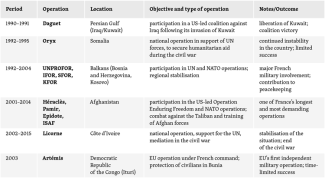
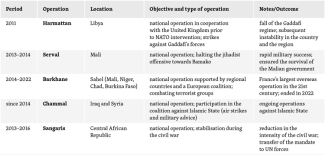
Source: the authors’ own compilation based on data from Fondation iFRAP and Vie-publique.fr.
France’s view of NATO’s role evolved after the end of the Cold War. In the 1990s, France maintained its commitment to participating in the Alliance as a political organisation, while also calling for far-reaching reform to adapt it to new threats, including cyberterrorism, rogue states, crisis management and changes in transatlantic relations. At the same time, French policy after 1990 consistently recognised the central role of nuclear deterrence as the foundation of the country’s security, in light of a reduction in its conventional military capabilities. France’s nuclear forces remain outside NATO’s nuclear planning and retain a sovereign character, although, according to French policy, they are meant to contribute to enhancing the security of other allies.[2]
In 2009, France decided to return to NATO’s military structures, which it had left in 1966.[3] This move stemmed from the desire of Presidents Nicolas Sarkozy and Barack Obama to improve Franco-American relations and to increase France’s role in NATO’s military planning at a time when the organisation was focused on the fight against terrorism. Strategic documents issued by Paris from 2008 onwards state that the North Atlantic Alliance should retain its role as the guarantor of collective defence, while the European Union should be responsible for crisis management tasks.
The 2017 strategic review, published in the wake of Russia’s annexation of Crimea and the war in the Donbas, marked the first time that France identified Russia as a threat to the European security architecture and to its allies. Moscow’s aggressive policy reignited the risk of France being drawn into a high-intensity conflict with an adversary of equal or greater capability, which was reflected in the document. At the same time, all the French strategic reviews, including that of 2017, regarded Europe’s engagement in dialogue with the Kremlin as necessary. The actions of the first Trump administration also left a mark on the 2017 document, as it placed much greater emphasis than previous reviews on developing European defence capabilities and reducing dependence on the United States. Moreover, expert discussions increasingly highlighted the need to articulate more clearly the ‘European dimension’ of France’s nuclear deterrence. President Macron repeatedly declared his readiness to initiate such a discussion, beginning with his speech on this issue in February 2020.[4]
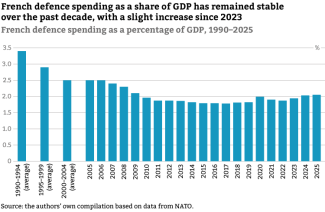
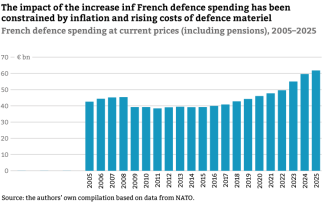
The trends and priorities outlined in successive strategic documents were broadly reflected in French defence spending between 1990 and 2025. Between 1990 and 2000, it declined as conscription was reduced and the armed forces gradually transitioned to a professional model. Between 1990 and 1994, average defence expenditure stood at around 3.4% of GDP, before falling to 2.9% in 1995–2000. Further cuts to the defence budget were halted following a reassessment of threats after the attacks of 11 September 2001. Between 2001 and 2008, defence spending stabilised at a lower level of around 2.5% of GDP. Another round of cuts to military spending followed the global financial crisis, but since 2018 expenditure has been gradually rising again, with the pace of growth accelerating after 2022.
II. CHANGES FOLLOWING RUSSIA’S FULL-SCALE INVASION OF UKRAINE
Russia’s full-scale invasion of Ukraine caught the French government by surprise, although it also confirmed the assessments of the 2017 review and validated Macron’s policy of modernising the armed forces and increasing defence spending. A new security strategy released in 2022, entitled the National Strategic Review (RNS22), signalled the continuation of these changes. It highlighted the need to adapt the armed forces to collective defence scenarios and to counter hybrid threats from Russia, such as attacks on critical infrastructure and propaganda campaigns.
In the French public debate, Russia’s invasion of Ukraine also raised the question of revising the existing approach towards Russia. Before 2022, even though the French government recognised the risks stemming from Russia’s increasingly aggressive policy, it simultaneously called for maintaining dialogue with Moscow[5] in order to agree on a new European security architecture that would be acceptable to both Russia and the EU. The outbreak of the full-scale Russo-Ukrainian war did not immediately bring these efforts to an end: Macron continued talks with Vladimir Putin, aiming to secure a ceasefire and resume the peace process within the Normandy format. At the same time, France began supplying weapons to Ukraine.
France shifted its position significantly in 2023–25. The first signal of the new approach came with Macron’s speech in Bratislava in May 2023, in which he acknowledged that Central European countries had been more accurate in their assessment of Russia’s policy than France and Germany.[6] The French president suspended direct contacts with Putin for three years[7] and abandoned his efforts to mediate in the Russo-Ukrainian conflict. France stepped up deliveries of weapons, including long-range missiles, to Ukraine and in February 2024 raised the possibility of deploying French forces to Ukraine.[8] In the following months, particularly after Donald Trump’s election as US president, this evolved into a Franco-British initiative to deploy stabilisation forces in the event of a ceasefire.
France also increased its engagement with countries on NATO’s eastern flank. Until 2022, its activity in this area had been limited to deploying – every other year, on a rotating basis with Denmark – a company-sized unit (SGTIA, approximately 200 troops) to the British-led NATO battlegroup in Estonia, contributing aircraft to air policing missions in the Baltic states (Baltic Air Policing, BAP) and Romania (Enhanced Air Policing), and occasionally participating in large multinational exercises, including NATO drills. Following Russia’s full-scale invasion of Ukraine, the French presence in Estonia shifted to a persistent rotational model. France also joined the framework nations of NATO’s new forces in Romania, launching permanent rotations of an understrength GTIA battalion task force (approximately 800 troops, complemented on a rotational basis by companies from Belgium or the Netherlands) and a SAMP/T medium-range air defence battery. Moreover, the French air force and navy increased their presence on the eastern flank, including as part of the allied operations codenamed Baltic Sentry and Eastern Sentry.[9]
In response to the growing threats facing Europe stemming from Russia’s aggressive policy and Donald Trump’s return to the US presidency in early 2025, the discussion on the European dimension of France’s nuclear deterrence[10] entered a new phase. This process culminated first in the Northwood Declaration with the United Kingdom, which established mechanisms for coordinating the two countries’ independent nuclear forces,[11] and then in President Emmanuel Macron’s speech at Île Longue in March 2026.[12] There, Macron announced a shift towards the concept of “forward deterrence” (dissuasion avancée), including greater involvement of European allies through participation in French nuclear exercises and the temporary deployment of French strategic aircraft to selected allied countries, while explicitly ruling out the stationing of French nuclear weapons abroad. At the same time, France reaffirmed that its nuclear deterrent would remain fully sovereign: decisions on the use of nuclear weapons would continue to rest exclusively with the French President, and the French arsenal would remain outside NATO’s nuclear planning arrangements.[13]
III. NATIONAL STRATEGIC REVIEW 2025: COLLECTIVE DEFENCE AS A PRIORITY
The latest edition of the strategic review, released in July 2025 (RNS25), presents a significantly more alarmist assessment of France’s international environment. It concludes that there is a high risk of a major armed conflict breaking out in Europe on the territory of France’s allies before 2030, requiring the country’s direct involvement. RNS25 explicitly identifies Russia and Iran as the most significant immediate military threats, while describing China’s actions as reflecting a ‘tougher stance’. It also emphasises the indispensability of increasing the output of the European defence industry, while embracing the logic of ‘champions’, reflecting France’s preference for supporting the most effective and largest defence companies.
RNS25 sets the goal of enabling the French government to adapt the armed forces and security policy to a range of priority tasks by 2030. In addition to defending national territory, these priorities include contributing to European security, notably through France’s nuclear deterrence capabilities. Moreover, France is expected to possess “the capacity to engage in high-intensity conflict and to act as a framework nation within a NATO, EU or ad hoc coalition in a major war scenario”.
Beyond Europe, RNS25 identifies the Indo-Pacific as a priority in the country’s security policy, highlighting the importance of France’s overseas territories, military presence and regional partnerships for stability and the freedom of maritime routes in the region. The document also points to the growing risks associated with China’s expansion, the need to strengthen power projection capabilities, and the importance of international cooperation in the region. France prioritises its partnerships with India, Australia, Japan and ASEAN countries, expanding cooperation in the military, maritime and technological domains to balance China’s growing influence.
Africa, in turn, is presented as a strategic area due to its proximity to Europe, security challenges such as terrorism, instability in the Sahel and migration, as well as its economic importance and its role as a supplier of natural resources. France declares a shift in its approach: a reduced unilateral military presence and greater emphasis on developing partnerships and local military capabilities. It aims to build partnerships based on shared responsibility, supporting regional organisations such as the African Union and ECOWAS and assisting countries willing to cooperate in key areas (for example, the Gulf of Guinea region), while at the same time reducing its direct military presence.
The provisions of RNS25 define France’s role as a ‘reliable NATO ally’. This underscores the vital importance of collective defence within the Alliance, which had remained a secondary priority before 2022. In this context, during Trump’s second term, the need for greater European autonomy continues to be emphasised as a constant element of Macron’s policy, although it now takes account of the changed environment marked by a full-scale war at the borders of NATO and the EU.[14]
RNS25 emphasises the role of the EU as a platform facilitating the expansion of the military capabilities of France’s allies. It also defines the country’s role as a ‘driving force behind European strategic autonomy’. During its presidency of the Council of the EU, which coincided with the start of the full-scale war in Ukraine, France participated in the diplomatic mobilisation in support of Ukraine, which notably resulted in the use of the European Peace Facility (EPF) as a mechanism for reimbursing military assistance provided by the EU’s member states to Ukraine. Paris also initiated the Versailles Declaration of March 2022, a joint statement by all EU member states calling for the expansion of the EU’s security policy, including its industrial dimension, which falls within the remit of the European Commission.[15]
France regards Germany, the United Kingdom, Poland, Italy and the Baltic and Nordic states as its most important European partners within NATO. However, when it comes to building the continent’s strategic autonomy, the set of key allies is somewhat different – these are Germany, the United Kingdom, Italy, Spain and Poland. This selection underscores two objectives that are to some extent parallel but not identical: the urgent need to strengthen European defence capabilities vis-à-vis Russia and a long-term strategy to make Europe independent of the United States in the sphere of security.
In 2024–25, France strengthened bilateral relations with selected allies and partners. It deepened ties with the United Kingdom: in addition to the previously mentioned Northwood Declaration,[16] the two countries also issued the Lancaster House 2.0 declaration in July 2025, which envisages transforming the Combined Joint Expeditionary Force (CJEF), established in 2010, into Combined Joint Force (CJF) capable of commanding a Franco-British corps (rather than only a brigade, as was the case previously). President Macron has also sought to strengthen France’s security ties with the new government in Berlin. A joint declaration following a meeting of the Franco-German Defence and Security Council in August 2025 confirmed the political determination to implement joint industrial projects – including the FCAS multi-role aircraft and the MGCS tank – but did not provide specifics on how to overcome the significant differences in interests between the two countries and their respective defence industries.[17] Among France’s new agreements with other NATO and EU members, the security provisions of the Polish-French Treaty of Nancy of May 2025 are particularly relevant.[18] Poland has thus joined the limited group of European countries – alongside Germany, Italy, Spain, Greece and the United Kingdom – that have signed such agreements with France.
France’s increased engagement in strengthening the security of Eastern European and post-Soviet countries is reflected in the security cooperation agreement with Ukraine signed in February 2024. This highly ambitious and wide-ranging document covers multiple areas, including direct support for Ukraine in its war against Russia and cooperation between the two countries’ defence industries, but contains a limited number of concrete commitments, notably the provision of €3 billion in military assistance by the end of 2024.[19] A month later, France signed a similar agreement with Moldova, which placed particular emphasis on training its armed forces.[20] Relations with Armenia also deepened in 2023–24.[21] Moreover, France hopes to strengthen its defence industry through orders from Ukraine, as indicated by a letter of intent signed in November 2025, in which Ukraine declared its intention to purchase up to 100 Rafale fighter jets and additional next-generation SAMP/T air defence systems. However, the financing for these purchases remains unclear.
IV. DEFENCE SPENDING AND THE DEVELOPMENT OF THE FRENCH ARMED FORCES
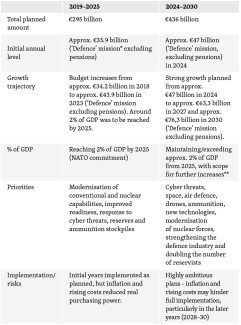
The direction of modernisation and reform of the French Armed Forces is outlined in the multiannual military programming laws (Lois de programmation militaire, LPM). These define the level of funding over the specified period (covering six years since 2003) and establish a detailed investment plan, particularly with regard to the procurement and disposal of equipment, as well as personnel levels. LPMs also specify defence spending for each subsequent budget year. From the perspective of the current state of the French Armed Forces and future modernisation plans, the laws for 2019–25 and 2024–30 are of key importance. The former sets a target for defence spending at 2% of GDP, while also highlighting the need to address capability gaps and replenish stockpiles that had been depleted during the period of the so-called peace dividend. It also provides for the modernisation of nuclear forces – the foundation of the country’s territorial defence which underpins the continued reliance on a professional army model and relatively small land forces.[22]
The LPM for 2024–30 builds on the previous assumptions while significantly expanding them. Taking into account the changed security environment following Russia’s invasion of Ukraine and rising global tensions, the document envisages further increases in the defence budget to ensure the full implementation of technical modernisation. It also assigns specific tasks to the armed forces regarding troop deployment, which is important for France’s readiness to operate within collective defence scenarios. These assume that, starting in 2025, France will be able to field a brigade (the 7th Armoured Brigade, numbering around 8,000 personnel) in a state of immediate combat readiness. From 2027, it should be capable of bringing a division (around 25,000 personnel) to combat readiness within 30 days. By 2030, France is expected to be able to assume command of a NATO corps numbering up to 60,000 troops, with half of them French.[23]
Table 2. Key parameters of LPM 2019–25 and LPM 2024–30
* The ‘Defence’ mission (Mission Défense) is the most important component of France’s defence budget, covering all expenditure related to maintaining and modernising military capabilities, as well as ensuring that the state can implement its defence policy.
** In July 2025, Macron decided to accelerate the increase in defence spending so that the targets of the LPM for 2024–30 (doubling defence spending compared with 2017) would be reached as early as 2027 rather than 2030. This entails expanding the budget by an additional €6.5 billion in 2026 and 2027. Following the LPM updates approved in 2026, this acceleration sets the defence budget (excluding pensions) at €57.1 billion for 2026 and €63.3 billion for 2027, including an additional €3 billion allocation for 2027. Consequently, the total LPM envelope rises to €436 billion, paving the way for reaching the €76.3 billion target by 2030. If the next president of France continues this policy, it could also be seen as preparation for meeting NATO’s new targets (allocating 3.5% of GDP to defence spending by 2035), which France has endorsed.
Source: the authors’ own compilation based on ‘Budget de la défense: quelles étapes pour le porter à 5% du PIB en 2035?’, 26 August 2025, vie-publique.fr.
At present, the French Armed Forces stand out among the European members of NATO as the only fully expeditionary military capable of rapidly deploying and sustaining substantial forces beyond national borders. France’s land forces are not large, comprising just two divisions, but it also fields around 200 fighter aircraft and an extensive navy, while maintaining very high readiness levels among individual subunits within the Guépard rapid reaction reserve (approximately 5,500 soldiers). The remainder of the armed forces also displays significantly higher levels of manning and readiness than the militaries of other European countries. Moreover, an advanced domestic defence industrial base ensures that almost all the weapons and military equipment used by the French Armed Forces are of indigenous design and production.
French land forces are highly diverse in structure. Although they maintain standing formations (two divisions with three brigades each and a joint Franco-German brigade), since the end of the Cold War they have operated exclusively through modular company- and battalion-sized battlegroups (groupements tactiques interarmes, GTIA). These are formed on an ad hoc basis – depending on operational requirements and the task at hand – by combining companies drawn from different regiments, brigades and divisions. This allows the French military to assemble and deploy forces equivalent to a brigade within a relatively short timeframe. Moreover, French brigades do not formally include battalions but are instead structured around five to six regiments comprising manoeuvre, engineer, artillery and reserve units. These, in turn, consist of five combat companies, two support companies and one or two reserve infantry companies, meaning that French brigades number between 7,000 and as many as 10,000 troops. The very high readiness and the strategic and operational mobility of France’s land forces come at the cost of their relatively light structure: they rely almost exclusively on wheeled vehicles, including infantry fighting vehicles and fire support platforms, and are characterised by a low density of heavy weapons such as artillery.
The ongoing large-scale modernisation programme (Scorpion) envisages replacing almost the entire fleet of wheeled vehicles in the French Armed Forces. The structure of land subunits is also set to undergo significant changes in order to adapt them to the demands of Large-Scale Combat Operations. Those reserve infantry companies that were previously engaged in supporting internal security will be reorganised into a genuine reserve capable of replacing losses incurred by individual regiments in combat. The remainder will be disbanded, and the personnel thus freed up will be used to form subunits equipped with unmanned systems at all organisational levels. In another important step, 120 mm mortars, which are currently centralised in artillery regiments, will be restored to infantry regiments, while anti-tank capabilities will be strengthened by replacing ageing Milan anti-tank guided missiles with Akeron MP systems and by equipping subunits with significant numbers of NLAW and AT-4 grenade launchers.[24]
The French Navy, which possesses the full spectrum of maritime capabilities – ranging from patrol tasks, through anti-submarine, surface and air warfare, to strategic nuclear deterrence – is among the strongest in Europe. Alongside the United States, France is the only country to operate a nuclear-powered aircraft carrier. The main operational theatres for the French Navy are the Mediterranean and the Atlantic Ocean, and its activity is far greater in the Indo-Pacific than in the Baltic Sea.
The French Air and Space Force is undergoing a generational replacement of most of its aircraft and some of its satellites, but the modernisation programme has faced delays. The expansion of the Rafale fighter jet fleet and the corresponding phase-out of older Mirage 2000 aircraft have been hindered by an arms export policy that offers foreign customers rapid deliveries of used Rafale jets currently in service with the French Armed Forces. As a result, the Air and Space Force is weaker than envisaged in the modernisation plans adopted over the past 20 years.[25] At the same time, its air component remains modern and possesses an almost full spectrum of capabilities (with the exception of SEAD – suppression of enemy air defences), including reconnaissance and the planning and execution of long-range precision conventional or nuclear strikes. France also remains self-sufficient in the space domain.
OUTLOOK
Changes in France’s defence policy – if continued after the next presidential election scheduled for 2027 – signify a partial shift in focus from previous priorities, including counterterrorism (both at home and abroad) and stabilisation operations in Africa, collective defence in Europe. France will play a more active role in NATO than before, calling for the ‘Europeanisation’ of the Alliance and striving to increase its own influence within NATO’s command structures.
Nuclear deterrence and the country’s geographical location mean that Paris will continue to regard a direct threat to the territorial integrity of metropolitan France as negligible. It will perceive Russia’s aggressive policy not as an existential threat, but as an attempt to dismantle the European security system. As the only European nuclear power alongside the United Kingdom, France seeks to counter this, particularly in view of the prospect of a reduced US military presence on the continent. At the same time, given its global engagement, it will continue to use the remaining channels of communication with Russia on issues where ad hoc arrangements could strengthen France’s diplomatic standing and support its initiatives, for example with regard to the situation in the Middle East.
Over the next decade, a renewed increase in France’s military engagement in Africa appears unlikely. Its presence is currently being adjusted to the need to directly safeguard the economic interests of France and Europe, more specifically the freedom of navigation (hence the continued French presence in Djibouti and some countries in the Gulf of Guinea). France will actively participate in shaping an EU strategy for the Sahel, focusing on the need to counter disinformation and limit the potential for the resurgence of terrorist movements. A possible weakening of Russia as a result of the protracted war with Ukraine could reduce its influence in Africa and create space for renewed French engagement in the future. In the Indo-Pacific, France will continue to prioritise the defence of French overseas territories and cooperation with India, Japan and Australia.
If the election of a new head of state does not bring about a sharp political shift, France will continue to strongly support the development of EU initiatives in the field of security. At the same time, its government will look beyond the EU in its efforts to enhance Europe’s autonomy, drawing on formats such as E3, E5, the European Political Community and the European Intervention Initiative (E2I). Franco-British relations will remain central to these ambitions, particularly with regard to the European dimension of nuclear deterrence.
Even the full implementation of the current modernisation cycle will not translate into a significant increase in the capabilities of the French Armed Forces.[26] They are most likely to achieve the ability to field a division within 30 days by 2027 and to establish a functional corps-level command by 2030. French land forces will become more modern and better adapted to the contemporary battlefield, but their size and capabilities will not increase markedly.[27] France has no plans to expand the number of its land formations or to replace their equipment with heavy tracked vehicles. This is most clearly illustrated by the intention to possess only a dozen or so multiple launch rocket systems and by the absence of division-level subunits and formations. The increased activity of French land forces on NATO’s eastern flank has highlighted France’s difficulties in sustaining long-term deployments abroad: French formations rotate roughly every three to four months, whereas other allied forces are typically deployed for six months.[28]
The increase in defence spending enjoys high public support and commands cross-party consensus. Therefore, the LPM for 2024–30 is likely to be implemented. France has committed to allocating 3.5% of GDP to defence spending by 2035. However, delivering this commitment will depend on the international situation and on the next president. A potential shift to the right in state policy could lead to greater involvement of the armed forces in ensuring internal security, including within the overseas territories. In the immediate future, the decision-making capacity of the French political system faces a key test: the adoption of the 2026 budget, including the declared acceleration in defence spending. A lack of consensus on this bill could leave the armed forces operating on funding levels unchanged from the current year during the first few months of 2026.
In the longer term, 2027 remains a key juncture: the presidential election may bring either continuity or a significant shift in France’s security policy in the event of a victory by the National Rally (RN) led by Marine Le Pen. The party calls for lifting some of the sanctions imposed on Russia, takes a sceptical view of arms deliveries to Ukraine and – like the governments of Hungary and Slovakia – advocates a swift ceasefire in the Russo-Ukrainian war. Public sentiment may act as a moderating factor in the scope of potential changes. According to surveys from June 2025, 70% of French people support maintaining the restrictions imposed on Russia, while 62% believe that military assistance to Ukraine should be continued or increased (a drop of 10 percentage points compared with June 2023). It is worth noting that a majority of RN voters favour reducing or halting this support.
APPENDIX 1. French strategic documents
Since the 1970s, the priorities of France’s security policy have been defined in strategic documents, whose titles have changed over recent decades. These are prepared at the request of the president or the prime minister (during periods of cohabitation) by special commissions composed of ministers, members of parliament, senior military officers and experts.
The main strategic documents published since the end of the Cold War are:
- the 1994 White Paper on Defence (Livre blanc sur la défense, 1994, vie-publique.fr; LB94),
- the 2008 White Paper on Defence and National Security (Défense et sécurité nationale, Le Livre blanc, 2008, vie-publique.fr; LB08),
- the 2013 White Paper on Defence and National Security (Livre blanc. Défense et sécurité nationale – 2013, vie-publique.fr; LB13),
- the 2017 Strategic Review of Defence and National Security (Revue stratégique de défense et la sécurité nationale, diplomatie.gouv.fr; RSDSN17),
- the 2022 National Strategic Review (Revue nationale stratégique 2022, sgdsn.gouv.fr; RNS22),
- the 2025 National Strategic Review (Revue nationale stratégique 2025, sgdsn.gouv.fr; RNS25).
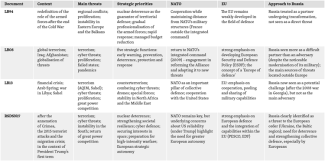
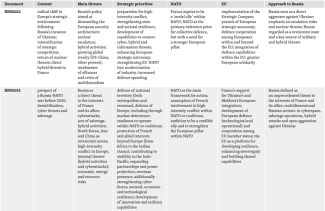
All the white papers and reviews include an analysis of the strategic context, the main challenges and threats, the priorities of security policy and the approach to alliances and partnerships.
Table 3. Overview of key French strategic documents (1994–2025)
Source: the authors’ own compilation.
APPENDIX 2. The French Armed Forces
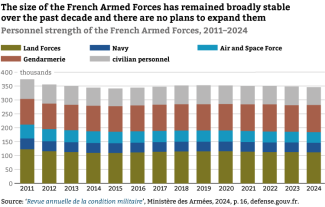
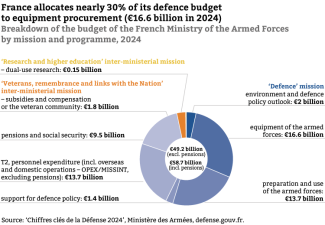
Table 4. Aircraft and helicopters of the French Army
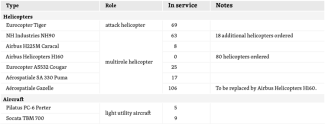
Source: the authors’ own compilation.
Table 5. Vessels of the French Navy
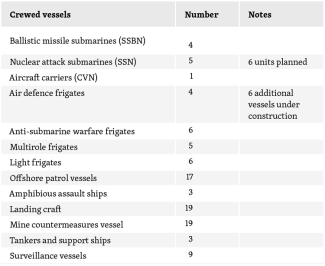
Source: the authors’ own compilation.
Table 6. Naval aviation of the French Navy
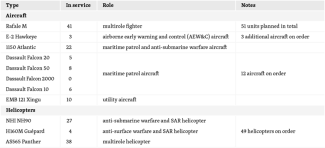
Source: the authors’ own compilation.
Table 7. Aircraft and satellites of the French Air and Space Force
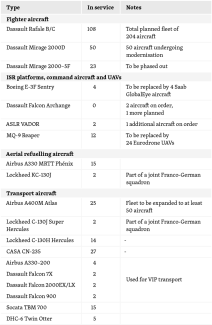
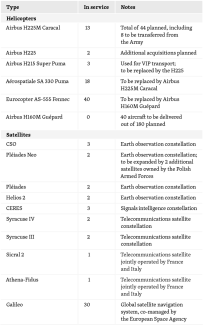
Source: the authors’ own compilation.
[1] Ł. Maślanka, ‘Vanishing partners: the implications of the Sahel coups for the EU’s security policy’, OSW Commentary, no. 550, 2 November 2023, osw.waw.pl.
[2] France has a limited nuclear deterrent capability, manifested in the continuous rotational deployment of a single nuclear-powered ballistic missile submarine on combat patrol (it operates a total of four such vessels). In addition, France possesses ASMP air-launched cruise missiles with nuclear warheads, with a total stockpile of around 290 nuclear warheads. The maintenance and modernisation of the nuclear deterrent accounted for around 11% of France’s defence budget in 2024.
[3] Between 1966 and 2009, France remained outside NATO’s integrated military structures, meaning that its forces were not subordinated to NATO’s command structures and that Paris retained full independence in operational planning and the use of its armed forces. At the same time, the country remained a political member of NATO, participated in consultations and could, if necessary, cooperate militarily with its allies on the basis of separate arrangements.
[4] ‘Speech of the President of the Republic on the Defense and Deterrence Strategy’, Élysée, 7 February 2020, elysee.fr.
[5] For an overview of Macron’s efforts, see: Ł. Maślanka, ‘Twilight of Jupiter: The Legacy of Macron’s Foreign and Security Policy’, OSW Commentary, no. 613, 18 July 2024, osw.waw.pl.
[6] ‘Globsec Summit in Bratislava’, Élysée, 1 June 2023, elysee.fr.
[7] The two leaders held a phone call at France’s initiative in July 2025.
[8] Ł. Maślanka, ‘France’s rhetorical offensive on the war in Ukraine’, OSW, 8 March 2024, osw.waw.pl.
[9] ‘Renforcement du flanc Est de l'OTAN’, Ministère des Armées, defense.gouv.fr.
[10] H. Fayet, ‘How should Britain and France cooperate to realise the Northwood Declaration?’, IFRI, 18 July 2025, ifri.org.
[11] Ł. Maślanka, J. Tarociński, ‘France and the United Kingdom: the beginning of bilateral coordination of nuclear deterrence’, OSW, 11 July 2025, osw.waw.pl.
[12] ‘President delivers speech on France’s nuclear deterrence’, Élysée, 4 March 2026, elysee.fr.
[13] Ł. Maślanka, ‘Sovereign, yet forward-oriented towards Europe: the evolution of France’s nuclear deterrence doctrine’, OSW, 3 March 2026, osw.waw.pl.
[14] ‘Devant la Communauté politique européenne, Emmanuel Macron réaffirme son souhait d’une autonomie stratégique renforcée du continent’, Le Monde, 7 November 2024, lemonde.fr.
[15] Versailles Declaration, the European Council and the Council of the European Union, 10–11 March 2022, consilium.europa.eu.
[16] Ł. Maślanka, J. Tarociński, ‘France and the United Kingdom: the beginning of bilateral coordination of nuclear deterrence’, op. cit.
[17] B. Kunz, ‘The Persistent Lack of Strategic Convergence between France and Germany’, Internationale Politik Quarterly, 26 September 2024, ip-quarterly.com
[18] ‘Przełomowy traktat polsko-francuski podpisany w Nancy’, the Chancellery of the Prime Minister of Poland, 9 May 2025, gov.pl.
[19] ‘Agreement on security cooperation between France and Ukraine’, Élysée, 16 February 2024, elysee.fr. According to an unpublished report by the French Ministry of the Armed Forces to parliament, France has spent €8.2 billion on military assistance to Ukraine, including €5.9 billion in equipment transfers and €2.3 billion in contributions to the European Peace Facility. Ch. Plantade, ‘Livraisons d’armes, formations, aide financière… Ce que coûte réellement le soutien militaire français à l’Ukraine’, Les Échos, 18 September 2025, lesechos.fr.
[20] A. Dziubińska, J. Pieńkowski, ‘France and Moldova Sign New Defence Cooperation Agreement’, PISM Commentary, no. 13, 13 March 2024, pism.pl.
[21] ‘La France renforce sa relation de défense avec l’Arménie’, Ministère des Armées, 24 October 2023, defense.gouv.fr.
[22] C. Brustlein, ‘Defense: Presidential Ambition Meets Reality’ [in:] Macron, Diplomat. A New French Foreign Policy?, Etudes de l’IFRI, April 2018, pp. 13–16, ifri.org. At the same time, to increase the number of reservists, President Macron announced the launch of a voluntary military service programme for 18- and 19-year-olds, set to begin in 2026. It is intended to last 10 months and be remunerated.
[23] J.-D. Merchet, ‘En 2027, l’armée de terre pourra fournir une division de combat déployable en trente jours’, Secret Défense V2, 25 September 2025, secretdefensev2.com.
[24] Fantassins, no. 52, spring–summer 2024, fantassins.fr.
[25] J.-D. Merchet, ‘Défense : le Rafale devra encore attendre pour être «l’avion unique»’, l’Opinion, 5 April 2023, lopinion.fr.
[26] Idem, Sommes-nous prêts pour la guerre ? L’illusion de la puissance française, Robert Laffont, Paris 2024.
[27] Researchers who are sceptical about the French military’s ability to engage in high-intensity conflict describe its military model as a ‘bonsai tree’. It possesses a comprehensive range of capabilities, but only on a miniature scale. É. Tenenbaum, High-Intensity Warfare. What Challenges for the French Armed Forces?, Notes de l’Ifri, July 2023, ifri.org.
[28] É. Tenenbaum, A. Zima, ‘Return to the East: the Russian Threat and the French Pivot to Europe’s Eastern Flank’, IFRI Studies, no. 119, 13 June 2024, ifri.org.