The state as a family business? Succession scenarios in Belarus
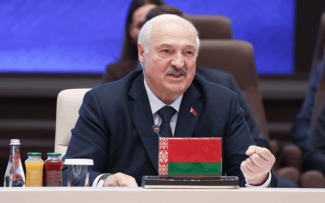
The personalist nature of Alyaksandr Lukashenka’s regime, his advancing age (72) and recurring signs of declining health have made the question of succession increasingly important. The dictator himself has done little to clarify the issue. His statements about potential successors remain ambiguous and appear primarily intended to conceal his deep-seated fear of establishing a clear mechanism for the transfer of power.
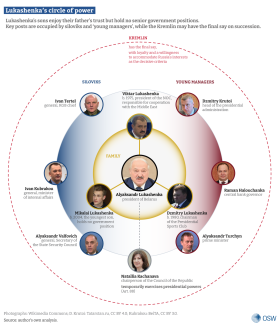
Against this backdrop, the actual standing of individuals within Lukashenka’s inner circle, including their privileges and the degree of trust placed in them, is becoming increasingly important. Particular attention centres on his three sons: the eldest, Viktar, the middle son, Dzmitry; and the youngest, Mikalai. Each plays a different role, but all three enjoy their father’s trust and have access to business networks that facilitate the accumulation of family wealth. However, none of the brothers holds a position that would give him a strong foothold within the power structure. Other influential figures within the ruling elite include senior security officials and a group of ‘young managers’ appointed to key state positions, including the prime minister, the head of the presidential administration and the central bank governor.
At this stage, the question of succession remains open. The process of selecting a successor is unlikely to begin in earnest until Lukashenka dies or becomes seriously ill. Moscow will also play a significant role in the struggle for power in Minsk, as Russia continues to regard Belarus as part of its exclusive sphere of influence.
Illusory constitutional mechanisms for the transfer of power
The first serious moves towards constitutional reform, indicating that Lukashenka was considering the question of succession, emerged in 2016–2017. Initially, he drew inspiration from the changes being introduced at the time by Kazakhstan’s leader, Nursultan Nazarbayev. However, Nazarbayev’s subsequent marginalisation within the state,[1] as well as the successful revolution in Armenia in 2018,[2] discouraged the Belarusian dictator from experimenting with changes to the system of governance.
The main factor that has reinforced his conviction that he must retain full control remains the rigged presidential election of 2020, which triggered mass protests. The so-called constitutional reform proposed after the brutal suppression of these protests ultimately proved to be a façade rather than a genuine transformation of the political system. Power was not decentralised: Alyaksandr Lukashenka himself assumed the chairmanship of the new constitutional body, the All-Belarusian People’s Assembly. Nor was a mechanism established for transferring power without jeopardising the stability of the system.[3]
Under the constitution amended following the referendum of 27 February 2022, if the office of head of state becomes vacant – for example, due to the president’s death or inability to perform his duties – the chairperson of the Council of the Republic, the upper house of parliament, assumes presidential responsibilities until a successor is elected (Article 88 of the Constitution of the Republic of Belarus). This position is currently held by Natallia Kachanava, who is unwaveringly loyal to Lukashenka but lacks charisma.
It is also worth noting the provision concerning the president’s death as a result of an assassination, a terrorist attack or armed aggression. In such circumstances, responsibility for governing the country passes to the Security Council, whose meetings are also chaired by the aforementioned head of the Council of the Republic.[4] However, this arrangement neither guarantees a stable transfer of power nor ensures continuity of the political system. Nor does it reflect the actual balance of power within the ruling elite. It is difficult to envisage Kachanava, who lacks political authority, effectively governing the country. Meanwhile, the designation of the Security Council as a whole, rather than its chairperson, could trigger factional struggles within this body, which is dominated by senior security officials.
Viktar: his father’s right-hand man
Born in 1975, Lukashenka’s eldest son Viktar has been involved in governing the country alongside his father for longer than either of his brothers. He graduated in international relations from Belarusian State University (BSU) in Minsk and subsequently joined the Ministry of Foreign Affairs. During the same period, he also completed military service with the border troops, following in his father’s footsteps in what could be regarded as a family tradition. Between 2003 and 2005, he worked at Agat, one of Belarus’s key state-owned defence enterprises. A turning point in Viktar’s career came in 2005, when he was appointed presidential adviser on national security. In 2007, he also became a member of the Security Council.[5] As Lukashenka himself acknowledged years later, his decision to entrust this position to his eldest son stemmed from the need to “exercise effective control over the security services, something that could only be ensured by a trusted individual in constant contact with the head of state”.[6]
Viktar carried out his duties while avoiding media attention. At the same time, rumours circulated in independent media that he had built an extensive network of contacts within the security services. These connections reportedly gave him considerable influence over senior appointments, potentially including the appointment of Valery Vakulchyk as head of the KGB in 2012, a position he held until 2020. They also facilitated his contacts with wealthy private businessmen linked to the regime, such as Alyaksandr Zaytsau. Viktar’s involvement in motorcycle enthusiast circles in the capital was also said to have helped him cultivate informal influence among political and business elites.[7]
Viktar’s privileged position, however, stems primarily from his extensive contacts with the elites of Arab states, particularly the United Arab Emirates (UAE). He has travelled to the region on numerous occasions, both with his father and independently. For a long time, the Belarusian authorities offered no official explanation for this aspect of Viktar’s activities and avoided publicising his foreign contacts. It was only in 2023 that Lukashenka’s press secretary, Natallia Eismant, revealed that his eldest son had been entrusted with the role of “special envoy” for the Middle East “at the request of the sheikhs in the UAE, where local tradition favours a state being represented by a trusted member of the leader’s immediate family”.[8]
In this capacity, Viktar’s responsibilities have also extended to Oman, with which Minsk has been developing close cooperation since late last year. Muscat has, among other things, pledged logistical support for the distribution of Belarusian goods across the region. Lukashenka’s talks with Oman’s Sultan Haitham bin Tariq Al Said in December last year were attended only by Viktar and his youngest son, Mikalai, with no representatives from the Belarusian Foreign Ministry or economic ministries present.[9] Official statements accompanying these meetings are usually extremely vague, reinforcing suspicions that the eldest son’s primary role is to oversee at least part of the Lukashenka family’s assets held in the Gulf states.
The latest stage in Viktar’s career began in 2021, when he became president of the National Olympic Committee (NOC), replacing his father. Although he lost his position as national security adviser, he retained his sensitive Middle East portfolio. In his new role, Viktar continues to make few public appearances and avoids media attention. Moreover, according to investigations by Belarusian journalists, the NOC controls numerous companies operating in sectors including trade and catering. This may provide the eldest son with an additional ‘reward’ for his many years of service alongside his father. The exploitation of such privileges by the dictator’s sons is, however, a broader phenomenon. Viktar’s wife, Liliya, has maintained close ties with Dana Holdings since at least 2012. The company is owned by the Karić brothers, Serbian businessmen who enjoy preferential treatment from Lukashenka and are actively involved in investment projects, including residential property development in Minsk.[10]
Dzmitry: in his father’s shadow
Born in 1980, Dzmitry followed in his elder brother’s footsteps by graduating in international relations from Belarusian State University (BSU). From the outset, his professional career has been closely linked to sport. In 2005, he became chairman of the Presidential Sports Club, a newly established organisation responsible, among other things, for identifying and training young talent across various sporting disciplines. In subsequent years, he also became involved in various business ventures, including the establishment of a sales office for BelAZ, the state-owned manufacturer, which produces large heavy-duty construction vehicles.[11] Both his senior position in sport and his ability to pursue lucrative business ventures are direct consequences of his father’s patronage.
Unlike his elder brother, Dzmitry shows no interest in politics and consequently makes even fewer media appearances. His wife, Anna, is a much more of a public figure. Known in Belarus under the pseudonym Anna Sialuk, she has written numerous songs that receive extensive promotion through regime-controlled media. She also coordinates various propaganda-oriented cultural and entertainment events, including a series of patriotic concerts under the slogan ‘Time has chosen us’, organised in 2024 to promote government policies among the public. According to media reports, Lukashenka’s daughter-in-law is also active in business, jointly controlling a number of media and catering companies with her sister and brother-in-law.[12]
Mikalai: his father’s favourite
Unlike his elder brothers, the youngest son, Mikalai, was born out of wedlock. Although Lukashenka has never explicitly revealed the identity of Mikalai’s mother, all indications suggest that she is Iryna Abelskaya, formerly his personal physician. Born in 2004, Mikalai has become his father’s favourite. Lukashenka takes every opportunity to express his pride in his youngest son and has taken him on most of his foreign visits since early childhood, from meetings with Vladimir Putin to an audience with Pope Benedict XVI. This privileged status has prompted both experts and journalists to speculate that Lukashenka is ‘grooming a successor’, but the dictator has consistently and firmly denied such suggestions.[13]
His father’s particular concern for Mikalai is undoubtedly reflected in the care taken over his education. After graduating from an elite secondary school in Minsk, Mikalai went on to study biotechnology at Peking University, where he graduated in 2026 as part of the first pilot cohort of a Belarusian-Chinese cooperation programme.[14] At the same time, Lukashenka proudly announced that his son was performing military service, although he did not specify the type of unit in which he was serving.[15] Presumably due to his age and lack of experience, Mikalai has so far held no government position or managed any business venture.
Privileged security officials and managers
Lukashenka has consistently denied all rumours that he intends to transfer power to one of his sons. He has explained that “as children, they saw from my example what a burden the presidency entails”. In August 2026, he also suggested that none of his sons possessed the qualifications necessary to hold the country’s highest office, dismissing any suggestion of hereditary succession as the invention of “complete idiots”.[16]
At the same time, the dictator has repeatedly speculated in recent years about the most likely candidates to succeed him. In March 2021, for example, he named former interior minister Yuri Karayev and Uladzimir Karanik, then governor of the Hrodna region. In June 2024, he emphasised the importance of a generation of “young, promising managers holding senior positions in the state apparatus”. He returned to this theme several times over the following months, while his personnel appointments during that period suggested that he may have been referring primarily to the head of the presidential administration, Dzmitry Krutoi, the governor of the central bank, Raman Halouchanka and Prime Minister Alyaksandr Turchyn.[17] On occasion, Lukashenka has even expressed doubts about whether a worthy successor possessing the necessary “unique personality traits” could be found, admitting that he was unable to identify a specific individual. He has also asserted that “you cannot simply become president; you have to be born to be one”.[18]
Lukashenka’s opaque and inconsistent statements about his potential successor or successors have fuelled speculation among journalists and experts. The strongest indications pointed to senior security officials (so-called siloviks), whose influence has grown markedly since 2020 amid intensifying repression and the transformation of the political system towards totalitarianism.[19] Recently, the most prominent figures within this segment of the elite have been KGB chief General Ivan Tertel, Interior Minister General Ivan Kubrakou and Secretary of the State Security Council, Alyaksandr Valfovich. Significantly, apart from his reference to Yuri Karayev, the dictator himself has never suggested, even indirectly, that he might hand over power to a senior security official or a member of the military high command.
Who will succeed Lukashenka?
Lukashenka’s contradictory statements on succession are a deliberate tactic designed to sow confusion within the ruling elite. The dictator most likely fears that naming a specific successor during his lifetime could lead to the emergence of an alternative, influential power base. He also appears to fear the transfer of power itself. This is characteristic of long-serving authoritarian or totalitarian leaders, for whom the monopolisation of power has become a way of life. Lukashenka therefore maintains that, despite his advancing age, he will be able to remain in power for many more years, partly owing to his healthy lifestyle.[20]
Although Lukashenka’s family occupies a privileged position within his inner circle, it has not become a centre of political influence. Nor is there any indication that any of the dictator’s sons is currently being groomed to govern the country. Even Viktar, the most politically engaged of the three, is primarily responsible for safeguarding the family’s financial interests and plays no role in official state policymaking.
It can therefore be assumed that the real struggle for power will begin only after Lukashenka’s death or if he develops a serious illness that renders him unable to perform his duties. This process is unlikely to be straightforward, and any successor will occupy a considerably weaker position than the current leader, who created the entire political system and was the first president of independent Belarus.
The Kremlin’s position will also be crucial, as it regards Belarus as part of its exclusive sphere of influence. The decisive criteria will be a candidate’s loyalty and willingness to accommodate Moscow’s interests. Russia will pursue its own agenda during the transfer of power, further exacerbating chaos within the Belarusian elite. Therefore, it cannot be ruled out that a compromise will be needed between contenders representing different factions. In the initial phase, power may be assumed not by a single individual but by a group comprising representatives of the security establishment, the economic bloc and – potentially crucial to maintaining the system’s stability – the Lukashenka family. However, the Kremlin may ultimately have the final say. Its actual influence over the succession process in Belarus – and, consequently, the extent of Belarusian sovereignty – will depend on the outcome of the war in Ukraine and Russia’s capabilities at the time.
[1] W. Górecki, ‘Kazakhstan: work starts on dismantling the Nazarbayev system’, OSW, 21 January 2022, osw.waw.pl.
[2] In April 2018, Lukashenka, probably influenced by events in Armenia, ordered the removal of a lengthy passage concerning reform of Belarus’s governance system from his speech. See Г. Шарипкин, ‘Как события в Армении повлияли на ежегодное послание Лукашенко и его планы’, RFI, 30 April 2018, rfi.fr.
[3] K. Kłysiński, ‘Voting under special supervision. The constitutional referendum in Belarus’, OSW, 28 February 2022, osw.waw.pl.
[4] ‘Конституция Республики Беларусь’, Президент Республики Беларусь, president.gov.by.
[5] ‘Три сына и семеро внуков: как выглядят наследники президента Белоруссии Александра Лукашенко’, Parents, 30 August 2026, parents.ru.
[6] ‘Лукашенко – о сыне Викторе: «Нужен был теснейший канал между мной и силовиками»’, Салiдарнасць, 19 November 2019, gazetaby.com.
[7] ‘Виктор Лукашенко на закрытии мотосезона: Беларусь объединяет друзей с Запада и Востока’, БЕЛТА, 15 September 2018, belta.by.
[8] ‘Почему старший сын Президента Беларуси Виктор Лукашенко курирует отношения с ОАЭ. Эйсмонт назвала причины’, БЕЛТА, 5 February 2023, belta.by.
[9] ‘Семейные интересы перестали отделяться от государственных даже формально. Что скрывается за южным вояжем Лукашенко’, Наша Ніва, 3 December 2025, nashaniva.com.
[10] ‘Золото империи. Как семейный клан Лукашенко зарабатывает на Беларуси’, Бюро Медиа, 23 December 2025, buromedia.io.
[11] К. Новицкая, ‘Дмитрий Лукашенко’, 24СМИ, 24smi.org.
[12] ‘Белсат: клан Лукашенко превратил Беларусь в собственный бизнес’, PAP, 12 July 2024, pap.pl.
[13] И. Якунин, ‘Сыновья Александра Лукашенко: что известно о детях президента Белоруссии’, Комсомольская правда, 14 August 2020, kp.ru.
[14] Т. Миссуми, ‘Батька года: Лукашенко приехал на выпускной к сыну Коле в Пекин. Николай Лукашенко получил диплом биотехнолога в Пекинском университете’, Life, 30 June 2026, life.ru.
[15] А. Журавка, Я. Пушнов, ‘Каким образом Николай Лукашенко мог одновременно учиться в Китае, служить в армии, а потом и летать с отцом в командировки — эксперт’, Зеркало, 15 September 2026, news.zerkalo.io.
[16] О. Игнатович, ‘«Дураки полные». Лукашенко высказался о возможности передачи власти сыновьям’, Газета.Ru, 14 August 2026, gazeta.ru.
[17] ‘Лукашенко заговорил о возможных преемниках. Среди них генерал Караев’, Радио Свобода, 19 March 2021, svoboda.org; В. Месхи-Георгиади, ‘«Идет смена поколений». Лукашенко сказал, что молодые и перспективные профессионалы должны прийти к власти’, Комсомольская правда, 27 June 2024, belarus.kp.ru.
[18] О. Лойко, ‘Просто богоизбранность и президенторожденность. Лукашенко устал что-то доказывать беларусам’, План Б., 3 October 2024, planbmedia.io.
[19] K. Kłysiński, P. Żochowski, Focused on survival. The Belarusian political and business elite post-2020, OSW, Warsaw 2023, osw.waw.pl.
[20] В. Корявская, ‘«Только сразу пускай ничего не ломает». Лукашенко рассказал, каким видит своего преемника и может ли им стать сын Николай’, Зеркало, 8 August 2025, news.zerkalo.io.