Derussification of Moldova: an accelerated shift away from Russia since 2022
Russia’s full-scale invasion of Ukraine has heightened Moldova’s sense of the Russian threat and prompted the government to accelerate efforts to sever ties with Moscow and reduce the country’s dependence on it. In less than five years, this process has extended to the economy (energy and trade), legislation, the media, language, culture, foreign policy and, to some extent, even religion. The Kremlin’s position has also weakened in the separatist region of Transnistria (the so-called Left Bank), which has effectively functioned as a Russian protectorate since the 1990s. Consequently, the previous relationship of dependence has been reversed, as Russian expectations no longer determine Chișinău’s policy towards this region.
The process of emancipation has been advancing most rapidly in areas where it is driven by the pro-Western political camp that has governed Moldova since 2021 – notably energy, legislation and foreign policy – or where circumstances have made it necessary, as in trade. Progress has been slower in the political arena and in the cultural and symbolic spheres. However, the gradual erosion of Russian influence could still be reversed, as the social foundations of this process remain relatively fragile. This means that a potential loss of power by pro-European forces could pave the way for at least a partial Russian ‘reconquest’.
Energy: from a Russian monopoly to complete independence
Since Moldova declared independence in 1991, the energy sector has been a cornerstone of Russian influence. Moscow has readily and effectively exploited Moldova’s dependence on Russian energy resources and electricity supplies from Russian-controlled sources to keep Chișinău in line. As the country’s sole gas supplier, Russia repeatedly threatened to halt deliveries (and actually did so in 2021)[1] or raise prices. A similar pattern applied to the electricity sector. Before 2025, the Moldavskaya GRES (MGRES) power plant in Transnistria, owned by Russia’s Inter RAO, met 80% of Moldova’s electricity demand. The remaining 20% came from combined heat and power plants in Chișinău and Bălți, which ran on Russian gas and thus depended on stable supplies from Russia.
Over the past five years, both of these dependencies have been almost entirely eliminated. As recently as early 2022, Gazprom accounted for 100% of Moldova’s gas supplies. Moldovagaz, in which Gazprom and other Kremlin-controlled entities hold a combined majority stake (63.4%), handled gas purchases and distribution and controlled the country’s entire gas transmission network. However, in December 2022, right-bank Moldova stopped purchasing Russian gas and switched to supplies from European markets. Under the existing contract, Gazprom continued to supply only Transnistria until 2025.[2] In September 2023, Moldova also successfully challenged Gazprom’s claim that it owed the company $709 million in ‘historical debt’ (auditors put the actual amount at just $8.6 million), thus depriving Russia of another tool it had previously used to exert pressure.[3]
In parallel, Moldovagaz was effectively broken up and marginalised. In 2022, as part of efforts to support diversification, the European Bank for Reconstruction and Development offered Moldova a €300 million loan to purchase gas from European suppliers. However, given the potential sanctions risks associated with the existing Moldovan operator’s ties to Gazprom, the bank channelled the entire sum to the state-owned company Energocom, which became the sole gas supplier to right-bank Moldova in December 2022. This arrangement, initially temporary in legal terms, was not formalised until 2025, when Moldovagaz permanently lost its gas supply licence. Earlier, in September 2023, the company had also been stripped of control over the gas transmission network, with Romania’s Vestmoldtransgaz taking over as its operator. As a result, the former monopolist is now confined to the distribution segment, the least strategically important link in the gas supply chain.
An equally revolutionary shift has taken place in the electricity sector. Moldova and Ukraine disconnected from the post-Soviet IPS/UPS power system in February 2022 and synchronised with the Continental Europe Synchronous Area (CESA) the following month, gaining the ability to import electricity from the EU. Over the next three years, Chișinău continued to purchase electricity from MGRES despite its desire to end cooperation with the plant. This stemmed from socio-economic considerations: electricity generated in Transnistria using Russian gas supplied free of charge was significantly cheaper. The situation changed in January 2025, when the gas transit agreement between Ukraine and Russia expired. Deprived of gas supplies, the breakaway region stopped supplying electricity to right-bank Moldova, which immediately replaced it with imports from the European grid, mainly from Romania. Although Russia resumed gas supplies to the region in February 2025 – purchasing gas on European markets through intermediaries and supplying roughly half the previous volume – MGRES has lost its price competitiveness and is no longer regarded as a potential electricity supplier to right-bank Moldova.[4]
Transnistria: a reversal of dependence
The war has also reversed the balance of dependence between the Moldovan government and Transnistria, which has traditionally served as an instrument of Russian pressure on Chișinău. For three decades, Chișinău could not afford to take firm measures against the region, including enforcing customs duties and taxes, for fear that Russia would reduce gas or electricity supplies. This constraint disappeared when Moldova gained energy independence. Meanwhile, Transnistria, deprived of free Russian gas, plunged into its deepest crisis since the 1992 war, with its GDP contracting by around 25% between 2023 and 2025.
Chișinău is capitalising on this new situation to gradually reintegrate the region economically. A major turning point came in 2022, when Kyiv effectively closed the border between Ukraine and Transnistria, forcing all trade with the left bank to pass through right-bank Moldova and be subject to its customs controls. As a result, in 2024 the Moldovan government imposed customs duties on Transnistrian companies for the first time, followed by VAT and excise duties in September 2026. Full tax harmonisation is planned by 2030.[5] However, this reintegration remains strictly economic. The country’s leadership still lacks a coherent vision for political reintegration and the will to pursue it, while around 1,500 Russian troops remain stationed in the region.
Marginalisation of Russia as an export and labour market
Moldova has also drastically reduced its dependence on Russia as a trading partner, becoming far less vulnerable to embargoes, a tool Moscow regularly used to exert pressure in the past, targeting wine in 2006 and 2013, meat, vegetables, fruit and canned goods in 2014–15 and fruit and vegetables in 2022 and 2023.[6]
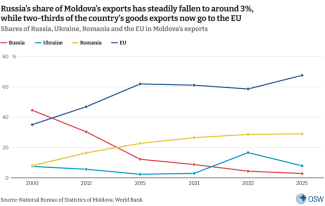
This process began long before 2022 but has accelerated markedly over the past five years. Successive embargoes drove Moldovan producers to seek new markets, primarily in the EU. At the turn of the century, Russia still accounted for 50% of Moldova’s exports, but by 2025 its share had fallen to just 2.8%, placing it ninth among Moldova’s export destinations, behind countries such as Poland, Bulgaria and Ukraine. Meanwhile, the total value of Moldova’s goods exports rose by 20% between 2021 and 2025, indicating that the ‘derussification’ of trade has not hampered export growth. Romania has emerged as the largest market for Moldovan goods, accounting for 29.5% of exports in 2025, while the EU as a whole absorbed 67.5%.
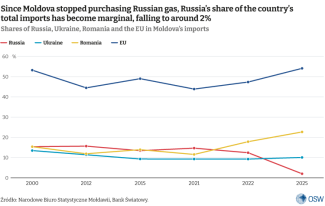
An even more pronounced shift has occurred in imports. In 2021, Russia was Moldova’s largest supplier (14.7%), largely owing to gas imports. As a result of Moldova’s decision to end cooperation with Gazprom, coupled with war-related logistical disruptions and sanctions, the value of goods imported from Russia fell to one-fifth of its 2021 level by 2025. Consequently, Russia’s share of Moldova’s imports shrank to just 2%, placing it ninth among the country’s suppliers.[7]
However, Russia’s marginalisation as an export market is not complete. It remains important for parts of Moldova’s agricultural sector, particularly fruit growing. This is especially true of apple production. In 2024, a record year in this respect, Russia accounted for 22.9% of Moldova’s fruit exports (or nearly 30% if Belarus, which serves as a re-export channel, is included).[8] Another, less obvious sector is the pharmaceutical industry, which sent around 20% of its exports to Russia in 2024. The slower reorientation in this segment stems from the costly certification required for medicines to enter EU markets.
Since 2022, the importance of the Russian labour market for Moldovan migrant workers has also declined significantly. As recently as 2021, remittances sent home by Moldovans working in Russia accounted for 10.9% of all money transfers from migrant workers.[9] Russia’s declining appeal as a destination for Moldovan migrant workers is also reflected in an 80% fall between 2021 and 2024 in the number of people working there for less than a year.[10]
Curbing pro-Russian media activity
‘Derussification’ has also extended to the information space. The state of emergency in force from February 2022 to December 2023 allowed the government to suspend broadcasts by television channels disseminating Russian propaganda or controlled by sanctioned oligarchs who fled the country in 2019, notably Ilan Şor. As a result, twelve television stations had their broadcasting licences suspended in 2022–23,[11] while nearly 200 Kremlin-linked websites were blocked between 2022 and 2025.[12]
In December 2023, the final month of the state of emergency, the government expanded the powers of the Council for the Promotion of Investment Projects of National Importance (CPPIIN), allowing it to suspend or revoke broadcasting licences without a court ruling on the grounds of unclear funding arrangements or a ‘reasonable suspicion’ that the beneficial owners were engaged in activities threatening national security. These powers enabled the government to maintain the broadcasting ban on 10 of the aforementioned stations (the other two had voluntarily relinquished their licences) and extend it to another 31 radio and television channels in the following months. However, this mechanism poses a risk of abuse and has drawn criticism from local NGOs advocating for freedom of expression, which have accused the government of introducing it hastily and without consultation.[13]
In addition, the authorities introduced a ban on Russian propaganda broadcasts. An amendment to the Audiovisual Code adopted in June 2022 (the so-called anti-disinformation law) prohibited local broadcasters from retransmitting news and current affairs programmes originating from Russia. In practice, the ban also extended to war films, including Soviet propaganda productions depicting the so-called Great Patriotic War that reinforce nostalgia for the Soviet Union.[14] The amendment also empowered the authorities to suspend the licences of broadcasters spreading disinformation and pro-war propaganda, including content justifying Russia’s invasion of Ukraine. In 2023, Moldova established the Centre for Strategic Communication and Combating Disinformation, while the EU launched its Partnership Mission in Moldova (EUPM) in Chișinău – its first civilian mission specifically designed to counter hybrid threats.
However, the effectiveness of these measures remains limited. Blocked websites reappear under new addresses: for example, after restrictions were imposed on the kp.md domain, Komsomolskaya Pravda in Moldova launched a clone website, while Russian media outlets have shifted their operations to platforms such as Telegram or Kremlin-influenced VK and Rutube. Moreover, the restrictions do not apply to the print media, which are subject only to registration rather than licensing. As a result, printed editions of publications such as Komsomolskaya Pravda continue to appear. Despite Moldova’s decision in November 2024 to adopt US sanctions against the Rossiya Segodnya media group, its Chișinău branch still employs 19 people and receives funding from Russia.[15]
Weakening Russian influence and institutional ties
Moldova has been working to dismantle the network of Russian institutions that have used cultural and educational activities as a cover for spreading propaganda and bolstering Russian ‘soft power’, although progress has been slow and selective. In 2024, the Moldovan government closed the Russian Centre at Moldova State University in Chișinău, a branch of the Russkiy Mir Foundation, which was established by Vladimir Putin’s decree in 2007. However, a similar centre in Bălți, the country’s second-largest city, remains operational for unclear reasons.[16] The Russian Centre for Science and Culture was not closed until July 2026.
The Russian embassy’s staffing levels have also been significantly reduced. In the summer of 2023, following an investigation into intelligence-gathering equipment installed on its roof, the Moldovan government ordered the embassy to cut its staff from around 70 to 25, including 10 diplomats.[17] Chișinău has also consistently taken action against political organisations illegally funded and run from Russia. In June 2023, the Constitutional Court declared Ilan Şor’s ȘOR party unconstitutional. In July 2025, the Central Electoral Commission refused to register Şor’s ‘Victory’ bloc for the parliamentary elections, and a year later the Court of Appeal dissolved four parties deemed to be successors to ȘOR.
Moldova has also been working to dismantle the institutional ties that bind it to Russia through post-Soviet structures. In April 2026, parliament voted to withdraw from the Commonwealth of Independent States (CIS), approving the termination of three of its founding agreements (membership will formally end after a one-year notice period). Chișinău had been signalling its intention to take this step since early 2023. It first withdrew from the CIS Interparliamentary Assembly and then stopped paying membership fees in 2024 and began terminating nearly 300 agreements concluded under the CIS framework.
At the same time, Moldova has dramatically deepened its cooperation with the EU. It submitted its application for membership in March 2022, was granted candidate status on 23 June that year and formally launched accession negotiations on 25 June 2024. In June and July 2026, the country opened two of the six negotiating clusters (‘Fundamentals’ and ‘External Relations’). The government aims to conclude negotiations by 2028 and join the EU in 2030. Moldova has also enshrined its commitment to European integration in the constitution, following a referendum on 20 October 2024 in which 50.35% of votes cast were in favour.
The growing prominence of the Romanian language
Subtler but potentially more lasting changes have been taking place in the linguistic sphere. The government’s policy in this area aims not to eliminate Russian from education, but rather to strip it of its privileged status and improve Romanian-language proficiency among ethnic minorities. Chișinău intends to make the official language the ‘main instrument of public communication’, supporting the development of a ‘united, solidarity-based and inclusive society committed to European integration’. Ultimately, the aim is to displace Russian as the lingua franca – the language used by ethnic minorities to communicate with one another.[18]
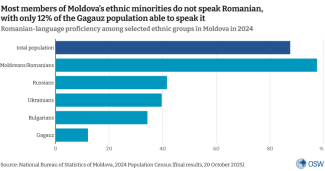
Since the start of the 2025/26 school year, educational institutions serving ethnic minorities (where Russian has typically been the main language of instruction) have been introducing a multilingual education model developed between 2023 and 2025,[19] which entails a gradual transition to teaching some subjects in Romanian; previously, students learned the language only in dedicated language classes. By 2028, at least 20% of minority-language schools and kindergartens are expected to gain multilingual status, rising to 50% by 2030. However, a serious shortage of teaching staff poses a major obstacle, prompting the government to offer relocation allowances to teachers.[20] Universities train around 100 Romanian language specialists each year, but only about 25% take up teaching posts in schools. Meanwhile, despite 90 vacancies, not a single graduate has applied to work in minority-language kindergartens in recent years.[21] In 2023, the government also launched a programme of free Romanian language courses for adults, aimed primarily at ethnic minorities. Demand[22] has been unexpectedly high: in 2024, more than 11,000 people applied for around 4,000 places, while over 8,200 participated in the programme in 2025.[23] In total, around 25,000 people received Romanian language training between 2023 and 2025.[24]
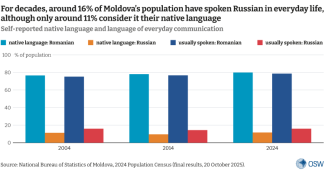
The role of the official language has also been strengthened beyond the education system. A new citizenship law, in force since December 2025, has made the granting of citizenship conditional on demonstrable proficiency in Romanian for the first time. This has also become a requirement for employment and promotion in the civil service, while a 2026 amendment to the Electoral Code introduced the same requirement for candidates for the position of Bashkan of Gagauzia (the head of the autonomous region, who sits in the government with ministerial rank). Meanwhile, a proposed amendment to the parliamentary rules of procedure would require MPs to address the chamber exclusively in Romanian. Until now, some deputies have regularly used Russian.
The government has also taken steps to increase the share of Romanian-language content in the media. A November 2022 amendment to the Audiovisual Code required broadcasters to ensure that at least 80% of domestically produced content aired between 6 am and midnight was in Romanian. In areas where ethnic minorities form the majority, the threshold was set at 25%, with broadcasters required to air the remainder in the relevant minority language. A draft amendment approved at first reading in August 2026 goes further, requiring at least 50% of all broadcast content to be in Romanian.[25] However, enforcing the existing regulations remains a challenge. In 2023, 13.5% of inspected broadcasters failed to meet the 80% threshold, a figure that rose to 20% in 2025.[26]
Symbolic measures have also played an important role. In March 2023, the government replaced the term ‘Moldovan language’ – an artificial Soviet construct designed to justify Moscow’s narrative that Moldovans and Romanians are distinct peoples – with ‘Romanian language’ across all legislation. This paved the way for an amendment to the constitution, which had continued to refer to ‘Moldovan’ as the official language despite a 2013 ruling by the Constitutional Court.[27] The government also abandoned the practice of publishing all official documents in Russian alongside Romanian. Since 2024, mandatory translation into Russian has applied only to normative acts.
De-Sovietisation of historical memory
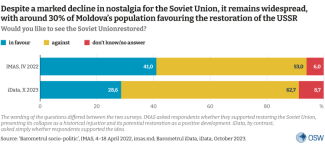
Chișinău has sought to challenge Russia’s historical narrative, which reinforces persistent nostalgia for the Soviet Union and underpins Russian ‘soft power’. The prevailing post-Soviet model of historical memory either glossed over or justified communist crimes committed against Moldova’s population, such as the Stalinist deportations of 1941–51 and the great famine of 1946–47. It portrayed the Soviet annexations of Bessarabia in 1940 (under the Molotov–Ribbentrop Pact) and again in 1944 as ‘liberation’, glorified the Red Army and presented the Soviet period as an era of prosperity. As a result, as many as 47% of Moldovans expressed a positive view of the former ‘communist regime’ in 2018 (the most recent survey on this question),[28] while nearly 29% supported the restoration of the Soviet Union in 2023.[29]
Recognising historical memory as crucial to building resilience against pro-Russian narratives, the government has made the first concerted effort in decades to develop a coherent policy on historical memory and establish institutions to support its implementation. Poland’s Institute of National Remembrance, which established regular cooperation with its Moldovan counterparts in 2026, has become a key point of reference in this effort. This cooperation includes consultations on institutional organisation and remembrance policy, as well as training sessions and workshops focused on research, education, archival work and digitisation.
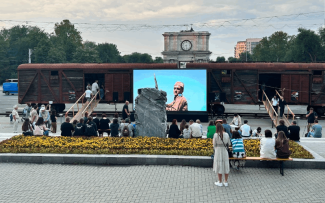
Since 2022, the Moldovan state has actively sought to raise awareness of communist crimes. In 2024, the government introduced an optional school subject covering communist repression and anti-Soviet resistance and expanded the Year 12 history textbook to include more extensive coverage of topics such as the Gulag and the Katyn massacre. The authorities have also been investing in museums, monuments and recurring exhibitions. Every summer since 2023, a freight wagon housing an exhibition dedicated to the victims of Stalinist deportations has been displayed outside the government headquarters; in 2026, the exhibition was also held for the first time in traditionally pro-Russian Bălți. New monuments and memorial sites have also been unveiled, including a memorial in Mereni dedicated to the deportations (2025) and a complex in Mingir commemorating the victims of the great famine and political repression (2026).[30] President Maia Sandu has also announced plans to establish a Museum of Memory modelled on similar institutions in Central Europe, including those in Poland. An interministerial Council of Memory, established in 2025, is responsible for coordinating these efforts.
The gradual weakening of the Russian Orthodox Church
Since 2022, a number of parishes under the Moscow Patriarchate’s Metropolis of Moldova (BOM) have decided to switch allegiance to the Metropolis of Bessarabia, which is subordinate to the Romanian Patriarchate.[31] Traditionally, the former accounted for around 80% of Orthodox believers in Moldova and the latter for the remaining 20%. This shift among the clergy has been driven by opposition to Patriarch Kirill’s open support for the invasion of Ukraine and by financial considerations. Priests belonging to the Metropolis of Moldova depend on donations from churchgoers, while the Metropolis of Bessarabia pays its clergy fixed salaries funded by Romania. In 2024, Bucharest doubled the number of clergy positions in the Metropolis of Bessarabia – which currently oversees around 300 parishes – to approximately 400 to accommodate priests switching allegiance.
This process has been accompanied by a legal battle over control of state-owned churches. In 2003, under the pro-Russian communist government, the BOM was granted the right to use more than 800 historic Orthodox churches indefinitely. In 2023, a parish priest serving in one of these churches, in Dubăsarii Vechi, switched allegiance to the Metropolis of Bessarabia and challenged the BOM’s right to use the building in court. In November 2025, the Court of Appeal ruled in his favour. If the Supreme Court upholds the ruling, it will set a precedent that could pave the way for some of these churches, along with their parishes, to be placed under the authority of the Metropolis of Bessarabia.
Outlook
Moldova’s shift away from Russia is a profound but uneven process. The key dependencies that gave Moscow tangible leverage over Chișinău for three decades – in gas, electricity and trade – have effectively been eliminated and are unlikely to re-emerge in the foreseeable future.
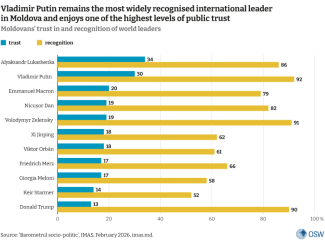
However, the political and social foundations of derussification remain far less stable. Pro-Russian or Moscow-linked political parties still attract around 40–45% support, 38% of the population hold a favourable view of Russia, and Vladimir Putin is more widely recognised than any other major international leader, with around 30% of Moldovans expressing trust in him.[32]
The narrow majority of just over 50% secured in the referendum on enshrining the country’s commitment to EU integration in the constitution underscores the fragility of public support for a lasting shift away from Russia. The future of this process will therefore depend primarily on whether the pro-Western political camp can remain in power and firmly anchor Moldova in European institutions.
[1] In the autumn of 2021, Gazprom reduced gas supplies by around one-third during contract negotiations. As two-thirds of the gas went to Transnistria, this effectively amounted to cutting off supplies to right-bank Moldova.
[2] See K. Całus, ‘Moldova diversifies gas import sources’, OSW, 8 December 2022, osw.waw.pl.
[3] Idem, ‘Moldova: reduction of Russian influence in the gas sector’, OSW, 14 September 2023, osw.waw.pl.
[4] According to the Ministry of Energy, electricity from MGRES would now be up to 64% more expensive than the average price paid by Energocom. See ‘Ministerul Energiei explică de ce electricitatea de la MGRES nu mai este competitivă: costuri mai mari, riscuri și dependență energetică’, Moldpres, 16 August 2026, moldpres.md.
[5] For more details, see K. Całus, ‘Moldova: taxation as a tool in reintegrating Transnistria’, OSW, 4 September 2026, osw.waw.pl.
[6] As with embargoes imposed on other countries, notably Georgia and Armenia, Russia justified these measures on phytosanitary grounds, although their underlying motives were political.
[7] Trade data from Moldova’s National Bureau of Statistics (NBS), statistica.gov.md.
[8] Breakdown of fruit exports in 2024 according to the NBS (as cited by V. Ioniță); see also A. Leahu, ‘Moldova sets new record in fruit exports’, MoldovaLive, 4 May 2025, moldovalive.md.
[9] Data from the National Bank of Moldova, bnm.md.
[10] Data from the General Inspectorate for Migration, part of Moldova’s Ministry of Internal Affairs, igm.gov.md.
[11] See ‘Este oficial: a fost suspendată licența a șase posturi de televiziune, printre care Prime și Publika’, Jurnal.md, 30 October 2023.
[12] For a list of blocked websites, see ‘Site-uri media, blocate la solicitarea autorităților’, Moldcell, moldcell.md.
[13] See the statement by the Independent Journalism Centre (CJI) and its partners, 27 March 2024, cji.md.
[14] The law does not explicitly mention Russia: the ban covers content produced outside the EU, the US, Canada and countries that have signed the European Convention on Transfrontier Television, which Russia has not ratified.
[15] See ‘Holdingul rus de propagandă din R. Moldova continuă să primească milioane de ruble’, Timpul, 30 July 2026, timpul.md.
[16] A third Russian Centre operates at a university in Tiraspol, outside Chișinău’s jurisdiction.
[17] See M. Necsutu, ‘Moldova Slashes Russian Diplomatic Staff, Citing Moscow’s ‘Hostile Actions’’, Balkan Insight, 26 July 2023, balkaninsight.com.
[18] ‘Guvernul a aprobat Programul național pentru învățarea limbii române 2026–2028’, Guvernul Republicii Moldova, 4 March 2026, gov.md.
[19] This also applies to schools where Ukrainian, Bulgarian and Gagauz are the languages of instruction.
[20] See the draft government resolution: ‘Programul național pentru învățarea limbii române pentru anii 2026–2028’, gov.md.
[21] Ibid.
[22] Ibid.
[23] ‘Peste 8200 de adulți beneficiază de cursuri gratuite de limba română’, Ziarul Național, 28 October 2025, ziarulnational.md.
[24] ‘Circa 25 de mii de persoane au beneficiat de Programul național privind învățarea limbii române’, Moldpres, 6 August 2025, moldpres.md.
[25] M. Ciobanu, ‘Mai multă limbă română și producție autohtonă în audiovizual’, Media Azi, 18 August 2026, media-azi.md.
[26] ‘Consiliul Audiovizualului a evaluat respectarea cotei de programe locale în televiziune pentru anul 2025’, Telegraph, 2 March 2026, telegraph.md.
[27] In 2013, the Constitutional Court ruled that the 1991 Declaration of Independence, which established Romanian as the official language, took precedence over the constitution. See K. Całus, ‘Mołdawski Sąd Konstytucyjny uznał język rumuński za państwowy’, OSW, 11 December 2013, osw.waw.pl.
[28] ‘Barometrul Opiniei Publice’, Institutul de Politici Publice, November 2018, bop.ipp.md.
[29] iData survey conducted between 22 and 29 October 2023; see ‘Sondaj: Aproape 2/3 dintre cetățeni susțin aderarea Moldovei la Uniunea Europeană’, Moldova News, 2 November 2023, moldova-news.md.
[30] ‘Reconstrucția Muzeului Victimelor Deportărilor, într-o nouă etapă. Când va fi deschis’, Stiri.md, 8 September 2026.
[31] The Metropolis of Bessarabia claims that nearly 200 parishes have switched allegiance, while the Moscow-affiliated church puts the figure at several dozen (out of around 1,300 parishes in total).
[32] ‘Barometrul socio-politic’, IMAS, February 2026, imas.md; ‘Barometrul Opiniei Publice’, Institutul de Politici Publice, bop.ipp.md.