Can logistics keep pace? France’s defence industry after 2022
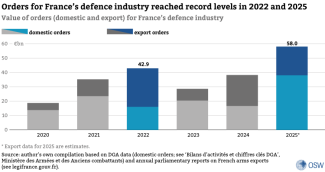
France’s defence industry received a major boost following the start of Russia’s full-scale invasion of Ukraine. In 2025, the French armed forces and foreign customers placed orders worth around €58 billion, almost three times the value of sales a decade earlier. In 2022, France overtook Russia to become the world’s second-largest exporter of weapons and military equipment. Military assistance to Ukraine has provided an opportunity to showcase French-made weapons systems, such as CAESAR self-propelled howitzers and SCALP-EG (Storm Shadow) missiles. However, French manufacturers have adapted at varying speeds to shifting conditions driven by rising orders and the need to accelerate production. The sector faces labour shortages and ongoing tensions between major defence companies and small and medium-sized enterprises (SMEs), and between industry and the state.
France’s defence industry: nine giants and 4,000 SMEs
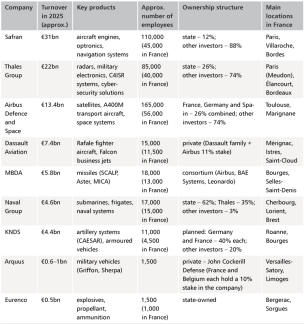
France’s defence industry ranks among the world’s leaders in terms of sales value, the number of major companies headquartered and operating in the country and the range of weapons systems it produces. Nine large companies with a global presence play the leading role, accounting for around 80% of the sector’s turnover, which reached €40.5 billion in 2021, equivalent to 4% of France’s total industrial output.[1] These companies are Airbus, KNDS, Arquus, Dassault, MBDA, Naval Group, Safran, Thales and Eurenco (see Table 1). Some of them, particularly Airbus, KNDS and MBDA, have multinational ownership structures, a common feature of the Western European defence industry. The production of these major companies relies on complex supply chains sustained by around 4,000 small and medium-sized enterprises, for which defence often represents just one part of a broader business portfolio.[2]
Table 1. Although France’s defence industry comprises more than 4,000 companies, nine large firms with different ownership structures play the dominant role
Source: author’s own compilation.
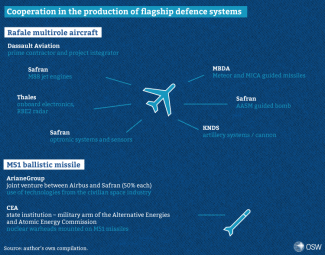
Designing and manufacturing complex weapons systems requires close cooperation and coordination among a range of defence companies. For example, Rafale multirole aircraft are assembled at Dassault facilities, with the company acting as both project integrator and prime contractor, while Safran supplies the engines and KNDS, Safran and most notably MBDA provide the weapons. Thales Group, in cooperation with Safran, is responsible for the aircraft’s onboard electronics. Similarly, M51 ballistic missiles – one of the two principal delivery systems for France’s nuclear deterrent alongside Rafale jets – are produced by ArianeGroup, a joint venture owned by Airbus and Safran that primarily manufactures launch vehicles for the space industry. The military arm of France’s state research body, the Alternative Energies and Atomic Energy Commission (CEA), produces the warheads for the M51.
The state retains minority or majority stakes in key defence companies, including Thales and Eurenco, respectively, and has both formal legal powers and informal means of influencing the sector. Moreover, the public shareholder often exercises greater voting power than its equity stake would suggest. In Safran, for example, the state owns around 12% of the shares but controls 18% of the voting rights. Nevertheless, a significant part of France’s defence industry remains privately owned. Major companies operate as quasi-monopolists in their dealings with the armed forces and the Directorate General of Armaments (Direction générale de l’armement, DGA),[3] the specialised agency responsible for defence procurement, as they are the only suppliers capable of meeting the customer’s highly specific requirements. The DGA’s role is to safeguard the interests of both the state and the armed forces in their relations with industry. This frequently gives rise to disputes over equipment pricing and production schedules.
The French government regards the domestic defence industry as an integral part of the country’s security system, serving as an instrument for maintaining the model of a ‘full-spectrum military’ that remains independent of external technology suppliers.[4] Consequently, French companies receive preferential treatment in weapons procurement, while the armed forces implement a multi-year procurement plan set out in the Military Programming Law (Loi de programmation militaire, LPM). Despite rising defence spending, domestic orders alone are insufficient to sustain the profitability of French defence companies, making exports crucial. The importance of exports increased after 1990, particularly in 2006–10, when France made substantial cuts to defence spending. Reduced orders from the French armed forces drove up the unit costs of flagship French weapons systems, including the Leclerc tank, whose unit cost increased sevenfold, as well as the Mirage and Rafale aircraft.[5] The shifting threat environment and the limited volume of orders prompted manufacturers to scale back production, reduce inventories and focus increasingly on a race for technological superiority, pushing up the unit costs of the weapons produced.
A wartime economy? Changes after 2022
Russia’s full-scale invasion of Ukraine forced the French defence industry to confront the challenge of rapidly scaling up production. As early as the spring of 2022, President Emmanuel Macron began stressing the need to introduce elements of a ‘wartime economy’.[6] The aim was to accelerate plans to modernise the armed forces, replenish stockpiles, especially ammunition, and speed up military assistance to Ukraine. In practice, this meant prioritising certain orders, pressing for shorter delivery times and threatening to place production under state control if companies failed to adapt to the new requirements. France also began rebuilding its stockpiles and storage facilities, as its armed forces had not maintained large ammunition reserves after the end of the Cold War. Following the outbreak of the full-scale Russia-Ukraine war, the value of orders placed with the sector began to rise, albeit unevenly. It reached €42.9 billion in 2022 and €48 billion in 2025, but stood at just €28.6 billion in 2023, compared with €18.7 billion in the pandemic year of 2020.
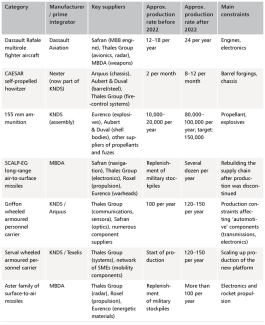
Progress towards a ‘wartime economy’ has varied considerably across equipment categories, with supply-chain bottlenecks acting as a key constraint (see Appendix). The Rafale fighter illustrates the problem. Although Dassault Aviation, the programme integrator, has increased output from around 12–18 to 23–26 aircraft a year, efforts to accelerate production further have been held back by capacity constraints among key component suppliers, such as Safran, which manufactures the M88 engines, and Thales Group, which supplies avionics and the radar system.[7] A similar issue affects missile systems. MBDA integrates the SCALP-EG cruise missile and the Aster family of surface-to-air missiles, but the actual pace of production depends on specialised components supplied by Roxel (propulsion), Eurenco (explosives) and Thales Group (guidance systems). Production capacity, which before 2022 was geared mainly towards replenishing military stockpiles, now has to be rebuilt almost from scratch. Consequently, MBDA has begun constructing a new €2 billion factory near Orléans with the aim of increasing missile production sixfold by 2030.[8]
Production of land systems has expanded more rapidly, as their supply chains are less complex. The CAESAR self-propelled howitzer is a case in point: Nexter, now part of KNDS, has managed to increase output from two to as many as 8–12 units a month.[9] However, bottlenecks have also emerged in this segment, including in the supply of barrel forgings from Aubert & Duval and chassis from Arquus. To ease production bottlenecks and make its export offer more attractive, KNDS France signed an agreement with Tatra Defence Vehicle in 2021. As a result, some CAESAR howitzers, including those supplied to the Czech and Ukrainian armed forces, are now fitted with Tatra T-815-7 truck chassis.[10]
One of the main challenges in the first months of the war was scaling up production of ammunition, particularly 155 mm artillery rounds. This case illustrates even more clearly the advantage of ‘simpler’ production, as annual output has risen from just over ten thousand rounds to as many as 100,000, with prospects for further expansion.[11] However, Eurenco’s capacity to produce explosives and propellant remains limited. To address this, the company restarted two production lines at its Bergerac plant in March 2025, almost 20 years after relocating propellant production to Sweden.[12] Eurenco also signed an agreement with MESKO, a subsidiary of the Polish Armaments Group (PGZ), under which MESKO began producing multi-base propellant and propelling charges using French technology.[13]
Main foreign partners and competitors
At the national level, France has managed to retain a broad range of capabilities comparable to those of the world’s largest arms producers, such as the United States and Russia. France’s main European competitors – the United Kingdom, Germany, Italy, Spain and Sweden – are also partners in specific programmes. Among the main challenges facing the French defence industry are the dominant position of the United States in global arms exports[14] and the growing presence of Asian producers, particularly those from Turkey, Israel and South Korea.[15]
Since the 1990s, France’s defence industry has helped shape European defence cooperation programmes. Positive outcomes of this collaboration include the development of the Airbus group since 2000 and the creation of MBDA in 2001, based on cooperation between Airbus’s French operations, BAE Systems in the United Kingdom and Leonardo in Italy. The establishment of the KNDS group in 2015, a holding company comprising France’s Nexter and Germany’s KMW, offers another example of a Franco-German compromise in industrial policy. This arrangement strengthened cooperation in the production of land systems, although the two companies retained separate production structures under KNDS France S.A. and KNDS Deutschland GmbH.[16] French companies also participate in numerous European projects funded by the European Defence Fund (EDF), covering areas such as unmanned systems, military electronics and emerging technologies.
At the same time, programmes such as FCAS (Future Combat Air System) and MGCS (Main Ground Combat System) illustrate the limits of cooperation on the most ambitious strategic projects. France and Germany launched FCAS in 2017, with Spain joining later. The programme was intended to replace the French-made Rafale and the Eurofighter Typhoon, and to develop not only a new fighter aircraft (the Next Generation Fighter, or NGF), but also a comprehensive system encompassing drones, sensors, weapons, data-sharing capabilities and a battle-management network known as the combat cloud. France’s Dassault would develop the airframe, while Airbus Defence and Space would be responsible for selected avionics and electronic systems as part of the German and Spanish contribution. From the outset, the project ran into difficulties over the division of responsibilities, control of technology and intellectual property rights. The French government was unable to exert sufficient political pressure on the privately owned Dassault to persuade it to accept the terms of cooperation with Airbus. The French manufacturer argued that the European group could dominate it under the agreed framework.[17] Ultimately, in 2026, France and Germany ended their cooperation on the joint fighter jet under FCAS in its existing form. Work on some components, such as network-centric combat systems, may continue separately.[18]
Meanwhile, MGCS has been under development since 2017 as a Franco-German programme to replace the Leclerc and Leopard 2 tanks. The aim is to develop not just a new tank but a comprehensive land combat system comprising crewed and uncrewed vehicles, sensors and an integrated command-and-control architecture. KNDS France and KNDS Deutschland are the main companies involved in the project. MGCS has also encountered difficulties related to the division of work and strategic differences between the partners. In July 2026, Germany and France therefore decided that, rather than develop a single common tracked platform, they would work jointly on technologies across eight areas – including ballistic protection, sensors and the gun system – enabling both countries to integrate them into their own vehicles in the future.[19]
Beyond cooperation, whether successful or unsuccessful, France’s defence industry faces competition from other European and non-European manufacturers in many areas. In the combat-aircraft segment, the main rival to Dassault’s Rafale is the Eurofighter Typhoon, produced by a consortium involving Germany, the United Kingdom, Italy and Spain. Within Europe, Dassault has so far sold Rafale aircraft to Greece, Croatia and Serbia. The jets also compete with US-made platforms for customers outside Europe: India plans to acquire 176 Rafale fighters, the United Arab Emirates – 80, Egypt – 54 and Qatar – 36.
Competition in long-range strike systems could evolve into limited cooperation based on the parallel development of different systems using shared technological solutions. A particularly significant example is the European Long-Range Strike Approach (ELSA), launched in 2024 by France, Germany, Italy, Poland and the United Kingdom with the aim of developing European deep-strike capabilities. France intends to draw on MBDA’s experience in implementing the programme. One particularly promising design is the Land Cruise Missile (LCM) with a range of more than 1,000 km. At present, however, ELSA remains a political and industrial initiative designed to coordinate various projects.[20] The conclusions of the Franco-German Defence and Security Council meeting on 17 July 2026 called for the United Kingdom, France and Germany to cooperate through the ArianeGroup consortium on the design and development of a long-range ballistic missile with a range of 2,500 km.[21]
In the short- and medium-range air defence segment, the Franco-Italian SAMP/T system, based on Aster 15 and Aster 30 missiles, competes primarily with the US Patriot system, which has been purchased by many European countries. SAMP/T is particularly important for France, which is developing a new generation of the system, as it provides a European alternative to Patriot and helps preserve independence from the United States in missile defence.[22] In the short-range missile category, France’s Mistral competes with systems such as Sweden’s RBS-15 and the Piorun man-portable air-defence system. Although France, like many other European countries, supports closer cooperation on air defence, tensions have emerged over the issue in recent years. Germany has opted for layered air defence through the European Sky Shield Initiative, which relies primarily on German, US and Israeli systems, notably Patriot and Arrow. France has criticised this approach, arguing that it could increase Europe’s dependence on non-European technologies and weaken the effectiveness of nuclear deterrence. In a speech outlining changes to France’s nuclear deterrence doctrine, President Macron suggested a possible compromise in this area: European countries could jointly develop new extended air defence systems.[23] Germany is currently considering the involvement of its companies in the SAMP/T NG programme.
French SCALP-EG cruise and precision-strike missiles, known in the UK as Storm Shadow, compete with systems such as the US-made AGM-158 JASSM and Germany’s Taurus. France is also developing a successor in this category under the FCASW programme, which aims to enhance European long-range strike capabilities. Lessons from the Russia-Ukraine war have spurred France’s defence industry to close the gap in the field of unmanned systems. Small and medium-sized enterprises play a major role in their production. In June 2025, the DGA ordered 1,000 micro-drones for the land forces from the start-up Harmattan, which delivered them in early 2026. Major defence groups are working on longer-term projects, such as the Dassault nEUROn, a European stealth unmanned combat aerial vehicle, and a loyal wingman drone intended to accompany a future version of the Rafale, a project launched in response to the crisis surrounding FCAS.[24] French politicians and manufacturers also place strong emphasis on cooperation with Ukraine on drone technology, but information on the results remains limited.[25] French industry is keen to test its technologies under combat conditions, and Ukrainian technical and military personnel could also offer valuable expertise.
In naval systems, France’s Naval Group competes with Germany’s ThyssenKrupp Marine Systems, Spain’s Navantia and the UK’s Babcock. Italy’s Fincantieri is both a competitor and a partner of Naval Group; a planned merger between the two companies was blocked by the Italian authorities. The Franco-Italian FREMM frigates have become one of Europe’s leading defence export products, competing with Spain’s Álvaro de Bazán-class ships, Germany’s F125 Baden-Württemberg-class frigates and the UK’s AH140 design. With its Scorpène family of submarines, Naval Group competes primarily with Germany’s Type 212 and Type 214 submarines, as well as with Swedish, Italian and Spanish designs. France is one of the few countries with the capability to build nuclear-powered submarines, although it does not export them. Under the Barracuda programme, Naval Group has been developing a new class of nuclear-powered attack submarines, the SNA Suffren, designed mainly to destroy hostile surface ships and submarines. Construction of a third-generation ballistic-missile submarine (SNLE) has also been under way at the Cherbourg shipyard since 2024.
France and EU defence cooperation
A key element of France’s policy to support its domestic defence industry is its drive to secure preferential treatment for European producers in the procurement policies of EU member states. France was the initiator and has since been the driving force behind the ‘Buy European’ principle,[26] which seeks to restrict EU funding for the development and procurement of weapons and military equipment that do not contain a sufficient proportion of components manufactured in EU member states or in other countries covered by close partnership arrangements, such as Norway and, more recently, Ukraine. France has been reluctant to broaden this group, as illustrated by the failure of negotiations over the United Kingdom’s participation in the SAFE mechanism after the sides failed to reach a compromise on the size of the UK’s financial contribution in exchange for allowing British defence products to be purchased with loans provided under the instrument. French companies are also among the main beneficiaries of funding from the European Defence Fund (EDF), the EU’s largest mechanism to support the defence industry to date, which finances projects at the research and development stage.[27]
During negotiations on the EU’s 2028–2034 Multiannual Financial Framework (MFF), France is likely to support the European Commission’s proposal to allocate €150 billion to security and defence, most of it for programmes supporting the defence industry.[28] However, securing this amount may require cuts to agricultural funding, as advocated by countries such as Germany. With the French presidential election scheduled for April 2027, the opposition is likely to seize on this issue. A victory for the National Rally (RN) candidate could lead to changes in France’s approach to EU support for the defence industry. The RN is sceptical of EU security policy and programmes to support the defence industry, citing concerns about sharing technology with other countries, even friendly ones, and about a possible increase in France’s contribution to the EU budget. The RN also opposes joint defence programmes in key areas, arguing that they could erode national sovereignty in favour of European partners.[29] This criticism is shared by some of France’s largest defence companies, particularly Dassault, which wields considerable influence among figures on the French right.
Outlook
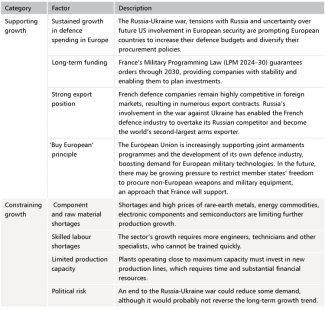
Demand prospects for France’s defence industry are currently very favourable, although significant constraints continue to limit production growth. Industry representatives assess market conditions as markedly stronger than the long-term average; according to data from mid-2024, they were also around 10% more favourable than in other sectors.[30] All indications are that demand for weapons and military equipment will remain high for many years to come. This stems from the Russia-Ukraine war, persistent tensions in international affairs and efforts by European countries to strengthen their own defence capabilities. Uncertainty over the future role of the United States in ensuring Europe’s security serves as an additional catalyst, encouraging EU countries to invest more heavily in their own defence industries and diversify their procurement policies.
Table 2. Even a swift end to the current phase of the Russia-Ukraine war would not reverse the growth trend in France’s defence industry
Source: author’s own compilation.
Although rising domestic defence spending is also driving the sector’s growth, even the increased level of funding available to the French armed forces will not be sufficient to pursue the most ambitious arms programmes independently, particularly in combat aviation and next-generation systems. The rapid rise in orders has pushed manufacturing capacity close to its limits. Supply difficulties are also becoming increasingly widespread among French defence companies, currently affecting around 30% of them – twice the proportion recorded in other industrial sectors.[31] Access to rare metals and electronic components, both essential for further production growth, is particularly problematic. A shortage of skilled workers also remains a major constraint. To sustain the current pace of expansion, companies will need to invest in new production lines, expand existing facilities, train personnel and deepen politically contentious international cooperation, which continues to generate disputes over cost-sharing, technology ownership and participation in production.[32] The future of key defence projects will depend on the policies pursued by the country’s next president, to be elected in the spring of 2027.
APPENDIX
Table 3. Technological and raw-material constraints are limiting production growth for key types of French weapons and military equipment
Source: author’s own compilation based on data from various media sources.
[1] ‘L’industrie de défense française : un appareil de production sous tensions’, Le Blog de l’Insée, 27 November 2025, blog.insee.fr.
[2] M. Desjeux, ‘L’industrie de défense au service des ambitions françaises. De la maîtrise à la supériorité’, Les Notes de la Fabrique de l’Industrie, no. 58, 13 October 2025, p. 19, la-fabrique.fr.
[3] P. Crauchet, ‘À quoi sert vraiment la Direction générale de l’armement (DGA) ?’, L’Essentiel de l’Éco, 3 March 2026, lessentieldeleco.fr.
[4] Ł. Maślanka, J. Tarociński, On a war footing. Changes in French security strategy after Russia’s invasion of Ukraine, OSW, Warsaw 2026, osw.waw.pl.
[5] M. Desjeux, op. cit., pp. 40–41.
[6] ‘« Economie de guerre » : Emmanuel Macron demande une réévaluation de la loi de programmation militaire’, Le Monde, 13 June 2022, lemonde.fr.
[7] Rapport annuel 2025, Dassault Aviation, 2026, dassault-aviation.com.
[8] A. Lacroix, ‘MBDA sort le chèque pour augmenter la production de missiles’, Enderi, 12 June 2026, enderi.fr.
[9] H. Chachaty, ‘De 2 à 12 canons Caesar par mois: comment l'industrie de l'armement française s'est mise en ordre de marche (mais doit encore faire mieux)’, BFM Business, 5 May 2025, bfmtv.com.
[10] A. Świerkowski, ‘Francuska artyleria będzie produkowana w Czechach’, Defence 24, 22 June 2025, defence24.pl.
[11] O. Sapwood, ‘France Increases Artillery Gunpowder Production’, Militarnyi, 30 April 2024, militarnyi.com.
[12] A.-F. Bost, ‘Bergerac rêve d’un nouvel âge d’or industriel avec le retour de la poudre à canon’, Le Monde, 25 April 2025, lemonde.fr.
[13] A. Kiński, ‘MESKO uruchomi produkcję modułowych ładunków miotających we współpracy z EURENCO’, Zespół Badań i Analiz Militarnych, 23 October 2025, zbiam.pl.
[14] H. Masson, ‘L’industrie américaine de défense en Europe, à l’heure de la stratégie "America First", Fondation pour la Recherche stratégique’, Fondation pour la recherche stratégique, 19 February 2026, frstrategie.fr.
[15] J.-M. Bezat, ‘L’industrie de défense française menacée par de nouveaux concurrents’, Le Temps, 9 January 2024, letemps.ch.
[16] Z. Lentowicz, G. Psujek, ‘Czy KNDS opancerzy Zachodnią Europę’, Rzeczpospolita, 31 December 2023, radar.rp.pl.
[17] J.-P. Maulny, ‘SCAF : un échec dommageable pour la coopération industrielle de défense et pour l’Europe’, IRIS, 9 June 2026, iris-france.org.
[18] A. Rinke, T. Hepher, ‘Germany and France drop joint fighter jet project’, Reuters, 8 June 2026, reuters.com.
[19] Ł. Maślanka, J. Tarociński, ‘Franco-German deterrence exercises and defence cooperation planning’, OSW, 22 July 2026, osw.waw.pl.
[20] R. Mielcarek, ‘ELSA, un mode de coopération inédit, fertile en projets de frappes dans la profondeur’, B2 Bruxelles, 24 June 2026, bruxelles2.eu.
[21] ‘Conclusions du Conseil franco-allemand de défense et de sécurité du 17 juillet 2026’, Élysée, 17 July 2026, elysee.fr.
[22] ‘Comment le missile Aster 30 B1NT repoussera les limites de la défense aérienne européenne ?’, Ministère des Armées et des Anciens combattants, 10 October 2024, defense.gouv.fr.
[23] Ł. Maślanka, ‘Sovereign, yet forward-oriented towards Europe: the evolution of France’s nuclear deterrence doctrine’, OSW, 3 March 2026, osw.waw.pl.
[24] R. Ruitenberg, ‘France kicks off development of wingman drone for Rafale fighter jet’, Defense News, 9 October 2024, defensenews.com.
[25] The French company EOS Technologie has supplied Ukraine with a small number of Rodeur 330 long-range drones, primarily for testing purposes. The Brave France cooperation programme is supported by a $20 million fund for the joint development of defence technologies, including drones. See: ‘BRAVE FRANCE : la France et l'Ukraine accélèrent leur coopération en matière d’innovation de défense’, Ministère des Armées et des Anciens combattants, 25 February 2026, defense.gouv.fr.
[26] A. Parmentier, ‘Préférence européenne : cette idée défendue par Emmanuel Macron qui gagne du terrain’, L’Express, 10 February 2026, lexpress.fr.
[27] H. Masson, ‘European Defence Fund – Assessment after three calls for proposals’, Fondation pour la recherche stratégique, 12 September 2024, pp. 38–40, frstrategie.org.
[28] Ł. Maślanka, ‘Wartime economies of scale: €150 billion for defence in the EU’s 2028–2034 budget’, OSW, 7 September 2026, osw.waw.pl.
[29] ‘Budget militaire français : 436 milliards d’euros pour quelle souveraineté ?’, Enderi, 24 June 2026, enderi.fr.
[30] B. Bjai, N. Bignon, C. Zimmer, ‘Depuis l’invasion de l’Ukraine, l’industrie de défense française bénéficie d’une hausse des commandes et a augmenté sa production, mais bute sur des contraintes d’offre’, Insee, Conjoncture française, 9 July 2024, insee.fr.
[31] Q. Regnaud, ‘L’industrie de défense française en pleine crise de croissance’, Les Echos, 10 July 2024, lesechos.fr.