Testing the limits: Russia’s regional budgets in wartime

In 2025, Russia’s regional budgets recorded their highest-ever deficits and levels of debt. This reflected the financial burdens imposed by the Kremlin on the regions to support Russia’s invasion of Ukraine, the broader economic consequences of the war and the underlying structure of fiscal relations between the federal centre and the regions. The regions cannot expect significant support from the central authorities, which are grappling with fiscal pressures of their own. At the same time, the Kremlin is shifting an increasing share of the wartime burden onto the regions. This is putting their finances under further strain. There is little reason to expect the situation to improve in the short term.
The underlying systemic cause of regional budget problems
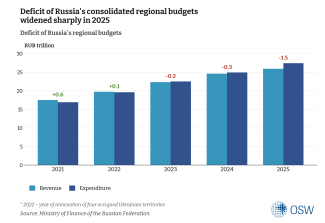
The first three years of Russia’s full-scale invasion of Ukraine did not significantly affect the overall health of the country’s regional public finances. In fact, Russia’s consolidated regional budgets ended 2022 with a surplus,[1] although this was significantly smaller than in the previous year. In 2023 and 2024, the regions recorded relatively modest deficits.
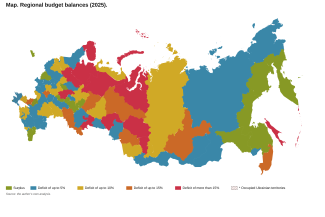
The situation deteriorated sharply in 2025. The combined regional budget deficit reached a record RUB 1.5 trillion (approximately 5.5% of total expenditure, or US$20 billion),[2] far exceeding the federal government’s previous forecast of around RUB 300 billion. In 74 of Russia’s 89 regions (including six federal subjects established in occupied Ukrainian territories), expenditure outpaced revenue. At the same time, debt levels among Russia’s federal subjects rose markedly.
The problems currently facing Russia’s regions stem partly from the structure of fiscal relations between the regions and the Kremlin. This model reflects the policy of centralisation pursued by Vladimir Putin’s regime over the past quarter of a century.[3]
Regional budgets rely on three main sources of revenue: personal income tax (PIT), corporate income tax (CIT) and interbudgetary transfers. These transfers are provided by the federal centre and take the form of subsidii (subsidies) and subvnetsi (subventions), which finance or co-finance specific expenditure obligations, as well as dotatsii (grants), which are not earmarked for any particular purpose. Other sources of regional revenue include excise duties, property taxes, transport taxes and other levies.
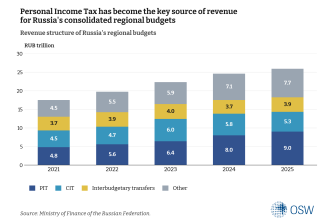
In the years immediately preceding the invasion of Ukraine, interbudgetary fiscal transfers accounted for an average of around 20% of the revenue of Russia’s consolidated regional budgets. This underscores the important role of the federal centre in regional finances, although the share of funding received from Moscow varied considerably between regions. In 2025, only 26 regions, the so-called ‘donor regions’, contributed more to the federal budget than they received in return.
As part of the Kremlin’s policy of centralisation, the federal authorities also increased their share of regional tax revenues through redistribution. Over the past decade, more than half of these revenues, on average, was channelled to the federal budget. The share reached 57% in 2025, the highest level on record.
Since the early 2010s, Russia’s Ministry of Finance has also gradually replaced regional debt owed to commercial banks with lower-cost loans from the federal budget.[4] Although this reduced regional debt-servicing costs, it also strengthened the federal centre’s political control over the regions.
The fiscal model outlined above provided the Kremlin with additional means of exerting political influence over the regions. At the same time, however, the federal centre assumed an increasingly important role in stabilising regional budgets. As the full-scale war continued beyond 2022, this task became increasingly difficult.
The situation became particularly acute in 2025, when the Russian economy entered a period of stagnation. Official GDP growth slowed to just 1%, while the federal budget deficit reached RUB 5.65 trillion (approximately US$70 billion, or 2.6% of GDP). Under these conditions, the Kremlin’s capacity to support the regions proved highly limited.
The sharp increase in the combined deficit of Russia’s consolidated regional budgets in 2025 was primarily driven by a widening disparity between expenditure and revenue growth. Expenditure increased by 8.9% in 79 regions, while own-source revenue rose by just 4.1% in 71 regions. After adjusting for inflation (5.6%), own-source revenue declined in real terms.
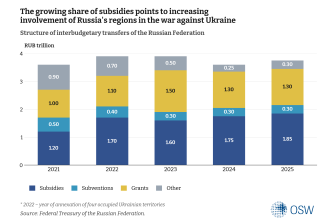
The regions collected significantly more revenue from personal income tax (PIT), with receipts rising in 88 regions, driven in part by the increase in the minimum wage and the indexation of public sector wages. At the same time, corporate income tax (CIT) revenue declined in 55 regions, reflecting not only the deteriorating macroeconomic environment but also the increase in the corporate income tax rate from 20% to 25%, which encouraged companies to engage in tax optimisation. By contrast, the federal budget benefited from the tax increase, with its share of CIT revenue rising from 3% to 8%.[5] Meanwhile, interbudgetary transfers remained unchanged at 15% of regional revenue, amounting to RUB 3.95 trillion, compared with RUB 3.75 trillion a year earlier. In real terms, this represented a decline compared with the pre-war period.
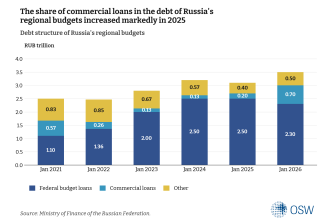
Russia’s consolidated regional budget debt rose to a record RUB 3.5 trillion, with increases recorded in 38 regions.[6] This was largely driven by an almost threefold increase in the share of commercial loans between January 2025 and January 2026. Over the same period, the share of budget loans declined.[7] Most regions had only limited financial reserves, with their combined reserves falling from RUB 2.9 trillion to RUB 1.9 trillion in 2025. Faced with a sharp increase in budget deficits, the regions were forced to borrow from private lenders at interest rates ranging from 17% to almost 30% to finance current expenditure. As a result, regional debt servicing costs rose by 39% over the course of the year.[8]
The financial and economic consequences of the invasion of Ukraine
The rapid growth in regional expenditure is at least partly linked to the invasion of Ukraine. The associated costs extend beyond official regional spending on defence and security. Although expenditure in these areas has increased significantly since 2022, it still accounts for only a small share of total regional spending.[9]
The available data are incomplete, while much of the war-related spending remains classified, making it impossible to determine the full costs of the invasion borne by Russia’s regions. A substantial share of these costs is deliberately concealed under budget headings such as social policy, healthcare and municipal services. Expenditure on social policy by Russia’s consolidated regional budgets increased by 18% in 2025.[10]
Changes in the structure of interbudgetary transfers since 2022 also provide some indication of the regions’ financial contribution to the war effort. In particular, the share of subsidies, which are allocated for specific purposes, although not necessarily for those officially declared, has increased markedly within transfers from the federal centre. This suggests that the Kremlin is shifting a growing share of the financial burden associated with the invasion on to the regions.
The largest war-related expense straining regional budgets is likely to be the co-financing of one-off enlistment payments to volunteers who sign contracts with the Ministry of Defence. The value of these regional bonuses varies considerably, ranging from RUB 300,000 (approximately US$3,600) in the Komi Republic to RUB 4.1 million (approximately US$50,000) in St Petersburg.
According to independent estimates, around 345,000 Russians enlisted in the military in 2023, followed by 407,000 in 2024 and 364,000 in 2025. Recruitment began to slow in the final quarter of 2025, falling by half compared with the same period of the previous year.[11] The downward trend continued in the first quarter of 2026, when recruitment declined by a further 20%.[12] In response, the federal authorities have increased pressure on the regions to boost enlistment. This has led to a rise in the average value of signing bonuses offered to volunteers.[13]
According to independent estimates, the regions may have allocated an average of 13% of their social policy expenditure to one-off enlistment payments in 2024. Spending on all transfers to servicemen, veterans and their families may have accounted for nearly a quarter of social policy expenditure.[14] This suggests that regional budgets spent at least RUB 840 billion (approximately US$10 billion) a year in both 2024 and 2025 on recruitment and war-related social benefits alone, such as compensation payments. Other estimates put regional spending on these purposes at no less than RUB 1 trillion.[15]
In addition, half of Russia’s regions introduced one-off payments for individuals who recruited volunteers to join the military, including private citizens, military recruiters and local government officials. In 2024 and 2025, these ‘intermediaries’ received at least RUB 7.7 billion, although the actual figure was likely considerably higher. In the first four months of 2026 alone, they received at least a further RUB 3.2 billion.[16]
The regions are also effectively required to contribute to the reconstruction of the Ukrainian territories annexed in 2022. Even approximate estimates of the cost of this involvement are unavailable. By 2025, regional budgets had financed the reconstruction of 10,000 public infrastructure facilities in the so-called Donetsk and Luhansk People’s Republics, as well as in Kherson and Zaporizhzhia oblasts. The four occupied regions also account for a substantial share of interbudgetary transfers. In 2026, they are expected to receive around RUB 340 billion (approximately US$4 billion), equivalent to 10% of the total allocated by the federal centre.
The war has also spilled into Russian territory, with regional authorities bearing part of the cost of repairing the resulting damage. The border oblasts of Kursk, where losses were estimated at RUB 700 billion by mid-2025, Belgorod (RUB 160 billion) and Bryansk (RUB 40 billion) have been the hardest hit. Regions far from the front line have also suffered losses. In early May 2026 alone, Ukrainian drone strikes affected nearly a third of Russia’s regions, in some cases causing serious environmental damage.[17] Attacks on fuel and energy infrastructure triggered a fuel crisis that, by early July 2026, had spread to nearly all Russian regions. Regional economies have also been affected by periodic shutdowns of mobile internet services, which the authorities have justified on security grounds.
Labour shortages are another major challenge. In addition to the demographic crisis,[18] these shortages stem from wartime losses, with the death toll reaching at least 230,000 by July 2026, the mobilisation ordered in 2022, the movement of workers to the front and the defence industry in search of higher wages and the emigration of skilled professionals following the start of the invasion of Ukraine. These issues may intensify as the Kremlin increases pressure to boost military recruitment. In March 2026, the governor of Ryazan oblast took the unprecedented step of requiring larger local companies to recruit employees for military service. Each company was instructed to supply between two and five recruits.
The financial burden imposed by the war, together with the damage caused by military operations, has been compounded by Russia’s deteriorating macroeconomic environment. The indirect consequences of the invasion, including economic sanctions, the withdrawal of Western companies, disruptions to supply chains, the reorientation of export markets, fluctuations in the rouble’s exchange rate against the US dollar, declining investment and technological regression, have all weighed on the economies of individual regions.
The regions facing the greatest difficulties are those whose economies depend on sectors affected by sanctions, including metallurgy, which employs around 700,000 people across Russia, the automotive industry, which employs several hundred thousand, and coal mining, which employs around 150,000. The downturn in these sectors, reflected in lower corporate income tax (CIT) receipts, became fully apparent in regional budgets in 2025. Regions specialising in oil and natural gas production, forestry and related industries, as well as exports to Western markets, have also been adversely affected.
As a result, the largest budget deficits in 2025 were recorded in Vologda oblast (23%), whose economy is centred on metallurgy, Kemerovo oblast (22%),[19] which accounts for around half of Russia’s coal production, as well as Tyumen oblast (22%), Sakhalin oblast (20%) and Yamalo-Nenets Autonomous Okrug (20%) – all of which are major hydrocarbon-producing regions. At the same time, around 70%, on average, of the tax revenue generated by regions with large oil and gas industries is transferred to the federal budget.
Financial difficulties have also affected some regions with well-developed defence industries, including Chelyabinsk oblast (20%), Nizhny Novgorod oblast (16.5%) and Samara oblast (14%).
Nevertheless, the budgets of most regions specialising in defence production, where personal income tax (PIT) receipts have grown significantly faster than the national median since 2022,[20] have remained broadly balanced or recorded surpluses. Meanwhile, the regions of Russia’s Far East have benefited from the reorientation of the country’s exports towards Asia and the Pacific, which has been accompanied by increased investment and infrastructure development. High corporate income tax (CIT) receipts have also supported the budgets of regions with significant gold-mining operations, such as Amur oblast.
Moscow, together with the surrounding Moscow oblast, and St Petersburg remain in a relatively strong fiscal position, benefiting from a high concentration of corporate income taxpayers. Paradoxically, the least developed regions, such as Chechnya, are also in a comparatively secure fiscal position because they rely heavily on intergovernmental transfers, which provide a stable source of budget revenue.
Despite mounting fiscal pressures on the regions, the Kremlin is increasingly drawing them into the war effort by shifting a growing share of its costs onto regional budgets through both formal and informal mechanisms. Some regions have responded by reducing one-off enlistment payments for volunteers and, in some cases, benefits for the families of military personnel killed in the war. However, pressure from the federal centre continues to compel the regions to co-finance war-related obligations.
As a result, cuts in other areas of regional spending have become unavoidable. Between 2021 and 2025, 85 regions reduced healthcare expenditure. Over the same period, nominal spending increased by just 12%, while cumulative inflation approached 50%. In 2026, 19 regions were planning further cuts of at least 10%. Since 2022, 66 regions have reduced spending on municipal services at least once, and 15 plan further cuts in 2026. In the final quarter of 2025, the number of redundancies rose by almost 60% compared with the same period of the previous year, with public sector employees accounting for 40% of those laid off. Fiscal restraint has also extended to wealthier regions. For example, Moscow announced plans to cut the size of its city administration by 15%.
A fiscal vicious circle
The prolonged invasion of Ukraine, Russia’s economic stagnation and the growing difficulty of balancing the federal budget suggest that the fiscal position of the regions is unlikely to improve in the near future. The federal budget recorded a deficit of RUB 5.7 trillion, equivalent to 2.5% of GDP, in the first half of 2026. Against this backdrop, the regions’ budgetary problems are likely to become more severe.
Data from the first quarter of 2026 appear to confirm this trend. The number of regions recording budget deficits increased to 56, up from 46 a year earlier, while the combined budget surplus fell to just RUB 140 billion, compared with RUB 335 billion in the same period of 2025. Expenditure increased by 4.3%, far outpacing the 0.5% growth in revenue. It should also be borne in mind that expenditure is typically lower in the first half of the year.
The decline in corporate income tax receipts, which fell by 11.7% in the first quarter of 2026, will have to be offset by higher personal income tax receipts, which rose by 14.6% over the same period.[21] Regional authorities have little scope to support sectors whose performance depends on Russia’s macroeconomic conditions and developments in global markets. Proposed increases in regional and local taxes are also likely to provide only limited fiscal relief, while potentially contributing to a further decline in CIT receipts as companies pursue further tax optimisation measures.
According to the regions’ approved budgets for 2026, only four, Karelia, Kalmykia, Kostroma oblast and Mordovia, expect to record a surplus. A further 25 regions may be able to balance their budgets by drawing on financial reserves and federal budget loans.[22] The combined deficit of Russia’s consolidated regional budgets is projected to reach RUB 1.7 trillion, equivalent to 8.9% of total revenue. However, some regions have already revised their original budget projections. It should also be noted that the 2025 forecasts proved overly optimistic. In April 2026, Russia’s Ministry of Finance raised its forecast for the combined regional budget deficit to RUB 1.9 trillion.
The central authorities also have limited capacity to support the regions. Under the current budget plans, which are due to be revised in the autumn, interbudgetary transfers are expected to remain broadly stable over the coming years, at RUB 3.5 trillion in 2026, RUB 3.7 trillion in 2027 and RUB 4 trillion in 2028. The volume of new federal budget loans is also unlikely to increase significantly, having amounted to RUB 370 billion in 2024 and RUB 530 billion in 2025.
Instead, the federal authorities intend to reduce regional debt. By July 2026, more than RUB 277 billion had been written off for 68 regions, compared with RUB 160 billion in 2024 and RUB 227 billion in 2025.[23] To qualify, the regions must allocate the freed-up funds to infrastructure projects and investment. In practice, however, these resources are used to finance obligations related to the invasion of Ukraine. In addition, Putin has approved the deferral of repayments on RUB 100 billion in regional budget loans until 2030.
At the same time, the Kremlin is unlikely to abandon its policy of prioritising wartime spending or shifting part of its costs onto the regions. As a result, regional authorities will be compelled to make further cuts in other areas of expenditure. However, with the State Duma elections scheduled for September 2026, they are unlikely to implement substantial budget cuts given the potential social and political repercussions.
Moreover, although cuts to public services may provide temporary fiscal relief, they are likely to exacerbate the already widespread problems affecting healthcare and education,[24] as well as municipal services, housing and waste management, over the medium to long term.[25] In recent years, Russia has also seen a rise in protests driven by socioeconomic grievances.[26]
Focused on sustaining the war effort, the Kremlin has limited capacity to provide meaningful support to regions facing mounting budgetary pressures. At the same time, against a backdrop of broader economic stagnation, it continues to draw on regional resources to finance the invasion of Ukraine while shifting the political responsibility for the socially unpopular consequences of its policies onto regional authorities. A fundamental revision of the existing system of fiscal relations between the federal centre and the regions appears highly unlikely, given both the ongoing war and the logic underpinning Putin’s highly centralised model of governance. These two factors are mutually reinforcing.
[1] Russia’s consolidated budget consists of the federal budget and the consolidated budgets of the country’s regions. It excludes interbudgetary transfers and state extra-budgetary funds.
[2] This was more than twice the level recorded in 2020 (RUB 677 billion), previously the worst year on record, when regional budgets were grappling with the economic impact of the COVID-19 pandemic.
[3] M. Bartosiewicz, ‘A tactical pause. The Kremlin’s regional policy in the shadow of the war’, OSW Commentary, no. 543, 6 October 2023, osw.waw.pl.
[4] The remaining regional debt consists primarily of debt securities and state guarantees.
[5] The federal budget also benefited from the introduction of a progressive personal income tax (PIT) scale in 2025, as it received all revenue generated by the higher tax rates of 15%, 18%, 20% and 22%.
[6] Excluding municipal debt (i.e. the debt of local government authorities), which stood at approximately RUB 400 billion in January 2026.
[7] As of January 2026, the debt of 36 regions consisted entirely of federal budget loans. A further 37 regions also had outstanding debt to commercial lenders.
[8] Т. Тирских, ‘Рост регионального долга и дефицита бюджетов: итоги 2025 года’, Эксперт РА, 27 February 2026, raexpert.ru.
[9] According to the Federal Treasury, official expenditure by Russia’s consolidated regional budgets on defence and security amounted to RUB 4.6 billion and RUB 32.9 billion respectively in 2021. By 2025, these figures had risen to RUB 48.5 billion and RUB 139.4 billion respectively.
[10] Spending on social policy increased in 83 regions in 2025. In 36 of them, it rose by 20% or more.
[11] К. Бонч-Осмоловская, ‘К концу 2025 года темп набора на контракт с Минобороны упал в полтора раза’, Важные истории, 1 June 2026, istories.media.
[12] К. Бонч-Осмоловская, ‘В первом квартале 2026 года контракт с Минобороны подписали 71,2 тыс. человек’, Важные истории, 9 June 2026, istories.media.
[13] J. Kluge, ‘Federal budget data shows 71,216 new contract soldiers in Q1 2026, lowest in 3 years’, Russianomics, 9 June 2026, janiskluge.substack.com.
[14] С. Савина, ‘Соцзащита военного времени’, Важные истории, 11 November 2024, istories.media.
[15] J. Kluge, ‘Russia’s consolidated budget deficit reached almost 4% of GDP in 2025’, Russianomics, 7 February 2026, janiskluge.substack.com.
[16] К. Бонч-Осмоловская, ‘В 2026 году среднемесячные расходы на выплаты вербовщикам выросли более чем вдвое’, Важные истории, 15 May 2026, istories.media.
[17] F. Rudnik, M. Bartosiewicz, ‘Ukrainian attacks on Tuapse: a threat to Russia’s fuel sector and the environment’, OSW, 8 May 2026, osw.waw.pl.
[18] K. Chawryło, ‘Short-term stability and long-term problems. The demographic situation in Russia’, OSW Commentary, no. 610, 3 July 2024, osw.waw.pl.
[19] Kemerovo oblast’s budget problems began earlier. Its budget deficit reached 24.5% in 2023 and stood at 24% in 2024. In contrast, the region recorded a budget surplus of 14% in 2022.
[20] S. Parviainen, Russia’s regional economies in wartime: Fiscal divergence, defence windfalls and transfer pressures, BOFIT, 27 May 2026, bof.fi.
[21] Оперативный доклад о ходе исполнения консолидированных бюджетов субъектов Российской Федерации январь – март 2026 года, Федеральное казначейство, March 2026, gov.ru.
[22] Д. Исхакова, ‘Прогнозируемое исполнение региональных бюджетов в 2026 году’, Бюджет.ru, February 2026, bujet.ru.
[23] A total of approximately RUB 1.1 trillion in regional debt is planned to be written off by 2030.
[24] M. Bartosiewicz, ‘The crisis affecting Russia's public services: healthcare, education, and the postal service’, OSW Commentary, no. 608, 27 June 2024, osw.waw.pl.
[25] Idem, ‘The Russian public services crisis: the municipal infrastructure is in a critical condition’, OSW Commentary, no. 641, 27 January 2025, osw.waw.pl.
[26] Д. Таланова, ЖКХ вместо ФБК, Новая газета Европа, 16 June 2025, novayagazeta.eu.