Between the hammer and the anvil: the challenges facing Ukraine’s local government in wartime

Ukraine began efforts to establish a modern system of local government before Russia’s full-scale invasion. Although the reform remained incomplete, it is widely regarded as a success, even in its unfinished form, and as one of the factors that enabled the country to mount an effective defence in 2022. The war has, however, created new challenges for local authorities, including Russian attacks on critical infrastructure, the need to support internally displaced persons, and declining budget revenues caused by the evacuation of local residents and economic emigration. The division of responsibilities between the central government and local authorities also remains unclear. Despite these challenging circumstances, some local government leaders have gained considerable public support. This has raised concerns within the central government, which has increasingly relied on wartime legal provisions and the security services under its control to target political opponents.
Unfinished centralisation
Ukraine launched its decentralisation reform in 2015. The first stage reduced the number of hromadas (municipalities) from more than 10,000 to 1,469, while the number of raions (districts) fell from 490 to 136. The aim was to increase the autonomy of these larger administrative units. The government also introduced an initial reform of local government finance, granting hromadas their own sources of revenue, including selected taxes and fees, thereby increasing their financial independence from the central government. The strengthening of hromadas is widely regarded as a success and as one of the factors that helped Ukraine withstand the initial months of the war.[1]
The reform, however, remained unfinished and Russia’s full-scale invasion pushed it down the political agenda. In financial terms, the reform still requires amendments to existing legislation or the adoption of new regulations. Some hromadas remain too small to be financially self-sufficient, particularly following the departure of large numbers of Ukrainians from the country. At the same time, raions and the country’s 24 oblasts (regions) continue to depend on transfers from the central budget. The main challenge, however, is the lack of a clear division of responsibilities between the different tiers of local government and between local self-government and the state administration. This has resulted in jurisdictional disputes, decision-making paralysis, and political conflict.
The anvil of war
The war has exacerbated Ukraine’s institutional disorder. Under the Law on the Legal Regime of Martial Law, the president may establish military administrations at the oblast and raion levels by converting existing civilian administrations into military ones. In addition, at the president’s request, the Verkhovna Rada may establish military administrations in individual localities where “representative and executive bodies fail to exercise the powers assigned to them by the Constitution and the laws of Ukraine, as well as in other cases provided for by the Law on the Legal Regime of Martial Law”.
The broadly defined legal grounds make the establishment of military administrations in cities largely a matter of discretion. Local government representatives argue that, in some cases, their establishment cannot be justified even by the challenges of administering a locality under wartime conditions. Such administrations operate, for example, in Hostomel near Kyiv, which was briefly occupied before being liberated in April 2022, and in Chernihiv, which has been free from hostilities since 3 April 2022 (see below).
In practice, military administrations have assumed control over these localities and their financial policies. Their establishment places a locality directly under the president’s authority, as the head of a military administration may, but does not have to, be the incumbent local executive, such as the mayor. During martial law and for 30 days following its termination, the military administration assumes the powers of both the local council and the executive authorities. Local military administrations also have extensive powers to intervene in the activities of local self-government bodies, including by drafting and approving budgets and setting local tax rates and charges for municipal services. If the Verkhovna Rada so decides, they may even replace local self-government bodies altogether.
Population displacement has also posed significant challenges for local authorities. In areas closer to the front line, many residents have left, parts of the territory remain outside Ukraine’s full control, and industrial facilities have been damaged. Consequently, the local tax base has contracted significantly, placing increasing strain on municipal finances. According to the Accounting Chamber of Ukraine, between 2022 and 2024 the tax base declined by 28% in Kherson Oblast, 19% in Donetsk Oblast and 6% in Zaporizhzhia Oblast.[2] Meanwhile, hromadas hosting internally displaced persons incurred substantial costs during the first years of the war, including additional expenditure on infrastructure and social assistance. At least initially, however, they received little financial benefit in return, as displaced persons did not immediately enter the labour market or purchase property, and therefore did not generate additional local tax revenue.
Although the overall revenues of Ukraine’s local governments increased in 2025, the gains were distributed unevenly. The revenues of hromadas in western Ukraine grew considerably more rapidly year on year than those of hromadas closer to the front line. For example, revenues rose by 18% in Lviv and Ivano-Frankivsk oblasts, compared with just under 8% in Chernihiv Oblast, broadly in line with the rate of inflation in 2025.[3] De-occupied municipalities also continue to face significant challenges. In Irpin, near Kyiv, for example, economic activity has not returned to its pre-war level, and local revenues fell by 14% year on year. Meanwhile, front-line cities, such as Kherson, have become heavily dependent on transfers from the central budget.[4]
Map. Change in hromada revenues in 2025, by oblast.
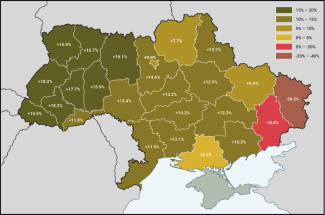
Source: А. Даркович, В. Шиманський, Ю. Маркуц, Бюджети територіальних громад у 2025 році: ключові тренди, op. cit., p. 4.
In addition, under current legislation, personal income tax is allocated not to the hromada in which an individual resides but to the locality in which their employer is registered, which may be elsewhere. The central government has also done little to ease the financial pressure on local authorities. In 2024, the Verkhovna Rada decided to reallocate part of the personal income tax paid by members of the armed forces, police officers and other uniformed services away from local governments. These losses were not offset by additional transfers from the central budget. Furthermore, under the 2026 Budget Law, the government reduced local governments’ share of personal income tax by 4 percentage points in favour of the state budget. This is expected to cut local government revenues by a further 15.2 billion hryvnias (approximately $340 million).
The financial standing of hromadas, raions and oblasts has also been undermined by the populist policies pursued in some cities. This is particularly evident in Kharkiv, where the local authorities, including the mayor, have refused to pay bills owed to energy companies.[5] Overall, the city’s debt has reached 44 billion hryvnias (almost $1 billion). Residents of many cities pay utility charges that are well below the market cost of electricity, gas and water. In Kharkiv, for example, public transport is provided free of charge. These measures are intended to boost the popularity of local leaders, but they are also partly driven by necessity, as a population impoverished by the war would be unlikely to bear the full cost of public services.
The hammer from the centre
The governing camp has used legal provisions, the security services under its control and the prosecution service to exert pressure on local self-governments and undermine the position of local politicians. This became particularly evident in early 2025, when Donald Trump’s election victory fuelled expectations that the war might soon come to an end and that elections could follow. Against this backdrop, the authorities sought to limit political competition. Concerned by the growing popularity of several local leaders, including Kharkiv Mayor Ihor Terekhov and Dnipro Mayor Borys Filatov, the government sought to prevent the emergence of a political movement centred on any one of them or the formation of a hypothetical ‘party of mayors’. Above all, President Volodymyr Zelensky’s camp appeared to be concerned about the political ambitions of Kyiv Mayor Vitali Klitschko. The Association of Ukrainian Cities has repeatedly complained of political pressure. In January 2025, at the request of the State Bureau of Investigation, a court ordered the pre-trial detention of Irpin City Council Secretary Oleksandr Markushyn for 60 days over his alleged unlawful departure from Ukraine to visit his two-year-old son abroad. Following the death of the child’s mother, however, he was legally entitled to leave the country despite being of military age. A year later, the Association again complained that local government officials were being subjected to pressure from the prosecution service.[6]
This pressure is not an end in itself. Rather, it serves as a pretext for invoking the provisions of the Law on Martial Law to establish military administrations subordinate to the president and remove elected mayors from office. This approach was first employed in Chernihiv. In the 2020 local elections, Vladyslav Atroshenko was re-elected mayor in the first round with 76% of the vote. During his previous term, the widely popular mayor oversaw the city’s development and, following Russia’s full-scale invasion, led Chernihiv’s response during the 40-day siege.
Atroshenko, however, came into conflict with both the oblast administration and the oblast military administration established in February 2022. The central authorities’ hostile attitude towards him appears to have stemmed from his decision, together with that of the city councillors aligned with him, not to stand on the Servant of the People party list in the 2020 local elections. Consequently, he was removed from office by a court on charges widely regarded as questionable, including the alleged misuse of official property for private purposes and a conflict of interest between his public duties and private interests.[7] In February 2023, a court barred Atroshenko from holding public office for one year. Just weeks later, on 7 March 2023, a military administration was established in Chernihiv, effectively sidelining the city’s elected local government institutions. In December 2024, acting mayor Oleksandr Lomako was also forced to resign after the local military administration threatened to use its statutory powers to paralyse the functioning of the city administration.[8] This demonstrates that military administrations do not hesitate to use their powers to pressure and intimidate local government officials, even when doing so comes at the expense of the city’s interests.
The governing camp has also used legal provisions allowing the president to determine that individuals holding foreign identity documents, primarily Russian ones, have lost their Ukrainian citizenship as a tool against local government officials. Since at least 2015, media reports have alleged that Odesa Mayor Gennadiy Trukhanov holds a Russian passport. Trukhanov has criticised Ukraine’s de-Russification policies and defended statues of Catherine the Great and Alexander Pushkin in Odesa, along with other monuments. The city council, which he has controlled since 2014, together with its executive bodies, has also faced accusations of embezzling public funds. In April 2023, Trukhanov himself was detained in connection with the case.
Nevertheless, Trukhanov was not removed from office until October 2025, following a devastating flood in the city that claimed 11 lives. He was accused of negligence in connection with the disaster, but the formal basis for his removal was the allegation that he held a Russian passport. In a decree issued on 14 October 2025, President Volodymyr Zelensky declared that Trukhanov had ceased to be a Ukrainian citizen. Under Ukrainian law, this constitutes one of the grounds on which a city council may remove a mayor from office. Before the Odesa City Council could act, however, the Verkhovna Rada established a military administration in the city on 15 October. In effect, this stripped Trukhanov of his authority regardless of whether he might subsequently have succeeded in having the presidential decree overturned by the courts. Consequently, officials subordinate to the president assumed control of Odesa, one of Ukraine’s wealthiest cities.
The cases of Chernihiv and Odesa are intended to serve as a warning to the mayors of other cities who are critical of the government. One such example is Dnipro, a city of more than one million inhabitants in south-eastern Ukraine, governed by Borys Filatov, a political opponent of President Volodymyr Zelensky. Filatov has openly accused the president of using the security services to target local governments, increasingly echoing the criticism voiced by Kyiv Mayor Vitali Klitschko, who has long been at odds with the head of state.
The Kyiv cauldron
Kyiv has a distinctive system of governance. As the capital, it enjoys a special legal status that places it on a par with Ukraine’s oblasts. Consequently, the Kyiv City State Administration (KCSA) functions both as a central government body and as the executive authority of the Kyiv City Council. Although the office of head of the KCSA is formally separate from that of the mayor, both positions have been held by Vitali Klitschko since 2014.
Klitschko’s relationship with Zelensky has been strained since the president took office. As early as 2019, Zelensky sought to remove him as head of the KCSA. Shortly before Russia’s full-scale invasion, the Cabinet of Ministers also adopted a resolution stripping the mayor of his influence over the appointment of the heads of Kyiv’s raions (districts).
The establishment of the Kyiv City Military Administration (KCMA) in 2022 further complicated the institutional chaos. Unlike the oblasts, where state administrations were simply transformed into military administrations, Kyiv retained the KCSA while a parallel military administration was created. The new body was established without its own administrative apparatus, apart from its head, and was provided only with office premises. Consequently, the head of the military administration has been unable to implement decisions in practice without the support of either the KCSA or the city’s own administrative structures.[9] The first head of the KCMA, General Serhii Popko, did not interfere in the city’s personnel or financial affairs, focusing instead on defence-related matters. Consequently, the issue of dual authority had not yet become politicised. Over time, however, the central authorities came to regard the institutional confusion as an opportunity to weaken Klitschko. In February 2024, at the initiative of Vitali Bezhin, a Servant of the People MP and chair of the Verkhovna Rada’s Subcommittee on Local Self-Government, parliament established an investigative commission to examine the effectiveness of governance in the capital.[10]
In January 2025, Tymur Tkachenko, a civilian with close ties to Andrii Yermak, the head of the Office of the President, was appointed head of the KCMA. His appointment marked the beginning of an ongoing public dispute with Kyiv mayor Vitali Klitschko, characterised by mutual accusations and political sparring. The immediate trigger for the conflict was the issue of public transport services during air raid alerts. Kyiv was the only city in Ukraine where public transport was required to stop whenever an alert was issued. Tkachenko proposed changes to this policy, but Klitschko blocked the initiative, dismissing it as populist. The changes were ultimately adopted, however, owing to strong public support among the city’s residents.
Both sides have exploited the unresolved ambiguity surrounding institutional arrangements and the division of powers to deflect responsibility for unpopular decisions and shift the blame onto their rival. Through a campaign on Telegram and other social media platforms, Klitschko succeeded in portraying Tkachenko as being responsible for raising charges for the maintenance and management of municipal residential buildings. In fact, the decision had been taken earlier under General Popko, and the matter should have fallen within the remit of the city’s elected authorities rather than the KCMA. Consequently, the head of the military administration suffered reputational damage over a decision that was not his own, while Klitschko avoided criticism for failing to adjust the charges for populist reasons. The previous rates had not been revised for many years and remained well below the market cost of providing the services.
The central authorities, however, have other means of deepening the institutional confusion and shifting responsibility for alleged or actual shortcomings onto Klitschko. From March 2026, one such instrument was the so-called Resilience Plan – a government programme to repair critical heating and energy infrastructure in cities and oblasts ahead of the following winter. Under the programme, funding was to be allocated to measures aimed at protecting facilities such as power plants and district heating systems. Local governments and state administrations were required to specify the measures they had undertaken to implement. Kyiv’s initial proposal was the only one to be rejected by the National Security and Defence Council. President Volodymyr Zelensky subsequently used the decision to argue that Kyiv was unprepared for the coming winter, just as, in his view, it had been unprepared for the previous one.
Politically motivated disputes over the division of powers have had a detrimental impact on the functioning of the city and on the safety of its residents. They have also contributed to decision-making paralysis and impeded meaningful reforms in the capital. At the same time, neither the central authorities nor Klitschko have much incentive to resolve these institutional problems. Their persistence allows both sides to engage in political point-scoring and shift responsibility onto one another without bearing the consequences. Attempts by members of the Verkhovna Rada to reform Kyiv’s system of governance have attracted little interest from Klitschko. Nor is there any clear indication that the central authorities have achieved the political gains they had anticipated. Elections remain a distant prospect, the mayor’s position has not been significantly weakened and Tkachenko’s continued presence in the city’s governing structures has become increasingly difficult to justify. Moreover, the pressure exerted on the mayor has enabled Klitschko to turn the criticism back on the president, arguing, for example, that Ukraine “stinks of authoritarianism”.[11]
Kyiv in the grip of corruption
The capital’s budget amounts to 91 billion hryvnias (over $2 billion). Kyiv is also the centre of Ukrainian business and owns numerous valuable plots of land. The struggle for control of the city is therefore not only a contest for political power but also for business influence and access to profits derived from a range of sources, including illicit ones. Where these profits are sufficient to satisfy all parties, political rivalry tends to give way to cross-party cooperation based on corrupt arrangements.
The scale of these practices was exposed by the National Anti-Corruption Bureau of Ukraine (NABU) in February 2025 through its high-profile ‘Clean City’ operation. The investigation uncovered a network of officials involved in so-called ‘toilet schemes’, which enabled valuable municipal land to be sold without a competitive tender to the purported owner of a structure located on the plot. To exploit the scheme, participants would register even the smallest structures, such as public toilets or building foundations, with the relevant municipal departments. In practice, however, even this was often unnecessary: a certificate from an architect and a title document issued by a notary were sufficient. On this basis, the applicant could privatise the land, sell it to a company and the new owner could then develop the site for residential buildings, shopping centres or hotels.
The corruption scheme involved representatives of virtually every political group on the City Council, as well as numerous departments within the Kyiv City State Administration. Denys Komarnytskyi, who coordinated the operation, financed the 2020 election campaigns of City Council candidates from several parties, including UDAR, Batkivshchyna and Servant of the People. Many of those elected subsequently acted on his instructions. After the scheme was uncovered, Komarnytskyi fled abroad. His role was to provide legal and technical support for procedures relating to the designation of land for development and to secure the necessary votes in the City Council. Companies linked to him also regularly won municipal procurement contracts. He also oversaw the distribution of profits from these operations among the various beneficiaries, who came from across the political spectrum, including Servant of the People. According to investigative journalists, Komarnytskyi, widely referred to as ‘Kyiv’s overseer’, worked closely with Artur Palatnyi, the chairman of UDAR, and maintained ties with Servant of the People MP Mykola Tyshchenko and the Office of the President. They argue that his influential position stemmed from a compromise reached in 2020 between President Volodymyr Zelensky’s inner circle and Klitschko.
Despite initial scepticism in the Ukrainian media,[12] which pointed, among other things, to family ties between the head of NABU and Tkachenko, the agency’s actions did not appear to be politically motivated. Rather, the investigation demonstrated NABU’s institutional independence. Komarnytskyi’s ties to both sides of the political dispute meant that the scandal did not seriously damage the mayor and received considerably less coverage in pro-government media than might have been expected, as the case also had the potential to embarrass the central authorities. As a result of the ‘Clean City’ operation, more than a dozen officials responsible for urban planning and land management in the capital resigned or were dismissed from office, including the deputy head of the KCSA and the chair of its architecture commission. In June, the City Council also approved the dismissal of Mykola Povoroznyk, the First Deputy Head of the KCSA. Given the scale of the affair, Klitschko emerged largely unscathed, while subsequent scandals involving figures close to President Volodymyr Zelensky pushed the so-called ‘toilet schemes’[13] out of the public spotlight.
Tempered in murky waters
During the war, the Office of the President has succeeded in centralising power.[14] Outside the capital, however, this process has advanced more slowly than within the central government administration and the security services. Even so, the current martial law legislation has enabled the authorities to gradually undermine the position of local self-government and expand central control over cities, thereby creating incentives to weaken potential political rivals ahead of any future elections.
Addressing the institutional shortcomings and completing the decentralisation reform is not currently in the interests of either the central authorities or local governments. Their ongoing disputes allow each side to deflect responsibility for inaction and unpopular decisions, while the continuing war provides a convenient justification for postponing reform. Given the increased popularity that some local leaders have gained during the war, it seems unlikely that the central authorities will be able to establish effective control over the regions unless local officials themselves provide grounds for doing so through corruption scandals or links to Russia. Many of the instruments currently used to exert pressure on local government are likely to disappear once the country returns to peacetime. At the same time, local officials and elected representatives will have gained experience of governing under the most challenging conditions. This raises hopes that Ukraine’s system of local self-government will emerge from the war in a stronger position and that the decentralisation reform can finally be completed.
[1] H. Arends, T. Brik, B. Herrmann, F. Roesel, ‘Ukraine’s resilience: How an administrative reform boosted social capital and trust in Ukrainian communities’, VoxEU/CEPR, 31 August 2023, cepr.org/voxeu.
[2] Звіт про результати аналізу виконання основних показників місцевих бюджетів за 2022–2024 роки, Рахункова палата, 25 November 2025, rp.gov.ua, p. 24.
[3] А. Даркович, В. Шиманський, Ю. Маркуц, Бюджети територіальних громад у 2025 році: ключові тренди, KSE Institute, March 2026, institute.kse.ua, p. 5.
[4] Ibidem, p. 6. In 2025, transfers from the central government accounted for 57% of Kherson’s total revenues.
[5] М. Солодовнік, ‘Харківські КП заборгували понад 30 млрд гривень перед державними підприємствами — Шмигаль’, Суспільне Харків, 10 April 2026, suspilne.media/kharkiv.
[6] ‘Заява про тиск органів прокуратури’, Кадри та організація роботи, 13 January 2026, auc.org.ua.
[7] In March 2022, the mayor’s wife travelled to Poland in his official vehicle. On 2 July that year, Atroshenko was travelling to a conference in Switzerland and planned to collect the vehicle en route. Ukrainian border guards prevented him from crossing the border.
[8] Д. Шапошніков, М. Кирієнко, ‘Олександра Ломака звільнили з посади секретаря Чернігівської міської ради’, Суспільне Чернігів, 20 December 2024, suspilne.media/chernihiv.
[9] The legal basis for establishing the Kyiv City Military Administration in the same manner as military administrations at the oblast level, rather than under the provisions governing individual localities, is also questionable. Paradoxically, in 2023 the Kyiv City Council declared that the Kyiv City State Administration had ceased to exist and had been transformed into the Kyiv City Military Administration.
[10] Т. Матяш, А. Стешенко, ‘Парламент створив спецкомісію щодо ефективності влади в Києві під час війни (доповнено)’, LB.ua, 22 February 2024.
[11] ‘Зеленський і Кличко перейшли до відкритої конфронтації — The Times’, ZN.ua, 31 May 2025.
[12] І. Ведерніковa, ‘Корупція в Києві. Хто замовив НАБУ бек-офіс Комарницького та до чого тут Банкова?’, ZN.ua, 6 March 2025.
[13] M. Jędrysiak, ‘Operation Midas: the largest corruption scandal within Zelensky’s inner circle’, OSW, 13 November 2025, osw.waw.pl.
[14] Idem, ‘Zelensky, Yermak and Ukraine’s wartime governance’, OSW Commentary, no. 619, 14 August 2024, osw.waw.pl.