The bedrock of security: NATO in Turkey’s Policy
NATO remains the fundamental pillar of Turkey’s security and its most important framework for defence cooperation with the West. Turkey wants to be seen as indispensable to the Alliance’s south-eastern flank: a state with substantial military potential, a developed defence industry and key allied infrastructure. This does not, however, eliminate tensions between Ankara and some of its allies, mainly over threat perceptions. While many NATO members currently regard deterrence against Russia as their priority, Turkey regards instability in the Middle East and terrorism as equally important threats.
As uncertainty in international relations grows, NATO will become increasingly important to Turkey; at the same time, Turkey’s importance to the Alliance’s security will also increase. This does not mean that Ankara will abandon its multi-vector foreign and security policy or its autonomous stance towards its allies. Turkey will continue to pursue a policy based on the pursuit of so-called strategic autonomy: remaining ready to cooperate with and within NATO, while preserving freedom of manoeuvre vis-à-vis states that compete with the West.
An indispensable but difficult ally
Turkey’s accession to NATO in 1952 marked a turning point in the policy of a state which, since becoming a republic in 1923, had tried to keep an equal distance from the world’s major powers. Membership anchored Turkey in Western military structures in a bipolar world and strengthened its security vis-à-vis the Soviet Union, which reportedly threatened, among other things, to seize the eastern provinces of Kars and Ardahan.[1]
For the United States, Turkey’s accession to the Alliance was particularly advantageous. It secured Ankara’s loyalty, including access to key military bases such as İncirlik (under construction from 1951; joint-use agreement in 1954) and Izmir (US presence from 1952), as well as ensuring that the Dardanelles and Bosphorus straits remained under the control of an allied state. This limited Moscow’s ability to project power both in the Black Sea and the Mediterranean. In return, Turkey received billions of dollars in US military and economic assistance (estimated at more than $13.8 billion in 1947–1992)[2], including favourable loans, grants for military equipment, personnel training and access to US technologies and weapons on preferential terms. As a result, NATO became synonymous with the United States in Turkish strategic thinking.
The first crisis with allied states to have a direct adverse impact on Turkey’s defence capabilities was the 1974 invasion of Cyprus by the Turkish Armed Forces.[3] Ankara sought to block plans to incorporate the island into Greece (enosis), which would have meant losing political influence in Cyprus and weakening Turkey’s position in the eastern Mediterranean. Turkey invoked the 1960 Treaty of Guarantee, which gave it – together with Greece and the United Kingdom – the right to intervene to restore the constitutional order and protect the Turkish community. In response to the operation, the US Congress imposed an embargo on arms and ammunition deliveries to Ankara. Turkey was then heavily dependent on American weaponry, and the embargo left Ankara with a lasting distrust of its Western partners while strengthening its drive for self-sufficiency in the defence industry.[4]
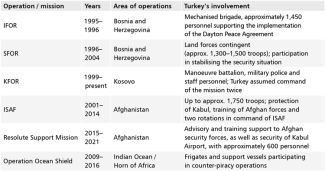
The end of the Cold War brought changes to Turkey’s relations with NATO, as it ceased to be defined as a frontline state. For Ankara, this meant redefining its role in the Alliance and looking for new opportunities to develop relations with post-Soviet states, including in the South Caucasus and Central Asia. At the same time, NATO was shifting towards crisis-response operations and expeditionary missions, which created new opportunities for Turkey to become involved and maintain its strategic importance (including through participation in operations in Bosnia and Herzegovina, Kosovo and Afghanistan; for more details, see the table in the Appendix).
However, Turkey’s relations with NATO and the United States began to deteriorate as a result of differences in threat perceptions on the southern flank. The first sign of this was the 2003 Iraq War and the Turkish parliament’s refusal to allow the country’s territory to be used for military operations against Saddam Hussein’s regime. Ankara feared that the US operation would destabilise the Middle East and embolden Kurdish terrorist groups, especially in northern Iraq. Another serious problem emerged after the outbreak of the civil war in Syria, particularly the United States’ cooperation with local Kurdish groups from 2014 onwards in the fight against the so-called Islamic State (IS). Ankara regarded Syrian Kurdish organisations, especially the People’s Protection Units (YPG), as an offshoot of the terrorist Kurdistan Workers’ Party (PKK), and their plans to establish Kurdish autonomy in northern Syria as a direct threat to Turkey’s security.[5] The problems were compounded by Turkey’s downing of a Russian Su-24 bomber in Syria in November 2015 after it had violated Turkish airspace. Ankara expected unequivocal support from its NATO allies but regarded their response – which emphasised de-escalation and the risk of drawing the Alliance into a Turkish-Russian confrontation in Syria – as insufficient. In Turkey, this was seen as yet another sign that its allies were disregarding the country’s security concerns.[6]
At the same time, Ankara has invoked the consultation mechanism under Article 4 of the Washington Treaty on several occasions: in 2003 in connection with the war in Iraq, and in 2012, 2015 and 2020 in the context of threats arising from the civil war in Syria (to date, NATO has held Article 4 consultations nine times, five of them at Ankara’s request). In response, the Alliance declared solidarity with Turkey and strengthened its air defence, for example through AWACS missions and the deployment of Patriot air-defence batteries in the south-eastern part of the country, close to the Syrian border.
Political relations, especially with the United States, nevertheless continued to deteriorate. The failed coup of July 2016 in Turkey proved to be a turning point: Ankara accused Fethullah Gülen – a Turkish cleric living in the United States and, at the time, one of Recep Tayyip Erdoğan’s main political rivals – of orchestrating it. Further difficulties arose when Ankara acquired the Russian S-400 air-defence system in 2017.[7] The United States opposed the decision. In July 2019, it excluded Turkey from the consortium producing the F-35 fighter and refused to sell the aircraft to Ankara. In December 2020 it also imposed sanctions, including a ban on granting Turkey’s defence procurement agency export licences for US technologies and goods.
Turkish-American frictions and divergent threat perceptions in the Middle East also affected Ankara’s relations with the rest of the Alliance. In 2019–2020, Turkey delayed the adoption of NATO contingency plans for Poland and the Baltic states, demanding that Alliance members give greater weight to threats posed by the PKK and by Kurdish organisations in Syria.[8] Ankara adopted a similar position on Sweden’s and Finland’s NATO membership, conditioning its consent to Alliance enlargement on both states taking action against organisations linked to the PKK operating on their territory, lifting restrictions on arms exports to Turkey and combating the financing of organisations that Ankara regards as terrorist.[9] Turkey’s relations with NATO have also been burdened by recurring disputes with Greece over maritime boundaries and energy resources in the Aegean sea and the eastern Mediterranean. Ankara has also criticised French support for Athens, as France has developed military cooperation with Greece and opposed Turkey’s maritime claims. In Turkey’s view, these actions were intended to constrain its influence in the region.
Turkey’s engagement with NATO
Turkey plays a key role in the security of the Alliance’s south-eastern flank, which encompasses the Black Sea and the eastern Mediterranean. It also participates, albeit to a limited extent, in Alliance exercises supporting the security of other regions, including the Baltic Sea. In doing so, Ankara underscores that it is not only a beneficiary of allied security guarantees, but also a provider of them. It also expects its engagement to translate into broader recognition of its own security interests, especially in the Middle East.
In recent years, Turkey has become more active in allied activities on NATO’s eastern and south-eastern flanks. As part of NATO Allied Reaction Force (ARF) exercise Steadfast Dart 2026, held in Germany and the Baltic Sea region, Ankara deployed a contingent of more than 2,000 troops, including land, naval and air units. Turkey also took part in the Allied activity Eastern Sentry, using, among other assets, AWACS airborne early-warning and control aircraft to support airspace monitoring on NATO’s eastern flank. It also participated in NATO’s Enhanced Air Policing missions, deploying F-16 fighters with ground personnel to Romania (2023–2024, with another rotation planned from December 2026) and to Poland (2021). These activities were complemented by Turkish participation in NATO’s multinational Forward Land Forces on the south-eastern flank, primarily in Romania and Bulgaria. Ankara has also announced its first participation in the Baltic Air Policing mission in Estonia in 20 years, starting in August 2026.
Turkey also seeks to strengthen Black Sea security, but prefers to act either independently or in limited cooperation with NATO littoral states.[10] It therefore promotes formats of cooperation with Romania and Bulgaria, such as the MCM Black Sea mine-countermeasures group, which improves the safety of shipping without being explicitly directed against Russia. At the same time, Ankara is developing initiatives to monitor the situation in the Black Sea, coordinate the activities of regional states and protect critical infrastructure by supporting maritime cooperation within the CTF Black Sea format. It applies a similar approach to Ukraine, focusing primarily on the maritime dimension of future security guarantees in the Black Sea within the so-called coalition of the willing.
NATO infrastructure, command structures and force elements are deployed on Turkish territory.[11] These include NATO Allied Land Command (LANDCOM) in Izmir and the NATO Multinational Corps Command (MNC-TUR), which is being established in Adana. The İncirlik Air Base in Adana also plays an important role. It is one of the most important US and NATO military facilities on the southern flank, supporting logistics, military operations and the reinforcement of air defence in the region. According to open sources, the base hosts between 20 and 50 US B61 nuclear bombs deployed under the nuclear-sharing programme. Another key installation is the radar site at Kürecik in southern Turkey, which forms part of NATO’s missile-defence architecture and early-warning system.
Over the past decade, Ankara has allocated an average of around 1.3–2.0% of GDP to defence. After Russia’s aggression against Ukraine in 2022, however, this spending began to rise steadily; by 2025 it had reached around 2.33% of GDP ($27.3 billion)[12]. Although this level remains close to the Alliance average, long-term investment in the domestic defence industry and the consistent modernisation of the armed forces have given Turkey’s military significant capabilities.
The Turkish Armed Forces are the second largest in NATO, with around 494,000 active-duty personnel.[13] They are currently undergoing extensive modernisation. In the air force, the priority is to maintain combat capabilities until the Turkish-made KAAN fighter jet enters service. This includes modernising existing F-16 Block 30 aircraft, purchasing new F-16 Block 70s and acquiring a total of 44 Eurofighter Typhoon fighters – both new and used – by 2033.[14] At the same time, Ankara remains interested in purchasing fifth-generation F-35 fighters from the United States. It is also developing domestic short-, medium- and long-range air-defence systems (HİSAR-A+, HİSAR-O+ and SİPER), as well as rocket artillery. In the land forces, the priority is the modernisation of armoured and mechanised units, including the introduction of Altay tanks (85 by 2028), the modernisation of Leopard 2A4 and M60T tanks, and the development of new Tulpar and Kaplan infantry fighting vehicles. In the navy, the MILGEM shipbuilding programme plays a key role, covering the construction of Ada-class corvettes, Istanbul-class frigates and future TF-2000 air-defence destroyers. These capabilities are complemented by the TCG Anadolu amphibious assault ship, which entered service in 2023. At the same time, Ankara is developing the MILDEN programme, which aims to build the first Turkish-designed submarine. Most of these programmes are still at the implementation stage, so their main impact on the operational capabilities of the Turkish Armed Forces will not become apparent until the next decade.
Turkey’s agenda for the summit
The NATO summit scheduled for 7–8 July 2026 in Ankara will give Turkey an opportunity to strengthen its image as one of the Alliance’s key members and to highlight its role in the security of the south-eastern flank. Ankara will seek to present itself not only as a beneficiary of allied guarantees, but also as a country that makes a significant contribution to NATO’s security, especially in the Black Sea, the Middle East and the Mediterranean. The summit is also intended to draw greater attention to Turkey’s security priorities and to demonstrate that, as the international situation deteriorates, Turkey’s military, infrastructure and logistics potential remains an important element of the Alliance’s crisis-response capabilities.
Ankara’s broader objective will be to secure NATO’s reaffirmation of its commitment to the “360-degree” security policy, which assumes equal treatment of threats emanating from all directions and across all operational domains.[15] In connection with the escalation of conflicts in the Middle East, Turkey may expect the Alliance to become more involved in deterring and countering threats to the south-eastern flank, including ballistic threats, terrorism and regional destabilisation. Particular importance will be attached to terrorist groups such as the PKK and IS, which Turkey believes may seek to exploit regional instability to rebuild their structures. Ankara will also emphasise its own role in stabilising neighbouring states, above all Syria, and will seek to deepen NATO cooperation with the Gulf states – Qatar, the United Arab Emirates, Bahrain and Kuwait – within the Istanbul Cooperation Initiative.[16] Reports that Turkey is seeking the participation of representatives of these states in the upcoming NATO summit underscore these efforts.
Ensuring the political success of the summit itself will also be important for Ankara. In this context, Erdoğan’s good relations with Donald Trump may play an important role. The Turkish authorities hope these ties will help maintain a constructive atmosphere and reduce the risk of Euro-Atlantic disputes. At the same time, a successful summit attended by the US president would reinforce perceptions of Turkey’s growing role within NATO.
Ankara will closely follow the debate on the future of the US military presence in Europe and on the increasing responsibility of European allies for the continent’s security. From Turkey’s perspective, any reduction in US engagement weakens European security, especially against the backdrop of the Russia-Ukraine war. At the same time, however, it creates opportunities for Turkey’s importance to the EU to grow as the need for closer military cooperation increases.
In this context, the authorities in Ankara will present their own armed forces and its defence industry as assets that can help fill potential capability gaps created by a reduction in the US military presence in Europe. Turkey can therefore be expected to put forward demands for its defence sector to be more closely integrated into the development of European defence capabilities and industrial cooperation; in its view, this should also include access to EU financial instruments supporting the defence sector, such as SAFE. At the same time, Ankara will probably use the NATO summit to improve defence relations with the United States. It will seek, among other things, the lifting of sanctions that restrict its access to US military technologies, prevent it from purchasing F-35 fighters and complicate the development of the KAAN fighter. Progress in this area, however, remains conditional on resolving the dispute over the S-400.
Between selective cooperation and autonomy
Amid deepening regional instability and international rivalry, NATO’s importance to Turkey will grow. Ankara will seek to deepen cooperation with individual Alliance members, especially in the field of military technologies. Despite progress in building greater autonomy in its defence sector, Turkey remains dependent on cooperation with Western partners to modernise its armed forces and gain access to advanced military technologies. At the same time, Turkey’s own importance to NATO will also grow, as it is a state with significant military potential that influences the security situation in the South Caucasus and the Middle East and controls access to the Black Sea.
The increasing importance of the Alliance for Ankara will stem above all from the deterioration of the security situation in Turkey’s immediate neighbourhood. Russia’s full-scale invasion of Ukraine was an attempt by Moscow to alter the balance of power in the Black Sea, which Ankara perceived as a challenge to its own security and to regional stability. To limit the consequences of military escalation, Turkey applied the provisions of the Montreux Convention in the first days of the war, closing the Bosphorus and Dardanelles straits to warships belonging to states that were parties to the conflict. This restricted Russia’s ability to reinforce its Black Sea Fleet with vessels from outside the Black Sea. It did not, however, eliminate the risk of escalation in the Black Sea altogether. At the end of 2025, shipping and maritime trade of major importance to the Turkish economy were disrupted by attacks on merchant vessels in Turkey’s exclusive economic zone in the Black Sea, incidents involving Russian reconnaissance drones violating Turkish airspace at the turn of 2025 and 2026, and rising war-risk insurance costs.[17]
However, Ankara will not depart from its existing approach to the Russia-Ukraine war, which combines security support for Ukraine with continued dialogue with Russia and the protection of Turkey’s own economic and energy interests. It will emphasise the importance of Black Sea stability, the safety of shipping and the continued existence of mechanisms that help control the military dimension of the conflict. At the same time, it will highlight its role as a state capable of communicating with both Kyiv and Moscow, while avoiding actions that Russia could interpret as an expansion of NATO’s engagement in the region. In this spirit, Turkey can be expected to remain active within the so-called coalition of the willing, primarily on the maritime dimension of future security guarantees for Ukraine.
NATO’s importance to Turkey will be reinforced not only by challenges in the Black Sea, but also by the worsening security situation in the Middle East, which Ankara regards as the most serious source of threats. This applies above all to Iran, which has fired ballistic missiles towards İncirlik Air Base on four occasions since March 2026, where US forces and contingents from NATO states (including Poland) are stationed. Thanks to allied air-defence systems, the missiles were intercepted over Turkish and Syrian territory.[18] Incidents of this kind will strengthen Ankara’s appreciation of the value of allied security guarantees.
Turkey’s conviction that the Alliance is fundamental to its security will not mean that Ankara will refrain from pursuing an assertive policy towards some allies, especially France and Greece, or from using the NATO forum to advance its own security priorities. Nor will its objective be to choose between the West and other international actors. Rather, Ankara will seek to balance among different foreign-policy vectors in a way that maximises political and economic benefits. In practice, this will mean maintaining developed relations with states that are in competition with the West, above all Russia, but also China.
In this context, the most likely scenario for the coming years is a selective rapprochement between Turkey and selected NATO states, including the United Kingdom, Italy, Spain and Poland. This cooperation will focus mainly on the defence industry and security. At the same time, problems in relations with Greece, the Republic of Cyprus and France will continue to complicate the development of deeper ties with Western states. This will not change the fact that NATO will remain Turkey’s indispensable security pillar, with no viable alternative, and that Ankara will continue to seek recognition of its contribution to European security while emphasising its own priorities, especially in the fight against terrorism and the stabilisation of the southern neighbourhood.
A key test for Turkey’s relations with NATO will be the future role of the United States in ensuring European security. A reduction in the US military presence on the continent increases pressure on European allies, including Turkey, to assume greater responsibility for regional security. Ankara will try to use this process to strengthen its position as a partner for Europe, especially in the Black Sea region and on NATO’s south-eastern flank. As a result, Turkey can be expected to continue participating in Alliance exercises, airspace-surveillance missions and initiatives related to the safety of shipping. This will not, however, lead to a fundamental change in its policy towards Russia: Turkey will maintain economic and energy ties with Moscow and avoid actions that could lead to direct military escalation. It will also most likely view with caution proposals emerging within the Alliance for more decisive responses to Russia’s hybrid activities and any attempts to increase NATO’s presence in the Black Sea beyond the current frameworks of cooperation.
APPENDIX
Map. NATO installations and elements of command and force structures in Turkey
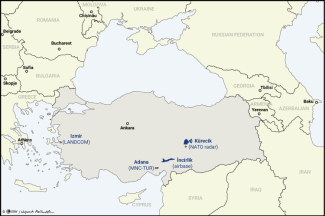
Table. NATO operations with the largest Turkish Armed Forces deployments after the end of the Cold War
[1] A. Michalski, W. Rodkiewicz, Dwuznaczne partnerstwo. Rosja i Turcja między rywalizacją a współpracą, OSW, Warsaw 2026, osw.waw.pl.
[2] J. Zanotti, Turkey-U.S. Defense Cooperation: Prospects and Challenges, Congressional Research Service, Report R41761, 8 April 2011, congress.gov.
[3] Earlier tensions in Turkish-American relations included President Lyndon B. Johnson’s 1964 letter to Prime Minister İsmet İnönü, in which the United States warned Turkey against intervening in Cyprus, as well as the withdrawal of US Jupiter medium-range ballistic missiles from Turkey following the Cuban Missile Crisis.
[4] A. Michalski, ‘Lekcje z tureckiej drogi ku autonomii sektora zbrojeniowego’, Pomorski Thinkletter, no. 1(24), 23 April 2026, kongresobywatelski.pl.
[5] C. Thomas, J. Zanotti, Turkey (Türkiye): Major Issues and U.S. Relations, Congressional Research Service, Report R44000, 15 September 2025, congress.gov.
[6] A. Coşkun, ‘Turkey’s Role in Consolidating European Security: Challenges and Opportunities’, CATS Network Paper, no. 14, 5 May 2025, cats-network.eu.
[7] Ibid.
[8] R. Emmott, ‘Exclusive: Turkey Holds Up NATO Military Plans over Syria Dispute - Sources’, Reuters, 26 November 2019, reuters.com.
[9] J. Gotkowska, J. Tarociński, ‘NATO enlargement: Sweden and Finland facing Turkish objections’, OSW, 24 June 2022, osw.waw.pl.
[10] K. Całus, A. Michalski, J. Nowinowski, J. Tarociński, ‘Romania, Bulgaria and Turkey in the Black Sea region: increased cooperation?’, OSW Commentary, no. 676, 26 June 2025, osw.waw.pl.
[11] C. Thomas, J. Zanotti, Turkey (Türkiye): Major Issues and U.S. Relations, op. cit.
[12] C.D. Yaylali, ‘Turkey begins 2026 with defense-spending numbers trending up’, Defense News, 8 January 2026, defensenews.com.
[13] Defence Expenditure of NATO Countries (2014–2025), NATO, 3 June 2025, nato.int.
[14] A. Michalski, ‘Modernisation of Turkey’s tactical air force faces challenges’, OSW, 3 April 2026, osw.waw.pl.
[15] ‘Türkiye Urges Allies not to Neglect Southern Flank Security Challenges including Terrorism, Mass Migration and Climate Change’, NATO Parliamentary Assembly, 20 June 2022, nato-pa.int.
[16] A. al-Khatib, ‘Four Gulf states to attend NATO summit amid uncertainty over Iran war’, The New Arab, 22 May 2026, newarab.com.
[17] J. Saul, ‘War insurance costs spike for ship owners as Black Sea threats grow, sources say’, Reuters, 4 December 2025, reuters.com.
[18] A. Mammadov, ‘What Iran’s Attacks on Turkey Reveal About NATO’s Future’, Atlantic Council (TurkeySource), 26 March 2026, atlanticcouncil.org.