A new Ostpolitik? Ukraine as a priority of the Merz government
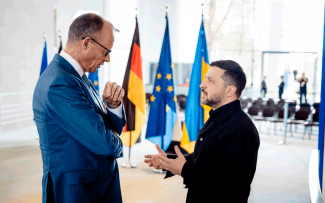
One year after the CDU/CSU–SPD coalition took office, the continuation of civilian and military support for Kyiv remains one of the principal directions of German foreign policy. According to the German government’s assessment, Ukraine is not only defending its own sovereignty, but also restraining Russia’s imperial ambitions, which could extend to NATO’s eastern flank states. In light of Russia’s ongoing full-scale aggression, Friedrich Merz’s government does not intend to return to the previous model of cooperation with Moscow, now defined as the principal direct threat to Germany’s security. Although the Chancellor does not rule out a future resumption of cooperation with the Kremlin, he has made such a step conditional on the terms for ending the war and a fundamental change in the political situation.
The shift in emphasis from avoiding escalation with Russia to active cooperation with Ukraine represents a significant reorientation of German policy in recent years. By virtue of its position as the largest European provider of assistance to Kyiv, Berlin seeks to reinforce its aspirations to play a leading role both in future peace negotiations and within the European Union on security matters.
At the same time, parts of the German business community continue to display a willingness to ‘wait out’ the war and return to close economic cooperation with Russia. A significant portion of German society also favours dialogue with Moscow, with the AfD remaining its principal political representative in the Bundestag. The ongoing economic difficulties and high energy costs may reinforce these tendencies, increasing pressure on Chancellor Merz’s government to resume dialogue with Russia.
Germany and Russia: not the time for dialogue
Like the preceding coalition of the SPD, Greens and FDP, the CDU/CSU–SPD government defines Russia as the greatest direct threat to Germany’s security.[1] According to Berlin, Vladimir Putin’s imperial revisionism extends beyond Ukraine and constitutes one of the key arguments for increasing defence spending and for the modernisation and expansion of the Bundeswehr.
Russia is also regarded as one of the principal threats to internal security. The Federal Office for the Protection of the Constitution has indicated that the number of attacks against Germany has risen noticeably since the beginning of Russia’s full-scale invasion of Ukraine, and the security services continue to warn of a persistent threat of similar actions.[2] In 2025, there were more than 300 attempted acts of sabotage and over 1,300 drone flights over critical infrastructure facilities, a significant proportion of which the security services attributed to Russia.[3] The CDU/CSU–SPD government supports maintaining the restrictions imposed on Russia – a position unchanged despite the blockade of the Strait of Hormuz – and criticises the United States’ 30-day suspension of sanctions on Russian oil.
Merz rules out a return to business-as-usual relations with Russia. At the same time, he occasionally signals that, in the longer term, Germany does not reject the possibility of resuming cooperation. In January this year, during a meeting of the Chamber of Industry and Commerce in Halle, the Chancellor briefly referred to such a possibility, making it conditional on guaranteeing peace and freedom in Europe.[4] The Chancellor’s position is consistent with the CDU programme, which assumes that Russia – as a state waging war and threatening peace in Europe – cannot be a partner for Germany.[5]
Unlike his predecessor, Merz refers far more frequently to Russia in the context of the threats it poses to Europe,[6] and employs firmer rhetoric when describing its actions.[7] So far, he has not initiated any telephone conversations with Putin, while during Olaf Scholz’s tenure two such calls took place. Moreover, the current Chancellor does not support establishing a new European channel of dialogue with Russia. In his view, the German authorities receive sufficient information from the United States and Ukraine regarding the progress of the peace negotiations.[8] He also argues that the Kremlin could use such an initiative for propaganda purposes and to divide the EU. In his view, this assessment is supported by the visits to Moscow in 2024 by then Hungarian Prime Minister Viktor Orbán and, in February this year, Emmanuel Bonne, adviser to French President Emmanuel Macron. The latter visit was coordinated with counterparts from Germany and the United Kingdom. However, neither visit contributed to ending the conflict and instead generated controversy.
Germany and Ukraine: a strategic partnership
Defining Russia in terms of a threat has resulted in a shift in the priorities of Germany’s eastern policy: Merz is now focusing on developing cooperation with Ukraine.[9] One indication of the growing importance of this relationship was Berlin’s decision to grant it the status of a strategic partnership and – after more than 20 years – to revive the mechanism of intergovernmental consultations.[10] In addition to supporting Ukraine in the war with Russia, Germany supports Ukraine’s accession to the EU, although it makes this conditional on Kyiv implementing the necessary reforms.[11]
The objectives of the Merz government are to guarantee long-term support for Kyiv and to maintain Germany’s image as a key partner and provider of assistance to Ukraine. Among the measures serving this purpose was the reform of Germany’s Basic Law in March 2025, which excluded financing for broadly defined defence expenditure – including military support for Kyiv – exceeding 1% of GDP from the scope of the so-called debt brake. Ensuring stable funding for Ukraine removed a potential source of tension that, during the previous term, had contributed to the collapse of the coalition of the SPD, Greens and FDP. Merz was also one of the main advocates of granting Ukraine a so-called reparations loan using Russian assets.[12] However, the initiative ultimately failed due to opposition from Belgium, France and several other countries.
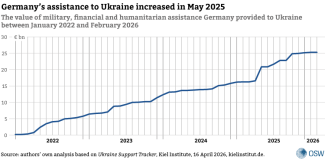
According to the Kiel Institute for the World Economy, the value of German assistance to Ukraine since January 2022 has amounted to approximately €25 billion, equivalent to 0.7% of Germany’s 2021 GDP, of which €20 billion has consisted of military support. In 2026, the government plans to allocate €11.5 billion for military assistance to Kyiv, while in 2027, 2028 and 2029 it intends to earmark €9 billion annually for this purpose. Germany’s status as a ‘leader in assistance to Ukraine’ has been further reinforced by Berlin and London assuming from the United States the leadership of the Ukraine Defence Contact Group (the so-called Ramstein Group) in March 2025.
As part of its assistance to Ukraine, Germany is supporting cooperation between the defence industries of the two countries. One outcome of the bilateral intergovernmental consultations was the decision to open a branch office of the Ukrainian Defence Industry (UDI) conglomerate in Berlin.[13] Unlike Scholz’s policy of ‘red lines’ regarding support for Ukraine, Merz has adopted an approach of ‘strategic ambiguity’: since June 2025, Berlin has ceased publishing data on the weapons and military equipment supplied to Ukraine and has declared that there are no restrictions on the range of weapons used by Kyiv. Although the Christian Democrats criticised the Scholz government for not transferring Taurus cruise missiles to Ukraine, Merz has likewise refrained from taking this step, which may stem in part from the opposition of the coalition partner, the SPD. Instead, he has declared readiness to support Ukraine in the production of its own long-range weapons systems and to further deepen cooperation between the defence industries of the two countries.
Further objectives of the CDU/CSU–SPD government’s policy towards Ukraine are to secure Germany’s status as a significant participant in the peace process and as a key actor in shaping European security. Since taking office, Merz has worked successfully to ensure Germany’s inclusion among the European participants in talks with the United States on resolving the conflict. The results of these efforts included his participation in the summit on the conditions for ending the war with Russia in August 2025, Germany’s involvement in formulating the European response to the US peace plan of November 2025, and the organisation in Berlin of a summit devoted to Ukraine with the participation of a US delegation in December 2025.
Germany’s credibility in this regard will be demonstrated by its readiness to participate in security guarantees for Kyiv. The exact form of these guarantees has not yet been defined. According to Merz, Germany could deploy Bundeswehr troops to the territory of a NATO member state bordering Ukraine. He also did not rule out ‘other forms of involvement’.[14] However, he made this conditional upon several requirements: a negotiated ceasefire, US participation in the security guarantees, and the consent of both the SPD coalition partner and the Bundestag.
Talks with Russia: challenges to the consensus within the governing parties
Although the leadership of the SPD within the governing coalition supports the Chancellery’s policy towards Russia and Ukraine, a faction within the party advocates a return to dialogue with Russia in order to de-escalate tensions and gradually rebuild trust. One of its leading figures is Rolf Mützenich, a member of the Bundestag’s parliamentary oversight panel for the intelligence services and former chair of the Social Democrats’ parliamentary group. In June 2025, together with a group of more than a hundred SPD activists, he signed a manifesto opposing increases in defence spending and calling for a “gradual return to détente and cooperation with Russia”.[15]
Merz’s course is supported by the majority of Christian Democrats, although even within their ranks there are calls for a swift end to the war and the resumption of cooperation with Russia, for example from the Minister-President of Saxony, Michael Kretschmer. A similar division is evident regarding the question of opening a new European channel of communication with the Kremlin. Within the CDU, such a solution is supported by a small number of influential politicians, including Armin Laschet, chair of the Bundestag Foreign Affairs Committee.[16] In the SPD, these views are shared by, among others, Adis Ahmetović, the Social Democrats’ foreign policy spokesperson within the parliamentary group, as well as the aforementioned Mützenich.[17] The reasons cited are a lack of trust in the United States and the failure to safeguard European interests during the peace negotiations.
The AfD remains the only party in the Bundestag to consistently advocate a return to cooperation with Russia, including direct talks with Putin. The party remains the largest opposition force, polling at approximately 27%, and has a realistic chance of securing its first state premiership – in Saxony-Anhalt in the election scheduled for September this year. Among the demands contained in the AfD’s election programme in this federal state are the lifting of EU sanctions on Russia, the resumption of energy cooperation, including through the repair of the Nord Stream pipeline, and the renewal of school exchange programmes with Russian schools.[18] Among AfD supporters, opposition to support for Ukraine and to its integration with the EU and NATO is particularly pronounced – only 15% of the party’s electorate support the latter. By comparison, the figure stands at 56% among supporters of the Christian Democrats, 59% among the SPD electorate and 60% among supporters of Die Linke, while the strongest supporters of Ukraine’s accession to NATO are Green Party voters, at 81%.[19] This stance is contributing to shifts in the public debate, particularly within the Christian Democrats in the eastern federal states and in Bavaria. This is reflected, among other things, in the tightening of approaches to support for refugees from Ukraine.[20]
Visits by AfD politicians to Russia are intended to lend credibility to the party’s calls for dialogue with Moscow. Since the outbreak of the full-scale war against Ukraine, AfD representatives have visited Russia on several occasions. In November 2025, a party delegation travelled to Sochi for the ‘BRICS–Europe’ symposium. Participants included Bundestag members Steffen Kotré and Rainer Rothfuß, Jörg Urban (the head of AfD in Saxony), and MEP Hans Neuhoff. They also participated in events organised by the Russian Embassy in Berlin.
At the same time, the AfD leadership does not present a unified approach to visits to Russia. The group centred around Alice Weidel seeks to limit such activities conducted under the party’s banner. The main aim is to soften the party’s radical and pro-Russian image in the western federal states, where attitudes towards Moscow are more critical (see below). The more radical wing, particularly strong in the eastern federal states, supports the continuation of such visits. This position is represented by the party’s co-leader Tino Chrupalla. During an appearance on Germany’s most popular political programme on public television, the Saxony-born politician suggested that, in his view, Poland poses as much of a threat as Russia.[21]
An issue that has attracted particular public attention in Germany concerns suspicions among German experts that the AfD is facilitating Russian efforts to obtain sensitive information relating to national security. The modus operandi of the AfD was described, for example, by the Interior Minister of Thuringia, Georg Maier (SPD), who noted that in 2025 representatives of the party submitted more than 40 parliamentary inquiries in the state parliament concerning transport infrastructure, digital infrastructure, water and energy supply, among other issues. In the Bundestag, the AfD has also submitted parliamentary questions relating to critical infrastructure. Similar issues are also raised during closed meetings of parliamentary committees and expert hearings.
Contacts with Russia are also maintained by former and current politicians from the coalition parties. According to media reports, members of the Petersburg Dialogue – an institution for German-Russian societal rapprochement established in 2001 – most frequently participated in such meetings. At the time, the ‘dialogue’ was conducted with participants selected by the Russian authorities, including representatives of the authorised opposition. The institution was dissolved in 2023 in response to Moscow’s increasingly aggressive policies. Nevertheless, in November 2025, meetings with Russian representatives took place in Abu Dhabi for the fourth time within the space of several months. Participants included, among others, Viktor Zubkov, chairman of Gazprom’s supervisory board and former prime minister, and Valery Fadeyev, head of the Presidential Council for Civil Society and Human Rights. On the German side, attendees included Ronald Pofalla (CDU), head of the Chancellery from 2009 to 2013 and former chairman of the Petersburg Dialogue, as well as Matthias Platzeck, former Minister-President of Brandenburg, former SPD chairman and member of the Petersburg Dialogue board. In May 2025, a similar meeting in Baku was attended by Ralf Stegner of the SPD, a member of the Bundestag parliamentary oversight panel for the intelligence services, known for his pacifist and pro-Russian views.
Public interest in the war in Ukraine is declining, while support for dialogue with Putin persists
Russia’s aggression against Ukraine and the prospect of negotiations with Moscow play only a secondary role in public debate in Germany. German society is primarily preoccupied with domestic issues, above all the weak state of the economy, high energy prices and welfare reforms. These issues will shape assessments of the Merz government’s performance, and 84% of Germans declared dissatisfaction with its actions, according to an April survey by the Infratest dimap polling company.
The focus on economic issues – particularly high energy prices – is contributing to public support for dialogue with Russia. Some respondents still regard such dialogue as a means of accelerating an end to the conflict. Potential direct German-Russian talks are supported by 58% of respondents, while only 26% oppose them, according to a YouGov survey conducted on 12 February this year. Such talks are also viewed favourably by CDU supporters: 64% approve of direct discussions between Merz and Putin. Attitudes towards Russia and Ukraine continue to differ markedly between eastern and western Germany.[22] In the former East German federal states, a majority of respondents (54%) believe that Ukraine must cede certain territories to Russia, compared with 46% in western Germany. At the same time, only 29% of respondents in eastern Germany, compared with 49% in western Germany, support Ukraine’s accession to NATO.
Waiting it out: German business and the war
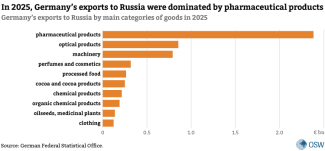
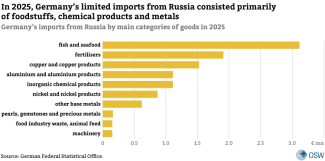
Regardless of political measures, including support for sanctions against Russia, German business intends to wait out the current situation until the Russian market reopens. According to a survey conducted at the end of last year by the German-Russian Chamber of Commerce Abroad (AHK), which represents around 750 companies operating in Russia, only 4% of German businesses – out of approximately 2,000 still operating in the country, compared with 3,600 in 2022 and around 6,000 in 2011 – plan to withdraw from Russia.[23] Although EU sanctions have significantly curtailed Germany’s economic cooperation with Russia, and the value of bilateral trade fell sharply to €8.1 billion in 2025, compared with €59.7 billion in 2021, the prospect of completely abandoning the Russian market is not regarded by most entrepreneurs as a viable option.
Among the principal goods still imported by Germany are basic commodities, including foodstuffs, fertilisers, fats and oils. Germany continues primarily to export investment goods to Russia, such as vehicles and machinery, although their importance is diminishing. In addition to the direct restrictions resulting from sanctions, trade is also complicated by logistical obstacles. The cumulative value of German foreign direct investment has likewise declined in recent years, falling to $17 billion in 2024, compared with $23.6 billion in 2021. At the same time, the government in Berlin supports maintaining the restrictions and is not signalling any intention to resume economic cooperation with Russia. The only parties consistently calling for the lifting of sanctions are the AfD and the BSW, which remains outside the Bundestag.
Outlook
For the CDU/CSU-led government, support for Ukraine has become the central pillar of its eastern policy. It is viewed as a means of containing Russia’s imperial revisionism and is used to support the narrative that Germany is assuming greater responsibility for Europe. It also forms part of Berlin’s effort to present itself to the United States as a potential intermediary between Europe and Washington, as well as a leading actor on the continent. At this stage, Berlin rejects the creation of an additional European channel of dialogue with Russia. This reflects Germany’s assessment that the Kremlin continues to pursue a war of attrition against Ukraine and is not prepared to make genuine concessions in peace negotiations. At the same time, Berlin does not rule out resuming dialogue with Moscow in the future. However, it makes this conditional on circumstances arising that would justify such a step, for example a peace agreement between Russia and Ukraine, and on conducting talks in a manner that would not create the impression of a return to the pre-2022 Ostpolitik. Such a perception could potentially complicate Germany’s relations with certain Central European partners. For this reason, any resumption of contacts with Russia would require Germany to continue strengthening the European pillar of NATO, maintaining its presence on the eastern flank, and sustaining assistance to Ukraine. A potential trigger for opening such a debate in Germany could be the consequences of a significant prolongation of the ongoing war in Iran, particularly persistently high energy prices and supply shortages. This could intensify pressure from the German business community and wider society on the government to enter into talks with the Kremlin.
[1] See J. Gotkowska, L. Gibadło, ‘Germany’s first national security strategy: the minimal consensus’, OSW Commentary, no. 519, 26 June 2023; OSW Germany and Northern Europe Team, ‘Course adjustment: the CDU/CSU–SPD coalition agreement’, OSW Commentary, no. 660, 17 April 2025, osw.waw.pl.
[2] ‘Gefährdungen durch russische Spionage, Sabotage und Desinformation’, Bundesamt für Verfassungsschutz, Köln, May 2025, bfv.de.
[3] M. Bewarder, J. Diehl, F. Flade, ‘BKA zählt mehr als 320 Sabotage-Verdachtsfälle’, Tagesschau, 5 February 2026, tagesschau.de.
[4] ‘Rede des Kanzlers bei der IHK Halle-Dessau: Mehr Leistung, weniger Bürokratie in Wirtschaft und Mittelstand’, Die Bundesregierung, 14 January 2026, bundesregierung.de. He made similar remarks during the election campaign ahead of the Lower Saxony election in October 2022, when he stated that the normalisation of relations with Russia “is currently impossible, but in the longer term – without Putin – there is no alternative to cooperation from Lisbon to Vladivostok”.
[5] K. Frymark, ‘A return to conservatism: the CDU’s new platform’, OSW, 8 May 2024, osw.waw.pl.
[6] ‘Regierungserklärung des Bundeskanzlers Friedrich Merz’, Die Bundesregierung, 16 October 2025, bundesregierung.de.
[7] ‘Deutscher Kanzler Merz über Putin: „Er sabotiert, er spioniert, er mordet”’, Die Presse, 17 September 2025, diepresse.com.
[8] ‘Questions to Chancellor Merz about Talks with Russia | MSC 2026 | BR24’, BR24, 13 February 2026, youtube.com.
[9] Kurskorrektur für Deutschland. Koalitionsvertrag 2025–2029, p. 122, koalitionsvertrag2025.de.
[10] L. Gibadło, K. Sienicki, ‘Germany-Ukraine intergovernmental consultations: security as the foundation of a strategic partnership’, OSW, 16 April 2026, osw.waw.pl.
[11] ‘Europa im Klassenzimmer: Kanzlerbesuch am Carolus-Magnus-Gymnasium’, Der Bundeskanzler, 30 April 2026, bundeskanzler.de.
[12] Ł. Maślanka, S. Matuszak, I. Wiśniewska, ‘A bitter compromise over the EU’s financial assistance to Ukraine’, OSW, 19 December 2025, osw.waw.pl.
[13] L. Gibadło, K. Sienicki, ‘Germany-Ukraine intergovernmental consultations...’, op. cit.
[14] “I want to say on my own behalf and on behalf of the federal government that we do not rule out any possibility” – see ‘Frieden für die Ukraine weiter vorantreiben’, Der Bundeskanzler, 6 January 2026, bundeskanzler.de.
[15] ‘Friedenssicherung in Europa durch Verteidigungsfähigkeit, Rüstungskontrolle und Verständigung’, Erhard-Eppler-Kreis, 11 June 2025, erhard-eppler-kreis.de.
[16] M. Schulte, ‘Armin Laschet fordert direkte Gespräche mit Russland und „mehr europäisches Selbstbewusstsein“’, Neue Osnabrücker Zeitung, 14 February 2026, noz.de.
[17] B. Ritzer, ‘SPD-Debatte über Ukraine-Krieg: Ringen um den Draht zu Putin’, Süddeutsche Zeitung, 21 March 2026, sueddeutsche.de.
[18] Regierungsprogramm der AfD Sachsen-Anhalt, April 2026, afd-regierungsprogramm.de.
[19] ‘ARD-DeutschlandTREND Dezember 2025’, Infratest dimap, December 2025, infratest-dimap.de.
[20] See K. Frymark, ‘Germany is cutting benefits for refugees from Ukraine’, OSW, 20 November 2025, osw.waw.pl.
[21] Markus Lanz’s TV show with the participation of Tino Chrupalla and other guests, ZDF, 11 November 2025, zdf.de.
[22] K. Frymark, ‘Fear of change. The social costs of the Zeitenwende’ [in:] A. Kwiatkowska (ed.), Making up for lost time. Germany in the era of the Zeitenwende, OSW, Warsaw 2023, osw.waw.pl.
[23] ‘Geschäftsklima in Russland. Deutsche Firmen wollen trotz Sanktionen in Russland bleiben’, Tagesspiegel, 1 January 2026, tagesspiegel.de.