More than life at stake: the uncertain future of the Kadyrov regime in Chechnya
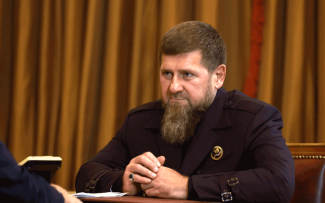
The regime of Ramzan Kadyrov, which governs the Chechen Republic, enjoys a level of internal autonomy vis-à-vis Moscow that is unparalleled within the Russian Federation, thereby conferring on Chechnya a distinct status compared with other federal subjects. This situation is the result of an unwritten arrangement that has been in place for over two decades between Vladimir Putin and Kadyrov, grounded in their personal relationship.
However, the future of the Kadyrov regime remains uncertain. Recurring reports of his incurable and progressive illness appear to be at least partially substantiated. In recent years, the region’s leader has been consolidating power within his family and strengthening the position of his children within the system. These measures are most likely intended to secure dynastic continuity in the event of his death. The decision regarding succession rests with the Kremlin. From the perspective of the Russian authorities, tighter subordination of Chechnya would constitute a more advantageous option. Any potential revision of the existing model of relations with the republic, however, would be likely to encounter resistance.
Chechnya as a ‘sovereign duchy’
Ramzan Kadyrov’s father, Akhmad Kadyrov – a mufti originating from the Benoy teip, one of the largest Chechen teips (traditional territorial and kinship-based structures akin to clans) – ruled Chechnya from 2000 to 2004 under an arrangement concluded with the Kremlin at the outset of the Second Chechen War.[1] In exchange for extensive political and financial support, the new authorities in Grozny committed themselves to loyalty to Moscow, the maintenance of stability in the region, and the suppression of separatist tendencies, as well as the influence of radical Islam. Following Akhmad Kadyrov’s death in a bomb attack in 2004, Putin informally designated his son as his successor.
Ramzan Kadyrov has ruled Chechnya single-handedly and without interruption since 2007, when he reached the legally required age of 30 for the post of regional head (having previously served as prime minister) and replaced the then president, Alu Alkhanov.
His authority within the republic and his privileged position within the Russian system of power rest on three pillars: direct access to Putin (and, consequently, near-total impunity in his actions), federal financial transfers (in 2024, Chechnya officially received approximately 121 billion roubles – $1.3 billion – from the centre, accounting for 82% of its budget revenues), and his own law enforcement/paramilitary structures (formally subordinate to federal ministries but de facto autonomous; prior to 2022 they numbered fewer than 10,000 personnel, but following the launch of the invasion of Ukraine they have expanded to over 20,000).
Kadyrov’s loyalty to the Kremlin is primarily personal rather than institutional. He provides the Putin regime with a range of specific services in both domestic and foreign policy: among other things, he participates in the intimidation of the opposition at home and abroad (including through political assassinations – for example, that of Boris Nemtsov in Moscow in 2015) and supports Russian diplomacy, particularly in the Middle East,[2] he also plays an active role in the war in Ukraine. By the end of 2025, Chechen units (subordinated to the Ministry of Defence, the National Guard of Russia, and the Ministry of Internal Affairs) deployed on the front were estimated to number around 14,000 personnel.[3] Prior to the full-scale invasion, so-called kadyrovtsi also took part in combat operations in Ukraine’s Donbas and in Syria.
The Kadyrov regime – based on close family members and loyal associates (often related to the Kadyrov family and/or, like them, originating from the village of Tsentoroy, now Akhmat-Yurt) – has, through repression, corruption, and nepotism, taken control of all spheres of public life in Chechnya. In 2025, around one hundred individuals linked to the leader held positions within the republican state apparatus or in enterprises affiliated with it.[4] The authorities in Grozny effectively operate in an openly extra-legal manner, functioning beyond the framework of Russian law.[5] With the Kremlin’s tacit consent, they arbitrarily persecute internal opposition figures and homosexuals, as well as abduct (and in some cases kill) women who have fled their families in Chechnya; they have also subordinated regional traditional media (and, to a lesser extent, social media) and religious organisations. Kadyrov’s inner circle effectively controls the region’s economy by taking over local businesses or extorting payments from them, as well as forcing competitors to withdraw (a practice that has affected even nationwide actors such as Yandex Taxi and the Lenta hypermarket chain).
The regime in Grozny also operates beyond the borders of the republic, for example by seeking to interfere in the domestic politics of neighbouring Ingushetia.[6] In 2024, Kadyrov effectively disrupted – without facing any consequences – the merger of the e-commerce platform Wildberries with the advertising company Russ, a process overseen by the Russian Presidential Administration, triggering a shooting incident in central Moscow.[7] His affiliates have taken over enterprises in the occupied territories of Ukraine (e.g. industrial facilities in Mariupol) as well as the assets of Western businesses in Russia (e.g. Danone), and they also conduct business activities in Germany, the United Arab Emirates, and other countries. Operating in Europe and across the post-Soviet space, the regime likewise leverages its influence within the Chechen diaspora, as well as its links to organised crime and combat sports circles.
Kadyrov expands his personal wealth and finances the implementation of covert tasks assigned to him by the Kremlin through the Akhmad Kadyrov Foundation (which is subject to EU and US sanctions), formally headed by his mother, Aimani. The opaque finances of this ‘charitable’ organisation (operating within Chechnya, across Russia and abroad – for example in Syria and Palestine – as well as in the occupied territories of Ukraine) are funded, among other sources, by resources derived from levies imposed on employees of the republic’s public sector (in the form of compulsory salary deductions), the embezzlement of public procurement funds, and similar practices. In 2025, the foundation is reported to have allocated more than 42 billion roubles (approximately $550 million) to support the war in Ukraine.[8]
Among the few factors limiting Kadyrov’s influence is his lack of control over the republican branches of Russia’s security agencies, in particular the FSB (whose Chechen directorate is the largest regional branch in the country), and, to a lesser extent, the Investigative Committee of the Russian Federation and the prosecutor’s office.[9] These bodies, however, rarely interfere in the internal affairs of the region; they are most likely focused on gathering compromising material on the leader and his inner circle.
Despite his unique position within the Putin system of power, the leader of Chechnya has been unable to place his close associates in key positions at the federal level. He unsuccessfully lobbied, for example, for the appointment of his long-time aide Daniil Martynov as deputy commander of the National Guard of Russia (he was ultimately appointed as an adviser to the Minister for Emergency Situations). Former chairmen of the government of Chechnya – Ruslan (Abubakar) Edelgeriyev and Muslim Khuchiyev – currently serve as aides to the President of the Russian Federation and the Prime Minister, respectively. These positions, however, do not entail significant influence. Edelgeriyev advises Putin on climate issues, while Khuchiyev deals with regional matters, which are in practice, largely dominated by the Presidential Administration.
The limited presence of Kadyrov’s associates at the federal level stems from resistance among Russian elites, who are broadly hostile to his status and the impunity he enjoys. Moreover, the Chechen leader frequently comes into conflict with figures close to Putin. His opponents include the head of the Investigative Committee of the Russian Federation, Aleksandr Bastrykin; the Kremlin spokesperson, Dmitry Peskov; the Minister of Internal Affairs, Vladimir Kolokoltsev; and Vladimir Medinsky, an aide to the President of the Russian Federation and head of the Russian Military Historical Society.
An open secret: Kadyrov’s progressive illness
The first rumours of Ramzan Kadyrov’s incurable illness emerged as early as 2019. Although this remains in the realm of speculation (with conditions such as pancreatic necrosis and associated renal failure mentioned), his health has visibly deteriorated since 2023. This has been reflected in the leader’s activity – he takes leave more frequently, appears in public less often, and has increasingly delegated routine meetings to his subordinates.
Unconfirmed reports continue to appear regularly in the media regarding further serious health incidents, Kadyrov’s stays in clinics in Grozny, Moscow, and Dubai, and the procedures he is allegedly undergoing there. These include, for example, dialysis (to which his work schedule is said to be subordinated), and in 2025 he was reportedly subjected to a nephrotomy.[10]
Kadyrov himself denies that he is ill.[11] He has also expressed his readiness to stand in the ‘election’ for the post of head of Chechnya, scheduled for September 2026 (in other North Caucasian republics, leaders are selected by regional parliaments from among candidates nominated by the President of Russia).
Affiliations, balance of power and future plans
As rumours of Kadyrov’s progressive illness have intensified since 2023, he has moved to consolidate both internal and external influence in the hands of his family and closest associates. This process has involved the gradual formalisation of control over the regime’s instruments – political, economic, and security-related – as well as the establishment of new affiliations and networks of dependency, with the leader himself and his children at their centre.
Among Kadyrov’s numerous offspring (he has 12 biological children and two adopted sons), the leading roles are played by his eldest sons – Akhmat, Zelimkhan (Ali/Eli) and Adam – as well as his eldest daughters – Aishat, Khadizhat (Karina), Khutmat (Khedi), and Tabarik.
Their father has arranged their marriages (concluded before they reached the age required under Russian law), primarily with the children or relatives of his close associates. In this way, he has strengthened the ties between his supporters and the family, relying on their loyalty, while also increasing the regime’s internal cohesion.
Kadyrov has begun entrusting his children with numerous functions – most notably Adam, widely regarded as his father’s favourite, for whom positions linked to the law enforcement and paramilitary sectors have been created. Akhmat (previously seen as the likely successor) was appointed acting deputy prime minister in January 2026. Zelimkhan oversees combat sports circles. In order to strengthen his sons’ position and prestige, their father arranged meetings for them with Putin in the years 2023–2025.
Kadyrov’s daughters, who had initially held governmental posts, were withdrawn from political functions by their father in 2025 (these roles are now performed by their husbands); they were instead entrusted with managing family-owned businesses, as their status as public officials would have precluded them from engaging in commercial activity. Their personal data have been concealed in the Russian register of legal entities.[12]
Table. Ramzan Kadyrov’s children are playing an increasingly prominent role within the Chechen authorities and elite structures
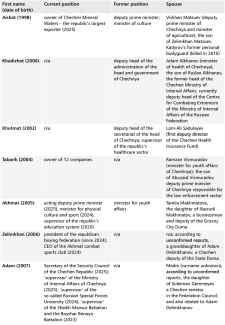
Source: author’s own research based on official information and media reports.
At the same time, the position of Magomed Daudov (alias ‘Lord’), appointed Prime Minister of Chechnya in 2024, has steadily strengthened. As Kadyrov’s public activity has declined, Daudov (previously Speaker of parliament, responsible for internal repression, and since 2022 secretary of the regional branch of the ruling United Russia party) has begun to assume an increasing share of his administrative functions and day-to-day responsibilities, and has even held meetings at the federal level. It may be assumed that Akhmat Kadyrov Jr., appointed to the post of deputy prime minister, is intended to exercise oversight over his formal superior.
The post of acting deputy prime minister has also been assumed by Akhmed Dudayev – an aide to the head of Chechnya and minister for national policy, external relations, the press and information. He plays a key role in overseeing the media and directing propaganda. As a trusted associate of Kadyrov, he is likely intended to support Akhmat while also managing information concerning the leader’s illness and any prospective transfer of power in Grozny.
Unlike other members of Kadyrov’s inner circle, Ruslan (Abubakar) Edelgeriyev, Putin’s climate adviser, has never been accused of human rights violations and has not been subject to international sanctions. Representing Russia abroad and having access to federal institutions, he is intended to facilitate the Chechen leader’s children’s contacts with the federal level of power. Edelgeriyev is reportedly held in high regard by Aishat Kadyrova.
One of the most influential figures in the republic – Adam Delimkhanov, a cousin of the Kadyrov family, a close associate of the leader and a deputy of the State Duma – has significantly curtailed his public activity. He has been responsible, among other things, for internal repression and the organisation of political assassinations, and has also participated in the invasion of Ukraine. The reasons for his reduced activity remain unclear. According to some sources, Delimkhanov has been instructed to focus more closely on his role as a ‘mentor’ to Adam Kadyrov, supporting him, for example, through his links to organised crime in Russia and abroad.[13]
The role of Apti Alaudinov in the current balance of power within the republic remains unclear. A major general of police and former deputy head of the Chechen Ministry of Internal Affairs (responsible, among other things, for internal repression), he fell out of favour and left the republic in 2021. The Grozny regime’s involvement in the invasion of Ukraine, however, has restored his standing and accelerated his career. In 2022, despite lacking military experience, Alaudinov assumed command of the ‘Akhmat’ Special Rapid Response Unit (SOBR), formally subordinated to the National Guard of Russia. In 2024, he was appointed deputy head of the Main Military-Political Directorate of the Armed Forces of the Russian Federation (equivalent to a deputy minister of defence) and was granted the military rank of lieutenant general. His influence within Chechnya remains limited, but he is regarded as a figure enjoying Moscow’s backing. During the war, he has gained prominence in nationwide Russian media; he has also begun to distance himself from the Grozny regime and to promote the narrative of the ‘Russkiy mir’ (Russian World). His pro-Kremlin activity thus calls into question his loyalty to Kadyrov.
It is not possible to verify media reports concerning Kadyrov’s alleged succession plans.[14] It nevertheless appears that the ongoing consolidation of instruments of power in Chechnya, as well as the internal strengthening of the regime, is at least partly linked to his deteriorating health.
Kadyrov’s internal actions are aimed at restructuring the pillars of power so that, following the death of the head of the family, it may – either directly or through closely affiliated figures – retain its political and economic position, control over the law enforcement structures, and the security guarantees (both external and internal) deriving from the provisions of the unwritten agreement with Putin. Although Kadyrov effectively holds a lifetime mandate to govern Chechnya, it is doubtful that the Kremlin would automatically extend this arrangement to his children.
None of Kadyrov’s sons has yet reached the age required to assume power in the region. His daughter Aishat will reach it in 2029; however, given the social conservatism prevailing in Chechnya (where a woman formally becomes part of her husband’s teip), her designation as a potential successor appears unlikely. This is further underscored by the withdrawal of her and her sisters from governmental positions.
Media reports regarding plans to appoint a ‘regent’ (with figures such as Delimkhanov and Daudov mentioned among the potential candidates), who would govern after Kadyrov’s death until one of his sons reaches the required age, are likewise impossible to verify. The same applies to alternative scenarios – for example, the division of governmental posts among his children and the establishment of a collective system of governance.
The dynamics of political processes within the republic are therefore of secondary importance. Regardless of Kadyrov’s intentions and his efforts to secure the position of his family and regime, decisions concerning Chechnya’s future will ultimately be taken in the Kremlin.
Moscow locuta, causa finita
Moscow remains silent on the issue of Kadyrov’s health and, at present, does not signal that it is preparing for a scenario involving a change of power in Chechnya. It should be assumed, however, that the matter is the subject of ongoing scrutiny and behind-the-scenes negotiations. According to independent media reports, there is no consensus within the Kremlin regarding a successor, and various actors (such as the FSB or the Presidential Administration) have their own preferred candidates. The prospects for maintaining the current model of governance in the republic are likewise unclear. A power vacuum at the top of the authority in Grozny would undoubtedly pose a political dilemma for the federal centre.
Kadyrov’s death would create an opportunity to curtail the internal autonomy of the Chechen regime. This would be consistent with the Kremlin’s centralising logic, which has involved the systematic tightening of control over the regions. The original premises underpinning the current model of governance have also ceased to exist: separatist tendencies in the region have been effectively eliminated, while the insurgency invoking radical Islam that has re-emerged in recent years in the North Caucasus has manifested itself in Chechnya only to a limited extent (and only partly as a result of the policies pursued by the authorities in Grozny).[15] It is also necessary to take into account the prevailing resentment among Russian elites towards the impunity enjoyed by Kadyrov and his inner circle.
The dismantling of Kadyrov’s structures and mechanisms would require the appointment of a new head of the republic – originating from Chechnya (yet only loosely connected to the Kadyrov regime) and subordinate to Moscow – as well as the staffing of key ministries with similarly aligned figures. The restoration of direct federal control over Chechnya would primarily entail taking over Kadyrov’s security apparatus, in particular the Ministry of Internal Affairs. The federal authorities appear to be preparing for such a scenario – in 2023, Dmitry Kechkin, experienced in operations in the North Caucasus, was appointed head of the Chechen directorate of the FSB. He had previously served in Dagestan and Ingushetia, where he was involved in countering structures linked to Kadyrov.[16]
It is also unclear to what extent the Kadyrov regime enjoys support among the population of Chechnya. A lack of a swift response from Moscow in the event of the leader’s death could lead to unrest (in a worst case scenario – even armed clashes) within the republic (for example, as a result of the mobilisation of groups marginalised by Kadyrov), as well as to a strengthening of Islamist influence.
International dynamics, particularly in the context of the war in Ukraine, may in turn incline the Kremlin – focused on other priorities – to preserve the status quo in the republic and maintain its highly autonomous system of governance. At the same time, it appears unlikely that any of Kadyrov’s children would be designated as the future leader. A regency scenario would risk triggering a struggle for power among factions within the family’s entourage (despite efforts to unify them around the leader’s children) and destabilising the situation in the region.
From the perspective of the federal centre, a more favourable option may be the appointment of a figure from Kadyrov’s inner circle who is not compromised at the all-Russian level and is more amenable to control (which reduces the prospects of Delimkhanov while favouring Daudov). It also cannot be ruled out that Moscow may turn to less politically prominent figures and/or more distant relatives of Kadyrov (for example, the mayor of Grozny, Khas-Magomed Kadyrov), who would seek its patronage.
Regardless of the actual state of health of the head of Chechnya, the issue of succession in the republic will inevitably intensify over time. Any potential solution, however, entails specific risks for the Kremlin. The factors that Moscow will have to take into account in making its decision include the balance of power within the republic and the stability of the governing regime, security considerations, the local socio-economic structure, the still vivid collective memory of the two Chechen wars, the interests of various actors at the federal level, the broader situation in the North Caucasus, the logic of Putin’s centralising policy, and the dynamics of international developments.
At present, it appears that in the event of Kadyrov’s death the Kremlin would have considerably more reasons to dismantle the highly autonomous system of governance and tighten its control over Chechnya. In such a scenario, however, Moscow should expect resistance from local elites. Having derived substantial benefits from the region’s special status, these elites have a vested interest in preserving the existing model of relations with the federal centre. Alongside the assumption of control over Kadyrov’s law enforcement structures, the key to establishing full authority over the republic would therefore lie in the effective co-optation of the actors constituting the current regime in Grozny.
It is doubtful, however, that efforts by the Kremlin to tighten its control over Chechnya would rekindle separatist sentiments there. Such tendencies, having been suppressed by the Kadyrov regime, might instead re-emerge under conditions of a significant weakening of central authority in Russia and a reduction in federal financial transfers. At present, however, this appears to be an unlikely scenario.
[1] During the First Chechen War (1994–1996), Akhmad Kadyrov, as the chief mufti of the separatist Chechen Republic of Ichkeria, was a leading figure in the anti-Russian resistance. At the outset of the Second Chechen War (1999–2009), he shifted his allegiance towards Moscow. The Kremlin’s decision to conclude an agreement with Kadyrov formed part of its policy of so-called ‘Chechenisation’ – that is, transforming the conflict into an internal dispute and delegating responsibility for the situation in the region to local, nominally pro-Russian elites.
[2] For example, Kadyrov has acted as an intermediary in contacts between Russia and Qatar on the issue of Syria, where Moscow has sought to maintain a military presence following the overthrow of Bashar al-Assad’s regime in December 2024. He also frequently takes part in Putin’s meetings with leaders of Arab states – for example, during the most recent visit of the President of the United Arab Emirates to Moscow on 29 January 2026. In the past, the Chechen leader has also been capable of influencing the official course of Moscow’s foreign policy – for instance, with regard to the situation of the Muslim Rohingya population in Myanmar (Burma). See M. Domańska, W. Górecki, ‘Russia’s foreign policy – concessions to Kadyrov’, OSW, 6 September 2017, osw.waw.pl.
[3] According to Kadyrov, by January 2026 a total of 76,440 individuals (including 23,774 volunteers) had been sent from the republic to Ukraine. However, the actual figure is most likely several times lower due to the rotational nature of the deployment of Chechen forces. The so-called kadyrovtsi primarily perform policing functions. According to independent estimates of Russian losses, by mid-January 2026 approximately 400 fatalities from Chechnya had been identified. The relatively small number of units engaged in direct combat consists to a significant extent of fighters from outside the republic – for example, following Yevgeny Prigozhin’s mutiny, around 3,000 Wagner Group mercenaries were incorporated into the Ministry of Defence’s 204th ‘Akhmat’ Special Forces Regiment. The recruitment of volunteers is at least partly financed by Kadyrov himself. It is conducted, among other organisations, through the so-called Russian Special Forces University named after Vladimir Putin in Gudermes – a private training centre established by him (and financed by the businessman Movsadi Alviev), which nevertheless also receives funding from the federal budget. In addition, Chechen opponents of the regime are sent to the front as a form of punishment.
[4] ‘По закону гор’, Проект, 11 November 2025, proekt.media.
[5] A case in point is that of Nikita Zhuravel, who in 2023 was accused of burning a copy of the Quran in Volgograd. He was, however, unlawfully transferred to the jurisdiction of a court in Grozny, which in 2024 sentenced him to three and a half years in a penal colony. During his detention in a Chechen remand centre, Zhuravel was beaten by Ramzan Kadyrov’s son, Adam. The head of the republic made footage of the incident public. Chechen politicians praised Adam Kadyrov’s actions, and the investigation into the case was discontinued amid the passive stance of the Russian Human Rights Commissioner, Tatyana Moskalkova.
[6] In September 2018, Chechnya and Ingushetia signed an agreement on the delimitation of the border between the two republics (which in the Soviet period had formed a single entity – the Chechen–Ingush Autonomous Soviet Socialist Republic within the Russian Soviet Federative Socialist Republic). The agreement favoured Chechnya, triggering significant public protests in the neighbouring republic. In 2025, Kadyrov was reportedly supporting the establishment of a new muftiate in Ingushetia dependent on him.
[7] In the dispute surrounding Wildberries, the parties involved – the company’s owner and Russia’s wealthiest woman, Tatyana Bakalchuk (now Kim), and her then husband, Vladislav – placed themselves under the protection of influential actors. Kim was backed by the oligarch and senator from Dagestan, Suleiman Kerimov. Bakalchuk, in turn, was supported by Ramzan Kadyrov, who accused Kerimov of commissioning an attempt on his life. In January 2026, a symbolic reconciliation between Kerimov and Kadyrov took place. Under a confidential arrangement, reportedly brokered by Putin himself, the Chechen leader was said to have received ‘compensation’ amounting to nearly $2 billion.
[8] ‘Фонд Кадырова в 2025 году направил более 42 млрд рублей на нужды бойцов СВО’, ТАСС, 14 December 2025, tass.ru.
[9] In 2013, Kadyrov forced Moscow to dismiss the newly appointed head of the Chechen branch of the Investigative Committee, Major General Sergei Bobrov, who had been investigating crimes committed by his aides. Although in 2022, after ten years in office, Kadyrov’s ally Sharapuddi Abdul-Kadyrov was removed from the post of prosecutor, its activity declined rather than increased.
[10] ‘ФСБ следит за здоровьем Рамзана Кадырова: врачи установили ему нефростому’, Вёрстка, 11 September 2025, verstka.media.
[11] ‘Кадыров вышел в прямой эфир после слухов о госпитализации из-за болезни почек’, Коммерсант, 14 January 2026, kommersant.ru.
[12] ‘Двух дочерей Кадырова скрыли в реестре юрлиц после того, как на одну из них переписали завод с активами на 3 млрд рублей’, Вёрстка, 24 March 2025, verstka.media.
[13] ‘Возвращение «молодого Рамзана»’, Новая газета Европа, 5 May 2025, novayagazeta.eu.
[14] Some sources also report parallel preparations to relocate the family and transfer its assets to the Middle East (for example, to the United Arab Emirates) in the event of Kadyrov’s death. Р. Анин, Н. Кондратьев, ‘Кадыров вступил в конфликт с Кремлем, говорят источники «Важных историй»’, Важные истории, 27 March 2025, istories.media.
[15] M. Bartosiewicz, ‘Increasing radicalisation: terrorist attacks in Dagestan’, OSW, 25 June 2024, osw.waw.pl.
[16] In Dagestan, Kechkin took part in an operation targeting senior regional officials, including Sagid Murtazaliyev – a deputy and head of the regional branch of the Pension Fund (currently in hiding abroad). Kadyrov unsuccessfully attempted to intervene on his behalf. As head of the FSB directorate in Ingushetia, Kechkin also acted against the so-called Batal Hajji brotherhood – a religious Sufi community resembling a sect, closely linked to Kadyrov (with around 20,000 members and an armed wing designated as a terrorist organisation in Russia). Kadyrov’s interventions in its defence likewise proved ineffective.