The truce at Oleshky. Day 1707 of the war

On 27 October at 3.00 am Kyiv time, a ceasefire aimed at facilitating a humanitarian mission came into effect in the occupied town of Oleshky on the River Dnipro. The town is on the left bank of the river, opposite Kherson, and the Russians had been using it as a convenient position from which to carry out shelling and drone attacks on the capital of Kherson Oblast. Combined with Ukrainian defensive operations, this led to a humanitarian disaster. Unlike the Ukrainian forces, who are organising the compulsory evacuation of civilians from the frontline zone, the Russians have left the population to fend for themselves. On 23 October, the office of US First Lady Melania Trump announced that an agreement had been reached on a ceasefire to allow for the delivery of aid and the possible evacuation of the residents of Oleshky who wish to leave. The ceasefire was due to come into effect on 29 October, but the warring parties agreed to bring the date forward. According to preliminary reports, the ceasefire is being observed.
Ukrainian forces continue to hold the initiative to the north and east of Sloviansk, though they have not made any significant territorial gains. Further attempts to establish bridgeheads on the eastern bank of the Zherebets River and to dislodge Russian troops from their positions on the hills between Sloviansk and Siversk have ended in failure. Furthermore, groups of Russian soldiers are reportedly still infiltrating Lyman, which prevents the establishment of stable control over the town. Nevertheless, the Ukrainians remain on the offensive, and the local Russian command has so far not decided to reinforce its units engaged in the combat.
The Russians have advanced into further neighbourhoods of Dobropillia, but have been unable to expand their zone of control, which still ends at the outskirts of the town. One success it has had is the intensifying infiltration of areas to the north and west of Dobropillia, where Russian soldiers are primarily carrying out sabotage and reconnaissance missions and eliminating Ukrainian drone control posts. Russian operations in the Druzhkivka area are of a similar nature, whilst analogous sabotage operations by Ukrainian forces on the northern outskirts of Kostiantynivka serve primarily to demonstrate a presence. Intensifying Ukrainian attacks on Komar, in the part of Donetsk Oblast bordering Dnipropetrovsk Oblast, have forced the Russian command to send reinforcements there, which is likely to stabilise the front in this area.
Russian forces have captured further neighbourhoods in Kupiansk and reached the western outskirts of the town; however, they are unable to maintain control over the territory they have seized. The Ukrainians are holding out mainly in the southern part of the town; however, as is the case with Russia, their presence does not translate into control over the occupied area. For both sides, the main obstacle to stabilising their presence is the high level of activity by unmanned systems. It is likely that the Russians have taken part of the village of Kupiansk-Vuzlovyi – situated south of Kupiansk, on the eastern bank of the Oskil River.
Ukrainian forces launched a counterattack in the Orikhiv area of Zaporizhzhia Oblast, where they re-entered Mala Tokmachka. However, the front line there remains relatively stable, with minor shifts in favour of both sides, as is the case in the border regions of the Kharkiv and Sumy oblasts.

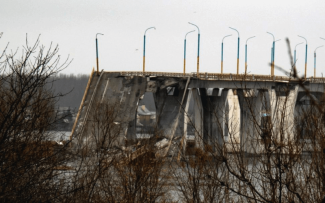
The Russians carried out further missile strikes on Kyiv, with energy infrastructure as their main target. On the night of 22 October, the TEC-4 and TEC-5 combined heat and power plants were damaged once again, as was the South Bridge located near the latter (where metro infrastructure was damaged) and the Antonov Aviation Plant. Damage was reported in six districts of the city; one person was killed and 22 were injured, including four children. Depending on the source, Russia fired between 21 and 30 missiles, none of which were shot down. The next missile strike on Kyiv was reported to have taken place in the early afternoon. On the evening of 26 October and during the night of 27 October, Russian missiles struck the TEC-5 combined heat and power plant once again, whilst the South Bridge was also damaged and closed to traffic until further notice. Hits were also reported in the eastern and northern parts of the city. One person was killed and 15 were injured. According to OSINT data, the Russians fired 20 ballistic missiles, of which, as reported by the Ukrainian Air Force Command (UAFC), two were shot down.
Russian drone attacks on Kyiv and Kyiv Oblast continued unabated. Following a strike on the 330 kV Novokyivska substation on 20 October, four districts of the Ukrainian capital were periodically cut off from the electricity supply. One person was killed and 20 were injured in the city. A day later, transport infrastructure was damaged, and emergency power cuts occurred in three districts and the Bucha Raion near Kyiv. Damage was also reported to buildings at Kyiv University (on 21 October, Russian drones also struck higher education institutions in Uman in Cherkasy Oblast and Kremenchuk in Poltava Oblast). On 23 October, the 330 kV Northern substation in the Vyshhorod Raion was damaged. As a result of earlier strikes, on 25 October the power grid failed in three districts of Kyiv and the Bucha Raion.
Attacks on energy, industrial, logistics and transport infrastructure across the whole of Ukraine have become a constant feature. From the evening of 20 October until the morning of 27 October, there were daily strikes using drones, and occasionally missiles, in the oblasts located directly behind the front line, including the major cities – Kharkiv, Dnipro and Zaporizhzhia – as well as in the central and western parts of the country, through which Ukraine’s main supply routes from abroad run (particularly in the Vinnytsia and Zhytomyr oblasts). Notable examples include:
- the strikes on the Prydniprovska thermal power station in Dnipro, which lasted several days and which most likely caused it to cease operations on 23 October;
- a missile strike on the market square in Lozova in Kharkiv Oblast, in which three people were killed and 34 were injured;
- an attack on energy infrastructure in Zhytomyr Oblast on 23 October, causing most of the oblast (over 900 localities and 750,000 customers) to be temporarily cut off from the electricity supply;
- a strike on railway infrastructure in Poltava on 23 October, which resulted in a shockwave and damage to the surrounding area;
- an attack on the Dnipro Hydroelectric Power Station in Zaporizhzhia on 24 October, which brought traffic on its causeway to a standstill; the day before, a cable-stayed bridge in the city had been hit;
- an attack on energy infrastructure in the Konotop area of Sumy Oblast on 24 October, which left the town with electricity at all and partially without gas, with no prospect of when supplies will be restored;
- an attack on the Zmiivska Thermal Power Station in the village of Slobozhanske in Kharkiv Oblast on 24 October;
- the destruction of Epicentr shopping centres in Kharkiv, Poltava, Vinnytsia and Zaporizhzhia on 25 October;
- an attack on the Dniester Hydroelectric Power Station in Chernivtsi Oblast, near the border with Moldova, on 26 October.
Power substations were also hit in the Kharkiv, Khmelnytskyi, Ivano-Frankivsk, Lviv, Odesa, Poltava, Rivne and Volyn oblasts, as well as the Kanatove airbase in Kirovohrad Oblast (due to a missile strike on 26 October).
On 23 October, off the coast of Romania, the Comoros-flagged general cargo ship ‘Khoryv’ sank after being struck by a Russian drone. One sailor was killed and three were reported missing (the crew consisted of ten Ukrainians and three Azerbaijani nationals). It was the fourth vessel to be sunk in a Russian attack since the start of the month. On 25 October, the Financial Times published a report suggesting that the Black Sea is far more dangerous for shipping than the Persian Gulf. Since the start of this year, 570 vessels have been attacked, with 40 seafarers killed on board. In July 2026, Ukraine launched massive strikes against Russian shipping, but by September the intensity of these attacks had dropped significantly, in contrast to similar operations carried out by the Russians. Over the last 45 days, it is thought that Russia has been responsible for 90% of the attacks on ships in the Black Sea. The FT cites data from TIS, Ukraine’s largest private port operator, according to which the so-called ‘Greater Odesa’ handled ten ships in September, compared with 400 in July. Nor do Ukraine’s Danube ports, which have significantly lower capacity, guarantee safety.
The official restoration of full access to the Starshield system for Ukraine on 23 October did not translate into an improvement in the reported effectiveness of its air defence. According to UAFC reports, there was even a slight decline, from over 85% between 13 and 22 October, when access was restricted, to just under 84% between 23 and 27 October. The UAFC reported that, from the evening of 20 October to the morning of 27 October, the Russians deployed a total of 1,271 attack drones and drone decoys against Ukraine, of which 1,058 were neutralised. The UAFC did not disclose the total number of Russian missiles, but stated that five were shot down during the period in question. A compilation of data from other sources suggests that Russia used 50–60 missiles, mainly ballistic missiles, in attacks on Kyiv, and that Ukrainian air defences did not shoot down any of them.

Ukrainian forces have intensified attacks on facilities supplying semi-finished products to the Russian arms industry, whilst suspending strikes against enterprises in the fuel and energy sector. On 23 October, Storm Shadow cruise missiles struck the Proton plant in Oryol. A day later, drones damaged facilities at the Tolyattikauchuk chemical complex in Samara Oblast. However, the attack on the Omsky Kauchuk plant in Omsk did not result in any significant damage. On 25 October, a drone strike caused a fire in one of the production halls at the Energia plant in Yelets, in Lipetsk Oblast, Russia’s largest battery manufacturer. On 26 October, Voronezhsintezkauchuk was targeted in Voronezh.
On 22 October, the Ukrainians carried out another massive attack on Moscow, where they failed to score any hits. Damage was reported in Serpukhov, near Moscow, and in Lipetsk in Lipetsk Oblast. According to some sources, a hit was recorded in the Serpukhov area at the ‘75 Arsenal’ military enterprise. The Moscow authorities reported that 630 Ukrainian drones were heading towards Moscow, most of which were shot down.
On 24 October, Ukrainian drones attacked energy infrastructure in occupied Crimea, causing a temporary blackout there. Energy facilities in Rostov Oblast and Krasnodar Krai were also hit.
On 25 and 26 October, the capital cities of two border oblasts – Belgorod and Voronezh – were the targets of massive Ukrainian attacks. In Belgorod, a shopping centre, was among the targets damaged; one person was killed and 14 were injured. In Voronezh, a business centre and the Voronezhsintezkauchuk plant were hit, whilst a passenger train was struck on the outskirts of the city. Two people were killed and 17 injured. These were among the first Ukrainian attacks in many months that could be described as retaliatory strikes in response to Russian attacks on Ukrainian cities. On 23 October, Ukrainian cruise missiles struck the Baltimore airbase near Voronezh. On the same day, the Ukrainian General Staff reported that an aircraft had been damaged at Yeysk airport in Krasnodar Krai.
On 20 October, the Federal Security Service (FSB) announced the arrest of an 18-year-old collaborator of the Ukrainian Military Intelligence Directorate (HUR) operating in the Mari El Republic. He was alleged to have been gathering information on, amongst other things, defence industry facilities in the region. A day later, the FSB reportedly apprehended an active-duty soldier of the Armed Forces of Ukraine, a German national with experience of serving in the Bundeswehr (including in Afghanistan). The circumstances of his arrest are unclear; according to the FSB, he had deserted from the Ukrainian army. On 22 October, a Russian citizen working for the counter-intelligence unit of the Security Service of Ukraine (SBU) was detained in Crimea. He was allegedly photographing ships of the Black Sea Fleet, as well as its infrastructure, from his own flat.
On 26 October, the FSB detained two citizens of South Caucasus countries who were allegedly preparing drone attacks on energy facilities and air defence positions around Moscow on behalf of the SBU. Their task was to retrieve drones prepared by the SBU from hideouts in the Smolensk and Kaluga oblasts, to then deploy them at designated locations in Moscow. The attack would have taken place once the drones were activated; they were to be controlled from Ukraine.

On 21 October, the SBU detained an 18-year-old man from Odesa who, on behalf of Russian intelligence, had been surveying infrastructure sites in that city and in Dnipro, and had also been planning a terrorist attack in Kyiv. His actions were intended to result in the destruction of, amongst other things, the postal terminal in Odesa. On the same day, six people were detained – two each in Zakarpattia and Cherkasy Oblast, and one each in Kyiv and Mykolaiv – for engaging in pro-Russian and anti-Ukrainian propaganda, mainly online. One of those detained is alleged to have posted around 100,000 anti-Ukrainian messages on the Telegram messaging app over a two-year period. Meanwhile, in Kramatorsk, a court sentenced a Ukrainian man to 15 years’ imprisonment for directing guided air strikes and artillery fire at Ukrainian military positions in the vicinity of the city.
A day later, the SBU detained a deserter from the Ukrainian army who had been recruited by the FSB; after leaving his unit, he had passed on to the Russians the location of a depot storing around 100 Ukrainian unmanned aerial vehicles. According to the Ukrainian side, thanks to operational measures, the traitor was identified in advance and the depot was evacuated. Meanwhile, in Mykolaiv Oblast, another deserter was detained who, after leaving his unit, had posted several videos on TikTok revealing the location of his military unit (presumably Neptune anti-ship systems). In Kharkiv Oblast, a Ukrainian man was sentenced to 15 years’ imprisonment for setting fire to two facilities belonging to Ukrainian Railways.
On 23 October, the SBU, together with the State Border Guard Service, detained a Ukrainian citizen, a veteran of the Russian Armed Forces, in Volyn Oblast. In February 2022, she was reportedly working as a nurse at a hospital in Donetsk, before joining the Russian army, where she served until August 2024. She returned to Volyn Oblast to obtain a Ukrainian passport ahead of her planned departure to one of the EU countries. On 26 October, the SBU reported the detention in Odesa of a man who had placed at least two GPS transmitters on tankers transporting petroleum products. He had been attempting to identify depots used in fuel logistics. A day later, also in Odesa, the SBU detained a 21-year-old man who, on behalf of the Russians, had been gathering information on energy infrastructure and had been involved in preparations for Russian propaganda operations in the city.

On 22 October, the HUR reported that Russia had carried out another phase of the operation codenamed ‘Illegal-2026’ in the occupied territories. This took place in the first ten days of October and was aimed at Ukrainian citizens who had not accepted Russian passports. If such individuals were identified, they were registered as foreign nationals, which allows them to be treated in accordance with migration law and, ultimately, expelled from Russian territory; in such cases, any property they hold is also confiscated. Russian citizens (often of immigrant origin) are being settled in place of the deported Ukrainians. On the same day, a propaganda teleconference took place in the occupied town of Oleshky in Kherson Oblast, in which, according to the Russians, representatives from around 80 countries took part. It was devoted to alleged war crimes committed by Ukrainian forces against the inhabitants of that area. In reality, however, it was intended to divert attention from the dire humanitarian situation of the inhabitants of Oleshky (up to 6,000 people), who have been without basic necessities for weeks.

On 22 October, another exchange of remains took place between Russia and Ukraine at the Novaya Huta border crossing between Belarus and Ukraine. According to the Ukrainian Coordination Headquarters for the Treatment of Prisoners of War, the remains of 252 people were returned to the country, whilst the bodies of 25 soldiers of the Russian Armed Forces were handed over. This was the first exchange of its kind since 17 September. A day later, the first exchange of prisoners of war since August took place. A total of 270 people returned to Ukraine, comprising 261 soldiers and 9 civilians. Among them were 38 soldiers who had been taken prisoner prior to Russia’s full-scale aggression, between 2018 and 2020.

On 11 October, the Bulgarian news agency Novinite reported that Sofia had refused to fund new arms deliveries to Ukraine via the European Peace Facility (EPF). At the same time, Bulgaria will continue to provide funding for the transfer of non-lethal military equipment. Between 2021 and 2027, the EPF budget is set to total approximately €17 billion, of which €10.8 billion has so far been spent on supporting Ukraine, including €4.7 billion to partially reimburse EU member states for the costs of military aid already delivered to Kyiv.
On 22 October, the Ukrainian Ministry of Defence signed a letter of intent with ICEYE and Nokia regarding cooperation on the development of a new satellite communications system. The first communications satellites are due to be placed in low Earth orbit in 2028. No source of funding for this project has been disclosed.
On 22 October, the Estonian Ministry of Defence announced the transfer of a further €10 million under the mechanism for the procurement of US armaments, the so-called Prioritised Ukraine Requirements List (PURL). In total, Tallinn has already allocated €31 million under this mechanism.
On 23 October, the Ukrainian Ministry of Defence announced that Denmark had completed the delivery of over 50,000 rounds of 20 mm ammunition for the onboard cannons of F-16 fighter jets.