Devastating Russian attacks on energy infrastructure. Day 1700 of the war

On the Lyman front, the Ukrainian army continues to push back the occupiers on the Shandryholove salient. Zelena Dolyna, Kolodiyazi and Lypove are reported to have been liberated, although it is most likely that the defenders’ advances in this sector may have reached as far as the Zherebets River (a fact even confirmed by some Russian sources). On 14 October, General Andriy Biletsky, commander of the Centre Group, summarised the ‘fourth phase’ of Operation ‘Vivaldi’ being carried out in this area: according to his statement, the Armed Forces of Ukraine (AFU) have liberated approximately 277 km² of territory, neutralising 8,000 enemy soldiers.
Claims by the Russian Ministry of Defence that it has captured Dobropillia are false; however, the situation for the defenders there is deteriorating. Russian forces have significantly intensified their infiltration operations, whilst concentrating troops on the outskirts and in the peripheral districts of the town to prepare for an assault on the centre of Dobropillia. However, the situation for Ukrainian forces on the Orikhiv front has improved following the arrival of substantial reinforcements in the form of the 7th Airborne Assault Corps, redeployed from the Dobropillia sector. The defenders cleared most of Orikhiv of Russian infiltration groups and regained control of the southwestern part of Mala Tokmachka.
It is unclear to what extent the suspension and subsequent slowdown of the Starlink/Starshield satellite network, which the Ukrainian government reported, affected the operations of the Ukrainian army. According to accounts from some Ukrainian military personnel, ‘technical problems’ with the terminals are said to have significantly reduced the use of medium-range drones used to strike directly at the Russian army’s rear. According to a statement by President Volodymyr Zelensky, the network’s operational speed remains limited to 161 km/h. According to media reports, the Starshield system was previously said to enable drones to reach speeds of 400 km/h.

Over the past week, the Russians have stepped up the scale of their air strikes, doubling the number of attack drones deployed compared with the previous period. According to estimates by the Ukrainian Air Force Command, between the evening of 13 October and the morning of 20 October, Russia deployed an undisclosed number of cruise and ballistic missiles, as well as 2,256 Shahed-type attack drones (574 of which were jet-powered, accounting for 25% of the total used), Gerber, Banderol/Dan-T, Italmas and Parodiya-type decoy drones. Ukrainian air defences reported that they had neutralised 1,942 unmanned aerial vehicles (86%), including 419 jet-powered ones, which equates to a 73% success rate in countering jet-powered drones during the period under review.
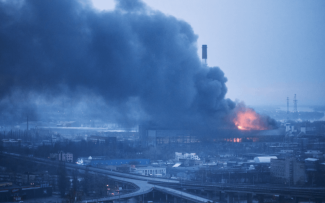
Energy infrastructure facilities in the capital and Kyiv Oblast were the main targets of the daily attacks. Two massive air strikes, carried out on the nights of 13–14 October and 16–17 October, were among the most severe attacks on facilities belonging to the state transmission system operator Ukrenergo since the start of the full-scale invasion. On 13 October, among Russia’s targets werethree Kyiv combined heat and power plants, a water pumping station, and a nine-storey residential building (at least three people were killed and over 20 were injured). As a result, around 600,000 customers in Kyiv were left without electricity and water. Meanwhile, in an attack carried out on 16 October, more than 15 key electricity generation and transmission facilities were shelled (leading to emergency power cuts in the capital and parts of Kyiv Oblast).
On 16 October, Vinnytsia Oblast was hit by one of the largest Russian air strikes since the start of the full-scale invasion, targeting civilian and critical infrastructure. As a result, power supplies to Vinnytsia were completely cut off, forcing critical infrastructure facilities to switch to backup power sources. Further attacks in Vinnytsia Oblast also took place on the nights of 17–18 and 18–19 October. On 13 October, another drone attack damaged a railway infrastructure facility in the Zhmerynka district.
Russian air strikes carried out on the night of 16–17 October targeted energy infrastructure in ten oblasts: Vinnytsia, Volyn, Donetsk, Zaporizhzhia, Zhytomyr, Odesa, Rivne, Ternopil, Khmelnytskyi and Kharkiv. Across the country, over 500,000 customers were left without electricity. Due to grid capacity constraints resulting from earlier Russian attacks, hourly power cut schedules were introduced in some regions, whilst power consumption restrictions for industry and businesses were in force across all oblasts.
Russia also continued to strike residential buildings, terrorising the residents of Rivne (an attack on an educational establishment on 16 October), Kharkiv (on 19 October, an attack took place in a city park in a town near Kharkiv, killing six people, including two children, and injuring 15), Poltava (at least one person was killed on 17 October), Zaporizhzhia (one person was killed and two were injured), Chernihiv (an attack on an educational establishment on 18 October), Odesa (an attack on a 19-storey residential block on 18 October), Dnipro (19 October), Kryvyi Rih (on 19 October, two people were killed and four were injured), Khmelnytskyi (on 19 October, two people were killed). In a further missile attack on Kyiv carried out during the night of 18–19 October, one of the metro stations was damaged, and a 25-storey residential block (in which at least one person was killed and eight were injured), a shopping centre, a medical facility and a school were hit. On 20 October, Russia attacked vehicles travelling along the Kyiv–Odesa motorway (local authorities reported fatalities and injuries).
On 19 October, Ukraine’s Prime Minister Serhii Koretskyi stated that since 16 July – that is, since his government took office – there had not been a single day without Russian attacks on Ukraine’s energy infrastructure. On the same day, President Zelensky reported that 28 power substations and other key energy infrastructure facilities had been damaged as a result of the latest Russian attacks. Zelensky instructed the Ministers of Defence and Foreign Affairs, as well as representatives of the presidential administration, to hold urgent talks with foreign partners on strengthening Ukraine’s air defence. He pointed out that the US Department of Defence is delaying the delivery of certain types of essential equipment, including Patriot missiles. He also referred to limitations in the operation of the Starlink and Starshield systems on the front line, noting that the devices cease to function at speeds of between 130 and 161 km/h, which hinders the use of certain unmanned aerial vehicles, including drones designed to intercept Russian strike drones.
According to a statement by a spokesperson for the Ukrainian Air Force Command, during the attack on the night of 13–14 October, Ukraine managed to intercept only four of the 39 Russian missiles. One of the reasons was reportedly a lack of information from the US regarding the first wave of Russian strikes. This situation is said to have recurred during the attack on the night of 18–19 October.

On 14 October, Ukrainian forces struck a Sberbank-owned data centre in Balakovo, in Saratov Oblast. The facility is still under construction, although at least some of the systems installed there were already operational on behalf of the bank. According to design specifications, the complex’s total power capacity was to be 82 MW, and it was to consist of approximately 3,000–3,500 server racks and around 120,000 servers. The attack did not result in any prolonged interruptions to the bank’s services.
On 15 October, the AFU carried out a successful attack on the airbase in Borisoglebsk in Voronezh Oblast. According to President Zelensky, four Su-34M aircraft were reportedly destroyed and two others damaged as a result of the strike. A modified Neptune anti-ship missile was reportedly used to carry out the attack.
On 16 October, the Ukrainians resumed their attacks on refinery facilities in Russia. The strikes targeted the Ryazan Refining Company, owned by Rosneft, and the Surgut Gas Condensate Stabilisation Plant, owned by Gazprom, in the Khanty-Mansi Autonomous Okrug. On the same day, the AFU reported the destruction of a Nebo-U long-range three-coordinate radar station, deployed in Krasnodar Krai.
Further attacks on oil facilities took place on 18 October, with the main targets being the St Petersburg Oil Terminal (capable of handling approximately 12.5 million tonnes of fuel per year) and the ‘Ruchi’ oil products storage and distribution depot. In addition, the attacks affected a VK data centre and a logistics facility belonging to the Ozon group in the St Petersburg area, as well as power substations in the vicinity of the city. At least one Ukrainian drone also struck the cable-stayed bridge over the Korabelny Fairway in St Petersburg. On 20 October, the Nikolskoye oil pumping station in Tambov Oblast was targeted by a Ukrainian attack. It serves the operational section of the Druzhba oil pipeline, which transports crude oil to Slovakia and Hungary. Photographs and video footage from the scene of the attack show a fire in the area where the strike occurred; however, there are no reports on whether the pipeline’s operation was disrupted.
Between 14 and 18 October, Ukrainian drone strikes caused major disruptions to the operation of Russian airports. On the night of 15–16 October, operations were suspended at all four airports serving Moscow, with restrictions affecting a total of 17 cities. Further serious disruptions occurred on 18 October during an attack on St Petersburg and Leningrad Oblast. These actions form part of the Ukrainian ‘M&Ms’ operation reported in the media, the aim of which is to systematically disrupt the functioning of Russian civil aviation, whilst avoiding casualties amongst passengers.
On 19 October, the Federal Security Service (FSB) detained a woman from Crimea who was allegedly passing photographic and video material concerning Russian air defence systems on the peninsula to Ukrainian military intelligence; this material would subsequently be used to plan attacks on those systems.

On 14 October, the Security Service of Ukraine (SBU) detained a man in Dnipro and a woman in Sloviansk who, acting on behalf of Russian intelligence, were directing and adjusting attacks by the Russian Armed Forces. Meanwhile, in Kyiv, an 18-year-old man was detained who had been registering Starlink terminals intended for Russian troops occupying the Zaporizhzhia and Donetsk oblasts. He had successfully registered 15 terminals and was preparing to activate a further 133. A day later, the SBU detained a taxi driver from Kramatorsk who, on the orders of Russian military intelligence (GRU), had been gathering data on the locations of the AFU and the city’s energy infrastructure. On the same day, in a joint operation by the SBU and the National Police across the country, a total of five people were arrested for setting fire to military vehicles and cars belonging to volunteers – including in Zaporizhzhia, Lviv and Ternopil.
On 16 October in Kharkiv, the SBU detained a man who, on the orders of the GRU, was allegedly preparing a series of attacks in the city. He had been supplied with the materials necessary to construct explosive devices using a ‘Molniya’ unmanned aerial vehicle. At the time of his arrest, he was found in possession of nearly 4 kg of explosives, detonators and a bomb already prepared for use, disguised as a car battery. Another arrest by the SBU took place on 19 October in Odesa. A Ukrainian citizen was alleged to have been passing information to the Russian security services regarding the location of National Guard forces in the city, as well as details concerning port and fuel infrastructure. A day later, the SBU detained two individuals who were alleged to have been preparing a series of bomb attacks on territorial recruitment centres located in Kyiv.
On 19 October, the SBU reported that, since the start of this year, 75 people had been sentenced for publishing photographs or videos showing the movements and positions of Ukrainian forces.

On 15 October, The Washington Post and CNN reported, citing Ukrainian officials, that Ukraine’s stockpile of interceptor missiles for the Patriot air defence systems had once again reached a critically low level. According to a source speaking to The Washington Post, Ukraine had only a few missiles left, as the 10 ten missiles delivered on 7 October had already been used up during the Russian attacks on Kyiv. A CNN source, however, stated that Ukraine’s stockpiles had been completely depleted.
Meanwhile, on 18 October, in an interview with Bloomberg, President Zelensky stated that the United States is delaying deliveries of interceptor missiles for the Patriot air defence systems, which have already been paid for by Ukraine’s allies under the NATO-coordinated PURL (Prioritised Ukraine Requirements List) mechanism. According to Zelensky, Washington has approved the transfer of only part of the purchased armaments, and the hold-up on the remaining deliveries is not due to technical reasons. He also pointed out that Ukraine is currently receiving just 12 Patriot missiles per month from the US, which is about a quarter of the number supplied under Joe Biden’s administration.
The day before, Zelensky reported that the Ukrainian Air Force is responsible for neutralising approximately 55–60% of Russian attack drones equipped with jet engines. According to Zelensky, Ukraine is working to increase supplies of 20 mm ammunition for F-16 aircraft, which play a key role in combating Russian drones.

On 16 October, the UN Human Rights Monitoring Mission in Ukraine (HRMMU) reported that the number of civilian casualties from Russian attacks remained at a record high. Their data indicate that in September at least 328 civilians were killed and 2,105 were injured, representing an 85% increase in the total number of casualties compared with the same period last year.
On 19 October, the Kyiv International Institute of Sociology published the results of a public opinion poll, which show that the majority of Ukrainians oppose making territorial concessions to Russia in exchange for Western security guarantees and declare their readiness to continue the war for the long term. According to the poll conducted between 8 and 16 October, 61% of respondents categorically reject the proposal to withdraw Ukrainian troops from the Kyiv-controlled part of the Donbas and hand these territories over to Russia in exchange for security guarantees from the US and Europe, whilst 35% consider this solution to be acceptable. At the same time, 62% of those surveyed say they are prepared to endure the hardships associated with the war for as long as necessary, whilst 21% indicate a period not exceeding six months.

On 14–15 October, further sentences were handed down to Ukrainian citizens detained in the occupied territories on charges of supporting the AFU. In Melitopol, a man was sentenced to 14 years’ imprisonment for making a transfer of 500 hryvnias to a bank account supporting the Ukrainian army. Meanwhile, in Zaporizhzhia Oblast, the head of a school was sentenced to 13 years’ imprisonment for allegedly passing on information to Ukrainian intelligence regarding the movement of Russian military equipment.
On 16 October, a military court in Rostov-on-Don sentenced four Ukrainian citizens for organising a series of attacks on Russian collaborators in occupied Melitopol. They were given sentences ranging from 25 years to life imprisonment. On the same day, two Ukrainians were sentenced by a court in Rostov to 25 and 17 years’ imprisonment respectively for collaborating with Ukrainian military intelligence and allegedly planning terrorist attacks in Crimea. They were alleged to have established contact with the intelligence service in 2023 and to have subsequently undergone training in the manufacture of explosives. They were arrested in 2024.

On 13 October, the UK government announced the allocation of an additional £45 million to accelerate the production of Lightweight Multirole Missiles (LMMs), of which London has promised to supply 5,000 to Ukraine as early as 2025.
On 14 October, the European Commission announced the disbursement of a further tranche of €2.86 billion from the €90 billion loan to Ukraine. The latest tranche is to be used to meet the most urgent operational needs, particularly in the areas of drones and missiles. To date, €19.76 billion has been disbursed to Kyiv under this loan.
On 14 October, the Ukrainian company TENCORE and the Canadian firm Dominion Dynamics announced the launch of the production in Canada of TerMIT NRC unmanned ground vehicles for the Ukrainian Armed Forces. The production is being funded by the Canadian government.
On 16 October, Belgian Prime Minister Bart de Wever stated that his country would transfer ten F-16AM/BM fighter jets to Ukraine by the end of the year, rather than three as had previously been planned.