Volkswagen forced to transform
On 1 October, CARIAD, the Volkswagen subsidiary responsible for developing vehicle software, announced plans to cut around 1,000 jobs from its current workforce of 4,300. The company also intends to reduce its planned investment for 2027–2031 by approximately €6.1 billion; the size of the investment budget originally envisaged for this period is unknown.
CARIAD’s difficulties are symptomatic of deepening problems across the Volkswagen Group. The previous day, the group’s management had given notice to terminate certain provisions of its collective agreements, including those governing pay and vocational training. The changes will take effect at the beginning of 2027 but will not affect employment guarantees, which remain in force until the end of 2030.
Both decisions form part of a wide-ranging overhaul of the group, which culminated in the announcement of a restructuring plan on 3 September. Among other measures, the plan envisages 50,000 job cuts. Together with the reductions agreed two years earlier, this would bring the total to 100,000 by 2030 (the group currently employs around 620,000 people worldwide). According to unofficial reports, half of the cuts are to affect jobs at plants in Germany. The plan also envisages reducing the number of vehicle models and variants on offer by 50% and 75% respectively by 2035, as well as cutting annual production by 1 million vehicles to 9 million. The group is due to decide by June 2027 on the future of its plants in Emden, Zwickau, Hanover and Neckarsulm, which are at risk of becoming unprofitable.
The deepening crisis in Germany’s automotive sector stems primarily from the global expansion of subsidised Chinese automotive companies, US protectionist trade policies, high production costs in Germany and years of delayed investment in new technologies by German carmakers. Falling sales of German cars and the sector’s weakening competitive position illustrate the scale of the problem. Consequently, the industry is increasingly inclined to support the imposition of EU countervailing duties on hybrid vehicles from China.
Commentary
- CARIAD’s failure to keep pace technologically, combined with high costs, prevented it from reducing the Volkswagen Group’s reliance on external software suppliers. Established in 2020 to develop software in-house for the group’s brands, the company soon incurred excessive costs and fell behind on project delivery. As a result, Volkswagen turned to external technology partners. In 2024, it established a joint venture with US electric vehicle manufacturer Rivian. The venture took over some software-related responsibilities. In China, meanwhile, Volkswagen is developing digital solutions in cooperation with local partners, including XPeng.
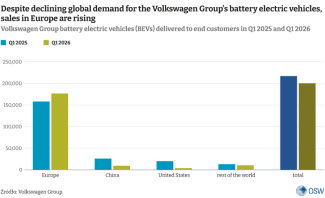
- The so-called China shock 2.0 and US protectionist trade policy, which has resulted in 15% tariffs on EU goods, continue to weigh on the Volkswagen Group’s performance. In the first half of 2026, the group’s vehicle sales fell by 8.4%. The situation remains particularly challenging in China, where Volkswagen faces intense competition from domestic manufacturers in the battery electric vehicle (BEV) segment (see chart). Nevertheless, the group retains a strong position in the EU market, accounting for 26.5% of new vehicle registrations between January and August 2026. Over this period, total registrations rose by 1.3% year on year, despite declines for the Volkswagen (-2.9%) and Porsche (-13.2%) brands. However, the rapid expansion of Chinese brands into the EU market poses a growing threat, with registrations surging for BYD (+163.0%), SAIC Motor (+19.8%), Chery Automobile (+250.9%) and Leapmotor (+426.8%). Together, these four manufacturers accounted for 9.6% of new vehicle registrations in the EU, compared with 6.2% in the same period of 2025.
- Plant closures are a last resort for Volkswagen, which is therefore seeking alternative ways to utilise its existing production capacity. According to the supervisory board, production at the plants in Emden, Zwickau, Hanover and Neckarsulm is expected to become unprofitable between 2031 and 2034. However, amid ongoing job cuts across German industry, which is shedding around 15,000 jobs a month, closing these plants would provoke opposition from trade unions and local authorities. The group is therefore exploring options for temporarily repurposing the facilities, for example to manufacture military equipment or assemble VW models previously developed and produced in China. A similar approach is reflected in the agreement to sell the Osnabrück plant to the German state of Lower Saxony (which holds 20% of Volkswagen’s voting rights) and Aurelius Capital. The facility is to be converted into a centre specialising in security and defence solutions.
- The threat of deindustrialisation is forcing German industry to reassess its approach to China. The EU’s introduction of countervailing duties on electric vehicles from China in 2024 has failed to provide effective protection for the European automotive industry, as Chinese manufacturers have responded by increasing sales of combustion-engine and hybrid vehicles. In July 2026, Volkswagen’s CEO voiced support for imposing tariffs on these vehicles for the first time. The German Association of the Automotive Industry (VDA) has also signalled a shift in its position, expressing openness to measures aimed at protecting European industry against distortions of competition caused by other market participants, in this case Chinese manufacturers.
- The shift in the German automotive industry’s position means that Chancellor Friedrich Merz can count on the sector’s support if a decision is taken at EU level. Berlin and Paris have drawn up a joint paper calling on Brussels to take stronger measures to protect the EU single market. The document was submitted to the European Commission ahead of the European Council meeting on 15–16 October, at which EU leaders are expected to set the direction of EU policy towards China.