Latvian parliamentary election: historic victory for the United List
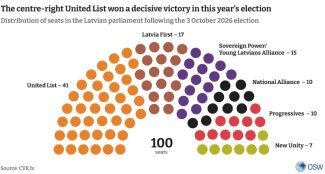
On 3 October, Latvia held an election to its 100-seat parliament, the Saeima, in which the United List (Latvian: Apvienotais saraksts, AS), led by incumbent Prime Minister Andris Kulbergs, won a decisive victory, securing 41 seats. Latvia First (Latvija pirmajā vietā, LPV), led by oligarch Ainārs Šlesers, came second with 17 seats. The pro-Russian Sovereign Power/Young Latvians Alliance (Suverēnā vara/Apvienība „Jaunlatvieši”, SV/AJ) also entered parliament, winning 15 seats, while the nationalist National Alliance (Nacionālā apvienība, NA) and the left-wing Progressives (Progresīvie, P) each secured 10 seats. The centre-right New Unity (Jaunā Vienotība, JV) also cleared the 5% electoral threshold, winning seven seats.
The record-low turnout in elections to the Saeima – 51.5% – reflects public dissatisfaction with the state of politics and the country’s long-standing socio-economic stagnation. Incumbent Prime Minister Kulbergs led the United List to the best electoral result of any party since Latvia regained independence, enabling him to form a stable centre-right government with the National Alliance and/or New Unity.
Commentary
- The strong electoral mandate secured by Kulbergs has raised expectations among the Latvian public. The United List’s success was driven primarily by the prime minister’s effective image-building campaign, in which he presented himself to voters as a competent administrator and a politician capable of addressing the country’s immediate challenges. His regular, direct communication on social media, highlighting his day-to-day activities and achievements, reinforced his image as an effective and accessible political leader. This strategy gave Kulbergs a strong electoral position but also placed responsibility on him to deliver on his extensive pledges. During the new parliamentary term, it will be difficult to attribute a lack of expected reforms or government failures to coalition tensions, as his predecessors had done.
- Latvia has a prospect of a stable government after years of recurring coalition crises. Securing 41 seats – significantly more than the polls had suggested – gives Prime Minister Kulbergs’s party a strong negotiating position and considerable flexibility in forming a coalition. The most natural option appears to be a centre-right government with the National Alliance, supplemented by New Unity, which would give it as many as 58 seats. This would give the United List greater influence than before over the composition of the coalition and its policy agenda. The incoming government plans to reform public finances, reduce bureaucracy, attract investment, and strengthen the uniformed services.
- The new government will not alter Latvia’s pro-Atlantic foreign and security policy. A new Kulbergs government will bring changes at the helm of the defence and foreign ministries; the portfolios, previously held by New Unity nominees, are likely to be handed over to representatives of the United List. Latvia will continue to regard NATO membership and closer cooperation with the United States and Canada as the cornerstones of its security policy. At the same time, Russia’s policies will remain the principal long-term threat to national security, while support for Ukraine will continue to be one of Latvia’s foreign policy priorities.
- The Russian-speaking electorate is fragmented and no longer constitutes the significant electoral force it once did. The overwhelming majority of voters who speak Russian at home supported either the oligarchic LPV or the openly pro-Russian SV/AJ alliance. In Latgale, which has a large concentration of Russian-speaking residents, LPV came first with 29.07%, ahead of the United List’s regional wing, which emphasises, among other things, a distinct local Latgalian identity, and won 18.86% of the vote. The SV/AJ bloc came only third, with 17.27%. In Riga, home to a substantial proportion of Latvia’s Russian-speaking citizens, the radical Sovereign Power outperformed Šlesers’s party, with the two finishing second and third respectively. The combined support for the two groupings was slightly lower than that secured in the 2011 and 2014 elections by the Social Democratic Party “Harmony”, which was the principal electoral choice of this segment of the electorate between 2011 and 2022 (although it performed less strongly in 2018). The remaining parties seeking the support of the Russian-speaking electorate failed to clear the 5% electoral threshold.