Shock on the Turkish stock market: another crisis of confidence
On 25 September, Turkey’s justice minister announced the arrest of 45 people as part of an investigation into suspected manipulation of share prices on the Istanbul stock exchange through investment funds. Investigators are examining, among other things, whether investors’ money was used to artificially inflate the prices of illiquid, thinly traded stocks, allowing the funds to report high returns and attract new clients. The opposition accused Fatma Betül Sayan Kaya, deputy chair of the ruling Justice and Development Party (AKP), of selling shares worth a total of approximately $44 million shortly before the scandal broke. On 26 September, she resigned from her post.
The arrests follow a crisis in mid-September, when difficulties faced by some funds in meeting redemption requests intensified a sell-off in shares. Consequently, the Istanbul stock exchange’s benchmark BIST 100 index fell by more than 8% between 14 and 18 September. In response to the turmoil, Turkey’s Capital Markets Board (SPK) ordered the liquidation of 131 funds managed by seven companies. Around 455,000 people had invested in these funds, whose combined assets were estimated at more than $18 billion. Investors face the prospect of losing part of their investments.
The scandal could weaken confidence in Turkey’s capital market and make it harder to attract foreign investors. The case involving the AKP deputy chair has also fuelled suspicions that people linked to the party enjoy preferential treatment in the market. These concerns have been reinforced by media reports that such individuals realised profits before the market slump. The authorities’ response will test their willingness to tighten oversight of the capital market and to investigate allegations thoroughly, including those involving figures from their own political camp.
Commentary
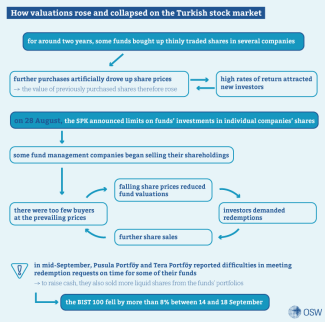
- The stock market slump followed the bursting of a bubble in the artificially inflated share prices of thinly traded companies (i.e. those with low trading volumes), compounded by widespread attempts to withdraw money from funds that had invested in these stocks. The bubble had been building for around two years, as asset management companies, including Pusula Portföy and Tera Portföy, invested their clients’ money in shares of several such companies (see Appendix). These purchases artificially drove up their share prices, allowing the funds to report high rates of return and attract new investors, whose inflows financed further purchases. When the SPK announced limits on funds’ investments in individual companies’ shares on 28 August, some fund managers began selling these holdings. However, there were too few buyers willing to pay the prevailing prices, causing share prices to fall sharply and, in turn, reducing the value of the funds. This prompted investors to demand redemptions and forced further asset sales, exacerbating the losses. In mid-September, Pusula Portföy and Tera Portföy reported difficulties in meeting some investor redemption requests on time. To raise cash, fund managers also sold shares in more liquid companies. This contributed to the BIST 100 index’s largest weekly decline since March 2025, when the mayor of Istanbul was arrested.
- The stock market scandal undermines the government’s narrative that confidence in the Turkish economy is being restored and could make it more difficult to attract further foreign investment. It also presents Finance Minister Mehmet Şimşek with another challenge: alongside stabilising the economy he must restore the credibility of the capital market. Investors may have concerns about share valuations and whether large volumes of shares can be sold at quoted prices, particularly in the case of thinly traded companies. Even before the scandal broke, MSCI and S&P Dow Jones, which compile international stock market indices, had raised concerns about the transparency and functioning of Turkey’s equity market. For foreign investors, the proportion of invested capital recovered from the funds being liquidated will be an important consideration. Heavy losses could undermine Istanbul’s credibility as an international financial centre and make it more difficult to attract foreign capital.
- The stock market scandal is a serious blow to the ruling camp, as it undermines the AKP’s credibility as a party capable of managing the economy. The case involving the AKP deputy chair makes it more difficult for the authorities to attribute the crisis solely to misconduct by fund managers and increases pressure to investigate allegations involving people linked to the party. It also puts political pressure on Şimşek, who is responsible for the economic stabilisation programme and for coordinating the liquidation of the funds and payments to investors. At the same time, the minister may use the crisis to push for tighter oversight of the capital market. The success of these efforts, and any resulting strengthening of his position, will depend on whether the AKP leadership provides political backing for stricter supervision, including of companies and investors linked to the party. This presents the party with a difficult choice, as limiting the scope of the reforms risks reinforcing accusations that it is protecting its own associates, weakening voter support and further eroding investor confidence in the stock market.
APPENDIX