The Russians are attacking data centres in Kyiv. Day 1679 of the war

Pushing Russian forces back to the line of the Zherebets River, and thereby shortening the front line, enabled Ukraine to redeploy forces to carry out a series of counterattacks east of Sloviansk. The Russians were driven out of the outskirts of Mykolaivka, which neighbours the city, whilst the Ukrainians re-entered the Rai-Oleksandrivka junction. They were aided by the fact that Russia, which had until that point been on the offensive had failed to prepare defensive positions. It remains to be seen whether the Ukrainian 3rd Army Corps, under the command of General Andriy Biletsky, has sufficient forces at its disposal to attempt to regain control of the range of hills between Sloviansk and Siversk, and thereby relieve the former of Russian shelling.
The main element of the Russian offensive in the Donbas was the levelling of the front line between Dobropillia and Chasiv Yar. As a result, further territories to the east and west of Kostiantynivka came under Russian control. Meanwhile, the invaders continued their flanking manoeuvres in the Dobropillia area. Although they did not achieve any significant successes there, the activity of their sabotage and reconnaissance groups to the north and west of the town increased; as a result, some sources have suggested that the town is now surrounded, which has not yet happened.
The situation in the north-eastern part of Kharkiv Oblast remains unclear, with two conflicting accounts emerging from the area. According to (pro-)Russian sources, the encirclement in which the local Ukrainian force finds itself is being gradually broken. (Pro-)Ukrainian sources deny that it has been cut off from the main forces, though they generally remain silent on the operations taking place there. Videos and photographs confirm Russian advances, but do not conclusively prove that an encirclement has been formed. It cannot be ruled out that some Ukrainian soldiers may have found themselves under operational encirclement.

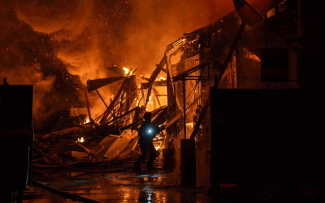
The Russians have launched massive attacks on data centres located in Kyiv, which have disrupted or forced the suspension of operations by major telecoms operators, internet and hosting service providers, and the companies that use their services. Strikes on ‘critical digital infrastructure’ have been ongoing since 23 September, with the most serious attack taking place on 27 September, when ten data centres in the capital and one in Dnipro were damaged, including the server rooms of Cosmonova, Datagroup, Kyivstar and Ukrtelecom. This has disrupted the provision of internet access services to the residents of Kyiv, and Foreign Minister Andriy Sybiha stated that Russia is seeking in this way to disrupt the flow of information, including warnings about missile and drone attacks, which enable the civilian population to take shelter in quickly.
Warehouses, railway infrastructure, petrol stations and companies linked to the defence industry remain regular targets in the Ukrainian capital and Kyiv Oblast, with attacks taking place every few hours, regardless of the time of day. On three occasions (23, 26 and 28 September), Russian drones struck facilities belonging to the pharmaceutical company Darnytsia. On 28 September, the building of the National Academy of Sciences was hit, killing two people. Furthermore, on the same day in Kyiv, 26 people were injured, including three children. The attack on Kyiv on 25 September was the deadliest. Seven people were killed, including a 14-year-old Israeli citizen, and 59 were injured. Two people were killed on both 23 and 24 September, and one on 27 September. On those days, 20, eight and nine people were injured respectively. In Kyiv Oblast, damage was reported in several districts, whilst the loss of life was lower (from the evening of 22 September to the morning of 29 September, a total of three people were killed and more than a dozen injured).
Russian forces continued to destroy the port infrastructure of the so-called ‘Greater Odesa’ and its hinterland. From the evening of 22 September to the morning of 29 September, attacks took place daily, with the main targets being warehouses. At least five ships were damaged in the ports and at sea in their vicinity. On 23 September, the captain – a Ukrainian national – was killed on a vessel flying the flag of Antigua and Barbuda, and the crew were evacuated. On 27 September, the bridge in the town of Maiaky, near the border with Moldova, was once again targeted.
Of the major cities in the frontline regions, Zaporizhzhia continues to be the most frequently targeted. Further damage to warehouses and industrial facilities occurred there on 22, 23, 25, 26 and 28 September. At least two people were killed and 33 were injured. Kharkiv (22, 25, 26 and 28 September), where at least one person was killed and 29 were injured, Dnipro (22, 23, 27 and 28 September), where at least seven people were killed and 28 were injured, and Sumy (23, 25, 26 and 27 September), where at least four people were killed and 47 were injured (including seven children). On 25 September, the Russians damaged infrastructure in Kryvyi Rih and, on 26 and 27 September, in Mykolaiv. On 22 and 23 September, Naftogaz reported further damage to gas extraction and processing facilities in Poltava Oblast. Industrial and transport infrastructure in this region was also damaged (on 25 and 27 September), as was the case in Kirovohrad Oblast (on 23 and 24 September).
In western Ukraine, storage, fuel, industrial and transport infrastructure was once again targeted in Zhytomyr Oblast. From the evening of 22 September until the morning of 29 September, damage was not reported on only one day (23 September), and it occurred most frequently in the Korosten, Ovruch, Zviahel and Zhytomyr districts. Facilities belonging to the German company Kromberg & Schubert, which had already been attacked, were struck twice (on 22 and 25 September). On 22, 24 and 29 September, energy and railway infrastructure in Vinnytsia Oblast (including the Zhmerynka junction) was damaged. On 23 and 24 September, facilities in the Volyn Oblast were damaged. On 24 and 29 September, this occurred in Ternopil Oblast. On 24 September, damage occurred in in the Rivne and Chernivtsi oblasts, where, amongst other things, the infrastructure of border crossings with Romania and Moldova was hit. On 28 September, a Russian drone struck once again in the vicinity of the border crossing with Poland at Yahodyn.
Reports from the Ukrainian Air Force Command confirm that Ukraine is finding it increasingly difficult to repel drone attacks. This is mainly due to the growing number of Geran-4 and Geran-5 jet-powered drones being deployed by the Russians. From the evening of 22 September to the morning of 29 September, Russia is reported to have deployed a total of at least 1,684 strike drones of all types, of which 1,321 were neutralised. This means that a record number of over 300 enemy drones struck targets in Ukraine over the course of the week. President Volodymyr Zelensky reported that the defenders had neutralised 55% of jet-powered drones and over 90% of conventional Shaheds. According to OSINT sources, the effectiveness of Ukraine’s air defences was significantly lower than officially stated – in the case of Shaheds, it did not exceed 70%, whilst for jet-powered drones it may have been as low as just over 10%. The success of the drone attacks may have led the Russians to limit their use of missiles, of which they fired 23 during the period in question. In the Kyiv area, where the defenders utilised newly received PAC-3 MSE missiles for the Patriot systems, 8-10 missiles were shot down.

On 25 September, Ukrainian drones struck refineries in Novoshakhtinsk in Rostov Oblast and in Perm. As a result of damage to their facilities, both suspended operations. The Iskra electronics plant in Ulyanovsk and the Voronezhsintezkauchuk chemical plant in Voronezh were also hit, as were, a day later, the refinery in Ilsky in Krasnodar Krai and the Azov Optical-Mechanical Works in Rostov Oblast. Fires broke out at these sites, as well as at two fuel depots in Krasnodar Krai that were attacked on 28 September. The Security Service of Ukraine reported that four fuel depots in the region had been hit, though this has not been confirmed by other sources. The Kuibyshev Refinery in Samara, which was struck by drones on 22 September, has suspended operations.

On 22 September, the Security Service of Ukraine (SBU) announced the arrest in Kyiv of a female agent of the Russian Federal Security Service (FSB). The woman was allegedly planning the assassination of a Russian opposition figure who had been fighting on Ukraine’s side since 2022. A day later, the SBU announced the arrest in Rivne of an associate of the Russian security services who was planning a bomb attack in the city centre. The man, who worked as a courier for a local delivery company, was reportedly recruited via Telegram channels offering ‘easy money’.
On 24 September, the SBU reported the arrest of a soldier from the Armed Forces of Ukraine (AFU) suspected of collaborating with the FSB to carry out a missile attack on his own unit in Kharkiv Oblast. A day later, it reportedly detained a resident of the Lviv Oblast suspected of assisting Russia in preparing a missile attack on a factory producing unmanned systems, where he worked.
On 28 September, the SBU reported that Russian special services had stepped up their activities involved with the creation of websites and social media profiles imitating the official sites of Ukrainian state institutions and media outlets. According to the SBU, these were intended to be used for information and psychological operations and disinformation campaigns, as well as for gathering the personal data of Ukrainians.

On 24 September, the General Staff of the Armed Forces of Ukraine announced the appointment of Colonel Artem Martynenko as Deputy Commander-in-Chief for Digitalisation to Mykhailo Drapatyi. Martynenko is a specialist in information technology, and one of the creators and the chief architect of the DELTA battlefield management and situational awareness system.

On 28 September, Vladimir Putin issued a decree increasing the strength of the Russian Armed Forces to 2,441,630 posts, including 1,550,500 military personnel, i.e. an increase of 15,500 compared with the previous adjustment in July this year. This is the fourth such move in 2026 and the seventh during the full-scale aggression against Ukraine. However, the changes introduced this year are significantly smaller than in previous years, when – for example, in September 2024 – the number of military posts was raised from 1,013,628 to 1,500,000. This increase is primarily linked to the development of the Unmanned Systems Forces, the establishment of which must be regarded as the main reason for exceeding the expansion targets announced in December 2022. According to those plans, the Russian Armed Forces were ultimately to number 1.5 million troops, a figure scheduled to be reached by 2026. The number of civilian posts within the military has increased by just 2,000 compared with the situation prior to February 2022. The figures contained in the decree do not reflect the actual current strength of the Russian army. Most of the new posts are likely only just being created.
On 28 September, Reuters reported that Russia plans to allocate 17.1 trillion roubles (approx. 203 billion dollars) to defence in 2027. This is approximately 27% more than the originally planned 13.5 trillion roubles and the highest figure since the start of the full-scale war against Ukraine. Total defence spending for the period 2027–2029 is set to amount to 50 trillion roubles (approx. $590 billion). The documents also forecast an increase in the budget deficit in 2026 to 3.2% of GDP, compared with an earlier forecast of 1.6%. The draft budget is due to be submitted to parliament by 1 October, and the growing deficit is to be partly financed through the announced tax increases.

On 22 September, the Ukrainian Human Rights Ombudsman, Dmytro Lubinets, confirmed the findings of a report by the Office of the UN High Commissioner for Human Rights detailing 984 cases of sexual violence committed by Russians. Together with 20 cases dating from before 24 February 2022, the number of these incidents recorded up to 31 July 2026 stands at 1,004. Lubinets added that these figures do not reflect the true scale of the problem, as they only take into account documented cases, whilst some victims remain in the occupied territories or do not report the crimes due to fear or social stigma.

On 26 September, Lubinets reported on the catastrophic humanitarian situation in the occupied town of Oleshky in Kherson Oblast, where residents are without food, water and medicine. According to him, the evacuation is being hampered by mined areas and military operations. Ukraine had proposed to Russia the creation of evacuation routes and the establishment of a temporary ceasefire, but – as Lubinets claims – Russia did not agree to these solutions. A day later, Ukraine’s Foreign Minister Andriy Sybiha appealed to international organisations for help in delivering food and medicine to the civilian population and ensuring safe evacuation. According to him, Kyiv attempted to deliver nearly four tonnes of food using drones, but Russian forces are reportedly shooting down the drones and confiscating their cargo.

On 23 September, Finland and Ukraine signed a cooperation agreement on unmanned systems (the ‘Drone Deal’).
On 23 September, OpenAI announced that it would make its AI-based cyber defence system, Daybreak, available to the Ukrainian government free of charge. Among other things, the system can instantly identify security vulnerabilities in digital systems and help develop ways to address them. Kyiv is also set to gain access to OpenAI’s advanced GPT 5.6 Sol model.
On 24 September, Australia and Ukraine signed a bilateral agreement on long-term support and cooperation. Under the agreement, Canberra will provide Kyiv with AU$45 million (US$31.44 million) in aid in the form of military equipment surplus from the Australian Defence Force, and will join the Maritime Capabilities Coalition. The total value of aid provided to Ukraine by Australia to date amounts to nearly AU$1.9 billion (US$1.33 billion).
On 25 September, Reuters, citing its own anonymous sources, reported that the Pentagon had allocated 307 million dollars under the Ukraine Security Assistance Initiative (USAI, for the procurement of new weapons and military equipment from the US defence industry). In the current financial year (from 1 October 2025 to 30 September 2026), the US Congress has allocated $400 million to Ukraine under the USAI – $200 million for the purchase of weapons, ammunition and explosives, $100 million for vehicles and spare parts, and $100 million for logistics and other services, including the transport of arms and military equipment (AME) to Ukraine. Although Donald Trump’s administration openly declared its reluctance to spend these funds, according to Reuters, the entire sum is scheduled to be spent by the end of the month.
On 28 September, the European Commission announced a two-year extension of the European Union Military Assistance Mission to Ukraine (EUMAM), which provides training for Ukrainian military personnel in Poland and Germany. To date, over 87,500 soldiers have taken part in these training programmes.