Wartime economies of scale: €150 billion for defence in the EU’s 2028–2034 budget
The European Commission intends to increase funding for defence-related purposes to approximately €150 billion in its proposal for the 2028–2034 Multiannual Financial Framework (MFF). As part of its reform of the EU budget, the Commission plans to move away from numerous small sectoral programmes in favour of larger, more flexible instruments. Defence is set to become one of the funding priorities. Most of the funding would be channelled through the new European Competitiveness Fund, which would prioritise the most innovative and economically viable projects.
These plans build on measures taken by the EU since 2022 to increase the European defence industry’s production capacity and replenish member states’ military capabilities. On economic efficiency grounds, the Commission expects member states to make greater use of joint procurement and collaborative defence projects. The results to date have been unsatisfactory, so grants are likely to become even more closely conditional on meeting this requirement. For member states with less developed defence industries, this could create further difficulties in accessing EU funding.
Financing the EU’s defence-related expenditure
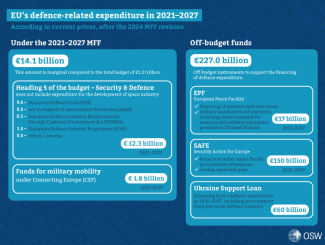
Russia’s aggression against Ukraine has significantly affected the EU’s ambitions regarding the financing of defence-related activities. Before 2022, a strict interpretation of Article 41(2) of the Treaty on European Union (TEU) prevailed, prohibiting expenditure arising from operations having military or defence implications from being charged to the EU budget. This prohibition was understood to cover all purchases of weapons and military equipment, as well as support for their production. Consequently, the European Defence Fund (EDF) – the main programme supporting the defence industry under the 2021–2027 MFF – focuses on research and development.
In view of the above interpretation, instruments for financing defence expenditure were established outside the EU budget. In 2021, the off-budget European Peace Facility (EPF) was established and used, among other things, to finance reimbursements to member states for weapons and military equipment supplied to Ukraine (see ‘An EU War Chest: the success and uncertain future of the European Peace Facility’). In 2025, the Council of the EU adopted a regulation establishing SAFE, an off-budget loan instrument for the joint procurement of weapons and military equipment (see ‘Imperfect balance: the EU’s defence loan mechanism (SAFE)’). The mechanism is the main component of the Commission’s ReArm Europe package, unveiled in March 2025 (see ‘The White Paper: the EU’s new initiatives for European defence’) and is intended to facilitate efforts to address gaps in military capabilities. Part of the Ukraine Support Loan granted to Ukraine in December 2025 can also be regarded as a means of financing defence expenditure: €60 billion of the total €90 billion is intended to finance Ukraine’s defence expenditure, including procurement from the European defence industry.
After 2022, the interpretation of Article 41(2) evolved under the influence of the member states and the Commission’s initiatives. Support for the defence sector at EU level came to be regarded as an instrument of industrial policy and the development of the internal market. This made it possible to finance programmes from the EU budget such as the Act in Support of Ammunition Production (ASAP), the European Defence Industry Reinforcement through Common Procurement Act (EDIRPA) and the European Defence Industry Programme (EDIP) (see ‘The patchwork defence union’).
Defence expenditure in the proposed 2028–2034 MFF
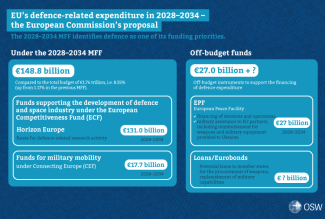
As part of the reform of the EU budget, the Commission plans to move away from numerous small sectoral programmes towards larger and more flexible instruments. Defence is set to become one of the EU’s funding priorities. As much as €131 billion of the approximately €150 billion would be allocated under the newly established European Competitiveness Fund (ECF). It would finance projects that support the development of the defence and space industries, and the expansion of military capabilities.
Member states would also be able to finance dual-use technologies and investments from the funding allocated to them under the so-called National and Regional Partnership Plans (NRPPs), including funding for cohesion, regional development and agriculture. This could cover, for example, the construction of shelters, the adaptation of existing buildings for civil protection purposes, and the protection of critical infrastructure.
The Commission’s proposed defence expenditure of around €150 billion was deemed insufficiently ambitious by the European Parliament, which is calling for an additional €25 billion for this purpose under the ECF. Meanwhile, some member states (Germany, the Netherlands, Denmark, Austria, Finland and Sweden) are seeking to reduce the funding proposed for the next MFF by several hundred billion euros. This would also affect defence expenditure, although agriculture and the NRPPs would bear the brunt of the cuts. A compromise proposal by the Cypriot Presidency envisaged cuts of approximately €30 billion, including to the ECF budget, while leaving the NRPPs unaffected. However, the proposal has already been rejected by the frugal member states.
The logic of supporting European champions and the defence of the eastern flank
The main political rationale for the sharp increase in funding for defence-related expenditure is the threat from Russia and the reduced US commitment to Europe. However, the Commission’s budgetary initiatives continue to prioritise industrial policy over the need to rapidly replenish military stocks, suggesting that the latter challenge takes precedence.
The new programmes under the next MFF can be expected to draw primarily on the experience of EDIP. They will favour member states and defence companies that are able to establish cross-border cooperation within the EU/EFTA or with Ukraine (see ‘The imperative of cooperation: the European Commission’s strategy for the defence industry’) and that produce weapons and military equipment with a relatively low share of components originating outside the EU and countries eligible for closer cooperation under separate agreements. The EDF will also continue, although the development of other initiatives will mean that it loses its status as the EU’s main defence programme. Proposals include, in particular, reducing the administrative burden associated with its procedures, linking projects more closely to national capability development programmes, and increasing the participation of small and medium-sized enterprises. Simultaneously, there is a strong emphasis on further broadening the range of countries participating in individual projects, which may not necessarily improve efficiency.
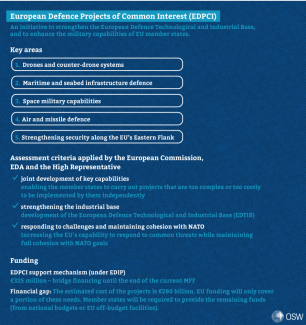
The preference for industrial policy understood in this way is justified by the need to increase the EU’s autonomy in defence industrial policy. Companies should produce more and at a faster pace in response to orders from member states and Ukraine, so they are no longer forced to procure weapons and military equipment from outside Europe. Joint procurement and projects prioritised by the EU, particularly the so-called European Defence Projects of Common Interest, are intended to foster ever closer cooperation, ultimately leading to a series of consolidations centred on the company and member states that are leaders in a given technology. It can be assumed that the main beneficiaries of ECF funding for the defence industry will continue to be countries with the most developed defence industries and those most closely involved in cooperation with EU partners.
EU member states may once again decide to pool funding for defence purposes outside the EU budget. The EPF will continue to exist after 2027, while calls for common borrowing modelled on the post-pandemic recovery funds have also persisted. Strong opposition from a group of member states, led by Germany, prevented such borrowing from being used to finance the closing of capability gaps. This resulted in the creation of SAFE, based on individual loans to member states, raised on their behalf by the Commission and backed by the EU budget. At present, many member states, including those on the eastern flank, lack sufficient budgetary resources to consider another such loan. The debate on common European defence bonds may therefore return. Moreover, critics of the current SAFE framework argue that the excessive discretion afforded to member states in making their own procurement decisions perpetuates the existing fragmentation of the defence industry. The Commission will therefore likely seek more restrictive conditions for any future programme to ensure greater cooperation among member states. Proceeds from common borrowing could finance European defence projects of common interest https://www.osw.waw.pl/pl/publikacje/komentarze-osw/2024-01-24/unijne-sily-szybkiego-reagowania-priorytety-polityczne-i.
Outlook
The increased funding for security and defence-related purposes under the 2028–2034 MFF is intended to support the objectives agreed by the member states and EU institutions following Russia’s full-scale invasion of Ukraine. In theory, this leaves national capitals with limited scope to criticise the Commission’s proposal, irrespective of how realistic the ambitions to establish a single market for the defence sector or harmonise armaments production standards may be. The adoption of such an MFF could become more difficult in the event of political changes in key member states following elections in 2027, including in France, Spain and Poland. For this reason, Brussels will seek to reach an agreement before the end of this year, although this is a highly ambitious goal.
The allocation of as much as €131 billion to defence under the ECF, a fund designed to support industrial policy, indicates that the trend of allocating most funding for this purpose to member states with the largest defence industries, and thus those most competitive in this field, will continue. These countries are also net contributors to the EU budget. For eastern flank member states, which are most exposed to Russia’s aggressive actions, this means limited opportunities to benefit from these funds. It is therefore in the common interest of Central European countries to preserve funding for military mobility and dual-use investments under the NRPPs broadly in line with the Commission’s proposal, as these funds are easier to absorb. In this context, particularly concerning are calls from some member states, especially Germany, for substantial cuts to the MFF as a whole, including in areas covered by the NRPPs.