Challenges in filling EU gas storage facilities ahead of winter
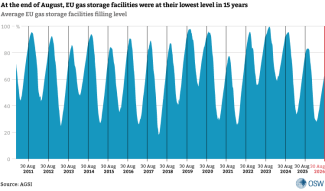
At the end of August, EU gas storage facilities were at their lowest level in at least 15 years, averaging just 65% full. This figure was even lower than the previous record low in 2021, which marked the onset of the EU gas crisis. The current situation results from the ongoing war in the Persian Gulf, now in its sixth month. Severe and persistent restrictions on shipping through the Strait of Hormuz have effectively halted Qatari LNG exports to the global market in recent months. Consequently, gas prices have increased, including on EU exchanges, where they exceeded €70/MWh on 1 September.
Low storage levels at the beginning of autumn heighten the risk that EU countries will not achieve the planned 80% target before the heating season. This target has already been reduced from its originally intended level. The resulting shortfall will likely intensify competition for gas supplies and contribute to further increases in gas prices during the winter.
Commentary
- Record-low gas storage levels in the EU will make it more difficult to prepare adequately for the 2026/2027 heating season. The previous low for the same period (67%) was recorded in 2021, when Gazprom restricted supplies and the filling of storage facilities on the EU market as part of Russia’s deliberate hostile actions. This contributed markedly to the gas crisis in the 2022/2023 season. Learning from this experience, the EU introduced a requirement to fill gas storage facilities ahead of the heating season (in principle to 90% by 1 November), although this requirement has been relaxed this year. Under the rules in force in 2026, greater flexibility has been introduced regarding both the deadline for filling storage facilities (between 1 October and 1 December) and the target level (which may be reduced to 80%). However, the current record-low storage level means that even this reduced target may be difficult to achieve.
- There are significant differences in gas storage levels among individual EU member states. Storage levels are particularly low in countries with large storage capacities, namely Latvia and the Netherlands (45–46%), Slovakia and Spain (approximately 50%), as well as Germany, the EU’s largest gas consumer (53%). At the same time, storage facilities in Portugal and Poland, for example, are more than 90% full. However, both countries have relatively limited storage capacity and rely heavily on imports during the winter.
- Insufficient volumes of gas in storage will affect the liquidity of the entire EU market during the winter, increasing demand for imports and competition on the global market, and thus driving up prices. Meanwhile, prices on the Dutch TTF gas hub are already at their highest level since the end of 2022. This reflects the lack of clear prospects for a swift end to the ongoing war in the Middle East and for the removal of significant restrictions on transit through the Strait of Hormuz, which have had the greatest impact on the availability of gas from the region. According to media reports, LNG exports from Qatar, the world’s third-largest supplier of liquefied natural gas, have fallen by 96% over the past six months.
- The shortfall resulting from reduced supplies from Qatar has been partly offset by increased LNG exports from the US, but European and Asian buyers are increasingly competing for these volumes (Asia has been hit hardest by the reduced availability of Qatari gas). In recent years, the EU has become the main market for US gas, which has largely replaced the sharply declining supplies from Russia. At the same time, in recent months, a growing number of US LNG carriers have headed to Asian buyers willing to pay higher prices, while several European companies have waited for market conditions to improve.
- Low gas storage levels in the EU entail a higher risk of price increases due to insufficient alternative sources of flexibility in the market. EU member states have sharply reduced imports from Russia in recent years and are now heavily dependent on supplies from the global LNG market. Moreover, under the regulation phasing out Russian gas, they plan to end imports of Russian LNG completely as of the beginning of 2027. Given the constraints on the availability of gas on the global LNG market, storage facilities therefore remain the EU’s key ‘safety buffer’ during the winter season. Demand reduction could provide an additional means of mitigating supply problems. So far, gas consumption in Europe has remained relatively high, partly because gas-fired power generation has increased in recent months as droughts have reduced hydroelectric and nuclear power generation. Reducing consumption may therefore require intervention in the functioning of the market.
- Further increases in gas prices are likely to feed through into already high electricity prices in the EU. Together with elevated fuel and gas prices, high electricity prices are generating considerable public concern across Europe. This is prompting individual EU member states to introduce further measures to shield consumers, in turn intensifying the debate over the coherence, direction, and nature of changes to EU energy and climate policy. At the same time, challenges in the gas market may strengthen what are, for now, isolated calls within the EU to slow down or even postpone the planned complete phase-out of Russian gas imports. Despite the tangible challenges, surprisingly little has so far been done at the EU level – beyond making gas storage targets and filling trajectories more flexible – to prevent and mitigate problems in the gas market in the coming months in a coordinated manner.