North Korean missiles strike Kyiv and Zaporizhzhia. Day 1630 of the war

Russian forces have continued their advance in the Donbas, capturing further positions south and east of the Sloviansk-Kramatorsk urban area. Humanitarian problems are worsening in both cities, with water now being delivered to Sloviansk by tanker trucks. Rai-Oleksandrivka, the last key junction east of Sloviansk, has most likely fallen entirely under Russian control. Fighting continues on the approaches to Druzhkivka from the Kostiantynivka and Pokrovsk directions, while the northern part of Kostiantynivka remains in the grey zone. Meanwhile, Russian forces have advanced to around 3 km of Dobropillia from the south and east. The situation around Lyman remains unclear, with Ukrainian forces continuing to launch counterattacks aimed at preventing Russian troops from also outflanking the Sloviansk-Kramatorsk urban area from the north.
Russian sabotage and reconnaissance groups have entered Orikhiv from the east, and have also managed to disrupt Ukrainian defences between the town and Mala Tokmachka, which is now under attack from two directions (fighting for the settlement has continued since 2023). The relative freedom of action enjoyed by these groups suggests that Ukrainian defences in the central part of Zaporizhzhia Oblast are weakening. Successful Russian counterattacks between Orikhiv and Kamianske on the Dnipro River also point to this trend, with Russian forces once again advancing northwards around Shcherbaky and Mali Shcherbaky. Russian troops continue to face strong Ukrainian resistance in the western part of Zaporizhzhia Oblast, around Stepnohirsk. They have also made further gains in Kharkiv Oblast, increasing the risk that Ukrainian troops in the border area east of Vovchansk could be cut off (in 2024, by contrast, it was Russian forces that were tactically encircled in the town).

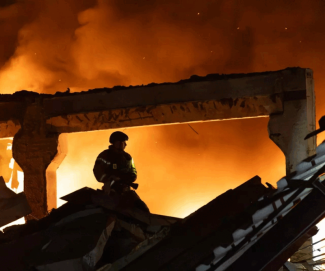
Russia carried out further devastating missile strikes on Kyiv and the surrounding area. The largest and most severe attack, on 5 August, killed between 15 and 17 people and injured between 34 and 47 across Kyiv and Kyiv Oblast. Thirteen warehouse and industrial facilities were hit in three districts of the capital, including three Nova Poshta terminals, while a Rozetka warehouse complex in Brovary was completely destroyed. An ammonia leak was also reported in Kyiv. Depending on the source, Russia used between 28 and 39 ballistic and hypersonic missiles, none of which were intercepted. On 8 August, between six and eight missiles struck facilities at the Kyiv Asphalt Concrete Plant and the Chaika logistics centre. Three people, including a child, were killed in the Brovary area, most likely as a result of a drone strike. On 11 August, industrial facilities and two logistics centres in Kyiv, including one operated by Nova Poshta, were targeted again, along with warehouses in the Bucha area. According to OSINT sources, this marked the first time that, aside from hypersonic missiles, only North Korean KN-23 ballistic missiles were used to strike the Ukrainian capital. A total of six missiles reportedly hit their targets, while PAC-3 MSE interceptors, used for the first time in several weeks, failed to intercept any of them; four interception attempts were recorded. According to some sources, on 10 August Russian forces simulated a missile attack on Kyiv using electronic warfare systems to test the city’s air defences. Similar incidents were also recorded in other parts of Ukraine a few days earlier. Analysts from the OSINT channel AMK Mapping calculated that from 1 July to 5 August inclusive, around 150 ballistic missiles struck Kyiv and the surrounding area, rising to 160 when the two subsequent attacks are included; only seven missiles were intercepted.
On 9 August, Russian forces launched one of the largest air attacks on Odesa and Odesa Oblast. According to OSINT sources, 16 missiles and 16 small Banderol cruise missiles (missile-drones) were launched at the region, with one of each type intercepted. Around 100 strike drones were also used, but no interception data are available. The attack targeted energy and port infrastructure, reportedly damaging two oil terminals (NASA FIRMS imagery confirmed extensive fires at both sites), a thermal power plant and seven substations. Fourteen people were injured and more than 300,000 customers temporarily lost power; two days later, tens of thousands were still waiting for power to be restored. Russian forces also attacked the port infrastructure of so-called Greater Odesa and at least seven vessels off its coast on 5–8 August and 10–11 August. On 6 August, the crew of one vessel had to be evacuated after a strike left at least one sailor dead and several injured. Ukrainian sources stopped reporting the names and flags of damaged vessels after commercial traffic to the ports of Greater Odesa was suspended. According to Russian sources, these vessels were carrying military materiel.
Zaporizhzhia was the target of a large-scale attack on 11 August. Four ballistic missiles – identified by some sources as North Korean KN-23s – and six guided aerial bombs (Russian: KAB) struck the city, while another five KABs hit its outskirts. The main target was the Zaporizhstal metallurgical plant, but residential buildings were also damaged; six people were killed and 19 injured. Russian forces also attacked Zaporizhzhia on 7, 8 and 10 August. In the frontline areas, Russian strikes targeted Kharkiv on 5 and 9 August, with the second attack injuring 30 residents, and Sumy on 6, 7 and 10 August. Pavlohrad was attacked on 6 and 8 August, leaving two dead and injuring 16, including four children. Shelling on 6 and 10 August left large parts of Kherson without electricity and water. Naftogaz extraction facilities were targeted on 7–9 August, with seven sites at different locations damaged on the first day of the attacks. On 9 August, Russian drones damaged the German-owned Kromberg & Schubert Zhytomyr plant, forcing it to halt production of electrical wiring harnesses for vehicles. Russia again intensified strikes on railway infrastructure, mainly rolling stock. Warehouses remained regular targets, while the number of strikes on petrol stations fell to around 10 over the past week. According to Ukraine’s Air Force Command, Russia used at least 965 drones between the evening of 4 August and the morning of 11 August, of which 782 were neutralised. Depending on the source, it also fired between 57 and 83 missiles, but Ukrainian forces managed to intercept only one.

On 4 August, the Security Service of Ukraine (SBU) announced the arrest of two FSB agents in Zaporizhzhia who had been gathering intelligence on defence industry enterprises and the positions and movements of Ukrainian forces to provide targeting data for Russian strikes. The following day, an agent of Russian military intelligence was detained in Odesa on suspicion of providing targeting information for missile and drone strikes against Ukrainian positions. On 6 August, an FSB collaborator was detained on the same charge. On 7 August, two more people were arrested for collecting information used to guide Russian missile and drone strikes on Mykolaiv.
On 4 August, Ukraine’s State Bureau of Investigation (DBR) reported that since the start of the full-scale invasion, it had charged 1,733 people with treason, collaboration and aiding the aggressor state, including 1,377 law enforcement officers. The suspects included 236 penitentiary service employees, 137 civil defence officers, 67 border guards and 55 tax service employees. According to the DBR, most had remained in the occupied territories after the invasion began and subsequently collaborated with Russia.

Ukrainian forces carried out further attacks on Russian refineries, damaging the primary processing unit in Ilsky, Krasnodar Krai, and facilities and storage tanks in Yaroslavl on 8 and 6 August respectively. Strikes or falling drone debris also caused fires at refineries in Ufa, Bashkortostan, on 5 August, in Syzran, Samara Oblast, on 8 August and in Orsk, Orenburg Oblast, on 11 August. The refinery in Nizhnekamsk, Tatarstan, was attacked on 10 August, although residential buildings suffered most of the damage; 13 people were killed and 48 injured. On the same day, a Ukrainian strike hit one of the chemical plants operated by the SIBUR holding company in Tobolsk, Tyumen Oblast. Ukrainian drones also struck additional Wildberries warehouses, causing fires in Aleksin, Tula Oblast, on 5 August, in Palkino, Tver Oblast, on two occasions on 6 August, in Yekaterinburg on 7 August and in Aleksandrovka, Voronezh Oblast, on 11 August.
Occupied Crimea and adjacent areas remain regular targets of Ukrainian attacks. A large-scale strike on the peninsula took place on 7 August. Further attacks on logistics infrastructure prompted authorities in Sevastopol to reintroduce petrol rationing on 11 August. Crimea also continues to experience power and water outages. According to Robert ‘Madyar’ Brovdi, commander of the Unmanned Systems Forces, between 4 and 11 August Ukrainian forces struck a further 25 ‘energy hubs’ in the occupied territories, 10 vessels in the Sea of Azov and the Black Sea and a number of other targets. The SBU also reported that two Project 10410 Svetlyak patrol boats belonging to the Coast Guard of the FSB Border Service – the Balaklava and the Kerch – were damaged in Kerch on 6 August. On 8 August, Bloomberg reported that Ukraine had agreed, via the United States, to refrain from striking the coastal infrastructure of the Caspian Pipeline Consortium (CPC), primarily its terminal in Novorossiysk, and third-country tankers using it – a commitment particularly important for Kazakhstan’s oil exports.
On 8 August, a Ukrainian Maya decoy drone exploded in Bulgaria. The incident, the first of its kind on Bulgarian territory, occurred near the border with Romania. According to the Bulgarian Defence Ministry, Russian electronic warfare systems most likely disrupted the drone’s flight.
Russia has tightened the air defence system protecting Moscow and, despite deploying more attack drones, Ukrainian forces are now unable to penetrate it, according to an analysis of interceptions by the Ukrainian OSINT channel Dronebomber. In July, around 1,500 drones reportedly reached the three defensive rings around the Russian capital, which largely overlap with the territory of Moscow Oblast. Around 1,400 (more than 93%) were neutralised at the first and second lines of defence, while around 100 (more than 6%) were stopped at the third, which follows the Moscow Ring Road (Russian: MKAD). Only one drone was shot down over the city itself. Dronebomber noted that over the past two months, mainly in June, Ukrainian drones scored only around a dozen hits in Moscow Oblast. The most significant success came on 18 June, when a strike damaged the Kapotnya oil refinery in Moscow. The channel also raised the question of whether continuing these attacks makes sense now that Russia has closed off the remaining approaches to the capital, as the large-scale Ukrainian attacks in July made clear.
Ukraine sends an average of between 500 and 1,000 ‘fixed-wing’ drones per day towards Russia and the territories it occupies (the Russian Defence Ministry reported neutralising 1,083 Ukrainian drones on 5 August and 1,134 on 10 August). Among them are so-called long-range drones, which are sent in large numbers towards Moscow. According to the city authorities, 6,225 such drones targeted Moscow in July, although most were probably neutralised earlier in their flight, before reaching the capital’s defensive rings. Moscow Mayor Sergei Sobyanin said that air defences shot down 780 drones on the approaches to the city during that period. This figure does not necessarily contradict Dronebomber’s calculations, as it may refer to drones stopped at the second and third lines of defence.
To breach Moscow’s air defences, Ukraine would need to field a new generation of drones or, in what would be a highly unlikely scenario, replace them with modern ballistic and/or cruise missiles. The FP-5 Flamingo missiles used by Ukraine have proved ineffective. According to AMK Mapping, Ukrainian forces launched approximately 60 cruise missiles of this type in 11 attacks between 1 July and 9 August, but only one hit its target, even though none of these attacks was directed at Moscow, which has the strongest air defence system in Russia.

On 5 August, Politico reported that intelligence cooperation between the US and Ukraine had improved significantly, an assessment reportedly shared by members of the US Senate Intelligence Committee.
On 6 August, the US State Department approved Turkey’s sale to Ukraine of 12 M270 multiple launch rocket systems of the earliest variant, 70 older M39A1 ATACMS ballistic missiles with a range of 300 km, 2,524 M26 unguided rockets equipped with DPICM (dual-purpose improved conventional munition) cluster munitions for the M270 launchers and 47,000 203 mm DPICM artillery rounds. The weapons, worth a total of $255.9 million, can be transferred as soon as the 30-day congressional review period has concluded.
On 6 August, European Commission spokesperson Balázs Ujvári stated that Ukraine would be able to allocate part of the €90 billion loan to finance purchases of air defence missiles and other weapons, even if they are manufactured outside the European Union.
On 8 August, President Volodymyr Zelensky met with Serbian President Aleksandar Vučić in Belgrade (see: ‘Zelensky in Belgrade: Kyiv’s interests, a fig leaf for Vučić and outrage in Kosovo’). One of the main goals of the visit was to secure assurances that Serbia would continue the existing arrangement for supplying Soviet-era weapons and military equipment and increase sales if necessary. Formally, Serbia neither supplies nor sells weapons and military equipment to Ukraine. In practice, however, a network of intermediary companies in Poland and the Czech Republic was established as early as 2022 to purchase Serbian materiel and transfer it to Ukraine. During a press conference with Vučić, Zelensky stated, without providing details, that Ukraine had reached an agreement with the United States on regular monthly deliveries of missiles for Patriot systems, but that the quantities of these shipments remained insufficient.

On 5 August, Vladimir Putin made changes to the command structure of Russia’s Armed Forces and promoted additional commanders of force groupings fighting in Ukraine. He appointed Colonel General Valery Solodchuk as Deputy Minister of Defence responsible for all rear logistics services, which have once again been brought under a single command. Solodchuk had previously commanded the Central Military District and, concurrently, the ‘Centre’ operational grouping of forces. Construction units will be re-established within the restored ‘Rear Services’, increasing the size of the Russian military by a further 25,000 personnel. The figure of 27,000 troops reported by the media on 5 August is not supported by the relevant legislative amendments. On 27 July, Putin signed a decree increasing the number of military personnel in Russia’s Armed Forces to 1.535 million, up from 1.510 million.
Colonel General Andrei Ivanayev, previously commander of the Eastern Military District and the ‘East’ grouping of forces, assumed command of the Central Military District and the ‘Centre’ grouping. He was succeeded in his previous posts by Colonel General Pyotr Bolgarev, formerly Chief of Staff of the Eastern Military District and the ‘East’ grouping. Colonel General Denis Lamin, previously Chief of Staff of the Central Military District and the ‘Centre’ grouping, was appointed commander of the Unmanned Systems Forces (USF).
A missile unit from the North Korean armed forces has begun deploying in western Russia, Andrii Cherniak, a representative of Ukraine’s military intelligence (HUR), reported on 5 August. Ninety North Korean troops are expected to be deployed to Voronezh Oblast and the unit will eventually field six launchers and 120 KN-23 and KN-24 ballistic missiles. An initial batch of 40 missiles has reportedly been sent to Russia. The North Korean personnel are expected to support Russian forces in attacks on Ukraine while also training under combat conditions. Until now, the Russian military has operated North Korean missiles on its own, making various modifications at facilities in Russia, primarily to improve their accuracy. According to HUR data, Russia received a total of 150 ballistic missiles from North Korea between late 2023 and August 2025. These are heavier derivatives of the Iskander-M, with a larger payload and longer range, but significantly lower accuracy and greater vulnerability to interception.
Russia has exceeded its missile production targets and is steadily increasing its use of new-generation ballistic missiles and strike drones against Ukraine, Vadym Skibitsky, a representative of HUR, reported on 10 August, adding that, on average, Russia is producing 10–20% more missiles each month than planned. However, in July production of Kh-101 and Kh-35 cruise missiles reached 140% of the target (87 missiles) and 200% (no figure available) respectively. By the end of July, Russia had also reportedly met its annual production targets for Oniks cruise missiles (60) and Tsirkon hypersonic missiles (33). Meanwhile, it has suspended production of Kinzhal hypersonic missiles, most likely to refine them further, and of Kh-32 cruise missiles. Skibitsky did not mention that the latter had been produced by upgrading Soviet-era Kh-22 missiles, which may either have failed to meet expectations or been exhausted. Russia is also reportedly increasing production of a less powerful but faster and cheaper counterpart to the 9M723 missile used in the Iskander-M system – the RM-48U ballistic missile for the S-400 system. Sixty-five 9M723 missile were produced in July, exceeding a target of 60, while 40 RM-48U are due to be produced in August.
In July, Russia used the highest number of ballistic and hypersonic missiles so far this year, reportedly launching 198, compared with 134 in June, 107 in May and 61 in April. It was also the second-highest month for Russia’s use of cruise missiles, with 153 launched compared with 157 in February. Although HUR assesses that this has reduced Russia’s missile reserves, with its stock of Iskander-M missiles dropping to 130, attacks are unlikely to cease, although the number of missiles used may fall temporarily. Russia also plans to produce 11,000 strike drones in August. It is reconfiguring production so that the turbojet-powered Geran-4 and Geran-5 become the main models. The principal challenge it faces in manufacturing these drones is the need to scale up domestic production of engines, which have so far been sourced from China.
Skibitsky also said that Russia had accelerated the development of its own equivalent of the Starlink system – the ‘Rassvet’ satellite constellation. In March 2026, it reportedly launched the first 16 satellites into low Earth orbit. The constellation is expected to comprise 292 satellites by 2027 and 924 by 2035. At present, the system can operate only intermittently, when individual satellites pass over a given area, but once the full constellation is deployed it is expected to provide communications in a manner broadly similar to Starlink. Skibitsky noted that the Russian programme was progressing faster than envisaged in earlier plans and that Ukraine was already analysing ways to counter the system.
On 9 August, Peru’s Ministry of Foreign Affairs reported that 459 Peruvian nationals had enlisted in the Russian military to take part in the war against Ukraine. Since the start of Russia’s full-scale invasion, 11 have been killed, 114 are considered missing and three have been taken prisoner by Ukraine. The ministry warned against fraudulent job offers that could expose Peruvian citizens to human trafficking and ultimately to recruitment into the Russian military.

On 4 August, the SBU reported the results of a 40-day campaign against Russia approved by President Zelensky. Between 25 June and 3 August, the SBU reportedly carried out successful attacks on more than 100 strategically important sites in Russia and the occupied territories of Ukraine, as well as more than 21,000 military targets on the front, killing nearly 5,000 Russian troops. It also reported strikes on 14 refineries, six military airfields and components of Russia’s air defence systems, claiming that it had destroyed or damaged several aircraft, including one Tu-95 strategic bomber and two Su-35 fighters, along with more than 11,000 unmanned systems and ground robots.
On 6 August, Ukraine’s military ombudsperson Olha Reshetylova presented data showing that around 16,000 foreign volunteers from at least 72 countries are serving in Ukrainian units, with Latin American nationals accounting for almost 40% of them (Colombians make up the largest group; see: ‘Ukrainian Armed Forces pin hopes on foreign recruits’). She announced the establishment of a special working group to examine the problems faced by foreign nationals and stateless persons throughout their service, and said that proposals for legislative changes would be prepared to simplify procedures for recruiting foreign nationals.
On 6 August, Ukraine’s Ministry of Internal Affairs reported that combat units of the National Guard, National Police and State Border Guard Service account for around 25% of the total strength of Ukraine’s Security and Defence Forces. Minister Ivan Vyhivskyi emphasised that these formations perform a dual role: they take part in combat operations alongside the army, conducting assault and defensive operations on the most challenging sectors of the front, while simultaneously ensuring internal security, including maintaining public order, responding to the consequences of Russian attacks and evacuating civilians.
On 10 August, Ukraine’s Prosecutor General Ruslan Kravchenko announced that in the first half of 2026, prosecutors dealing with the defence sector charged 488 people in 384 cases involving corruption and other abuses, and filed 530 indictments with the courts. The largest losses, amounting to 3.9 billion hryvnias (around $87 million), stemmed from irregularities in the procurement of equipment, food and services and in the construction of protective structures.

On 5 August, the Office of the UN High Commissioner for Human Rights in Ukraine reported that July saw the highest number of civilian deaths in the country since April 2022. It attributed the rise in casualties to intensified Russian air attacks on Ukrainian cities. According to the UN monitoring mission, 1,396 civilians were confirmed killed and 7,978 injured in the first half of 2026, representing a 37% increase in casualties compared with the same period in 2025 and a 114% rise from the first half of 2024.
On 7 August, the Kyiv International Institute of Sociology (KIIS) published the results of a survey, showing that 61% of Ukrainians were prepared to endure the war for as long as necessary. This marks a marked increase from April, when the figure stood at 48%, although it remains slightly below the January level of 65%. Most respondents do not expect a swift end to the war: only 21% think it will end by the end of 2026 and 15% expect this to happen in the first half of 2027, while 45% believe it will continue until the second half of 2027 or later; 19% have no firm view on this matter. In addition, 60% of respondents oppose ceding all of the Donbas to Russia even in exchange for credible Western security guarantees, while 33% would be prepared to accept such an arrangement. At the same time, 59% would accept an end to the war along the current front line without recognising the occupied territories as Russian, while 31% strongly oppose this solution.