Ukrainian attacks pose a growing problem for the Russian economy
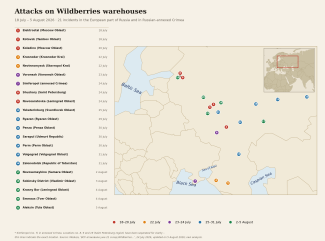
Since mid-July, Ukrainian drones have expanded their list of targets inside the Russian Federation, striking warehouses operated by the online marketplace Wildberries. Between 18 July and 5 August, 21 facilities were attacked, killing at least nine people. Preliminary assessments indicate that approximately 25% of the company’s warehouse capacity, out of an officially reported total of 5.2 million square metres, was destroyed. In late July, Ukraine also intensified strikes against oil processing facilities after the pace of such attacks had slowed in the middle of the month. Ukrainian drones targeted refineries in Ryazan, Perm, Tyumen, and Volgograd, among other locations.
The inclusion of Wildberries warehouses among Ukraine’s targets suggests an attempt to amplify the economic impact of its strikes on Russia. Until now, the effects of these attacks had been felt primarily in the fuel sector, in which the situation has recently shown some improvement. Disrupting the operations of a logistics giant such as Wildberries, which accounts for up to 45% of Russia’s e-commerce market, threatens other sectors of the economy and brings the war deeper into the country. The scale of the attacks on a key supplier of consumer goods is likely to have a direct impact on Russian society by increasing the tangible costs of the war.
Commentary
- Ukrainian strikes on logistics warehouses are harming the interests of small and medium-sized businesses, forcing the authorities to consider financial support. According to published estimates, losses incurred by companies whose goods were stored in the destroyed Wildberries warehouses could amount to between 215 billion roubles and 280 billion roubles (up to $3.5 billion). Tens of thousands of businesses may have been affected. Companies that suffered losses are seeking compensation from the platform, which has so far offered only limited payouts and not to all claimants. Wildberries CEO Tatyana Kim has stated that the company is in talks with the Russian government regarding financial support for those affected. Media reports have suggested that state-owned banks could provide loans both to Wildberries and to businesses using the platform. Any insolvency at Wildberries could also have negative consequences for Russia’s banking sector. The company has outstanding debts to several lenders, including VTB Bank, in which the Russian state holds a controlling stake.
- The attacks on Wildberries also fit into a broader political context, complicating the Kremlin’s efforts to conduct its propaganda campaign ahead of the parliamentary election scheduled for September. The strikes on the warehouses provide further confirmation to Russian society that the war is being brought onto Russian territory and that its costs are becoming increasingly severe. These developments could reinforce the deterioration in public sentiment that has been evident in Russia for several months. So far, this trend has been driven by a combination of factors, including mounting economic difficulties, Ukrainian attacks on fuel infrastructure and a series of unpopular government decisions (see ‘Russia accelerates internet shutdowns’).
- The start of the attacks on Wildberries warehouses coincided with a temporary decline in the frequency of strikes on oil refineries, contributing to an improvement in conditions on the fuel market. According to media reports, Russian crude oil processing increased by 400,000 barrels per day (bbl/d) between 16 and 22 July, reaching 3.8 million bbl/d, following the restoration of part of the damaged refining capacity. On 25 July, Deputy Prime Minister Aleksandr Novak stated that the situation was gradually improving, although it was still too early to speak of full stabilisation. According to the authorities, the measures introduced (such as maximising throughput at operational refineries, increasing imports and easing logistical bottlenecks by manually redirecting supplies without involving intermediaries) have reversed the negative trend. It should also be noted that the partial normalisation of the market has been supported by a decline in excess demand, which had been fuelled by panic buying among retail consumers.
- The renewed intensification of attacks on oil refineries casts doubt on the sustainability of the recent stabilisation of Russia’s fuel market. If Ukrainian strikes on refining facilities continue to prove effective, they could significantly slow the recovery in fuel production. According to media reports, the targeted refineries in Volgograd, Tyumen and Ryazan suspended operations following the attacks. Should Ukraine maintain this level of pressure, the measures introduced by the Russian authorities may prove insufficient to ensure further market stabilisation, thereby undermining progress in restoring refinery operations. For example, the Ryazan refinery suspended production following the attack on 29 July, only shortly after resuming operations following a two-month shutdown caused by a strike in mid-May.
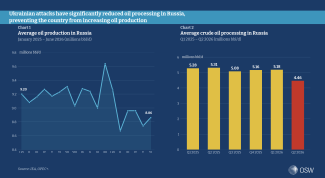
- Attacks on oil refineries are preventing Russia from increasing crude oil production and, consequently, its oil and gas revenues. In June, Russian crude exports to countries outside the Commonwealth of Independent States reached 5.5 million bbl/d, an increase of approximately 1 million bbl/d year on year. This increase reflects the country’s inability to process the additional crude domestically. The ‘extra’ one million bbl/d exported corresponds to roughly 20% of Russia’s average refining throughput in 2025. The increase in exports has been evident since March, when Ukraine intensified its attacks on Russian refineries. The strikes have also constrained Russia’s ability to expand crude oil production itself, particularly as Ukrainian forces have targeted other parts of the country’s oil infrastructure, including offshore production platforms in the Caspian Sea and tankers operating from Russian ports on the Black Sea. These attacks reduce Russia’s budget revenues, which depend in part on the volume of oil produced. Consequently, they also limit Moscow’s ability to benefit from elevated global oil prices.
APPENDIX