Kyiv defenceless against ballistic missiles. Day 1623 of the war

Russian forces have intensified their offensive in the Donbas, pushing Ukrainian defenders out of a series of positions across most sectors of the front. Russian troops now control most of the belt of high ground east of the Kramatorsk–Sloviansk urban area. According to some Ukrainian OSINT sources, they are now less than 5 km from the city limits of both Kramatorsk and Sloviansk. At the same time, Russian forces have stepped up attacks on the infrastructure of both cities using every available means. The only bridge connecting the two parts of Sloviansk has been seriously damaged, leaving just one lane open to pedestrians and light vehicles and significantly complicating supplies to the Ukrainian grouping fighting east of the city. Russian forces are also advancing south of the urban area, where their assault groups have begun regularly infiltrating Oleksiievo-Druzhkivka, north-west of Kostiantynivka.
After 840 days of fighting, the last Ukrainian troops, facing the risk of being cut off from the main Ukrainian force, have withdrawn from Chasiv Yar. For more than a year, they had held positions in the south-western part of the town under relatively little pressure. The Ukrainian command has denied reports of a withdrawal, insisting that fighting for the town continues. Russian forces have taken control of further settlements along the road from Pokrovsk to Druzhkivka. According to some sources, they have advanced to within just over 5 km of Druzhkivka. Russian troops have also captured additional positions south and east of Dobropillia and between Pokrovsk and the border of Dnipropetrovsk Oblast.
Russian advances in the north-eastern part of Kharkiv Oblast now threaten to cut off some Ukrainian forces operating near the border with Russia. Russian troops are attacking from two directions: across a broad front from Vovchansk, where they have reached Bilyi Kolodiaz, and from the Russian-Ukrainian border near Artilne, where they have advanced more than 10 km into Ukrainian territory. Russian forces have also continued to push Ukrainian defenders from positions on the eastern bank of the Oskil River near Kupiansk, where only a few pockets of Ukrainian resistance remain. They have also intensified operations towards Borova, where Ukrainian forces retain a second bridgehead east of the river. Moreover, Russian troops have made limited gains in the border area of Sumy Oblast and in Zaporizhzhia Oblast. In the eastern part of the latter, they have consolidated their control over Zaliznychne, while in the west they have slowed Ukrainian counterattacks near Stepnohirsk.

On 30 July, Russia launched a large-scale air attack on Kyiv and Lviv. Strikes in the capital and its surrounding areas hit at least three facilities producing strike drones and components for drones and missiles. One of these facilities, owned by the US-registered Ukrainian-American company Terminal Autonomy, was reportedly destroyed. An aviation plant was also targeted in Lviv. Damage to residential buildings in the city left one person dead and 38 wounded, while strikes on Kyiv killed one person and wounded three others. Industrial facilities in the Ivano-Frankivsk, Rivne and Dnipropetrovsk oblasts were also targeted. A North Korean KN-23 ballistic missile launched by Russian forces struck Radushne on the outskirts of Kryvyi Rih, killing six people, including three children. Meanwhile, a Kh-101 cruise missile entered Polish airspace and exploded over a field near Tarnawa-Kolonia in Lublin Voivodeship, 95 km from the Ukrainian border. Russia reportedly used a total of 83 missiles, of which between 32 and 55 were shot down, depending on the source.
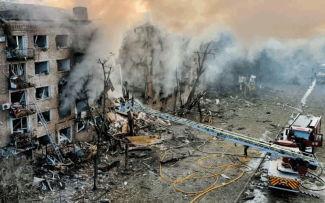
On 1 August, industrial facilities and warehouses in Kyiv and Kyiv Oblast were the main targets of a large-scale air attack. Damage was reported in seven districts of the capital, with 13 blocks of flats, an ambulance station and the Lithuanian embassy among the buildings damaged. Nine civilians were killed and 33 others, including four children, were wounded. One person was also killed and three were wounded in Brovary, near Kyiv, where the main warehouses of Rozetka, Ukraine’s largest e-commerce company, were targeted twice. A record 26 ballistic and hypersonic missiles struck at least five defence plants in Kyiv. During the attack, Ukrainian air defences used only one PAC-3 MSE Patriot interceptor. Reports vary, but at most one missile was intercepted.
Russia continued its strikes on Ukrainian port infrastructure, increasing the intensity of its attacks on Mykolaiv. The city has not been used as a seaport since 2022, but it remains an important inland shipping hub. Its infrastructure has also begun to serve as storage for spare parts intended for damaged facilities at ports in Odesa Oblast. Russia struck Mykolaiv on 28 and 30 July and carried out daily attacks on the city from 1 August onwards. These strikes damaged nine vessels moored there, bringing the total to 16 since the attacks began on 15 July. Odesa and nearby ports came under attack every day except 2 August. Fuel tanks were among the facilities destroyed on 1 August, while at least five vessels were damaged. Most were in the open sea, awaiting the resumption of traffic to the ports of Greater Odesa. On 1 August, the bridge at Zatoka across the Dniester Estuary, which was already out of service, was once again targeted in a missile strike.
Russia continued to target Ukrainian rear areas in the frontline regions, with Kharkiv and Zaporizhzhia the most frequently attacked major cities. Damage to industrial, transport, energy or storage infrastructure was reported in Kharkiv on the evening of 28 July and every day from 31 July to 3 August. Zaporizhzhia suffered two such attacks on 31 July and again on 2, 3 and 4 August. The 2 August attack on Zaporizhzhia killed one person and wounded 31. The following day, damage to a power line left 45,000 customers without electricity. Russian air attack weapons also struck Dnipro on 30 July and 3 August, Sumy on 1 and 4 August, where the second attack caused a ‘large-scale’ power outage, and Chernihiv and its surrounding area on 1 and 3 August. Poltava Oblast also came under attack every day from 30 July to 2 August, resulting in the destruction of three logistics terminals. A strike on industrial facilities and critical infrastructure in the Poltava area on 2 August caused a chemical leak and disrupted electricity and gas supplies. More than 20 petrol stations were also hit. According to local reports cited by the Financial Times on 31 July, Russian strikes had destroyed more than 200 petrol stations in the frontline regions since the attacks began, including at least 80 in Kharkiv Oblast.
A shortage of interceptor missiles for Patriot systems has rendered Ukrainian air defences ineffective against Russian ballistic and hypersonic missiles. Russia used at least 50 such missiles between the evening of 28 July and the morning of 4 August, but no more than two were shot down. During this period, Ukrainian military sources reported a total of 128 missiles, 57 of which were intercepted, including 55, primarily cruise missiles, during the large-scale attack on 30 July. According to the Ukrainian Air Force Command, Russia also used 1,254 strike drones and decoys, with Ukrainian forces neutralising 1,068 of them.

On 30 July, Latvia’s Ministry of Defence announced that it had signed a series of agreements with Ukrainian companies to expand cooperation on developing unmanned systems. These agreements aim to attract investment in the production of unmanned aerial vehicles in Latvia, facilitate the transfer of Ukrainian technology and establish modern testing infrastructure.
Also on 30 July, the European Commission announced that it had disbursed €3.47 billion to Ukraine for the procurement of unmanned systems, ammunition, air-defence missiles and JAS 39 E/F Gripen fighter aircraft. The funds represent the first tranche of the EU’s €90 billion loan to Ukraine.
On 3 August, US European Command (EUCOM) announced that, acting on instructions from the US Secretary of Defense (War), it had begun reorganising the Security Assistance Group–Ukraine (SAG-U) and restructuring the roles and responsibilities of individual components within the NATO Security Assistance and Training for Ukraine (NSATU) mission. The changes are intended to transfer leadership of key elements of the mission to European allies and free up US resources for other global priorities.

Ukrainian drones struck additional warehouses belonging to Wildberries, Russia’s largest online retailer. The company’s facilities were targeted in Ryazan on 29 July, Penza and Sarapul in Udmurtia on 30 July, Zelenodolsk in Tatarstan and Volgograd on 31 July, Novosemeikino in Samara Oblast on 2 August, Khryastovo in Vladimir Oblast on 3 August and Chekhov in Moscow Oblast, Krasny Bor in Leningrad Oblast and Emmaus in Tver Oblast on 4 August. Satellite imagery confirmed that the warehouse in Khryastovo had been completely destroyed. On 3 August, the Russian edition of Forbes reported that Wildberries had lost 17% of its warehouse space since the attacks began on 18 July.
Ukraine’s Unmanned Systems Forces continued Operation ‘Crimea Switch Off’ and increasingly expanded it to other Russian-occupied territories. According to its commander, Robert ‘Madyar’ Brovdi, Ukrainian drones damaged 33 energy infrastructure facilities between 28 July and 3 August, bringing the total to 187 since the operation began on 1 July. A strike on a substation supplying Mariupol caused the most severe disruption, leaving large parts of the city without electricity, water, mobile communications and internet access on 2 and 3 August. Meanwhile, the intensity and/or effectiveness of attacks on Russian shipping as part of Operation MoLoChKa declined significantly. According to Madyar, nine vessels were hit between 23 and 30 July, bringing the total to 205 since the operation began on 6 July. On 1 August, a Ukrainian uncrewed surface vessel sank a small Russian-flagged container ship, the Yanina, near Novorossiysk. The General Staff of the Ukrainian Armed Forces and the Security Service of Ukraine also reported further attacks on Russian logistics and air defences, mainly radar stations, in Crimea and the neighbouring Krasnodar Krai.
On 29 July, Ukrainian drones struck Lukoil’s refinery in Perm, damaging installations and leading to a partial suspension of production. Strikes also targeted refineries in Ryazan on 29 July, Volgograd on 31 July, Ufa on 1 August, Saratov on 2 August and Syzran in Samara Oblast on 4 August, as well as a fuel depot in Lyudinovo in Kaluga Oblast on 2 August, triggering fires at these sites. Ukrainian forces also carried out isolated attacks on petrol stations in Russia’s border regions and Russian-occupied territories. According to the Ukrainian General Staff, the Engels strategic aviation base in Saratov Oblast was hit on 2 August, causing a fire. Russian data indicate that Ukraine deployed a new record number of strike drones that day: a total of 1,158 were reportedly neutralised over Russia and Russian-occupied territories over a 24-hour period.

On 28 July, Dmytro Lykhovii, spokesperson for the General Staff of the Armed Forces of Ukraine, reported that a coordinated information operation was underway to discredit the newly appointed Commander-in-Chief, Mykhailo Drapatyi (see: ‘Change of commander-in-chief of the Armed Forces of Ukraine’), involving fake social media profiles and false announcements and decisions published under his name. A fake X account purporting to belong to Drapatyi was blocked, but similar pages appeared on Threads, while AI-generated false information was circulated on Facebook.
On 29 July, the Security Service of Ukraine (SBU) announced that it had detained two suspected Russian agents in Donetsk Oblast who had allegedly passed on information independently of each other to enable attacks on facilities of the Ukrainian Defence Forces. On 30 July, the SBU reported the detention of a man in Poltava on suspicion of collaborating with Russia’s FSB and gathering intelligence to facilitate Russian attacks. The same day, the SBU announced that it had detained three agents of Russian intelligence services allegedly responsible for two bomb attacks carried out in Odesa on 28 July. According to the investigation, two of them planted an explosive device under a soldier’s car and installed a hidden camera nearby, enabling their Russian handlers to monitor the target and detonate the bomb remotely. The third suspect placed an explosive device under a taxi. The resulting explosion killed the driver and seriously injured a female passenger.

On 31 July, an explosion followed by secondary detonations occurred at an ammunition depot of the Ukrainian Special Operations Forces in Khmelnytskyi Oblast. The incident was most likely caused by internal factors rather than a Russian attack. According to official figures, three soldiers were wounded and five were reported missing. The blast wave damaged buildings in the city of Khmelnytskyi, more than 10 km away.
On 3 August, Ukrainian President Volodymyr Zelensky appointed Rustem Umerov, Secretary of the National Security and Defence Council (NSDC), as head of the Foreign Intelligence Service of Ukraine. He also named former Interior Minister Ihor Klymenko as the Council’s new secretary (see ‘Ukraine: new government overshadowed by a controversial dismissal’). Umerov said that after taking office he intended to expand intelligence and defence cooperation with foreign partners, including the United States, the United Kingdom, the EU’s member states, Turkey and countries in the Middle East. His priorities are also expected to include implementing the Drone Deal programme and the Freya anti-ballistic project. Klymenko, for his part, said that he would focus on coordinating and swiftly exchanging information across the security and defence sector, conducting audits, monitoring the implementation of the NSDC’s decisions and forecasting threats.
On 29 July, in an interview with Axios, Zelensky said that he had asked US President Donald Trump to provide Ukraine with an emergency ‘winter package’ of Patriot interceptor missiles. According to Zelensky, Ukraine’s stocks of air-defence missiles are almost exhausted, leaving it unable to repel the latest Russian attacks. He added that Ukraine needed around 300 Patriot interceptors ‘yesterday’.
On 30 July, The Atlantic reported that Zelensky had also asked Trump to persuade Elon Musk to allow the Starlink system to be used to guide Ukrainian drones to targets in Russia, primarily mobile ballistic missile launchers. The proposal is intended as an alternative to supplying scarce Patriot interceptors. The Ukrainian leader stressed that neutralising Russian launchers before winter was essential to protect the country’s energy infrastructure.
On 30 July, the website Texty.org.ua published an investigative report accusing the command of the 225th Separate Assault Regiment of subjecting its soldiers to brutal and inhumane treatment. The authors compiled the report over six months, drawing on accounts from dozens of service personnel and the families of missing soldiers. It describes threats of execution for disobeying orders or retreating, incidents of opening fire on or using drones against the regiment’s own soldiers, confinement in locked rooms, beatings and abuse of subordinates. The report also features a recording of the regiment’s commander, Oleh Shyriaiev, ordering that anyone moving without permission be treated as an enemy. The command of the 225th Regiment has denied the allegations. The same day, Olha Protsenko, spokesperson for Ukraine’s State Bureau of Investigation, announced that two soldiers from the 425th Separate Assault Regiment “Skelya” had been remanded in custody on suspicion of torturing and mistreating other members of the unit (see: ‘A crack in the “Skelya”: disciplinary and reputational damage in the so-called Syrskyi regiments’). According to Ukrainian media reports, the new commander-in-chief, General Drapatyi, had suspended the assignment of new recruits to the so-called assault regiments.

On 2 August, Alyaksandr Ilyukevich, commander of the Special Operations Forces of the Belarusian Armed Forces, announced that the military had begun forming the 37th Separate Air Assault Brigade, which will be stationed near Homel, around 40 km from the Ukrainian border. One battalion has reportedly already been formed, with another battalion and combat support, artillery, air-defence and reconnaissance subunits planned for later this year. The announcement came despite a softening of rhetoric in relations between Minsk and Kyiv in recent weeks. On 22 July, Belarusian Defence Minister Viktar Khrenin said that the government had seen no signs of Ukraine preparing any hostile actions against Belarus. On 7 July, Kyrylo Budanov, head of the Office of the President of Ukraine, likewise assessed that there were currently no indications of Belarus preparing a ground offensive or any other form of military escalation against Ukraine. Kyiv had previously demanded the dismantling of relay stations on Belarusian territory used to guide Russian drone attacks on Ukraine (see: ‘State of emergency in Crimea. Day 1588 of the war’).

According to a report published by the International Organization for Migration (IOM) on 29 July, there are 3.9 million internally displaced persons in Ukraine, accounting for around 12% of the country’s population. Nearly 70% have been displaced for more than two years. An estimated 2.15 million of them come from the occupied or partially occupied territories. For 82% of respondents, a complete end to hostilities remains a prerequisite for returning home.
On 30 July, Ukraine’s State Bureau of Investigation announced that, together with the command of the General Staff of the Armed Forces of Ukraine, it had launched Operation ‘Fair Conscription’, involving inspections and investigative activities at more than 100 regional and district territorial recruitment centres. The operation aims to uncover cases of misconduct by officials, particularly instances of facilitating draft evasion in return for payment and abuses of authority, including beatings and torture of individuals liable for military service.