Change of commander-in-chief of the Armed Forces of Ukraine
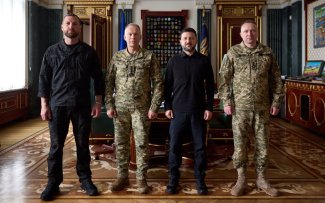
On 21 July, President Volodymyr Zelensky announced the dismissal of General Oleksandr Syrskyi as Commander-in-Chief of the Armed Forces of Ukraine (AFU) and the appointment of General Mykhailo Drapatyi, Commander of the Joint Forces, to replace him (see the profile in the Appendix). The reshuffle came against the backdrop of protests that began on 16 July in response to the removal of Mykhailo Fedorov as Minister of Defence, drawing crowds ranging from several thousand to over 10,000 people in Kyiv and other Ukrainian cities. The demonstrators primarily demanded the reinstatement of the popular minister and the dismissal of Syrskyi, who had been at odds with Fedorov.
President Zelensky made the decision after consulting representatives of a significant part of the military leadership. He held several meetings with Air Assault Forces Commander Oleh Apostol and also spoke with Deputy Chief of the AFU General Staff General Volodymyr Horbatiuk, Joint Forces Commander Mykhailo Drapatyi and corps commanders, including Generals Andrii Biletskyi, Ihor Obolenskyi and Denys Prokopenko.
The appointment of General Drapatyi, who enjoys broad public support and is held in high regard within the armed forces, aims to quell public discontent while preserving order and cohesion within the military. The remaining challenge is to find a new position for Fedorov that would allow him to continue work on reforming Ukraine’s armed forces, as demanded by the protesters, while also helping to curtail his political ambitions, a priority for Zelensky.
Commentary
- The replacement of the commander-in-chief is a direct result of public pressure on President Zelensky. The scale of public discontent appears to have caught him by surprise and forced him to reconsider his decision to back Syrskyi in his dispute with the dismissed minister of defence over their respective powers, compounded by personal differences (see: ‘Zelensky vs Fedorov: Ukraine’s Defence Minister dismissed’). In an effort to ease public tensions, Zelensky held a series of meetings over several days with senior military leaders, aiming to create the impression that the decision to dismiss Syrskyi had been thoroughly discussed and taken in consultation with the military leadership, so that it would share responsibility for the change.
- The scale of public support for Fedorov revealed by the protests has placed Zelensky in a difficult position. Reinstating the dismissed minister would amount to an admission of error and further damage the president’s public standing. However, leaving Fedorov outside the government risks further eroding public trust in Zelensky and creating the potential for the former minister to pursue an independent political career, potentially threatening Zelensky’s re-election prospects. Fedorov himself has further complicated matters by reportedly refusing to accept alternative positions related to coordinating the technological development of Ukraine’s armed forces, including posts as a member of the National Security and Defence Council and deputy prime minister, insisting instead on being reinstated as minister of defence.
- The protests initially centred on opposition to the dismissal of Fedorov but gradually evolved into broader criticism of the way the country is governed. Serious concerns have emerged over how the government makes and communicates decisions, and over the accountability of state institutions and political leaders for their actions. In public perception, Fedorov and Syrskyi embody contrasting visions of Ukraine’s future. Fedorov represents competence, technological development and innovation in warfare, including the prospect of further automation and robotisation of the armed forces, developments seen as offering hope for easing mobilisation rules and introducing reforms that could enable Ukraine to prevail over Russia (see: ‘Ukraine’s mobilisation crisis: a new minister, old challenges’). Syrskyi, by contrast, represents a conservative approach to military command based on a rigid hierarchy and disregard for human losses. His public image has also been damaged by the recent exposure of abusive practices in military units under his command (see: ‘A crack in the “Skelya”: disciplinary and reputational damage in the so-called Syrskyi regiments’). As a result, the protests may continue until Fedorov is appointed to a position that enables him to meet public expectations.
- The new commander-in-chief assumes command of the armed forces amid worsening manpower shortages. The Armed Forces of Ukraine are also facing a serious organisational crisis that has prevented them from building an operational reserve or regaining the initiative on the battlefield. Formally, General Drapatyi’s immediate task will be to complete the ongoing structural reform of the armed forces and the mobilisation system in order to create the conditions for rotating troops deployed along the front line. An equally important challenge will be to bridge divisions within the military. Several senior commanders have publicly backed General Syrskyi, including Commander of the Territorial Defence Forces, General Ihor Plakhuta, and Commander of the Air Force, General Anatolii Kryvonozhko, while General Drapatyi has sided with Fedorov.
Appendix. Biography of General Mykhailo Drapatyi
Born in 1982 in Kamianets-Podilskyi, Mykhailo Drapatyi is a major general who served as Commander of the Joint Forces of the Armed Forces of Ukraine (AFU) from June 2025 to July 2026.
He graduated from the Kharkiv Institute of Tank Forces in 2004 and began his military career with the 72nd Separate Mechanised Brigade. In 2015, he enrolled in a part-time programme at the National Defence University of Ukraine while taking part in combat operations in the Donbas. He earned a master’s degree at the operational-tactical level in 2017. Between 2019 and 2021, he completed the university’s operational-strategic programme. As the top graduate of his class, he was awarded the Sword of the Queen of the United Kingdom by Ambassador Melinda Simmons.
At the outset of the war in the Donbas in 2014, Drapatyi held the rank of major and commanded the 2nd Mechanised Battalion of the brigade. He gained widespread prominence following the events of 9 May 2014 in Mariupol, when an infantry fighting vehicle under his command broke through a barricade erected by the so-called separatists operating in the city. Between 2015 and 2016, he served as chief of staff of the 30th Separate Mechanised Brigade. He then commanded the 58th Separate Motorised Infantry Brigade from 2016 to 2019, attaining the rank of colonel. In 2021, he was appointed deputy commander for training at Operational Command ‘North’ before assuming the same position at the Joint Forces Command of the AFU.
In March 2022, shortly after the start of Russia’s full-scale invasion, Drapatyi was appointed commander of the Operational Group of Forces ‘South’. The units under his command halted the Russian offensive towards Kryvyi Rih and carried out successful counterattacks, liberating a number of settlements in Dnipropetrovsk and Kherson oblasts. Between August and November 2022, his forces took part in the operation to liberate Kherson. He subsequently commanded the Kherson Operational Group of Forces until January 2024, when he was appointed Deputy Chief of the AFU General Staff for Training. In May 2024, he also assumed command of the Kharkiv Operational and Tactical Group of Forces, tasked with defending Kharkiv Oblast against a renewed Russian offensive. In November 2024, he was appointed Commander of the AFU Ground Forces; in January 2025, he also took command of the Khortytsia Operational and Strategic Group of Forces.
In June 2025, Drapatyi resigned as Commander of the Ground Forces following a Russian strike on a military training ground in Sumy Oblast. He accepted responsibility for the lives of the troops under his command, even though the deaths of the servicemen were not caused by any error on his part. President Zelensky accepted his resignation but simultaneously promoted him to Commander of the AFU Joint Forces.
Drapatyi is regarded as a representative of a new generation of Ukrainian military commanders, educated in independent Ukraine, capable of strategic thinking and placing great emphasis on protecting the lives of the troops under his command. During the Fedorov-Syrskyi dispute, he expressed support for the dismissed minister.
He is married and has a son and a daughter.