State of emergency in Crimea. Day 1588 of the war

Russian forces are making advances in Dnipropetrovsk Oblast, moving towards Oleksandrivka. Although footage published by Russian sources showing soldiers infiltrating the villages of Pysantsi and Novoskelyuvate does not confirm that Russia has seized control of these settlements, it does indicate the expansion of the so-called ‘grey zone’ in this area. Gaining control of the Donetsk–Zaporizhzhia route, which runs through these villages, will effectively hamper the supply of the Armed Forces of Ukraine (AFU) at the junction of the Dnipropetrovsk and Zaporizhzhia oblasts.
The situation is also difficult for the defence forces in the Kupiansk sector. This is due to problems in maintaining supply lines by water or land, which necessitates the use of heavy unmanned aerial vehicles to resupply Ukrainian troops stationed on the left bank of the Oskil River. Contrary to statements from the Russian side, this does not yet prove that Ukrainian forces have been encircled in this sector.
In Donetsk Oblast, the frontline is gradually approaching Kramatorsk – it is currently around 12 km from the city, meaning that Russian FPV drones can terrorise residents and effectively strike Ukrainian positions. The city itself is the target of relentless air strikes, which are gradually reducing the urban area to ruins.

Between the evening of 23 June and the morning of 30 June, Russia deployed 913 Shahed-type strike drones, 14 ballistic missiles and two Zircon anti-ship missiles. The Ukrainian Air Force Command reported that 810 unmanned aerial vehicles and ten missiles had been damaged or neutralised. The largest attack took place during the night of 25–26 June, when over 200 air strike assets were deployed. Among its targets was Kyiv, where, despite Russian missiles being shot down using the Patriot system, debris from at least one of them fell in the Darnytskyi district, causing a widespread fire in warehouse facilities. A concentrated attack on the capital was repeated on the night of 27–28 June – the Darnytsia pharmaceutical plant was hit. On 25 June, Russia carried out an air strike on one of the hospitals in Kherson (the city centre was also targeted on 27 June). The day before, during a Russian missile strike on the village of Novopetrivka in northern Kherson Oblast, two staff members of Norwegian People’s Aid who were taking part in a demining operation were killed, and four others were injured.
On 24 June, Naftogaz Group reported that Russia had carried out an attack on Ukrnafta’s fuel processing plants and petrol stations in the Zaporizhzhia, Mykolaiv and Dnipropetrovsk oblasts. A refinery in Kremenchuk, which remained the only fully operational facility of its kind in the country, was also reportedly hit. The Russians also attacked a thermal power station adjacent to the refinery. On the same day, Kryvyi Rih was targeted, where four people were killed after missiles struck civilian infrastructure. On 24 June, Russian forces launched a drone attack on the centre of Konotop. According to the city authorities, the strike targeted a cinema building, injuring six people. On 23 June, during the day, Russian forces carried out a drone attack on Odesa Oblast. As a result, a woman was killed on one of Odesa’s beaches.
Zaporizhzhia remains a constant target of attacks. On 26 June, Russian forces carried out a massive attack on the city and Zaporizhzhia Oblast, using aerial bombs and missiles – 15 people were injured. Subsequently, on 27 and 28 June, Russian air strikes on Zaporizhzhia caused extensive damage to civilian infrastructure: amongst other things, a block of flats collapsed, from under which rescue workers extracted two people. Another strike targeted an educational establishment – nine people were injured, including two children. Russian forces are also carrying out attacks on public transport vehicles – on 29 June, a drone struck a minibus, killing three people, whilst another exploded near a bus, injuring several people. Ivan Fedorov, head of the Zaporizhzhia regional administration, reported that 70 people injured in the attacks are currently being treated in hospitals in Zaporizhzhia. Four children are among those hospitalised.

On 25 June, President Volodymyr Zelensky announced that he had approved a 40-day ‘operation of influence’ against Russia, aimed at persuading it to end the war. The operation will consist of strikes deep into Russian territory, as well as operational activities on the frontline. He also stated that Ukraine’s Unmanned Systems Forces (USF) have been achieving excellent results in protecting Ukrainian positions on the defence line for several months now, precisely thanks to the use of drones.
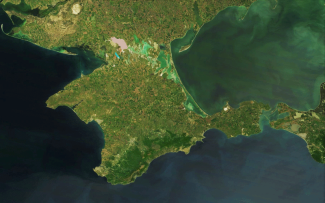
The commander of the USF, Major Robert Brovdi “Madiar”, reported on 23 June that Ukrainian medium-range drones had struck over 60 Russian targets in occupied Crimea and other territories seized by Russia. On the same day, Ukraine’s Special Operations Forces reported that a railway bridge across the North Crimean Canal in occupied Crimea, near the village of Rozdolne, had been destroyed. The structure was a vital military and logistical artery used for the transport of military equipment. The bridge had been hit during the night of 21–22 June, but after a repair team arrived during the night of 22–23 June, Ukrainian drones struck the remains of the structure and the repair equipment once again.
On 24 June, Russian sources, citing the so-called ‘Governor of Sevastopol’ Mikhail Razvozhayev, reported that, following a night-time attack on occupied Crimea, Sevastopol had been completely cut off from its electricity supply (the attack targeted one of the power substations in Sevastopol, as well as the Simferopol Combined Heat and Power Plant). According to statements from the occupying authorities, energy facilities were operating on a limited basis; due to the power cut, public transport was not running, and educational institutions were operating on a limited basis. The following day, Crimea came under another massive drone attack. According to sources monitoring reports on Russian social media, the Tavriisk and Balaklava thermal power stations were attacked, causing power cuts in parts of the peninsula.
Razvozhayev announced on 26 June that a ‘regional state of emergency’ had been declared in occupied Crimea and Sevastopol. The occupying authorities justified the decision by citing the need to swiftly resolve the ‘economic’ problems and to ensure the stable functioning of sectors vital to residents’ lives. Although the reasons for the decision were not explicitly stated, the announcement came following a series of Ukrainian strikes on Crimean military, energy and transport infrastructure, as well as after traffic jams at the Kerch Bridge lasting several hours. Prior to the introduction of the restrictions, Sergey Aksyonov, head of the occupying administration of Crimea, announced a reduction in the number of passenger trains running between the occupied peninsula and Russia. Services are to be gradually cancelled over the next two weeks; no reasons were given for the decision. It is most likely linked to growing security and logistical problems concerning connections with the peninsula.
Reuters reported on 24 June that the Moscow Oil Refinery will not resume operations for at least six months following Ukrainian drone attacks in recent weeks, and that full restoration of capacity may not occur until 2027. This facility, located on the southern outskirts of Moscow, is a key supplier of fuel to the capital region, including its airports. Meanwhile, on 25 June, two refineries belonging to Bashneft were attacked in Ufa, Russia. On the same day, the Ukrainian Defence Forces (UDF) struck the Poltavskaya fuel depot in Krasnodar Krai. According to the Ukrainian command, the depot was being used to supply Russian troops in the occupied territories of Ukraine. The following day, Ukrainian drones carried out an air strike on the Azot chemical plant in Novomoskovsk in Tula Oblast (for the second time in a month). On 27 June, the UDF reportedly struck the Titan-Barrikady defence plant in Volgograd with FP-5 ‘Flamingo’ cruise missiles. According to various estimates, four to five hits were recorded, but there has been no satellite confirmation of these to date. On 28 June, a night-time attack by Ukrainian drones on the region caused a fire at the refinery in Slavyansk-on-Kuban in Krasnodar Krai.

On 24 June, President Zelensky announced that the transmitters on Belarusian territory, used to direct Russian drone strikes against Ukraine, had ceased to function as of 22 June. It can therefore be assumed that the regime in Minsk has complied with the ultimatum issued by the Ukrainian leader a few days earlier (see ‘Crimea’s supply route at risk. Day 1581 of the war’). The following day, Zelensky reported that Belarus was completing the construction of military infrastructure along the border with Ukraine under Russia’s direct supervision. According to Kyiv, this involves roads, ammunition depots and fuel storage facilities. In this instance too, the Ukrainian government issued warnings to Minsk, demanding that the expansion of the infrastructure be halted. On the same day, Alyaksandr Lukashenka stated that he had recently met in Minsk with “representatives of Zelensky”, to whom he had conveyed that Minsk did not want war with Ukraine, but “would stand by Russia in any situation”.
On 24 June, the Belarusian Ministry of Defence announced that ‘mobilisation exercises’ had begun in Hrodna Voblasts. Since 20 June, reservists have been notified of their obligation to report to military units and have their registration details verified. The ministry plans to involve around 2,000 people in the procedure, with the verification due to be completed by 2 July. Although Minsk presents these actions as a routine part of checking mobilisation readiness, their location near the borders with Poland and Lithuania, coupled with reports of Russian pressure on Lukashenka, potentially exacerbate the tense situation in the region, prompting Kyiv to issue further unequivocal statements. Ukraine’s Foreign Minister Andrii Sybiha stated that the “mobilisation exercises” should attract greater attention from the international community, as they are in fact intended to intimidate neighbouring states. He also assessed that it is in the interest of the Kremlin to strengthen Belarus’s military presence along the borders of Ukraine and NATO and constitutes a form of political blackmail.
On 25 June, the Security Service of Ukraine (SBU) reported that Ukrainian and American cyber security experts had uncovered attempts by Russian intelligence services to hack into the messaging apps of officials, military personnel and activists in Europe, the US and Ukraine. According to the SBU, the aim of the operation was to gain access to sensitive military, political and economic information and to steal personal data. Russian hackers most frequently used phishing, including text messages posing as ‘support teams’ for official bots.

In response to the alleged threat from Belarus, Ukraine has announced the formation of new military units. The Commander-in-Chief of the Armed Forces of Ukraine, General Oleksandr Syrskyi, stated on 25 June that Ukraine must form new brigades due to the risk of hostilities spreading from the Belarusian front. He assessed that Russia might attempt to open a new front in the north, which would extend the line of combat by approximately 160 km and force the dispersal of Ukrainian forces.
On 27 June, the Ukrainian Air Force reported that a MiG-29 fighter jet was lost whilst carrying out a combat mission, though the pilot successfully ejected. The crash is said to have occurred after the mission was completed, and the circumstances of the incident are currently under investigation.
On 28 June, the Ukrainian police reported the death of Colonel Volodymyr Kononnikov, commander of the 154th Independent Mechanised Brigade. The victim was found with a gunshot wound, suggesting that he had been murdered.

On 26 June, Ukraine and Russia carried out another prisoner exchange on the Ukrainian-Belarusian border, enabling 160 Ukrainian soldiers to return home. All those released had been held captive by Russia since 2022. Among them are servicemen from the Armed Forces of Ukraine, the State Special Transport Service, the National Guard and the Border Guard Service, who had defended, amongst other places, Mariupol and Azovstal. Zelensky stated that since the start of 2026, Ukraine has repatriated 1,596 people from Russian captivity.
A report published on 29 June by the Office of the UN High Commissioner for Human Rights stated that between 1 December 2025 and 31 May 2026, the number of civilian casualties in Ukraine rose by 40% compared with the same period the previous year. During this period, the UN Monitoring Mission documented the deaths of 1,272 civilians and injuries to 6,871 people. The main causes cited were Russian attacks using long-range missiles and drones, as well as the increasing use of short-range unmanned aerial vehicles on the frontline.

On 25 June, a special Pentagon report to the Armed Services Committee of the US Congress revealed that the US Department of Defence had had exceeded the timeframe allotted to spend $910 million earmarked for military aid to Ukraine under the Ukraine Security Assistance Initiative (USAI), which was funded during Joe Biden’s administration. However, between October 2025 and March 2026, Ukraine received US$8.2 billion’s worth of American military equipment funded by the USAI. At the same time, military equipment already signed off for but not yet delivered is valued at US$13.61 billion.
During the Ukraine Recovery Conference (URC 2026), which took place on 25–26 June in Gdańsk, Poland, the following measures, amongst others, were announced:
- The Ukrainian Ministry of Defence announced that, together with its counterparts from France and Finland, it had concluded an agreement with the European Commission on €343 million in EU guarantees and grants to support the development of industrial capacity in the field of dual-use technologies and the defence industry;
- The Ukrainian company Ukrainian Unmanned Technologies and the French firm Haulotte are commencing joint production in France of ‘Ravlyk’ ground-based unmanned systems for the Ukrainian Armed Forces;
- Denmark will supply Ukraine with a further 15,000 155 mm artillery shells;
- Finland will provide an additional €40 million to Ukraine under the US Proceeds from the Sale of US-Made Defence Equipment mechanism (PURL). In total, Finland has contributed €140 million to date;
- The German company ARX Robotics and the Ukrainian company Roboneers have announced the formation of a joint venture, ARX Industries, which will undertake the mass production of the ‘Lynx Pro’ unmanned ground systems;
- Ukrainian communications equipment manufacturer HIMERA and Finnish defence technology firm Bittium have agreed to collaborate with a view to strengthening the defence capabilities of Finland and Ukraine by combining their communications technologies and relevant expertise;
- KNDS has signed a memorandum with the Ukrainian firm Ukrainian Unmanned Technologies on the joint development and production of unmanned ground systems;
- The Ukrainian company SkyFall and Poland’s National Development Bank have signed a memorandum on securing EU funding for Ukrainian defence technologies;
- The Ukrainian company DevDroid and the Norwegian firm Kongsberg Defence & Aerospace have signed a memorandum of cooperation on the production of existing ground-based unmanned systems and the development of new ones.
On 26 June, the communications director of the Norwegian company Nammo announced that this year alone the company had supplied the Ukrainian defence forces with hundreds of thousands of N7 shaped-charge warheads for FPV drones.
As part of its annual report to the UN, the Norwegian government stated that in 2025 it had supplied Ukraine with: 20 M113 armoured personnel carriers, 33 Iveco LMV armoured vehicles, three NM189 Ingeniørpanservogn engineering vehicles, 18 XA-185 SISU armoured personnel carriers, 12 NM204/M125A self-propelled mortar systems and six XA-186 SISU armoured personnel carriers.