Ukrainian drone explodes in Constanța. Day 1567 of the war

Russian forces continued their offensive on most major fronts but made little progress. Particularly fierce clashes took place in Kostiantynivka, where, despite the situation constantly deteriorating, the Ukrainians are still holding their positions in the town centre, as well as in the vicinity of Rodynske between Pokrovsk and Dobropillia. The eastern part of Lyman has become the scene of urban fighting and is currently not under the control of either side. Russia has stepped up its activity around Kupiansk, with fighting taking place mainly in its eastern part. It has also entered the built-up area of the town of Kupiansk-Vuzlovyi, situated south of the city, through which passes the bulk of supplies for Ukrainian forces on the right bank of the Oskil River. Further border areas in the Kharkiv and Sumy oblasts have also come under Russian control. Ukrainian counterattacks in the Dnipropetrovsk and Donetsk oblasts have not brought about any significant changes. However, they continue to effectively disrupt Russian logistics along the route known as “Novorossiya” in the occupied parts of the Kherson and Zaporizhzhia oblasts.

Russian forces have intensified their attacks on Ukrainian logistics, destroying or damaging large warehouse facilities to the immediate rear of the front line. On 3 June, the Nova Poshta terminal and the ATB logistics centre in Dnipro were hit; it took nearly two days to extinguish the fires. On 8 June in Kharkiv, fires and destruction affected the Ukrposhta logistics hub and the Nova Poshta logistics centre. On 5 June, the authorities of the Odesa and Zhytomyr oblasts reported damage to local logistics infrastructure, with eight workers injured in the attack in Odesa Oblast.
Energy, industrial and transport infrastructure remained constant targets for Russia, mainly in frontline and border regions. Damage to these facilities occurred, among others, in Kharkiv (3, 4, 6 and 9 June), Odesa and its surrounding port cities (3, 4, 6, 7 and 8 June), Zaporizhzhia (4, 6, 7 and 8 June), Chernihiv (5 June), Dnipro and Kryvyi Rih (6 and 8 June) and Kherson (7 June). During the attack on Zaporizhzhia on 8 June, a residential estate was also hit, with two people killed and 32 injured. The most severe damage to energy infrastructure (at least eight power stations and substations were hit) was recorded in Zaporizhzhia and the Chernihiv and Dnipropetrovsk oblasts. On 5 June, the bridge over the Dniester in the village of Maiaky was attacked, and on 8 June, the bridge in Zatoka on the Dniester Liman (both in Odesa Oblast) was closed to traffic following earlier attacks. On 4 and 5 June, damage to industrial infrastructure was also reported from Boryspil and Brovary in Kyiv Oblast. In areas immediately behind the front line, the number of attacks on petrol stations has increased, with at least a dozen or so destroyed or damaged.
On 7 June, a Russian drone struck a building at the Central Spent Nuclear Fuel Storage Facility near the Chernobyl Nuclear Power Plant. The Ukrainian authorities described this as an unprecedented threat and called on the International Atomic Energy Agency (IAEA) to respond. Following an inspection, the IAEA confirmed earlier Ukrainian reports that there had been no increase in radiation levels, and its director-general expressed concern. Two days earlier, a local ceasefire had been observed in the vicinity of another facility – the Zaporizhzhia Nuclear Power Plant – allowing repairs to be carried out on the power lines essential to its operation. The IAEA reported that the 15-hour blackout at this facility was one of the longest since fighting began (18 incidents have been recorded to date).
The Russians have increased the frequency of drone attacks arriving via Belarus. On 6 June, the State Border Guard Service of Ukraine reported this, but did not disclose the number of drones. According to the Ukrainian Air Force Command’s (UAFC), from the evening of 2 June to the morning of 9 June, Russia deployed 1,536 strike drones and their imitators, of which 1,385 were neutralised. Aggregated data (from the UAFC and also the General Staff and regional military administrations) indicates that the Russians also used 12 missiles, mainly ballistic missiles, none of which were shot down.

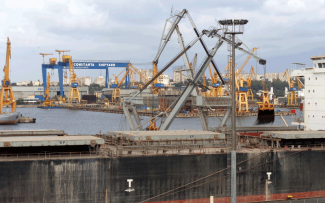
On 5 June, a Ukrainian surface drone exploded in the port of Constanța, Romania, where it had become stuck in an anti-pollution barrier (there were no casualties). Three further Ukrainian unmanned aerial vehicles exploded near the city and at other locations along the Romanian coast. The Ukrainian Navy Command commented on the incident at the port of Constanța – it was reported that the drone’s flight had been disrupted by Russian electronic warfare (EW) systems, and that the Romanian side had been notified that control over it had been lost. In May this year, there were several incidents in which Ukrainian maritime drones drifted towards the coasts of Greece and Turkey, but on those occasions the payloads they were carrying did not explode. It remains an open question whether this was already the result of Russian EW systems jamming their navigation systems, and whether the drone explosions off the coast of Romania stem from progress made by the Russians in taking control of their on-board systems. However, the use of unmanned aerial vehicles by the Ukrainians to strike Russia shipping has yielded results. On 5 June, as many as five ships were hit in the ports of Berdiansk and Mariupol and whilst sailing in the Sea of Azov (on one of them, the Azerbaijani crew suffered casualties – five were killed and six were injured).
Ukrainian drones struck Leningrad Oblast twice, damaging fuel infrastructure, shipyards and military facilities. On 3 June, an oil terminal in St Petersburg was hit, causing a fire in the tanks, and a repair shipyard in Kronstadt, where drones struck the ‘Boikiy’ corvette, which was undergoing repairs in a dry dock (a fire broke out and the superstructure was damaged). On 6 June, the 15th Arsenal of the Russian Navy in Bolshaya Izhora was struck, causing a fire and an explosion. Fires also broke out at the Peterhofskaya fuel depot and the Neste oil terminal in Lomonosov. However, a further strike on the shipyard infrastructure in Kronstadt failed to achieve its objectives. The strikes on Leningrad Oblast were part of the largest Ukrainian attacks on Russia and the territories it controls in Ukraine since mid-May. The Russian Ministry of Defence reported that it had neutralised 754 and 911 drones respectively over the course of the day.
The Ukrainians continued their attacks on critical infrastructure within Russian territory and the occupied areas. The most significant confirmed damage resulted from the attack carried out on 6 June on the Ust-Labinsk fuel depot in Krasnodar Krai (a loading ramp, two storage tanks and two tankers were damaged). A day later, Ukrainian drones caused fires at the Semikolodezyanskaya fuel depot and the terminal in Feodosia in occupied Crimea, and on 8 June at the Grushovaya Balka fuel depot in Krasnodar Krai and the Krasny Yar production-dispatch station in Krasny Yar in Volgograd Oblast. On 3 June, the Progress plant in Michurinsk in Tambov Oblast was hit (a warehouse caught fire), and a day later there was a massive attack on Simferopol (three people were killed and seven were injured). On 7 and 9 June, the bridge to Crimea at Chonhar was hit, where damage to the deck forced traffic to be suspended. As a result of Ukrainian attacks on energy facilities (including the Zuivska power station in Donetsk Oblast on 7 June), there were power cuts in the occupied territories and in Russian border regions. On 8 June, a Ukrainian drone struck the locomotive of a Moscow–Simferopol passenger train in Crimea, resulting in the temporary suspension of passenger traffic on the peninsula. The General Staff of the Armed Forces of Ukraine also reported to that a military radio-technical installation in Crimea had been hit (3 June) and an FSB Border Guard patrol vessel in the Sea of Azov (4 June).

On 2 June, the Security Service of Ukraine (SBU) announced the arrest in Zakarpattia Oblast of a Russian military intelligence agent who was allegedly gathering data on Ukrainian defence companies. This information was to be used to prepare air strikes against key facilities and the assassinations of senior management and engineers. On the same day, the SBU reported the arrest of a Russian intelligence agent who was allegedly involved in preparing a missile and drone attack on Dnipro. A day later, it was announced that a 17-year-old had been arrested who was alleged to have been coordinating Russian strikes in Kharkiv Oblast, and on 8 June, a student was arrested who was alleged to have been passing on the coordinates of Ukrainian military facilities in Dnipropetrovsk Oblast to the Russians.
On 5 June, the Financial Times, citing Ukrainian intelligence, published data showing that around 21% of those detained in 2025 for collaborating with Russia were teenagers. Russian intelligence services are increasingly turning away from professional agents in favour of minors recruited via Telegram, Discord, TikTok, Facebook and online games. They are offered money (often in cryptocurrencies) in return for carrying out tasks – initially distributing propaganda materials, arson and gathering information, and subsequently tracking military sites, photographing air defence systems and participating in the preparation or planting of explosive devices. The youngest person they attempted to recruit for sabotage activities was 11 years old. Similar cases have also been reported in Poland, the Baltic states, the Netherlands and the United Kingdom.

On 2 June, the Australian government announced its participation in the international Operation Legio, which aims to train Ukrainian soldiers in Poland. It was not specified how many instructor soldiers Australia would send to the Norwegian-run Camp Jomsborg, nor what its financial contribution would be.
In its annual report to the UN on the export and import of arms and military equipment for 2025, the United Kingdom declared that it had supplied Ukraine with six AS-90 gun-howitzers, six T-72EA tanks, 20 M113A1B tracked armoured personnel carriers, 158 wheeled armoured personnel carriers and various types of MRAP vehicles, and 110 assault boats of various types.
The Netherlands has concluded its participation in the training of Ukrainian soldiers as part of Operation Interflex, as announced by the country’s Ministry of Defence on 8 June. However, the Dutch intend to continue participating in the training of Ukrainian military personnel, including as part of the European EUMAM training mission. At the beginning of June, four years had passed during which 63,000 Ukrainians, mainly rank-and-file soldiers, commanding officers and instructors for infantry units, had been trained as part of the UK-led Operation Interflex. In its fifth year of operation, the mission is set to change its focus and concentrate on training specialists, including flight instructors and helicopter maintenance personnel, as well as soldiers in engineering units and medical services.

On 3 June, Volodymyr Zelensky dismissed Oleksiy Osypenko from his post as Deputy Commander of the Ukrainian National Guard, a role he had held since 2023, appointing in his place Colonel Oleh Myronenko, who had previously been commander of the 14th Operational Brigade “Red Kalina”. Myronenko has been serving since 2014 and during that time took part, among other things, in the recapture of the regional administration building in Kharkiv and in fighting in eastern Ukraine.
On 4 June, the commander of the Unmanned Systems Forces (USF), Robert “Madyar” Brovdi, published data on the effectiveness of his unit during its first year of operation. Since 11 June 2025, it is reported to have destroyed or neutralised over 350,000 verified Russian targets, including over 100,000 soldiers, and to have carried out 1.65 million combat missions, averaging around 5,000 sorties per day (the figures also include the use of small FPVs in the frontline zone). For the coming year, the USF has set itself the target of destroying 650,000 targets, including 200,000 Russian soldiers. In “Madyar’s” view, the figures demonstrate a sharp rise in the importance of the unmanned component within the Ukrainian combat system – drones are already responsible for approximately one-third of Russian losses and targets struck by the Ukrainian Defence Forces as a whole.

On 2 June, the State Bureau of Investigation of Ukraine (DBR) reported that since the start of the full-scale war, it had initiated 3,032 investigations into crimes against state security. The largest category consists of cases of treason – 2,012 investigations; a further 806 concern collaboration, and 54 concern support for the aggressor state. The DBR emphasises that it is also gathering evidence against individuals residing in the occupied territories or in the Russian Federation to enable their trial in absentia.
On the same day, the SBU and the National Police of Ukraine announced the dismantling of six channels for the illegal sale of weapons and ammunition originating in war zones. In various regions of Ukraine, the organisers of the scheme and individuals involved in the sale of so-called ‘trophy weapons’ – captured from the Russian army’s equipment – were detained. Among the items seized were: Kalashnikov rifles, anti-tank grenade launchers, combat grenades and nearly 20,000 rounds of ammunition. In the Kyiv and Donetsk oblasts, four current and former military personnel were arrested, alleged of secretly transporting weapons from the front lines in the east of the country.
Also on 2 June, the Ukrainian Ombudsman, Dmytro Lubinets, presented a report on the condition and functionality of civil defence shelters in Ukraine. The report reveals that of the 1,066 facilities inspected, as many as 993 – or 93% – had various shortcomings; only 7% met the inspectors’ standards. The document emphasised that the condition of the shelters is affected not only by human negligence but also by systemic failures – unclear rules of use, a lack of clear standards, poor inspections and a chronic shortage of funding.
On 7 June, Lubinets stated that, since the start of the Russian aggression in 2014, approximately 8.5 million citizens have left Ukraine, of whom over 5.7 million left following the start of the full-scale invasion in 2022. Lubinets described this scale of migration as a “global challenge” requiring coordinated action by the state and its foreign partners.
On 4 June, which marks the Day of Remembrance for Children Killed by Russian Aggression the Head of the President’s Office, Kyrylo Budanov published data showing that since the start of the full-scale invasion, Russian troops have killed 707 minors. Furthermore, 2,548 have been wounded or maimed, and over 20,000 have been abducted, deported or forcibly removed from their homes. According to Budanov, Russian attacks on civilian infrastructure and children are not random, but aim to destroy Ukraine’s history, memory and future.
On 6 June, President Zelensky signed a decree establishing a Coordination Council for the protection of the rights of war veterans, their family members, the families of fallen defenders, as well as prisoners of war and those missing in action. The body will operate under the President and a consultative and advisory body, and its task will be to prepare proposals for improving the system of legal and social guarantees for veterans, families of the fallen, military personnel and civilians held by Russia, and the families of those missing in connection with the war and occupation.
According to the results of a poll by the Kyiv International Institute of Sociology published on 8 June, 61% of Ukrainians reject the possibility of a ceasefire along the current front line if Ukraine does not receive security guarantees and increased supplies of weapons and financial resources. This solution would be supported by 32% of respondents.