Ukraine’s mobilisation crisis: a new minister, old challenges
On 25 March, the Minister of Defence, Mykhailo Fedorov, announced far-reaching changes to Ukraine’s mobilisation system aimed at addressing the armed forces personnel shortages. The reform effort has been endorsed by President Volodymyr Zelensky, who had previously distanced himself from the issue for fear of negative public reactions, as society becomes increasingly fatigued by the costs of a war now entering its fifth year. A socially acceptable solution will require striking a delicate balance between the need to strengthen the armed forces manpower and the imperative of preserving the younger generation for the post-war period. Political calculations on Zelensky’s part are also relevant, as he seeks to maintain his popularity in the event of a future presidential bid.
Mobilisation under the new defence minister
One of the key elements of the announced reform of the mobilisation system is a change in the functioning of the military draft offices. The reorganisation of these structures – widely regarded as corrupt and prone to the use of coercion – is to be supported by an audit, the timeframe for which has not been specified. The expansion of the functionality of the Reserve+ application, enabling individuals of conscription age to register online, is another measure expected to facilitate improvements in the operation of draft offices. This mechanism, however, applies only to those already included in the conscription system and holding a right to deferment (see ‘The Gordian knot of mobilisation: Ukraine balancing the needs of the military and business’) and thus will not address the most important problem – encouraging registration among those who have so far evaded this obligation. According to estimates presented by Fedorov, this group numbers around 2 million individuals, while approximately 200,000 have absconded from military units without authorisation.
The proposed remedy for filling the gaps in the armed forces involves a transition from a conscription-based system to a professional army. The cornerstone of the reform is to be a new contractual framework for soldiers, providing for service periods ranging from two to five years, with the possibility of discharge for up to one year after completing at least two years of service. An increase in remuneration is also envisaged.
The implementation of these proposals will, however, be very difficult. The promise of pay rises is not reflected in the current budget, while the solution suggested by President Zelensky – financial support from the West – remains, for the time being, blocked due to Hungary’s veto (see ‘A dispute with Ukraine fuels Orbán’s election campaign’). A further obstacle – given the deepening crisis in the Verkhovna Rada – will be securing the parliamentary majority necessary to adopt the required legislation (see ‘Ukraine: deepening crisis of the parliamentary majority’).
Between necessity and reluctance
Fedorov’s principal challenge, however, will be to overcome public resistance to mobilisation. A March 2025 survey by the Institute of Social and Political Psychology found that 58% of respondents express understanding for those evading service (only 39% consider it a source of shame). These attitudes are reflected in the increasing frequency of clashes between draft office personnel and individuals refusing to report for duty. Whereas in 2022 only five incidents involving violence against recruiters were recorded, and in 2023 there were 38, the figure rose to 118 in 2024 and 341 in 2025. At the same time, the number of complaints against draft office staff has surged. According to the Human Rights Commissioner, Dmytro Lubinets, 18 complaints were registered in 2022, 514 in 2023, 3,312 in 2024, and in 2025 nearly twice as many as the previous year – reaching 6,127 complaints.
Personnel shortages constitute the most serious obstacle hindering the Ukrainian army’s ability to conduct effective operations at the front. According to representatives of the authorities, the average manning level of a brigade of the Armed Forces of Ukraine stands at 40–60%; however, according to accounts from military personnel, the number of soldiers operating directly on the front line does not exceed 20–30% of authorised strength.
A key factor in this situation is the high number of desertions, stemming primarily from poor organisation of military service and the lack of clear prospects for its completion. Previous attempts to counteract absconding – for example by encouraging soldiers to return to the armed forces through the decriminalisation of desertion and unauthorised absence – have proved ineffective (under Ukrainian law, the two terms are treated separately: the former denotes the intentional abandonment of a military unit without the intention of returning to service, while the latter refers to the unauthorised departure from a unit or the failure to report for duty without valid justification for a period exceeding three days).
According to data from November 2025, since the beginning of the full-scale invasion, the Prosecutor General’s Office of Ukraine has registered 255,000 proceedings concerning unauthorised absence from a unit and 56,200 cases of desertion (the discrepancy with the figures presented by Fedorov most likely results from the fact that some cases concern the same individuals repeatedly committing the same offence). As early as autumn 2024, parliament adopted amendments to the Criminal Code allowing soldiers who had left their units to avoid criminal liability if they returned. Between January and August 2025, at least 29,000 individuals are reported to have made use of this provision; at the same time, from January to October 2025, more than 162,000 criminal cases concerning unauthorised absence were initiated. It should also be noted that a frequent reason for leaving a unit was the desire to change one’s place of service, which became possible upon re-reporting to a draft office.
The vicious circle of (de)mobilisation
Efforts to resolve the mobilisation problem are further undermined by the practice of assigning new recruits to assault units operating on the most difficult sections of the front and/or those commanded by ineffective and incompetent officers. Consequently, more than 80% of desertions occur during initial training. These are facilitated by the poor organisation of the training process (see ‘Army at a crossroads: the mobilisation and organisation crisis of the Defence Forces of Ukraine’) – conducted in overcrowded facilities, lacking adequate living conditions and security – as well as by the reluctance of frontline commanders to assign experienced soldiers as instructors.
Desertions and the limited inflow of new personnel have thus far deterred the authorities from adopting provisions regulating the length of service, out of concern that this could lead to a collapse of the defence effort as a result of the simultaneous demobilisation of a substantial proportion of troops. Consequently, the absence of rotation results in the physical and psychological overburdening of soldiers and reduces their combat effectiveness (see ‘On the threshold of a third year of war. Ukraine’s mobilisation crisis’). This leads to a systemic vicious circle in which desertions stem from the mounting exhaustion of soldiers caused by chronic personnel shortages.
Despite his constitutional responsibility for mobilisation policy, President Zelensky has thus far opted for half-measures. After the adoption of a law lowering the minimum conscription age from 27 to 25, he delayed signing it for ten months. The inclusion, in February 2025, of individuals aged 18–24 in a voluntary one-year contract programme failed to encourage young people to join the armed forces – only several hundred reportedly signed contracts. This reluctance on the part of the authorities to confront a difficult issue has been accompanied by attempts to shift responsibility for the army’s personnel situation to the General Staff of the Armed Forces of Ukraine and individual units. This has created space for effective Russian disinformation activities, which amplify the most extreme reports circulating online about the methods used by draft centre staff (e.g. so-called ‘busification’), presenting them as the norm rather than the exception.
Politics and demography
The prospect of a presidential election – even if currently distant – encourages Zelensky to refrain from undertaking unpopular measures. This applies above all to younger cohorts: in the first round of the 2019 election, as many as 52% of his electorate were aged 18–39. The fact that this group receives particular consideration is reflected in his response to the youth protests in July against attempts to curtail the independence of anti-corruption bodies. The swift withdrawal of these measures, as well as the decision to allow men aged 18–22 to travel abroad, were intended to regain support. Consequently, however (according to Eurostat data), between September and November 2025 the number of applications submitted by Ukrainian men aged 18–34 for temporary protection in EU member states increased almost fivefold compared with the preceding three months – from approximately 16,300 to over 77,000.
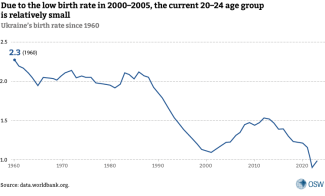
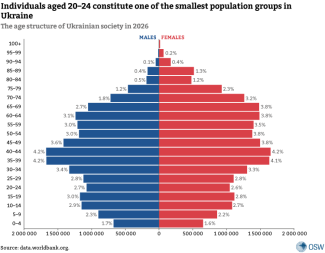
At the same time, demographic considerations may also underpin the decision to allow young people to travel abroad and to maintain 25 as the minimum mobilisation age. The birth rate in 2000–2005 reached its lowest level in the entire period preceding the Russian invasion (see Chart 1). Consequently, individuals aged 20–24 represent one of the smallest age cohorts, numbering approximately 1.5 million (see Chart 2). Given that Ukraine currently has the lowest birth rate in Europe and records a death rate three times higher than its birth rate, the loss of individuals of reproductive age would pose a serious obstacle to development.
A key challenge
Without the creation of attractive conditions of military service – providing for clearly defined terms of enlistment, the possibility of choosing a specific specialisation, satisfactory remuneration, and a professional training process – the reforms announced by Mykhailo Fedorov will not succeed. However, this task is not doomed to failure: the motivation to resist and the will to fight remain strong in Ukraine, and reputable units such as the 3rd Assault Brigade and the 12th Special Forces Brigade ‘Azov’ of the National Guard have been successful in recruiting volunteers, achieving manning levels of over 90% (see ‘Forging a nationalist model army. The political prospects of the Azov Movement’).
Moreover, in the view of a significant proportion of military personnel, considerable mobilisation potential still exists (estimated at 2–5 million individuals, including around 800,000 in the 18–25 age group), which could enable recruitment to increase beyond the approximately 30,000 call-ups per month planned by Kyiv. The figures disclosed by Fedorov regarding the number of individuals evading military service represent the first public admission by a senior official of the failure of the existing mobilisation policy and may be regarded as a positive indication that the authorities have recognised the scale of the problem. The success of the announced reform will, however, depend to a large extent on the political will to implement it