Ukrainian attacks on Russia’s oil export infrastructure
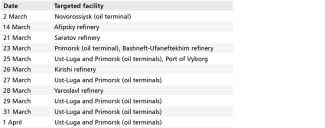
In March, Ukraine intensified its attacks on Russia’s oil and fuel infrastructure, primarily targeting facilities involved in the export of crude oil and petroleum products. Drones struck oil terminals in the Baltic ports of Primorsk and Ust-Luga, as well as the Black Sea port of Novorossiysk, along with adjacent infrastructure. The strikes caused significant disruption to operations. Following the attacks on 25 March, loading at the Ust-Luga terminal was completely halted, as nearby fires prevented tankers from docking. Operations at a gas processing plant and a fuel terminal owned by Novatek were also suspended.
According to data from Vortexa, exports of crude oil and fuel from Baltic ports fell by 80% between 23 and 30 March, compared with the previous week, reaching 600,000 tonnes. Notably, a decline is also visible in shipments from Black Sea ports: between 22 and 29 March, nearly 1.4 million tonnes of oil and fuel were exported from these ports, 26% lower year on year, according to CREA data. This points to challenges in restoring full export capacity following the attacks in early March.
The frequency and effectiveness of the strikes pose a serious challenge for the Kremlin. The attacks are paralysing a significant share of export capacity, with Baltic ports accounting for around one third of Russia’s total crude oil exports and nearly half of its petroleum product exports (see Appendix). If the intensity of the strikes persists, Russia will face significant logistical and financial challenges. The loss of export capacity increases pressure on domestic storage, which may force reductions in both oil production and refining. The slowdown in exports also negatively affects Russian oil and fuel companies, as the attacks limit their ability to sell these products on foreign markets and to generate profits. This is particularly acute under current conditions, given persistently high prices for crude oil and fuels, which would otherwise have contributed to improved financial performance after 2025, following a period of significant income decline (see ‘Gains amid mounting challenges: the consequences of the war in Iran for Russia’).
Commentary
- Ukrainian attacks primarily target Russian oil companies, but for now they have not affected Russia’s budget revenues. It is important to note that a physical reduction in export capacity does not directly affect the sector’s taxation. Russian companies pay tax at the point of extraction rather than export, although the tax rate is calculated on the basis of export prices. However, Ukrainian strikes create highly unfavourable conditions for the sector’s operations, depriving companies of the ability to export and to generate revenue from sales. If export restrictions persist over the longer term, this may impose significant costs on the Kremlin, which may be forced to compensate companies for their losses. Negative consequences for the budget will become evident if Russian firms are compelled to reduce production, thereby reducing the number of taxable barrels.
- Successful Ukrainian attacks on Russia’s export infrastructure highlight the Kremlin’s limitations in protecting key sectors of the economy. Notably, strikes on infrastructure have been accompanied by attacks on vessels involved in exports, both in the Black Sea (tankers) and in the Mediterranean (including an attack on the gas carrier Arctic Metagaz). As Western pressure on tankers from the so-called shadow fleet intensifies, Ukrainian strikes further exacerbate the operating environment for Russian exports. The cost of maintaining these flows, including freight and insurance, is rising significantly due to the increased risks associated with such operations.
APPENDIX
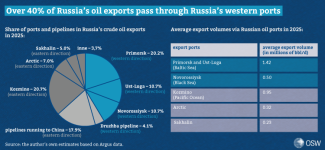
Table. Ukrainian attacks on oil and fuel infrastructure since March 2026