Ukrainian attacks on the CPC oil pipeline: outlook for Kazakhstan’s oil sector
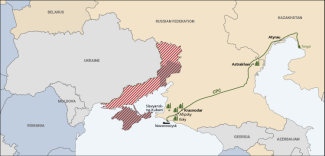
Kazakhstan’s oil sector is facing a serious crisis due to reduced throughput of the Caspian Pipeline Consortium (CPC), caused by Ukrainian drone attacks in November 2025 and January of this year. The CPC pipeline transports about 1% of global oil supplies, carrying crude from Kazakhstan to the Black Sea terminal in Novorossiysk. Russian companies are the majority owners of the CPC, holding 51% of its shares, while Kazakh and US companies hold 19% and 28% respectively. The remainder belongs to enterprises registered in Italy and the United Kingdom. As much as 80% of Kazakhstan’s oil exports flow through the CPC. As a result of the Ukrainian attacks, Kazakhstan has incurred multi-million dollar losses, estimated by local experts at up to $1.5 billion in January alone. It has therefore called on the United States and the European Union to help secure crude shipments across the Black Sea.
The collapse in Kazakhstan’s oil exports caused by the attacks has triggered the first serious crisis in the country’s relations with Ukraine. Kazakhstan views the Ukrainian operations as strikes on civilian facilities, while Ukraine sees its drone attacks on critical infrastructure in Russia as a legitimate means of combating the aggressor. If CPC infrastructure suffers further damage, leading to additional losses for Kazakhstan’s economy, relations between the two countries are likely to deteriorate further.
Critical dependence
On 29 November 2025, Ukrainian drones struck an oil terminal near Novorossiysk that forms part of CPC infrastructure. Similar attacks followed on 13 and 19 January of this year, targeting tankers in the Black Sea leased and operated by Kazakhstan’s state-owned company, KazMunayGas. These incidents constrained oil exports, dealing a heavy blow to Kazakhstan’s economy, as the world’s 12th largest oil producer. According to OPEC, in December 2025 the country’s daily oil production stood at approximately 1.5 million barrels, around 14% below the daily average for the year as a whole.
Oil is Kazakhstan’s most lucrative export commodity. More than half of the country’s export revenues come from the sale of crude oil and petroleum products. The vast majority of Kazakh oil is transported via CPC pipelines running through Russia. EU countries account for 60% of Kazakhstan’s exports of crude oil and petroleum products.
In addition, the Tengiz oil field, the country’s largest and most important, has faced disruptions. A fire on 18 January of this year, the cause of which remains unclear, resulted in power outages and reduced output. The current situation underscores the strategic dependence of Kazakhstan’s exports on Russian pipeline infrastructure. Measures introduced so far, such as the partial rerouting of oil to alternative transport corridors, have proven insufficient to shield the national economy from losses. These routes do not offer capacities comparable to those of the CPC, leaving Kazakhstan without a genuine alternative.
The Kazakh government and foreign companies operating the country’s largest oilfields, Tengiz and Kashagan, including Chevron, ExxonMobil, Lukoil, and Shell, have been seeking ways to mitigate losses. For the first time, crude produced at the Kashagan field has been redirected to the domestic market, specifically to the refinery in Shymkent, where around four million barrels are expected to arrive in January alone. This crude has also been sent directly to China via the Atasu–Alashankou pipeline, amounting to approximately 366,500 barrels in December. However, neither the domestic market nor the Chinese market can absorb volumes of crude comparable to those shipped via the pipeline running to Novorossiysk.
Kazakhstan’s stance towards Russia’s invasion of Ukraine
Since Russia’s invasion of Ukraine in 2022, Kazakhstan has maintained good relations with Ukraine. Like other Central Asian countries, Kazakhstan has refused to support the invasion or to recognise Russia’s annexation of the so-called Donetsk and Luhansk People’s Republics, viewing these actions as a violation of Ukraine’s territorial integrity. Stressing its neutrality, the Kazakh government has sought to strike a balancing act between Western countries, Russia, and China. At the same time, Kazakhstan has maintained close economic cooperation with Russia. Moreover, President Kassym-Jomart Tokayev has frequently met with Vladimir Putin.
Kazakh society is divided in its assessment of the conflict. According to a survey conducted in 2025, 27.8% of the Kazakh population consider Russia’s assault on Ukraine to be justified, describing it as a ‘fight against Nazis’ and ‘the West’, while 24% view it as an illegal invasion. Almost half of the respondents did not give a clear answer to this question. Both government officials and mainstream media typically adopt a neutral stance. However, openly pro-Ukrainian positions have appeared in independent outlets, where freedom of speech is systematically curtailed.
A day after the November attack, Kazakhstan’s Ministry of Foreign Affairs issued a statement calling on Ukraine to halt the strikes and describing the terminal as “an exclusively civilian facility whose operation is safeguarded by norms of international law.” Ukraine responded that the strike, which was in fact carried out by the Armed Forces of Ukraine, should be seen as part of its fight against Russia. It also stressed that Kazakhstan had never condemned Russian attacks on Ukraine’s civilian infrastructure.
Outlook
The November attack on the CPC terminal prompted an immediate response from the Kazakh government, whereas the strikes in January did not elicit any official reaction, even though Russia swiftly blamed Ukrainian forces for what it described as an ‘act of terrorism’ targeting tankers in the Black Sea. Despite the negative impact of the attacks on the country’s economic situation, Kazakhstan does not want to further damage its relations with Ukraine. A strong response condemning Ukrainian actions could be perceived on the international stage as a symbolic alignment with Russia in the conflict and could also be exploited by Russian propaganda, something that the Kazakh government is keen to avoid.
Any further strikes restricting the use of the CPC pipelines would reduce the scale of Kazakhstan’s energy cooperation primarily with the EU, but also with Turkey, which doubled its imports of Kazakh oil in the final months of 2025. Should this infrastructure suffer lasting damage, greater volumes of crude would be redirected eastwards. According to Kazakhstan’s state-owned company KazTransOil, pipelines running from Kazakhstan to China will soon be capable of transporting 146.6 million barrels a year, representing around 28% of the CPC’s capacity of 527.7 million barrels a year.
If the crisis related to oil transport via the CPC drags on, China’s importance as Kazakhstan’s energy partner will increase, primarily as a result of the fuller utilisation of the Atasu–Alashankou pipeline. Before the attacks on CPC-linked infrastructure, it was used mainly to transport Russian oil across Kazakhstan. Annual exports via this route totalled 73.3 million barrels, equivalent to half of its planned capacity. However, inadequate transport infrastructure continues to limit the volume of Kazakh crude that China can absorb.
The scale of the economic losses caused by the Ukrainian attacks on the CPC underlines Kazakhstan’s critical dependence on the extractive sector and Russian pipeline infrastructure. A prolonged crisis surrounding this infrastructure could create problems for the entire Kazakh economy and have a significant impact on the country’s domestic situation, particularly if citizens are strongly affected by its consequences. This could fuel public discontent; it is worth noting that oil sector workers, frustrated by the uneven distribution of profits, were the driving force behind major social protests in 2011 and 2022.
Map. Route of the Caspian Pipeline Consortium (CPC) pipeline