MOL moves towards acquiring Russian stakes in Serbia’s NIS
On 19 January, the Hungarian oil and gas company MOL announced that it had signed a binding heads of agreement with the Russian petrochemical company Gazprom Neft to purchase a 56.2% stake in Serbia’s fuel company NIS. Within this package, 44.9% of shares are held directly by Gazprom Neft, while 11.3% belong to a company affiliated with it, JSC Intelligence. It was also announced that the Abu Dhabi National Oil Company (ADNOC), a state-owned enterprise from the United Arab Emirates, would join the ownership structure, and that the Serbian state is also expected to increase its stake (from the current 29.9%). No details of either transactions has been disclosed.
The Russian stake in NIS motivated the US sanctions against the company which – after numerous postponements – entered into force on 9 October 2025 (see ‘US sanctions against Serbian oil company NIS’). The restrictions led to a cut-off of crude oil supplies and the suspension of operations at Serbia’s only refinery in Pančevo. On 31 December, Washington granted NIS a sanctions waiver until 23 January, allowing imports to resume and the plant to restart operations. The deadline for concluding the final sale agreement was also extended – to 24 March – although the transaction will still require approval from the US Office of Foreign Assets Control (OFAC).
The agreement is a consequence of US sanctions pressure on Moscow and the outcome of months of Hungarian–Russian negotiations. For Belgrade, it may bring a normalisation of the domestic oil sector and a reduction of Russian influence. For Budapest, in turn, it will enable it to strengthen its political leverage and enhance MOL’s position in the Western Balkans.
Commentary
- The completion of the transaction would mark the first case of Russian oil assets in Europe being sold under pressure from US sanctions. As a result of Washington’s leverage, Moscow would – after 18 years – lose control of a company that dominates around 80% of Serbia’s fuel market and accounts for 50% of retail sales. For now, the Hungarian–Russian agreement remains preliminary, but it is binding and will likely secure a continued sanctions waiver for NIS until the final contract is concluded, while enabling the normalisation of Serbia’s oil sector. For Belgrade, the Hungarian assurances that the Pančevo refinery will not be shut down are particularly important; this occurred, for example, with the Hungarian-controlled facility in Sisak, Croatia. Little is known at this stage about ADNOC’s role in the deal. It cannot be ruled out that it will provide financial backing to MOL in the costly acquisition of NIS (estimated at €1.5–2 billion) in exchange for participation in the majority stake. Operational control over NIS, however, would remain with the Hungarians.
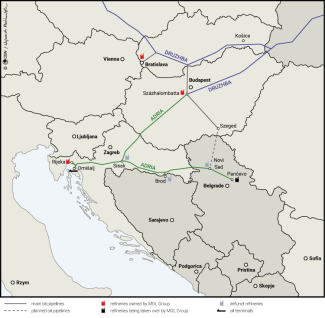
- MOL’s acquisition of NIS would curb Moscow’s influence in Serbia in the short term, but in the longer run it could facilitate a return to imports of Russian crude. At present, the only supply route for oil to Serbia is a pipeline controlled by Croatia’s JANAF. Following EU sanctions in 2022, JANAF stopped transporting Russian oil, forcing NIS to source crude from countries such as Iraq and Kazakhstan. When US restrictions on NIS in 2025 led to a complete interruption of supplies and the Pančevo refinery halted operations, Serbia relied on imports of petroleum products from Hungary. Owing to a derogation from EU sanctions, MOL continues to import Russian oil via the Druzhba pipeline. Budapest and Belgrade have expressed interest in extending this connection further south. In January this year, a tender was launched for the construction of a pipeline that would allow Serbia to import around 5.5 million tonnes of crude annually (mainly Russian). MOL’s takeover of NIS could provide additional momentum for accelerating this project. At the same time, Budapest faces the threat of a full EU ban on Russian hydrocarbons by 2028, as well as the possibility of US sanctions on deliveries of Russian oil – the annual US waiver for Hungary is set to expire in November this year.
- The preliminary agreement on MOL’s acquisition of Gazprom Neft’s assets reflects Hungary’s close political and energy ties with Russia. The resale of the stake was most likely discussed during Prime Minister Viktor Orbán’s meeting with Vladimir Putin in Moscow in November, as well as with President Donald Trump in Washington (since the transaction will require OFAC approval). Russian Foreign Minister Sergey Lavrov described the agreement as ‘mutually beneficial’, which may indicate both a price attractive to the Kremlin and the fact that the NIS stake would be transferred to a company from a country that maintains close energy cooperation with Moscow. The deal was also made possible by strong Hungarian–Serbian political relations and is set to further strengthen Budapest’s influence in the Western Balkans.
- The transaction fits into MOL’s long-term strategy of consolidating its position as a regional energy powerhouse. Taking control of NIS would give the company access to key assets, including the Pančevo refinery, an extensive network of filling stations in Serbia, and upstream production assets. The move would complement MOL’s earlier investments – including in Croatia (INA) and Slovakia (Slovnaft) – strengthening regional integration across the supply chain for crude oil and petroleum products. Consequently, MOL would expand the scale of its operations, improve logistical efficiency, and reinforce its bargaining position vis-à-vis regulators and suppliers (including Croatia’s JANAF, which transports oil to Serbia and Hungary).
Map. Hungarian oil group MOL increases its presence in the refining sector of neighbouring countries
Source: author’s own research.