Red nationalism
INTRODUCTION: THE STATE IS THE PARTY
I. HOW THE PARTY VIEWS THE WORLD
1. The Chinese nation and socialism
2. Politics and international relations according to the CCP
II. WHAT DOES THE PARTY ELITE WANT?
1. The CCP’s strategic objective
2. The CCP’s intermediate objectives in international politics
3. Shaping the views of others
4. The economy as an instrument of foreign policy
IV. THE CCP’S VISION OF THE IDEAL WORLD
1. Instruments of the ‘New Era’
2. Global Development Initiative
4. Global Civilisation Initiative
5. Global Governance Initiative
CONCLUSION: IDENTIFYING RISKS AND PLANNING ACTION
APPENDIX: The Chinese Communist Party’s power structure in international relations
MAIN POINTS
- The People’s Republic of China (PRC) is not a nation-state but a Leninist political entity in which all authority over politics, the economy and society rests in the hands of a hierarchical Communist party. This entity was created more than 75 years ago by the Chinese Communist Party (CCP) to control the country and participate in an international order dominated by nation-states. Consequently, the PRC’s foreign policy is, in effect, the foreign policy of the CCP. This distinction is not merely a matter of semantics; it carries profound practical implications. Both the foreign and domestic policies of contemporary China are shaped by the CCP's understanding of international relations, its identity and ideology, and the interests of the Party elite, which centre on the survival of the regime. Since the interests of the Chinese state or nation do not always coincide with those of the CCP and its leaders, the interests of the Party prevail whenever the two come into conflict.
- Like many other national liberation movements during the colonial era, the CCP not only fought against Western imperialism but also rejected the capitalist path to modernisation. Consequently, the worldview that predominates within the Chinese leadership and Party apparatus is a syncretic blend of Marxism-Leninism – both as a framework for understanding the world and as a blueprint for modernisation – and nationalism, which regards Western states as perennial adversaries. The memory of the ‘Century of Humiliation’ lies at the heart of contemporary Chinese nationalism. The end of that period, marked by the CCP’s victory in the Chinese Civil War, forms a central pillar of the Party’s claim to political legitimacy.
- Although the PRC has benefited from the existing liberal international order and globalisation, the CCP remains, by its very nature, a revisionist organisation that is suspicious of the outside world and antagonistic towards the West. Moreover, Marxism-Leninism provides the CCP with a millenarian sense of confidence and portrays China’s rise as the product of an objective historical process. This fosters a belief that history and time are on the Party’s side and that its ultimate destiny is to surpass the West, which is often portrayed as the embodiment of a Hegelian form of ontological evil. In this sense, the PRC sees itself as both a member and a leader of the Global South, comprising post-colonial states that have historically been exploited or that regard themselves as having been wronged by the West. Consequently, the Party is convinced that the past several decades, characterised by peaceful coexistence and sectoral cooperation with the West, particularly in the economic sphere, represent only a temporary phase.
- Marxism-Leninism is no longer an ideology aimed at achieving world revolution, but it remains both a worldview and a programme for preserving and expanding power. From the perspective of the Chinese Communist Party, the survival of the regime is paramount, as only the continuation of Party rule guarantees the Party elite the preservation of their power and wealth. The CCP leadership rationalises this position by arguing that the Party is the sole and indispensable guarantor of China’s domestic modernisation and the protection of its sovereignty. Consequently, the CCP leadership views the international environment primarily through the lens of threats to its authoritarian rule. Its response to both real and imaginary dangers originating beyond China’s borders is to secure a dominant global position, thereby enabling it to neutralise or eliminate any external risk effectively. Perceived external threats, together with the ambition to restore China’s vaguely defined ‘rightful place’ in international affairs, also form an important part of the regime’s legitimacy.
- According to the Marxist-Leninist concept of international relations, the majority of humanity is exploited and controlled by a minority that uses the economic system to build and maintain its dominance systematically. The only way to liberate the majority, therefore, is to seize and transform that system through political means, using force if necessary. The CCP leadership draws a practical conclusion from this premise: it views coercion and control over the economy as instruments for preserving and consolidating political power. Consequently, unlike many Western elites, the Party regards the economy not as an end in itself but as a political tool and a means of increasing military power. The PRC can therefore pursue policies that lie beyond the imagination of many Western policymakers because such actions are often judged to be economically irrational or short-sighted, damaging to international trade or detrimental to business confidence. The Party, however, is prepared to sacrifice economic objectives in pursuit of political goals and does not hesitate to employ economic coercion. Many of the PRC’s economic policies are also driven by the belief that confrontation with the West is ultimately inevitable, rather than by purely economic calculations.
- For several decades, the CCP adhered to the strategy of ‘hiding its strengths’, initiated by Deng Xiaoping. He adopted this approach at a time when, following the events of 1989, the PRC was not only facing international isolation but also confronting serious economic challenges and therefore required peaceful cooperation with the West. That period has passed, and in the eyes of the CCP leadership Deng’s dictum has lost its relevance since the global financial crisis of 2008, which they regarded as evidence of Western weakness and incompetence. Under Xi Jinping, the key concept has become the ‘New Era’, signifying a fundamental transformation in China’s development and a new stage in the country’s history. This shift is also presented as a response to a changing international environment.
- The current generation of CCP leaders views the Deng-era ‘reform and opening up’ not as a project aimed at building a capitalist system in China, but rather as the functional equivalent of Lenin’s New Economic Policy (NEP) in the Soviet Union between 1921 and 1928, albeit extended over a much longer period. Crucially, they regard this phase as having come to an end. It is to be followed by a period of reducing socio-economic disparities and a return to the construction of genuine socialism, which is seen as the ultimate means of securing lasting domestic legitimacy.
- The primary domestic objective remains the consolidation of the CCP’s absolute authority across all aspects of social life, including the economy, the military and society as a whole. This includes a strong emphasis on ideological discipline as a safeguard against ideological infiltration from abroad. In the Party’s official narrative, China’s superiority over the rest of the world is expected to extend far beyond economic and military strength, although those domains remain important, and encompass social, cultural and environmental progress as well. Inevitably, the ‘New Era’ signals a more self-confident and assertive approach to international relations. Its overarching aim is to reshape the global order through the concept of a ‘community with a shared future for mankind’, presented as an alternative to what the CCP characterises as Western hegemony.
- In foreign policy, as in domestic policy, the Communist Party has demonstrated a considerable ability to adapt to a rapidly changing international environment. It is adept at exploiting emerging circumstances opportunistically in order to gain an advantage. Nevertheless, the relative growth in China’s international standing and power, which has enabled Beijing to pursue an increasingly assertive foreign policy over the past two decades, has often proved counterproductive and produced outcomes contrary to those intended. This is largely the result of the Party’s efforts to secure domestic legitimacy at a time of slowing economic growth by appealing to nationalist, and at times even xenophobic, sentiments within the Chinese population. In doing so, however, the Party leadership has progressively narrowed its own room for compromise in international relations.
- The CCP leadership has accepted that Party propaganda has achieved limited success in developed countries, in contrast to the Global South, where it has proved relatively effective. At the same time, drawing on Russian experience, Beijing has placed greater emphasis on conducting disinformation campaigns aimed at Western societies. The objective is to foster apathy and a sense of civilisational decline, undermine confidence in democratic systems, relativise the concept of human rights, and encourage the belief that efforts to halt the CCP’s ‘triumphant march’ and the rise of its state are ultimately futile.
- At the global level, the CCP’s diplomacy and propaganda efforts focus on creating the impression that China offers an alternative to the existing international order. The series of initiatives launched since 2021 contains very few concrete proposals and relies largely on lofty slogans that are readily acceptable to most states. Chinese officials routinely speak of multilateralism, Beijing’s respect for the United Nations Charter, and its commitment to the sovereignty and independence of all countries. This rhetoric stands in stark contrast to the actual conduct of the PRC’s foreign policy, particularly in its immediate neighbourhood. Nevertheless, China has succeeded in assembling a coalition of medium-sized Global South countries dissatisfied with the existing international order, which includes both authoritarian and non-authoritarian states.
- The key to effectively countering an adversary lies not only in understanding the principles that guide its behaviour, but also in grasping its motivations and perception of the world. In the case of the PRC, this requires a thorough understanding of the worldview of the Communist Party and its objectives. Difficult though it may be, it is essential to stop projecting one's own way of thinking and value system onto the other side. The Party is adept at exploiting the stereotypes through which Western audiences often view China and can use them to its advantage. It does so by appealing to both Western prejudices and feelings of guilt stemming from the era of colonial domination, and to a fascination with ‘Oriental’ civilisation.
- Although defending the status quo and the existing international order is the instinctive choice of democratic elites, this position is becoming increasingly untenable. Not only are the PRC and other authoritarian states actively challenging the current order, but it also fails to satisfy many countries of the Global South. Under these circumstances, effectively countering China’s efforts to reshape the international system requires putting forward an alternative vision for its transformation, one that would enable the international community to address global challenges more effectively. At present, however, most developed countries have not reached a consensus on such an approach. Consequently, responses are often limited to ad hoc measures pursued through various ‘coalitions of the willing’.
INTRODUCTION: THE STATE IS THE PARTY
The People’s Republic of China is not a nation-state but a Leninist state,[1] created by the Chinese Communist Party (CCP) to control China and participate in international affairs. Consequently, attempts to analyse the PRC’s foreign policy through the lens of its national interest often lead to inaccurate predictions, as they rely solely on a Western understanding of the national interest and assume the existence of an objective interest separate from the interests of the CCP. In reality, both China’s foreign and domestic policies are shaped by the CCP’s perception of international relations and by the interests of the Party elite, which are centred on the survival of the regime. For these elites, regime survival is the only means of preserving their privileged status, wealth and, quite possibly, their lives. The existential importance of regime survival explains why the domestic and foreign policies pursued by Chinese communists often exceed what many Western partners are able to imagine in terms of their ruthlessness, brutality and disregard for human and material costs.
Because the PRC’s foreign policy is determined by the interests of the Party elite, and because the interests of the Chinese state or nation do not always coincide with those of the CCP and its leaders, the Party's interests invariably take precedence whenever the two come into conflict. The CCP leadership rationalises this situation by arguing that the Communist Party is the sole and indispensable guarantor of China’s domestic modernisation and the protection of its sovereignty in international affairs. Accordingly, as stated by Qiushi (Seeking Truth), the Party’s principal ideological journal, Chinese diplomacy:
“under the leadership of the Chinese Communist Party and within the framework of a socialist developing state, must not only create a more favourable international environment and provide stronger strategic support for the comprehensive advancement of building a strong country and achieving the great rejuvenation of the Chinese nation through Chinese-style modernisation, but also serve to uphold the Party’s leadership and consolidate its governing position”.[2]
At the same time, although the CCP now makes use of references to traditional Chinese culture in both its domestic and international propaganda, in practice it merely constructs a façade of tradition in order to secure broader acceptance of authoritarian rule at home and abroad.[3] This also affects external observers, many of whom tend to view China through the lens of Chinese culturalism: the belief that belonging to China is defined not by ethnic origin but by the degree to which one embraces Chinese moral values, traditions and a Confucian way of life. According to this view, these cultural attributes are unique and possess intrinsic value in their own right, independent of universal human rights (see Chapter I: How the Party views the world).
Consequently, the People’s Republic of China, created and governed by the CCP, is guided in both its foreign and domestic policy by a distinctive, internally coherent and thoroughly modern authoritarian logic with totalitarian tendencies. This logic is driven by the CCP’s ideology, which represents a characteristic blend of anti-Western nationalism and Marxist concepts of modernisation, commonly found in left-wing national liberation movements. At the same time, this ideology rejects the model of liberal modernisation, which assumes the gradual evolution of the socio-political system towards democratic governance. Consequently, the assertion that the foreign policy of the PRC is the foreign policy of the CCP is not merely a matter of semantics. It carries profound practical implications.
To understand the existing international order from the perspective of the People’s Republic of China, it is therefore necessary to understand how the Party perceives itself within the contemporary international environment and what role it envisages for the state it has created. This complex subject can be divided into four principal questions. The first concerns the nature of the CCP itself: what kind of organisation it is, how it perceives international relations and how it understands politics, including foreign policy. The second addresses the CCP’s strategic objectives and the intermediate goals it has set for itself. The third focuses on the Party’s methods and practices in international affairs. Finally, the fourth deals with the Party’s vision of an alternative international order and the model it seeks to promote globally. These four questions have shaped the structure of this study, which is organised into sections that seek to provide concise answers to each of them.
* * *
Note on Chinese romanisation. All Chinese proper names and expressions have been romanised according to Hanyu Pinyin, the standard system for transcribing Mandarin Chinese, with tone marks omitted. The exceptions are proper names with established Polish spellings recognised by the Council for the Polish Language, as well as the names of individuals from outside the PRC who have adopted other systems of romanisation.
I. HOW THE PARTY VIEWS THE WORLD
Western analysis of contemporary China, including its foreign policy, has been shaped by two cognitive biases since the earliest days of the Communist Party’s existence. The first is the tendency to project onto CCP decision-makers a particular form of political rationality derived from the theory and practice of liberal democratic states. The second is a form of ‘reverse’ Orientalism, which idealises non-European cultures and encourages attempts to understand the CCP’s objectives and actions through the prism of ancient Chinese thought, primarily – though not exclusively – Confucianism, and the traditional ideology of imperial China. The first approach assumes that Chinese policy is guided by the same paradigms as those prevailing in the West. Accordingly, Party leaders in Beijing are expected to recognise the logic underpinning international institutions, a rules-based order and the mutual benefits of political and economic cooperation conducted in good faith. From this perspective, they should understand that China is a beneficiary of the liberal international order and, consequently, become an active stakeholder in its preservation and development. The second approach views China as a civilisation fundamentally distinct from the West and therefore assumes that ways must be found to accommodate an ‘ancient’ China. Above all, this perspective leads to the belief that China should not be judged by the same standards as other participants in international relations, including with regard to the rule of law and human rights. Party decision-makers are well aware of both approaches and are highly adept at exploiting them in their dealings with Western counterparts. Their objective is to secure acceptance of a special status for the PRC, one that would exempt it from a range of international obligations while granting it numerous privileges within the international system.
In reality, however, the CCP and the PRC are genuine outsiders from the perspective of the existing international order. The PRC is a Leninist state rather than a nation-state. Its purpose is therefore to advance the interests of the CCP, not those of the Chinese nation. Naturally, the Party maintains that its own interests are identical to those of China and presents itself as the sole guarantor of the country’s independence and strength. Nevertheless, the CCP leadership is fully aware that both the Party itself and the state it has created are fundamentally incompatible with the existing international order, precisely because they operate according to the logic of a Leninist state.[4] This incompatibility does not, however, stem from civilisational or historical differences. Rather, it arises from the fact that the CCP’s thinking remains dominated by a worldview characteristic of,[5] an anti-Western, left-wing national liberation movement. Moreover, this worldview has been internalised so deeply at the social and cultural levels that, for members of the Party apparatus, it has become so self-evident and natural that they regard it as their own and adhere to its underlying rules without any sense of external compulsion.
For most Western policymakers, such a state of affairs is difficult to accept, as it would require them not only to move beyond established assumptions but also to develop a long-term strategy of counteraction, compelling them to make political and economic decisions that are often unpopular.
________________________________________
The Confucian façade
Both left-wing movements, including the CCP, and nationalist movements, including the Nationalist Party (Kuomintang, KMT), emerged in China not only from opposition to intervention by the imperial powers but also from a rejection of traditional Chinese institutions and culture. The New Culture Movement and the May Fourth Movement sought to free China from its semi-colonial dependence on the Western powers, but they also aimed to liberate the Chinese people intellectually and bring about a social and cultural revolution. What united all factions was the conviction that ‘the old must be destroyed’, a sentiment that reached its culmination during the Cultural Revolution (1966–1976).
In the practice of authoritarian rule, however, both the Communists and the nationalists were sooner or later forced to recognise the strength of tradition and the attachment of the Chinese people, particularly those in the countryside, to their culture. Consequently, both sides have frequently drawn on the trappings of classical Chinese philosophy, especially Confucianism, and have emphasised social conservatism in their rhetoric. At the same time, they have relied primarily on mechanisms derived from Chinese Legalism, a political philosophy that advocates strict laws, centralised authority and harsh punishments as means of maintaining social order and strengthening the state.
It should be remembered, however, that they do so consciously and selectively, drawing only on those aspects that are compatible with their Marxist-Leninist and nationalist worldview. The Party invokes elements of China’s autocratic tradition not because they are Chinese, but because they are autocratic. Such features of authoritarian statecraft as polycentric governance, a sense of cultural or ethnic exceptionalism and an emphasis on supposedly natural hierarchy and order are not unique to China. They are found in virtually every autocratic doctrine known to history, from the empire of Cyrus the Great to António Salazar's Estado Novo in Portugal.
Chinese languages make extensive use of idioms derived from the writings of ancient Chinese philosophers. Their appearance in Party speeches does not, however, necessarily indicate adherence to a particular philosophical doctrine. Rather, they serve as a means of demonstrating erudition. In this respect, their use is comparable to that of Latin maxims or quotations from Greek philosophers in the West, which does not automatically imply acceptance of the ideas of Thales of Miletus or Zeno of Citium.
The Party also exploits, for its own purposes, the Orientalist tendencies of certain Western scholars by emphasising references to traditional Chinese philosophy in its international propaganda. In doing so, it encourages observers to interpret its actions through the lens of those strands of Confucianism that stress peaceful coexistence and scepticism towards the use of military force. However, it must be stated clearly that analysing the CCP’s foreign policy and strategy through the writings of Chinese thinkers from one or two millennia ago makes about as much sense as analysing the domestic and foreign policy of contemporary Poland through the works of Jakub of Gostynin or Jan Ostroróg.
________________________________________
1. The Chinese nation and socialism
The CCP leadership’s belief that the Party is an outsider within the existing international system, that it is not treated as an equal partner or accepted as one of its own, stems from two underlying assumptions. The first is an awareness that the Party’s objectives (see Chapter II: What does the Party elite want?) are fundamentally revisionist and that their fulfilment would lead to a radical transformation of the existing international order. These objectives arise from the nationalist and Marxist paradigms that shape the Party elite’s perception of the world. The second assumption is the conviction that the CCP, as a non-state entity that merely uses the PRC to create the appearance of a nation-state, remains structurally incompatible with the other components of the international system despite enjoying widespread diplomatic recognition. Consequently, from the perspective of China’s leaders, the CCP is still engaged in a struggle (斗争)[6] with the capitalist camp and remains exposed to constant ideological pressure intended to force internal reforms. From the Party’s perspective, however, the reforms advocated and imposed by the West would entail not only the abandonment of its revisionist ambitions regarding the international order, but also a high probability of losing its grip on power in China.
The foundation of both the CCP’s identity and its domestic legitimacy is an ideology that combines nationalism and Marxism-Leninism as instruments of modernisation.[7] This created a form of ideological amalgam characteristic of left-wing national liberation movements, in which the distinction between nationalist and class-based perspectives becomes blurred, and in which the people, the nation and economically disadvantaged social classes are treated as one and the same. Consequently, it is often impossible to separate elements inspired by nationalism from those rooted in Marxism-Leninism. This stems from the fact that the CCP, like many other national liberation movements across different regions of the world during the colonial era, not only fought against Western imperialism but also rejected the capitalist path to modernisation favoured by the indigenous elites of the KMT, whom it ultimately defeated in 1949.
Consequently, contemporary Chinese nationalism as promoted by the CCP,[8] is heavily infused with anti-colonial and anti-Western themes, while the PRC regards itself as the natural leader of the countries of the Global South. Thus, the Party elite do not trust the West and never will. In their historical narrative, the Opium Wars of the nineteenth century,[9] merge seamlessly with Donald Trump’s trade war, which Beijing views not merely as an attack on the PRC’s economy but, above all, as an attempt to undermine an alternative model of development to capitalism. This fosters the belief that the West will always seek to keep China in a subordinate economic position and preserve its lower status within the international political order.
________________________________________
The ‘Century of Humiliation’
In its domestic narrative, the CCP makes extensive use of the concept of the ‘Century of Humiliation’ (百年国耻), referring to the period in Chinese history that began with the First Opium War (1839–1842) and ended in 1949 with the establishment of the PRC. This period was marked by the loss of parts of its territory and the erosion of its sovereignty as a result of intervention by the colonial powers, which imposed unequal treaties on China and established extraterritorial enclaves on its territory. They also created ‘spheres of influence’ and exercised control over key ports and sectors of the Chinese economy.
The memory of the ‘Century of Humiliation’ is a central component of contemporary Chinese nationalism, while its conclusion with the CCP's victory over the KMT in the Chinese Civil War forms a key pillar of the Party’s legitimacy. Party propaganda portrays the CCP as the only force that ‘stood up for’ China, brought an end to foreign oppression and restored the nation’s dignity. It also presents the Party as the sole guarantor of China’s sovereignty and territorial integrity today.
________________________________________
Under CCP rule, Chinese nationalism has undergone a profound transformation in character, a development closely linked to the Party’s search for domestic legitimacy following the protests of 1989. Since then, there has been a visible shift away from Chinese culturalism[10] to ethno-nationalism.[11] Traditional Chinese culturalism was rooted in the belief in the absolute superiority of Chinese high culture, the adoption of which was both a prerequisite for and a marker of social and civilisational advancement. At the same time, however, it allowed space for the existence of a wide variety of distinct local folk cultures, both within the dominant Han ethnic group and among the countless ethnic, religious and cultural minorities.[12] Because the logographic writing system was the carrier of culture, it also allowed numerous Chinese languages to survive.[13]
The ethnonationalism currently promoted by the CCP seeks to create a single, standardised model of Chinese culture, artificially constructed from selected elements of Han culture. The Party is also pursuing the linguistic unification of China. Its objective is not only to restrict the use of ethnic minority languages and ultimately replace them with Mandarin, but also to relegate the remaining Chinese languages to the status of dialects, effectively condemning them to eventual extinction. It should also be noted that, although no comprehensive research on the subject exists, policies of forced assimilation directed at minority groups have long appeared to enjoy the tacit acceptance, if not the active support, of the majority of Han Chinese.[14] At the same time, they reflect broader concerns about the influence of Western culture in its globalised form.
Although the CCP’s nationalist turn after 1989 has been presented through the trappings of a revival of an ‘age-old’ Chinese identity, it also bears the hallmarks of a classic Leninist social campaign aimed at creating a ‘new man’ (新人).[15] The current CCP leadership has not abandoned these aspirations either. Xi Jinping expressed them in the following words:
“(…) ideological and propaganda work is fundamentally about working with people, and cultivating a new generation capable of undertaking the great task of national rejuvenation must be regarded as an essential responsibility. The foremost priority is to strengthen spiritual foundations through firm ideals and convictions, maintain unwavering faith in Marxism, socialist and Communist beliefs and confidence in the path, theory, system and culture of socialism with Chinese characteristics. We must strengthen education and guidance, cultivate habits through practice and provide institutional safeguards in order to integrate the core socialist values into every aspect of social development, guiding the entire population to put them into practice consciously”.[16]
The ambition to create a new model of Chinese personality, or psyche, also forms part of the modernisation project. Although it draws on imagery associated with modernity in the first half of the twenty-first century, its underlying concept is rooted in Stalinist models. These include an emphasis on developing the supply side of the economy, large-scale but tightly controlled urbanisation and, above all, the conviction that the ‘liberation’ of China’s potential – a process portrayed as being threatened by external forces – must take place under the leadership and control of the CCP.
Therefore, although the PRC is a Leninist state, Marxism-Leninism no longer defines a utopian objective in the form of world revolution and, consequently, functions to a lesser extent as an ideology. Alongside nationalism, however, it remains a principal component in the formation of the Party’s worldview (German: Weltanschauung) – that is, a deeply internalised conception of life and the world held by an individual or group, based in this case on Marxist ideology and philosophy.[17] This worldview is absorbed naturally through the process of socialisation, not only by Party elites, many of whom, like Xi Jinping – the son of a senior Party official – were exposed to it from childhood, but also by ordinary Party members. This occurs primarily through a highly ideological system of education from an early age and through continuous indoctrination. It should also be remembered that in the PRC, Marxism-Leninism is a widely studied subject taught in countless institutes and university departments established specifically for that purpose. Moreover, its concepts are integrated into the curricula of many other disciplines, where they are presented as essential elements of general knowledge without reference to their Marxist-Leninist origins.
Chinese Communist ideology therefore serves three purposes. First, it provides the Party apparatus with a conceptual framework. Even if many Party members do not genuinely believe in Marxist-Leninist ideology, they nevertheless continue to view the world through the lens of Marxist-Leninist analysis and the socio-political concepts derived from that tradition. Second, Marxism-Leninism offers an alternative to the Western path of modernisation. Third, this ideology encompasses the tools required to manage and mobilise the vast Party-state apparatus. Indoctrination has served as a mechanism of control at least since the Rectification Movement (延安整风运动) of 1942–45, because it gives the leadership confidence that most members of the apparatus will respond in broadly similar ways when confronted with similar issues. For this reason, it remains an indispensable element of the regime and also shapes the CCP leadership’s perception of international relations.
The Marxist-Leninist worldview is particularly evident in the current generation of China’s leaders. They are the first generation to consist entirely of individuals born and raised in Communist China, whose youth and formative years coincided with the Cultural Revolution and whose careers began to take shape during the turbulent 1980s. The principal ideologue of the CCP for this generation is Wang Huning, currently a member of the Party’s highest decision-making body, the seven-member Politburo Standing Committee of the Central Committee (PSC). He has served as an adviser and speechwriter to successive Chinese leaders – Jiang Zemin, Hu Jintao and now Xi Jinping. Wang is also the editor of the CCP’s most important ideological publication since 1989, entitled The Logic of Politics: Principles of Marxist Political Science.[18] In the introduction he writes:
“We hold that these fundamental ideas of the classical Marxist thinkers constitute the basic framework of the principles of Marxist political science; they are the broader principles of political science. Beneath each of these broader principles lie secondary theoretical propositions. For example, under the principle that ‘politics is the concentrated expression of economics’, we may distinguish three subsidiary principles: ‘man is a social being’, ‘society is a developing and living organism’ and the concepts of the ‘economic base and superstructure’. Under the principle that ‘the state is an instrument of class domination’, we may further distinguish: ‘society determines the state’, ‘the state arises from irreconcilable class contradictions’, ‘the essence of the state is class dictatorship’, ‘the proletarian state is a new type of state’ and ‘the state is destined to wither away’, among others. Under the principle that ‘the character of an era determines the overall structure of international politics’, we may further distinguish: ‘modern society is a world system’, ‘class divisions within the structure of international politics’, ‘the uneven development of the international political economy’ and ‘war and peace are a continuation of politics’ (…)”.[19]
In this key text, the authors present Marxism-Leninism as a structured methodology for the study of politics, demonstrating that it rests upon a number of fundamental principles that can subsequently be developed into more specific ‘second-order’ propositions. This is not merely an attempt to organise Marxist-Leninist political theory into a hierarchical and logically coherent framework. Above all, it constitutes a comprehensive exposition of the Marxist analysis of the state: from its origins and functions to its theoretical final form – communism.
Wang Huning himself sets out the CCP’s Marxist-Leninist credo in the preface: “Politics arises directly from economic relations and, while every society has its own structure and dynamics, the economy is their source”. He also extends Marxist logic to the sphere of international relations: “States and the relations between them have a class character and are conditioned by the global economic structure”.
Xi Jinping is also a typical representative of this generation. As early as the first year of his leadership, he clearly set out his views on the PRC’s place in the world, the inevitability of the CCP’s rivalry with the West and his deterministic conviction that the Party would ultimately emerge victorious from this confrontation, even though it would be a difficult struggle lasting many years.
In January 2013, during a closed session of the Central Committee, he delivered what was probably his most important speech on the objectives of the CCP’s foreign policy. The transcript of the speech, however, was not published until 2019.[20] It was a lengthy address, modelled on the similarly programmatic speeches delivered by Mao Zedong in 1956 and Deng Xiaoping in 1982. At the very beginning of the speech, Xi Jinping posed the following question:
“Why did the Soviet Union disintegrate? Why did the Communist Party of the Soviet Union fall to pieces? An important reason is that in the ideological domain, competition is fierce! To completely repudiate the historical experience of the Soviet Union, to repudiate the history of the CPSU, to repudiate Lenin, to repudiate Stalin was to wreak chaos in Soviet ideology and engage in historical nihilism. It caused Party organisations at all levels to have barely any function whatsoever. It robbed the Party of its leadership of the military. In the end the CPSU—as great a Party as it was—scattered like a flock of frightened beasts! The Soviet Union—as great a country as it was—shattered into a dozen pieces. This is a lesson from the past!”.
He then goes on to express confidence in the CCP’s ideological superiority, arguing that:
“The capitalist road was tried and found wanting. Reformism, liberalism, social Darwinism, anarchism, pragmatism, populism, syndicalism—they all were given their moment on the stage. They all failed to solve the problems of China’s future destiny. It is Marxism-Leninism and Mao Zedong Thought that guided the Chinese people out of the darkness of that long night and established a New China; it is through socialism with Chinese characteristics that China has developed so quickly. (…) In recent years, with the rise of China’s comprehensive national strength and international status, there has been much international discussion and study of the “Beijing Consensus,” “China Model,” and the “China Road”. Among these studies there is no shortage of praise. Some foreign academics believe that the rapid pace of China’s development has called Western theories into question. A new form of Marxist theory is overturning the traditional theories of the West!”.
Xi Jinping does believe that conflict with the West is inevitable. At the same time, however, he warns that although the CCP is destined by the course of history to prevail, its victory should not be expected to come easily:
“The eventual demise of capitalism and the ultimate victory of socialism will require a long historical process to reach completion. In the meantime, we must have a deep appreciation for capitalism’s ability to self-correct, and a full, objective assessment of the real long-term advantages that the developed Western nations have in the economic, technological, and military spheres. Then we must diligently prepare for a long period of cooperation and of conflict between these two social systems in each of these domains”.
________________________________________
Document no. 9
The so-called Document no. 9 is fundamental to understanding how the CCP perceives the threat posed by the West. This is an internal directive intended for Party cadres, in which the new leadership updates its strategic vision for the PRC’s development and its international relations. The document is entitled ‘Communiqué on the Current State of the Ideological Sphere’[21] and identifies seven threats to CCP rule. Significantly, all of them portray the West as the source of those threats:
1. “Promoting Western Constitutional Democracy” is portrayed as an open attempt to undermine the leadership of the CCP and the system of governance known as ‘socialism with Chinese characteristics’.
2. “Promoting ‘universal values’ in an attempt to weaken the theoretical foundations of Party leadership”.
3. “Promoting civil society in an attempt to dismantle the ruling party’s social foundations”.
4 “Promoting Neoliberalism, attempting to change China’s Basic Economic System”.
5. “Promoting the West’s idea of journalism, challenging China’s principle that the media and publishing system should be subject to Party discipline”.
6. “Promoting historical nihilism, trying to undermine the history of the CCP and of New China”, including in order to “deny the scientific and guiding value of Mao Zedong Thought”.
7. “Questioning reform and opening and the socialist nature of socialism with Chinese characteristics”. In this section, the Party expresses concern that it may come under attack from the political left.
Document No. 9 also sets out the CCP’s strategy for countering external ideological pressure. This strategy assigns four tasks to the Party apparatus: (1) strengthening the Party’s monopoly over the ideological sphere, (2) guiding Party members to distinguish between true and false theories, (3) maintaining unwavering adherence to the principle of Party control of the media, (4) improving “all types and levels of propaganda”.
________________________________________
Xi Jinping’s speeches and other Party documents portray the PRC as an actor fundamentally distinct from the rest of the participants in international relations and from the international system itself. This stems both from the internal nature of the CCP’s authoritarian rule and from the conviction that conflict with the West is inevitable. Consequently, although the PRC has benefited from the existing liberal international order and from globalisation, the CCP remains, by its very nature, a revisionist organisation that is suspicious of the outside world and antagonistic towards the West. Moreover, Marxism-Leninism provides the CCP with a millenarian sense of confidence – the belief that history and time are on its side and that its ultimate destiny is to defeat the West, which it perceives as an embodiment of Hegelian ontological evil. Consequently, the Party is convinced that the past several decades, characterised by peaceful coexistence and sectoral cooperation with the West, particularly in the economic sphere, represent only a temporary phase.
2. Politics and international relations according to the CCP
The CCP’s approach to politics can most simply be characterised as holistic, or total (整体). Consequently, from the perspective of the Party elite, there are no spheres or aspects of social, economic or cultural life that are not political, including in the international arena. In short, everything is political. The international sphere is no different from the domestic one, although it imposes constraints that the Party does not encounter in domestic politics or can address through the use of violence. This difference is also the most common reason for failures in China’s international propaganda efforts, as Party cadres often struggle to operate effectively within democratic societies.[22] In recent years, however, one can observe not only an increase in the CCP’s external activities but also a significant improvement in the effectiveness of such efforts (see Chapter III.3.1: Propaganda and disinformation in the Party’s ‘external work’).
The Party also rejects the concept of compartmentalisation in international relations, which is popular among many Western policymakers.[23] According to this concept, relations between international actors can be divided into separate sectors, such as trade, investment, technological or scientific cooperation, cultural exchanges, security issues, climate policy and so forth. This allows states and international organisations to conduct negotiations within a given sector as though it constituted a self-contained domain, without making progress dependent on disputes in other areas. This is an idealistic approach. In the CCP’s political culture and practice, however, everything is connected to everything else. The Party therefore sees no reason not to use its advantages in one area to compensate for weaknesses in another. Indeed, one may observe that the CCP not only regards the concept of compartmentalisation as a weakness that can and should be exploited, but also sees it as evidence of Western decadence.
From the Communist Party’s perspective, nothing can be left unsupervised and everything must be subject to control, a principle that Xi Jinping set out in one of his speeches:
“The Party exercises leadership over all sectors of society – government, the military, civilian society and academia; in the east and the west, in the north and the south and at the centre. It is necessary to strengthen political consciousness, consciousness of the broader picture, consciousness of the core and consciousness of alignment. We must consciously uphold the authority of the Party Central Committee and its centralised and unified leadership, and consciously maintain a high degree of consistency with the Party Central Committee in thought, politics and action. We must improve the institutional mechanisms for upholding Party leadership and adhere to the general principle of pursuing progress while maintaining stability (...)”.[24]
Total control is the only way to secure political advantage and ensure the regime’s continued existence, including in the international arena. In accordance with the Leninist principle of ‘Who, whom?’, the Party views politics as a zero-sum struggle over power. Coercion remains both the primary source of power and the ultimate means of preserving it. For the Party, domestic and foreign policy are two fronts of the same struggle. However, while on the domestic front the CCP can freely and interchangeably employ direct coercion, economic incentives and propaganda under conditions of complete control over the mass media and social media platforms, in international relations it must demonstrate a capacity for self-restraint.
Three simple paradigms can be identified in the CCP’s actions:
(1) always push forward and never retreat, unless confronted by strong resistance and high costs;
(2) eliminate all potential threats as soon as they are identified, even if doing so entails certain costs;
(3) recognise no limits to the expansion of the Party’s sphere of influence, both domestically and internationally, since any self-imposed restraints are temporary and dictated solely by prevailing circumstances.
This way of thinking is integrated into the CCP’s modus operandi and has been evident in its conduct since the Party’s inception, although it has manifested itself differently across various historical periods. This has generally resulted from the prevailing constraints of a given moment, but also from a deliberate strategy of concealing objectives, misleading adversaries or cultivating temporary allies.
Until Xi Jinping came to power, Western policymakers’ perception of the CCP’s foreign policy was influenced by the slogan “hide your strength, bide your time” (韬光养晦), which is usually translated as advice that CCP leaders should build their strength quietly and wait for the right moment. The slogan originates from a dictum attributed to Deng Xiaoping: 冷静观察,稳住阵脚,沉着应付,韬光养晦,善于守拙,决不当头,有所作为,[25] which may be rendered as follows: observe calmly, secure your position, respond with composure, hide your strength, excel at remaining inconspicuous, never take the lead, but strive to achieve something. Deng Xiaoping formulated this strategy at a time when, following 1989, the PRC was not only grappling with international isolation but also facing serious economic challenges and therefore required peaceful cooperation with the West. Those circumstances have passed, and in the eyes of the CCP leadership the dictum lost its relevance after the global financial crisis of 2008. For them, the crisis was evidence not so much of Western weakness and incompetence as of China’s own strengths. China emerged from the crisis with the conviction that it had rescued the global economy through its economic stimulus programme.
This shift is well illustrated by a conversation between Wang Qishan, then Vice Premier of the PRC responsible for economic affairs, and US Treasury Secretary Hank Paulson in 2008, during which Wang reportedly remarked: “You were my teacher, but now I am in my teacher’s domain, and look at your financial system, Hank. We aren’t sure we should be learning from you anymore”.[26]
The PRC’s policy of concealing its capabilities, which lasted for more than two decades, gradually came to be viewed in the West as a permanent feature of Chinese foreign policy. This led to the mistaken belief that Xi Jinping’s rise to power marked a sudden departure from China’s commitment to stability and its gradual integration into the existing international order. In practice, however, the Party had already begun moving away from diplomatic restraint during the Hu Jintao era, when the emphasis shifted towards the formula: 韬光养晦,有所作为[27] “hide your strength and bide your time, never take the lead, but strive to achieve something”. From the CCP’s perspective, Deng’s strategy had been dictated by the necessities of a particular historical moment. Once that moment passed, the strategy had outlived its usefulness. Xi Jinping himself has continued to invoke Deng Xiaoping’s dictum in various forms, using it as a foundation for the formulation of his own foreign policy slogans.
In reality, there was never any abrupt change. Rather, what occurred was a process of continuous evolution,[28] which accelerated after Xi Jinping came to power.[29] This did not result from any sudden reorientation of policy, but rather from the PRC’s growing international standing and expanding capacity to act. Therefore, when it is said that under Xi Jinping the CCP began to pursue its intermediate objectives more openly, objectives that by their nature are continually adapted to the changing international environment, it should also be remembered that the Party's principal strategic goal – the preservation of the regime – has remained unchanged since the founding of the PRC in 1949. This was explicitly affirmed in the Central Committee’s Historical Resolution of 2021:
“The founding of the People’s Republic of China was proclaimed after 28 years of bitter and courageous struggle carried out by the people under the leadership of the Party and with the active support of other political parties and democrats without party affiliation, thus realizing the independence of the Chinese nation and the liberation of the Chinese people. This put an end to China’s history as a semi-colonial, semi-feudal society, to the rule of a handful of exploiters over the working people, to the state of total disunity that plagued the old China, and to all the unequal treaties imposed on our country by foreign powers and all the privileges that imperialist powers enjoyed on our land, marking the country’s great transformation from a millennia-old feudal autocracy to a people’s democracy. This also reshaped the world political landscape and offered enormous inspiration for oppressed nations and peoples struggling for liberation around the world. It has been proven through practice that history and the people have chosen the Communist Party of China, and that without its leadership, it would not have been possible to realize national independence and the people’s liberation. Through tenacious struggle, the Party and the people showed the world that the Chinese people had stood up and the time in which the Chinese nation could be bullied and abused was gone and would never return”.[30]
As it had for Stalin and the All-Union Communist Party (Bolsheviks) in the Soviet Union, Marxism-Leninism ceased for the CCP in the PRC to be an ideology aimed at achieving world revolution and instead became a worldview and a formula for preserving and expanding power. According to Marx, the majority of humanity is exploited and controlled by a minority that uses the economic system to build and maintain its dominance systematically. The only way to liberate the majority is therefore to seize and transform the economic system through political means, using force if necessary. The CCP leadership draws a practical conclusion from this premise: coercion and control over the economy should be treated as instruments for preserving and consolidating political power. Consequently, unlike many Western politicians, the Party does not regard the economy as an end in itself but as a political tool. The CCP also applies this logic to international relations. It not only casts itself and its state in the role of the vanguard of the Global South (the global proletariat), claiming for itself within that community the same role that it exercises domestically in relation to the people, but also regards control over the economy (the ‘base’) as an essential means of building military strength and acquiring political power – namely, the status of a superpower. This also answers the obvious question raised by Deng Xiaoping’s slogan: the Party should ‘hide its strength and bide its time’ while waiting for the right moment — the right moment for what, exactly?
II. WHAT DOES THE PARTY ELITE WANT?
The key concept shaping the CCP’s foreign policy objectives is the Bolshevik principle of ‘Who, whom?’, formulated by Vladimir Lenin in 1921. In essence, it is a simple slogan expressing the belief that the fundamental nature of politics is a struggle for power – between individual actors, social classes or, in the sphere of international relations, competing great powers. The concept emphasises both the irreconcilable antagonisms between them and the ideological contradictions inherent in different political systems. For this reason, in Xi Jinping’s Thought, struggle (斗争) is more than a mere metaphor. It is the foundation of the Party’s conduct and of the state it controls. It is a universal concept that shapes the Party’s mode of thinking and its official narrative, while simultaneously serving as an instrument of legitimacy, transformation, mobilisation and control. Through the notion of ‘struggle’, Xi Jinping prepares both the Party and the nation for internal and external challenges and upheavals.
According to this logic, the stronger the PRC becomes, the less threatened CCP rule is. Yet so long as China, under the Party’s control, does not become the dominant actor in international affairs, the danger of external intervention will persist. This creates a perceived need to eliminate the threat posed by adversaries once and for all, to destroy the opposing side in order to guarantee one’s own survival. As a result, the Party elite regard the West, and above all the United States, as an existential threat, which precludes the possibility of a lasting compromise. The Party pursues its objectives under nationalist slogans that facilitate the mobilisation of the Chinese population and the maintenance of its rule, while drawing on a desire to redress the humiliations of the colonial era and the period of Western dominance in East Asia. In the international arena, these slogans also make it possible to suggest that there are natural limits to China’s ambitions and that, at most, they extend as far as Taiwan.
________________________________________
Deficit of domestic legitimacy
Since the establishment of the PRC, the CCP has faced the need to continually renew its domestic legitimacy. As a de facto one-party authoritarian system, the PRC lacks a legitimising mechanism in the form of even nominally competitive universal elections or genuine multi-party competition. It must therefore rely on alternative sources of legitimacy, although none of them is capable of fully overcoming its domestic legitimacy deficit. Initially, the foundations of the Party’s legitimacy were its victory in the civil war, the programme of Stalinist-style modernisation and, according to official propaganda, the defeat of Western imperialists in the Korean War. Later, legitimacy was reinforced through successive political campaigns and, during the period of ‘reform and opening up’, through economic development and rising living standards. Following the suppression of the 1989 protests, the CCP based its domestic legitimacy on three pillars: economic performance, political stability and nationalist ideology.
The first two pillars are closely linked through what is commonly referred to as performance-based legitimacy. However, maintaining historically high rates of economic growth is becoming increasingly difficult, while rapid development has produced profound inequalities, which in turn affect political stability. The lack of effective protection for workers, a limited system of social services and the expropriation of land from farmers by local authorities, for whom land sales have become an important source of revenue, all cast doubt on the CCP’s claim to represent the people. Corruption among officials remains a persistent source of public dissatisfaction, undermining the CCP’s moral authority and credibility. At the same time, the relentless pursuit of economic growth has inflicted serious damage on the natural environment. Public protests directed against industrial projects and government policies on environmental issues pose a direct challenge to social stability and call into question the Party’s ability to govern effectively. This helps to explain Xi Jinping’s unsuccessful attempts to renew performance-based legitimacy through initiatives aimed at reducing economic disparities, such as the ‘common prosperity’ campaign, as well as through campaigns with distinctly populist overtones directed against the oligarchs of major technology companies. Under the banner of increasing corporate social responsibility, these efforts have been accompanied by an expansion of the role of CCP committees within both state-owned and private enterprises. This, however, has in turn had a negative impact on the economic efficiency of many of these companies.
The more performance-based legitimacy declines, the more the Party seeks to strengthen its so-called ideological legitimacy through nationalism and the selective use of history, portraying itself as the force responsible for restoring China’s greatness. Yet an increasingly educated society is becoming more willing to challenge the CCP’s historical narrative. This, in turn, compels the Party to intensify its efforts to control information through censorship and propaganda in order to limit discussion of sensitive issues relating not only to the economic situation but also to the Party’s own history and the PRC’s international position. Hence the growing emphasis on the ideological indoctrination of all groups and segments of the Chinese population.
________________________________________
1. The CCP’s strategic objective
Because the CCP has only one overriding objective – the survival of the regime – all of the PRC’s domestic and foreign policies are subordinated to it. During the celebrations marking the CCP’s centenary, Xi Jinping stated:
“We must uphold the firm leadership of the Party. China’s success hinges on the Party. The more than 180-year-long modern history of the Chinese nation, the 100-year-long history of the Party, and the more than 70-year-long history of the People’s Republic of China all provide ample evidence that without the Communist Party of China, there would be no new China and no national rejuvenation. The Party was chosen by history and the people. The leadership of the Party is the defining feature of socialism with Chinese characteristics and constitutes the greatest strength of this system. It is the foundation and lifeblood of the Party and the country, and the crux upon which the interests and wellbeing of all Chinese people depend”[31].
The retention of power is the objective of every political organisation that has succeeded in acquiring it. In certain authoritarian systems, however, including the PRC, which have endured long enough to experience the transfer of power between generations, this process takes place within a closed circle of elites. Membership of these elites is often hereditary, while newcomers gain entry through co-optation, and frequently through marriage as well[32]. Therefore, the fate and success of individual Party clans are closely tied to the fate of the regime itself, and the survival of the CCP is equated with the physical survival of the elite.
From the perspective of the Party elite, calls by Western politicians for the democratisation of the PRC are inseparable from the influence of Western popular culture, which they regard as a tool in a struggle for the Chinese mind, and from trade wars, which they view as an attempt to weaken the economic foundations of the regime. They therefore perceive their state as being under constant, multidirectional pressure from external forces. Consequently, no matter how often Western politicians speak of ‘coexistence’, ‘interdependence’, ‘shared interests’ or ‘the benefits of an international order based on equal rules for all parties’, Chinese Communists interpret such language as a smokescreen, because they neither understand nor share that worldview.
Fear of internal and external enemies is an inherent feature of authoritarian and totalitarian regimes. It has also been a dominant element in the thinking of the Party elite since the founding of the PRC. However, with the generational transition within China’s elite during the 1980s and 1990s, when the descendants of Party veterans (including Xi Jinping) began to assume key political positions, the interests of the political class became fully identified with those of the regime. The continued rule of the CCP guarantees the Party elite the preservation of their wealth and influence. The continued hold on power of this political class is also the guarantee of the survival of the CCP’s specific political project and of the state it has created. For any authoritarian or totalitarian regime, an alternative is always perceived as a threat. For authoritarian Marxist-Leninists, however, the very existence of democracy as an alternative political system constitutes a mortal danger. They will therefore do everything in their power to limit its reach and, where possible, to destroy it. Xi Jinping expressed this explicitly in a speech delivered in 2021 to mark the Party’s centenary:
“We must tighten the Party’s organizational system, work hard to train high-caliber officials who have both moral integrity and professional competence, remain committed to improving Party conduct, upholding integrity, and combating corruption, and root out any elements that would harm the Party’s advanced nature and purity and any viruses that would erode its health”.[33]
Two basic strategies underpin the survival of the regime: eliminating sources of threat and organising support for the CCP in order to eliminate the space in which its opponents can operate. In practice, CCP policy, including foreign policy, represents an attempt to balance the requirements of both strategies. Excessive domestic repression or an overly aggressive foreign policy risks undermining support, both at home and within the international community. At the same time, however, tolerating domestic opposition or foreign criticism is viewed by the CCP elite as a sign of weakness, and such a posture is regarded as an invitation for adversaries to escalate their activities.
2. The CCP’s intermediate objectives in international politics
The CCP presents the PRC as a responsible stakeholder in global affairs, actively engaged in promoting peace, development and international cooperation, while at the same time rationally, prudently and resolutely safeguarding its own interests and security.[34] Under Xi Jinping, CCP policy, including foreign policy, finds its principal expression in Xi Jinping Thought on Socialism with Chinese Characteristics for a New Era, which was formally adopted at the 19th National Congress of the CCP in 2017.[35] The key concept within this doctrine is the ‘New Era’, which signifies a far-reaching transformation in China’s development and a new stage in the country’s history, arising in part from changes in the international environment. In official propaganda, the ‘New Era’ is often compared to the period of ‘reform and opening up’ initiated under Deng Xiaoping. Whereas the previous era focused on economic reform and economic growth, the ‘New Era’ places emphasis on the CCP’s long-term ambitions.
The priority remains to secure the Party’s rule through the ‘great rejuvenation of the Chinese nation’, a project intended to restore China to the status of a global power by the middle of the twenty-first century. The principal means of achieving this objective remains the strengthening of the CCP’s absolute authority across all aspects of social life, including the economy, the military and society as a whole. This is to be supported by a renewed emphasis on ideological discipline as a safeguard against ideological infiltration from abroad. China’s advantage over the rest of the world is intended to extend far beyond economic and military strength, important though these two domains remain, and to encompass social, cultural and environmental progress as well. Inevitably, the ‘New Era’ signals a more assertive approach to international relations. The objective is to reshape the global order under the banner of a ‘community with a shared future for mankind’ (人类命运共同体),[36] presented as an alternative to Western hegemony. The fundamental justification for CCP rule remains modernisation, embodied in the goal of building a ‘great modern socialist country’ by 2050.
In principle, the traditional ‘Five Principles of Peaceful Coexistence’[37] remain the declared foundation of the PRC’s foreign policy. Under Xi Jinping, however, the CCP has articulated a more self-confident, proactive and ambitious vision of China’s role in international affairs. This involves not only safeguarding China’s own interests but also taking a more active role in shaping a new international order.[38] At the tactical level, six principal medium-term objectives that the CCP seeks to pursue in the international arena can be identified. All of them share one common characteristic: they increase the regime’s chances of survival, both domestically and externally.
1. Creating a Chinese international subsystem. Despite all the propaganda surrounding China’s status as a superpower, the Party elite are aware that, as an outsider, they have only limited ability to influence the structure and shape of the existing international order. Nor does the PRC currently possess the necessary knowledge, capabilities and resources to perform effectively as a global superpower. Consequently, at the practical level, the CCP seeks to create its own international subsystem of limited scope, composed primarily of economically dependent states, most of them authoritarian. This logic is consistent with the dual circulation strategy adopted in the Fourteenth Five-Year Plan.[39] According to this strategy, the PRC will build independent domestic supply chains while simultaneously developing a network of international relationships that support internal circulation and lead to the economic dependence of Western countries on China.[40]
2. Pushing the United States out of East Asia. Securing the PRC’s physical borders requires the CCP to establish a security buffer composed of friendly states dependent on Beijing not only economically but also in the sphere of collective security. The CCP recognises that it will not be able to create such a zone in East Asia[41] without pushing the United States out of the region and neutralising its allies, particularly Japan. Taiwan plays a crucial role in these plans, both because of its strategic location and its political significance. A rapid takeover of the island, in circumstances where the United States was unable to prevent it, would transform the PRC into a genuine power in the Indo-Pacific region.[42] The fall of democratic Taiwan would have a devastating impact on the United States’ global prestige. An amphibious landing on the island, however, would be a high-risk operation. Failure would carry serious domestic consequences, meaning that the Party elite are unlikely to take such a decision lightly.[43] Nevertheless, according to reports from US and Taiwanese intelligence agencies, the CCP leadership has tasked the People’s Liberation Army (PLA) with achieving the operational capability to conduct such an operation by 2027.[44] Official statements, meanwhile, indicate that by 2035 the PLA is expected to be capable of confronting any armed force in the world.[45]
3. Technological independence and independent supply chains. From the CCP’s perspective, protection against potential Western sanctions requires the PRC to achieve the highest possible degree of technological and industrial independence, while also ensuring food and energy self-sufficiency. In the technological sphere, efforts to increase competitiveness and technological independence can be traced back to the 1980s, with the so-called 863 Programme.[46] Over time, efforts were also undertaken abroad, focusing on acquiring data related to basic research and adapting it for the needs of domestic industry. However, it was only after Xi Jinping came to power that technological development became closely linked to national security.[47] This idea was expressed most comprehensively in a study prepared by the Office of the National Security Commission of the Central Committee and the Propaganda Department of the Central Committee entitled The Paradigm of Comprehensive National Security: An Outline of Studies.[48] The study sets out the perspective of the Central Committee’s decision-makers in explicit terms:
“Technological strength determines the global balance of political and economic power, as well as the future and destiny of nations. Technological backwardness is one of the principal reasons why China has lagged behind and suffered defeat. At present, a new wave of technological revolution and industrial transformation is advancing at a rapid pace, while competition at the frontiers of science and technology has reached unprecedented levels. Scientific and technological innovation has become the principal battlefield in global strategic competition, and the importance of science and technology has increased across all sectors. Whoever grasps the ‘tiller’ of technological innovation and takes the lead in innovation will be able to seize the initiative and gain the advantage”.[49]
At the same time, Xi Jinping’s campaign for technological independence has involved the accelerated replacement of foreign companies in sectors considered strategic to the economy and in advanced technology industries.[50]
4. One-way ideological and cultural isolation. One of the CCP leadership’s principal concerns is the influence of Western ideas and political concepts on Chinese society. Consequently, the Party elite seek to establish a form of one-way ideological and cultural isolation for the PRC. These efforts stem from the belief that Western influences, such as constitutionalism, freedom of the press and judicial independence, pose a threat to de facto one-party rule. The measures adopted are multifaceted, combining ideological pressure with censorship and political control. The Party seeks to make the penetration of foreign ideas into China as difficult as possible. Proposals put forward in this regard have included, among other things, abolishing the requirement to study English at school.[51]
The principal instrument for displacing, or ‘blocking’, Western ideas is intended to be the active promotion of Xi Jinping Thought on Socialism with Chinese Characteristics for a New Era. Presented as the ‘Marxism of contemporary China’, it emphasises the central role of the Party in all aspects of life, from the economy to social cohesion and governance. Its core message is that the PRC’s unique path, combining a market economy with a strong, centralised party-state, is the only route to China’s civilisational advancement. Xi Jinping Thought has been permanently integrated into the education system and has become part of the curriculum at every level, from primary school to university. State-controlled media promote it continuously, while CCP members and Party officials, including teachers, are required to study the doctrine and apply it in their work. This one-way isolation, however, is intended to be accompanied by outward ‘radiation’.[52] The CCP has set itself the objective of promoting Chinese culture and the Mandarin language around the world. Above all, however, it seeks to disseminate the Chinese perspective through the campaign to ‘tell China’s story well’ (讲好中国故事).[53] This is intended to form part of the effort to build Chinese soft power.
5. Promotion of authoritarianism. The CCP is aware that it has created a unique model of governance that cannot be readily adapted by other states.[54] Nevertheless, over the past several years, efforts have been made to promote the ‘Chinese model’ abroad[55] – as a source of inspiration for those seeking an alternative to the Western liberal model of modernisation.[56] In reality, the CCP is interested in promoting authoritarian rule as such around the world. The more countries in which authoritarian, ‘sovereigntist’ regimes become entrenched, the less ideological and political pressure there will be on the PRC. The emergence of a kind of ’authoritarian international’ would also facilitate the further removal of human rights issues from the agenda of international organisations,[57] and, more broadly, the reduction in the universal appeal and acceptance of concepts such as democracy, individual rights, minority rights and the rule of law, all of which the Party regards as threats to its own authority. At the same time, a growing number of authoritarian states can be portrayed in official propaganda as followers of the PRC’s example. This, incidentally, is one of the ways in which the CCP seeks to bolster its domestic legitimacy.
6. Eliminating the ideological threat posed by democracy. The CCP, like any authoritarian regime, fears democracy as an alternative form of governance. From the perspective of the Party elite, the mere existence anywhere in the world of a different system of government poses an existential threat to the CCP. Consequently, the Party will employ all means at its disposal to discredit, ridicule and weaken democracy, including through extensive social media campaigns directed at both countries in the Global South and highly developed states. Whenever the opportunity arises, it will seek to push democratic systems into a state of permanent political and economic crisis. This would enable Chinese propaganda to portray the PRC as a centre of stability and prosperity, while promoting the superiority of ‘socialism with Chinese characteristics’ – not only to bolster domestic legitimacy,[58] but also to expand the PRC’s influence around the world.
III. PARTY IN ACTION
The PRC’s foreign policy is the CCP’s foreign policy. The Party not only makes decisions but also gathers and analyses information, acting as the state’s ‘nervous system’, including in the sphere of diplomacy. State institutions play only a supporting role and, at best, serve as instruments for implementing political decisions made by the corresponding departments or other bodies of the Central Committee. In most cases, administrative structures are simply a façade for the Party committees that in practice direct them, enabling the Central Committee to conduct policy directly. Throughout the state administration, including the diplomatic corps, the Party hierarchy takes precedence over the formal chain of command.[59] In this way, an extensive Party apparatus and the government agencies subordinate to it were created (see Appendix).
At the apex of this system (系统) is the Politburo Standing Committee of the CCP Central Committee, led by General Secretary Xi Jinping. It is within this body that all major strategic decisions are made. The principal advisory body supporting the Politburo Standing Committee on foreign policy is the CCP Central Committee Foreign Affairs Commission, commonly referred to as the Central Commission for Foreign Affairs. It is chaired by Xi Jinping, while its day-to-day work is directed by Wang Yi, Director of the Commission’s General Office, who also returned to the post of Minister of Foreign Affairs following the dismissal of his predecessor, Qin Gang. It should be noted that, within the Party hierarchy, the Director of the General Office of the Central Commission for Foreign Affairs, who is a member of the Politburo, ranks above the Minister of Foreign Affairs. The Ministry’s primary role is to carry out the diplomatic tasks assigned to it by the Central Committee.
The Party also conducts foreign policy independently of the Ministry of Foreign Affairs through the CCP Central Committee’s International Department, which is responsible for relations with other communist parties and with parties that subscribe to ‘principles’ similar to those of the CCP. These are primarily the ruling parties of various types of authoritarian states (see Chapter III.3.2: ‘Educating’ foreign elites). The foundation and principal instrument of this entire system is the CCP Central Committee’s United Front Work Department, which oversees the activities of all social, religious and cultural organisations in the PRC (see Appendix).
________________________________________
The United Front strategy
The United Front (UF) is not an organisation but a political strategy employed by the CCP to build support through organisations that appear to be independent of the Communist Party. The UF encompasses a network of groups and influential individuals over whom the CCP exercises either direct or indirect influence and whom it uses to advance its interests. Historically, it originated as the Popular Front established on the instructions of the Comintern in December 1935. In 1945, it adopted the name Democratic United Front (not to be confused with the Second United Front between the CCP and the Kuomintang from 1936 to 1947). By 1946, it comprised eight political parties and mass organisations recognised by the CCP, which jointly conducted the political struggle against the Kuomintang and sought far-reaching, progressive socio-economic reforms in China. They also pursued active efforts internationally to obscure or downplay the Marxist-Leninist origins of the CCP. From the outset, UF organisations have been directed by the United Front Work Department. At the same time, all CCP cadre members are required to engage in United Front ‘work’. Since Xi Jinping came to power, both the scale and the scope of the UF and its influence operations have expanded significantly, both domestically and internationally.
Outside China, the UF operates through an extensive network of ‘front’ organisations that have either been taken over or deliberately established by the CCP. Their activities cover a broad spectrum, ranging from influence operations and propaganda to information gathering and support for intelligence operations in the strict sense.
________________________________________
The Politburo Standing Committee also receives intelligence reports and assigns tasks to both the civilian intelligence service (the Ministry of State Security, MSS) and military intelligence (the Intelligence Bureau of the Joint Staff Department of the Central Military Commission). The entire civilian security apparatus, including the MSS, is supervised by and subordinate to the CCP Central Committee’s Political and Legal Affairs Commission, whose Secretary is another Politburo member, Chen Wenqing. Military intelligence, meanwhile, reports to the CCP Central Committee’s Central Military Commission (CMC),[60] which is chaired by Xi Jinping.
The Party possesses an extensive propaganda apparatus. External propaganda (外宣) is conducted through two bureaucratic structures: the CCP Central Committee’s Propaganda Department and the Ministry of Foreign Affairs. In the field of international propaganda, the responsibilities of these two bodies overlap, often resulting in inconsistencies in messaging. Occupying a lower position in the party-state hierarchy, the Ministry of Foreign Affairs is under pressure to project the PRC as a great power. Consequently, its messaging has become increasingly ideological and inflexible. While this helps to fuel nationalism among Chinese audiences at home and abroad, it also makes it more difficult to reach foreign audiences effectively.[61] At the same time, there are grounds to conclude that, in the international sphere, the Propaganda Department now appears to focus more on disinformation than on propaganda.
This complex, multi-layered structure, characterised by extensive overlap both in personnel and in function, is marked by a certain bureaucratic rigidity and constrained by an ideological straitjacket. At the same time, however, it displays persistence, a capacity for gradual evolution and an ability to mobilise the PRC’s resources. From the CCP’s perspective, domestic and international affairs are closely interconnected, which is why it employs similar instruments on both fronts. Indeed, the methods and tools used at home and abroad are often closely linked and mutually reinforcing.
1. Effectiveness above all
The CCP has existed for 105 years, while the state it created has existed for 77 years. They have therefore already outlasted both the Bolshevik Party (88 years) and the Soviet Union (69 years), which served as the Chinese communists’ model and without whose support they would not have survived their first decades. Yet although Soviet assistance was indispensable, the CCP would not have endured had it failed to develop a capacity for adaptation and improvisation. For this reason, the Party elite regard the ability to adapt rapidly, revise established concepts and reassess previous assumptions as the foundation of all political action. This lies at the heart of the Party’s practical approach and effectiveness, enabling the CCP to overcome, to a considerable extent, the constraints imposed by its own ideological worldview.
The capacity for adaptation did not, however, emerge with the rise to power of Deng Xiaoping, who is often regarded as a pragmatist, in the late 1970s and early 1980s. The same capacity enabled Mao Zedong to pursue rapprochement with the United States after 1971 and, before that, to enter twice into an alliance with his mortal enemy, the nationalist Kuomintang (KMT), during the struggle against Japan. Today, it can be argued that the Party apparatus is subject to constant pressure from two directions. On the one hand, the Marxist-Leninist worldview defines the ideological boundaries of policy. On the other, adaptation is essential not only for operating effectively within those boundaries but also for the Party’s very survival.
“Remaining faithful to fundamental principles while pursuing innovation requires members of the Chinese Communist Party to adopt the correct approach to the relationship between continuity and development, both in theory and in practice. They must both uphold the theoretical achievements of Marxism adapted to China’s conditions and to the contemporary era, as well as the Party’s historical experience and fine traditions, and, at the same time, build upon new practices by continuously developing their content, forms, platforms, methods and means. Guided by new practices and new theory, members of the Chinese Communist Party must constantly improve themselves and surpass their previous achievements in the course of new practice, thereby enhancing their ability to respond to a wide range of risks and challenges”.[62]
This approach also enables the CCP to formulate policy through experimentation, including in the field of foreign policy.
The survival of the regime remains both the objective and the limit of adaptation. This is evident in the Party’s analysis of, and response to, the causes of the 1989 protests. In the view of the Party elite, the unrest resulted from four factors: economic stagnation; economic discontent arising from limited opportunities for upward mobility; an ideological crisis, reflected in the loss of faith in Marxism-Leninism among the masses; and political pluralism within the Party, together with attempts to establish alternative political organisations. The first two were addressed by changing economic policy and gradually expanding the provision of social services in the largest cities, which had been the centres of the protests. The fourth was attributed to deficiencies in cadre training and a general deterioration of Party discipline. Consequently, the Party carried out a purge of its membership and intensified ideological training.
The ideological shift among the masses was, in turn, identified primarily as the result of a Western campaign aimed at undermining the PRC’s ideological foundations through the promotion of democracy, human rights, the rule of law and similar concepts. In order to ‘immunise’ the population against everything regarded by the CCP as foreign and un-Chinese, the Party radically overhauled the education system, replacing the previously pervasive socialist internationalism with Han nationalism.[63] Every adaptation, however, has its consequences. As a result, the Party has become captive to its own nationalist narrative, which compels it to adopt an increasingly assertive posture in international affairs. Nevertheless, experimentation and improvisation remain the Party’s constant instruments of effective adaptation.
Because the Party views Marxism-Leninism as a tool and treats it as a formula for preserving power, it is able to employ methods developed by a Leninist state for purposes that are not inherently communist. There is therefore no contradiction in using free-market mechanisms to increase the efficiency of state-owned enterprises or in deploying those enterprises to invest abroad and acquire technology or influence. From the CCP’s perspective, allowing social inequality and such negative phenomena as individualism, characteristic of capitalist societies, to emerge was a necessary evil in order to create the means of production that are not only essential for improving China’s socio-economic conditions but also indispensable to international competition. The Party has never regarded this as a natural state of affairs; still less has it accepted the liberal logic that the middle class created in this way has the right to political empowerment and participation. The current generation of CCP leaders views Deng Xiaoping’s period of ‘reform and opening up’ not as a project to build a capitalist system in the PRC but rather as the prolonged equivalent of Lenin’s New Economic Policy (NEP) in the Soviet Union between 1921 and 1928. Crucially, they regard this as a phase that has already come to an end. It has been followed by a period focussed on reducing socio-economic inequalities and returning to the construction of genuine socialism, seen as the ultimate means of securing lasting domestic legitimacy.
________________________________________
GONGOs in the service of the Party
The CCP’s logic of action is also reflected in its practical activities in the international arena at the tactical level. Since interpersonal contacts and networks of non-state actors constitute an important element of contemporary international relations, the CCP seeks to exploit this sphere for its own purposes.
In the PRC, an entirely new category of government-organised non-governmental organisations (GONGOs) has emerged. Although GONGOs are not a Chinese invention, in many countries they are established to secure international assistance, address pressing humanitarian issues or implement specific cultural or historical projects. Chinese GONGOs, however, are created and controlled directly either by state administrative bodies or by the United Front Work Department[64] and most of them engage in no activities other than lobbying internationally on behalf of the CCP. International conferences are filled with Chinese experts from a wide range of often short-lived institutes. They speak fluent English and are dressed to fit the stereotype of the British professor, articulate and exceptionally well prepared, if not always substantively, then certainly rhetorically. Many of them are so-called covert CCP members (秘密党员).[65] They are also becoming increasingly active on online platforms such as Substack,[66] favoured by Western intellectual elites, where they present themselves as ‘independent Chinese experts’ and, in more or less subtle ways, advance the CCP’s agenda.[67] In recent years, Chinese GONGOs have also expanded their outreach to the parliaments of numerous countries, the European Parliament[68] and organisations within the United Nations system[69] where they seek to participate in public hearings.
Naturally, Party decision-makers do not trust even the tightly controlled and often effectively neutered grassroots initiatives of Chinese organisations. They can, however, establish organisations of their own. Such activities would probably not have received the Party’s approval fifty years earlier.
________________________________________
2. Feeling one’s way forward
The CCP accepts the inherent unpredictability of social, political, economic and international developments. Although the Party elite retain their belief in historical determinism, they regard the path towards the fulfilment of this ‘historical necessity’ as unknowable. This is encapsulated in Deng Xiaoping’s well-known saying that one should “cross the river by feeling for the stones with one’s feet” (摸着石头过河).[70] For the CCP, practice takes precedence over everything else. Learning takes place through action. The Party sets a general direction of action – an intermediate objective – while avoiding excessively detailed planning. The emphasis is on improvisation, adaptation and, above all, effectiveness. In its own political lexicon, the Party describes this approach as ‘universal practical responsibility’, arguing that:
“Most communist-led countries, such as the former Soviet Union and certain third world countries, fell into such rigid predicaments after their victorious revolutions. Having lost sight of the ideal of emancipating all humankind, once passionate communist leaders gradually degenerated into doctrinaires content with monopolizing power and using ideological slogans to camouflage social conflicts. This ultimately resulted in the failure of the communist movement in these countries. What makes the CPC exceptional in this regard is that, unlike certain rebels who seek only to wield power, it is a pragmatic party with a strong sense of universal responsibility (...). China’s diversity and complexity coupled with the CPC’s learning capacity guarantee the party’s vitality. Compared to other degenerate one-party ruled governments, the CPC can learn from mistakes and acquire knowledge from complex new situations. This is undoubtedly the key to its longstanding success”.[71]
In practice, the leadership assigns subordinates specific objectives but provides only broad guidance on how to achieve them, allowing considerable scope for experimentation, while ultimately judging success by results. Consequently, international initiatives such as the Forum on China–Africa Cooperation (FOCAC; see Chapter III.4: The economy as an instrument of foreign policy) and the Belt and Road Initiative (BRI; see Chapter IV.2: Global Development Initiative) should be understood as experiments. In keeping with the principle of continuous adaptation, they are not directed towards a single fixed objective but are continually reshaped in response to changes in the international environment.
This capacity for rapid adaptation and often creative improvisation, combined with an opaque political system whose internal processes remain hidden from outside observers and with the Party’s heavily promoted belief in historical determinism, creates the false impression that the CCP is pursuing a carefully conceived master plan extending decades into the future. No such plan exists. The Party nevertheless actively cultivates this myth because it reinforces another: the myth of the regime’s meritocracy – the belief that advancement within the CCP is based solely on competence and merit, whereas in practice it depends above all on loyalty to the Party, patronage networks and ideological conformity.
The CCP allocates substantial resources to the bureaucratic apparatus, giving it the capacity to act whenever opportunities arise. A good example is the Health Silk Road Initiative (健康丝绸之路), one of the sectoral components of the Belt and Road Initiative, which was officially launched in 2017.[72] Contrary to the official propaganda narrative, the initiative initially attracted only limited interest. Following the outbreak of the COVID-19 pandemic, however, the PRC was able to use it to rapidly mobilise substantial resources for efforts to combat the spread of the disease. At the same time, it made use of existing international and regional multilateral frameworks, as well as a range of newly institutionalised but previously dormant ‘alliances’ with non-governmental actors established under the initiative.
Commercial considerations have never been the CCP’s primary motivation, although they have played a role in the activities of individual PRC entities. For the CCP, the overriding priority has been, and remains, the ability to present China as a systemic, indeed civilisational, alternative to the West, which it portrays as having entered a period of decline.[73] Hence the strong promotion of traditional Chinese medicine under the initiative.[74] At the same time, Western countries were struggling to supply their own healthcare systems with essential equipment and lacked both the capacity and the reserves to assist countries in the Global South. Even when it later became clear that Chinese aid had often been inadequate, this did not alter the fact that China’s willingness to provide assistance left a favourable impression in many countries, particularly as it stood in stark contrast to the inability of the wealthy Global North to respond.
Beijing also opportunistically capitalises on initiatives put forward by other states and leaders. In doing so, it often demonstrates remarkable agility, exploiting new international dynamics to advance its own objectives. Promoting the renminbi as a global settlement currency has long been one of the CCP’s ambitions, but it is more advantageous to present this as a response to the needs of others. Thus, during a visit to China, Brazilian President Luiz Inácio Lula da Silva called on developing countries to replace the US dollar in international trade with their own currencies,[75] giving new impetus to the promotion of the renminbi. Naturally, the PRC will exploit its dominant position in trade and will avoid settling transactions in the currencies of other countries. Moreover, the escalating trade dispute between the United States and Brazil[76] will create additional opportunities for China to promote the renminbi and its own Cross-Border Interbank Payment System (CIPS).
Beijing not only uses others to promote its own initiatives but also, at times, allows others to make use of it, provided this enhances the PRC’s image and reinforces the impression that Chinese diplomacy is successful. In 2022, Mohammed bin Salman reportedly decided to invite Beijing to join the talks with Tehran on the normalisation of relations between Saudi Arabia and Iran. It is difficult to assess the extent to which Chinese diplomats actually played a constructive role in those negotiations,[77] or whether it was simply a way for the Saudi Crown Prince to express his dissatisfaction with the Biden administration.[78] Nevertheless, following the conclusion of the agreement, Chinese propaganda began to amplify commentary from Middle Eastern media,[79] to advance the narrative not only that Chinese diplomacy had achieved a major success, but also that the PRC was replacing the United States as the leading external power in the Middle East.[80] However, subsequent developments in the region, including the Israeli and US air strikes on Iran in June 2025 and the war that broke out in February 2026, brutally exposed the claims that the Middle East was moving into China’s orbit of influence as unfounded. Even so, it is difficult not to note how easily Beijing succeeded, albeit only briefly, in reshaping global public perception.
________________________________________
Manipulating translations
Perhaps the most striking example of Beijing’s diplomatic modus operandi concerns the Joint Communiqué on the Establishment of Diplomatic Relations between the United States of America and the People’s Republic of China, which took effect on 1 January 1979. The English-language version[81] states: “The Government of the United States of America acknowledges the Chinese position that there is but one China and Taiwan is part of China”. In the Chinese-language version, however, the same sentence was translated as follows: 美利坚合众国政府承认中国的立场,即只有一个中国,台湾是中国的一部分 (“The Government of the United States of America recognises the Chinese position that there is but one China and that Taiwan is part of China”)[82]. The use of the word “acknowledges” rather than “accepts” or “recognises” is regarded as an example of the United States’ deliberately ambiguous position on Taiwan’s future. In the Chinese version, however, the term 承认 (“chengren”) was used, which means “to recognise and accept” and is also used in the context of recognising state sovereignty. The Chinese translation, however, was agreed with and approved by the Americans. To this day, it remains a matter of controversy whether this occurred as a result of an oversight by the US Department of State or through deliberate acquiescence.[83] By contrast, in the 1972 communiqué, US diplomats ensured that, in the corresponding passage, the Chinese translation used the expression 认识 (“renshi”), meaning, among other things, “to know”, “to understand” or “to be aware of”.[84] Nevertheless, both language versions of the 1979 Communiqué are politically authoritative. Beijing, however, uses the Chinese version to promote the claim[85] that the United States recognised the One China principle.[86]
________________________________________
3. Shaping the views of others
The CCP continues to adhere to the Maoist concept of the ‘mass line’. It was set out, among other publications, in the so-called Little Red Book,[87] which today’s Chinese leaders, at times quite literally, recited day and night during the Cultural Revolution. The ‘mass line’ is, in essence, a theory of propaganda and public opinion. It describes a cycle in which the Party first identifies people’s grievances, organises them and formulates a response or devises another way of exploiting them for its own purposes. It then uses propaganda or disinformation to disseminate the resulting narratives. The process is repeated in the next cycle. In theory, this creates a feedback loop in which the Party not only shapes public opinion but is also shaped by it. In practice, however, it is a mechanism for shaping perceptions of China, both within the PRC itself and internationally.
3.1. Propaganda and disinformation in the Party’s ‘external work’
The foundation of effective propaganda is control over the means of mass communication, both traditional media and the internet. While this is possible within the PRC through mechanisms of oversight of traditional media and an extensive system of online censorship, beyond China’s borders the CCP must not only compete with other narratives in an open ‘marketplace of ideas’, but also contend with active resistance from journalists, civil society and, increasingly, political actors. These actions[88] are not directed exclusively against Chinese propaganda and disinformation operations. However, the more active the CCP becomes in this domain, the more frequently it becomes their target.
Since Xi Jinping came to power, the CCP has intensified its overseas influence operations. As early as 2013, the General Secretary called for China to “tell its story well” through more multidimensional, intensive and innovative “external propaganda”.[89] Under Xi Jinping, spending on various activities that can broadly be described as ‘external propaganda’ has also increased significantly. In 2023, such expenditure reached RMB 54 billion (approximately US$7.9 billion), representing an increase of 12.2% compared with the previous year.[90] The PRC’s efforts to establish a presence in the international information space are not new and date back to the Maoist period. Although the CCP’s propaganda at the time was, at best, relatively unsophisticated, it nevertheless achieved considerable success not only in developing countries but also among certain youth movements in the West.[91]
Today, the CCP commands a vast ‘information’ apparatus, which is also becoming increasingly professional, at least in technical and editorial terms.[92] The state-run Xinhua News Agency (literally, “New China”) is the CCP’s principal propaganda arm (see Appendix). According to its official website,[93] Xinhua currently maintains 184 overseas bureaux in 145 countries. Publicly available Chinese-language sources do not provide figures for the number of the agency’s foreign correspondents. However, as China’s largest official news organisation, Xinhua employs more than 16,000 people worldwide, the majority of whom are journalists. It is therefore reasonable to assume that the number of its foreign correspondents is substantial and continues to grow. Xinhua also distributes the CCP’s principal English-language newspaper, China Daily. China Global Television Network (CGTN), another state media organisation operating under the direct control of the CCP Central Committee’s Propaganda Department, offers at least some of its news services in 43 foreign languages. CGTN’s television channels are available in 160 countries in English, Spanish, French, Arabic and Russian, while the network maintains bureaux in 60 countries.[94] For years, there have been suspicions that Chinese journalists have been used to carry out open-source intelligence (OSINT) collection.
Formal media outlets serve to complement other information operations. The CCP seeks to influence narratives in foreign media through the advertising campaigns of Chinese companies, while local businesspeople with ties to the Party attempt to gain control of media outlets targeting the Chinese diaspora. There have also been efforts by Chinese businesses to acquire global publishers or advertising companies, which would enable them to exert influence over foreign media as well. Although the primary focus remains on shaping public opinion in the Global South, increasing efforts are being made to influence public discourse in Western countries.[95]
In recent years, the Party has also become increasingly willing, drawing on Russian experience, to employ disinformation directed at Western societies,[96] with Canada providing the best-documented example of such activity.[97] Taiwan, however, remains a constant target of similar operations. Provincial propaganda officials have also begun establishing local online platforms as a new form of ‘citizen-based external propaganda’ (人人外宣), and state media have hailed this as a successful innovation in global communications. Guangdong Province has been the pioneer of this approach.[98] The CCP also uses online influencers to promote a favourable image of the PRC. In addition, it has at its disposal one of the world’s most popular social media platforms – TikTok – which it does not hesitate to use for that purpose.[99]
________________________________________
‘Wolf Warrior’ Diplomacy
Like most authoritarian systems, the PRC suffers from a chronic lack of grassroots initiative within its bureaucratic apparatus. Party cadres are capable of creativity, but they generally require the stimulus of a political campaign launched by the leadership. At times, however, they act out of personal ambition and a desire for promotion, anticipating the expectations of their superiors. Diplomatic work is no exception. The need to distinguish oneself, combined with the nationalist education of recent decades, has given rise to a series of aggressive actions by PRC diplomats, a phenomenon that the media have dubbed ‘wolf warrior diplomacy’.[100] In 2018, during the Pacific Islands Forum, a closed session on climate change was disrupted by a confrontation involving Chinese diplomats. The PRC’s ambassador to Fiji insisted on addressing the assembled heads of state and government, despite diplomatic protocol not permitting him to do so. After being asked to leave, he conspicuously walked out of the meeting before it had concluded.[101] In 2019, Gui Congyou, China’s ambassador to Sweden, responded to Swedish criticism of the PRC’s human rights record by declaring: “We treat our friends with fine wine, but for our enemies we have shotguns”.[102] In October 2020, during a reception marking Taiwan’s National Day at the Taiwan Trade Office in Fiji, which serves as Taiwan’s de facto embassy in the country, Chinese diplomats filmed the guests. When staff from the Taiwanese mission demanded that they leave the premises, they were assaulted by the Chinese diplomats.[103] Also in October 2020, a spokesperson for China’s Ministry of Foreign Affairs posted a digitally manipulated image on Twitter depicting an Australian soldier holding a knife to the throat of an Afghan child.[104] In 2021, the PRC embassy in Paris published a series of posts attacking French lawmakers and a researcher, describing them as “small-time thugs” and “mad hyenas”.[105] In turn, China’s ambassador to France, Lu Shaye, sparked controversy in 2023 by questioning the sovereignty of the states that emerged following the collapse of the Soviet Union.[106]
Although these actions proved counterproductive, further damaging the PRC’s relations with its partners and making the work of Chinese diplomats in their host countries more difficult, they resonated with domestic public opinion. The absence of any repercussions, and in some cases the subsequent promotion of those involved, also suggests that they enjoyed the approval of the leadership. This appears to have reflected not only the enthusiastic reaction of audiences within the PRC but also the CCP leadership’s own perception of how a superpower ought to behave. In this sense, the Party leadership seems to have become a victim of its own propaganda. If the United States is portrayed as a bully and the PRC is to be regarded as a superpower, then China must act accordingly. Contrary to appearances, therefore, ‘wolf warrior diplomacy’ is not directed solely at domestic audiences. It is also intended as a display of power for international audiences. Consequently, even if Beijing has recently signalled a desire to curb its most egregious excesses, it should be assumed that the Chinese ‘wolf warrior’ diplomat has become a permanent feature of the CCP’s foreign policy.[107]
________________________________________
Despite the enormous resources invested and the extensive, multifaceted and, in many respects, innovative toolkit at its disposal, the results of the CCP’s propaganda efforts have been disproportionately modest relative to the human capital committed and the material resources expended.[108] The Party cannot escape the fact that the PRC’s image abroad is ultimately shaped by its political and social realities. Regardless of censorship and draconian penalties, the authorities are unable to conceal information about pervasive corruption, socio-economic inequalities, environmental disasters or the brutal suppression of all forms of dissent.[109] The regime’s determination to project an exclusively positive image of the PRC also makes its messaging appear artificial, fostering scepticism among many audiences regardless of their socio-cultural background.
Annual global public opinion surveys present a mixed picture. Research by the Pew Research Center shows that people in lower- and middle-income countries, particularly in Africa and Latin America, tend to hold more favourable views of the PRC and its contribution to stability than those in higher-income countries in Asia and Europe. This is hardly surprising, as the CCP’s anti-colonial and anti-Western propaganda naturally resonates more strongly across the Global South. Even in these regions, however, public attitudes towards the CCP and the Chinese state remain far from uniformly positive.[110] This appears to be one reason why, in recent years, particularly since Russia launched its full-scale invasion of Ukraine and Beijing intensified its cooperation and coordination with Moscow in the information domain, the CCP has become increasingly engaged in disinformation. From the Party’s perspective, disinformation is coming to be regarded as no less important than propaganda.
Despite its efforts to actively shape Chinese public opinion, the CCP recognises that its ability to manipulate public attitudes has limits. It therefore accepts that Chinese public opinion possesses a degree of autonomy that cannot be ignored. This reflects the fact that, even under an extensive system of control over public opinion, once a particular narrative has been introduced, it begins to evolve organically beyond the authorities’ control. This has been the case with the Party’s embrace of ethnonationalism after 1989. The CCP successfully used it to strengthen its domestic legitimacy, but it has also shaped public expectations of the PRC’s foreign policy. In this sense, the Party has become captive to the very force of nationalism that it unleashed. Moreover, generations educated after 1989 have internalised nationalist attitudes as a matter of course. This applies not only to society at large but also to members of the Party apparatus, including the diplomatic corps. As these cohorts now reach the middle ranks of the bureaucratic system, they bring with them expectations – formed by the CCP’s nationalist turn – that the PRC should act more decisively on the international stage. Having been told throughout their lives that China is a superpower on a par with the United States, they expect it to behave accordingly.
Structurally, the CCP distinguishes between two spheres of propaganda in its external activities: ‘external work’ (海外工作) as such (addressed in the remaining chapters of this part of the study), and ‘work among the diaspora’ (侨务工作). The latter involves maintaining and strengthening ties with the Chinese diaspora abroad, as well as with their families and returnees in the PRC. Here, the Party pursues several objectives, which can be summarised as follows: to prevent the emergence of anti-regime opposition within the diaspora and to use diaspora communities to influence the policies of host countries, particularly with regard to the PRC and Taiwan.[111] It should be borne in mind that concerns about foreign propaganda differ markedly between the West and the PRC. For the CCP, the penetration of Chinese society by Western ideas represents a serious threat to the security of the regime. It therefore regards disinformation as an effective instrument for weakening its adversaries.
3.2. ‘Educating’ foreign elites
An important, though often overlooked, instrument of the CCP’s foreign policy is its system of inter-party relations, managed by the CCP Central Committee’s International Department, established in 1951. Until the late 1980s, the Department was responsible for relations with ‘fraternal’ communist parties and left-wing national liberation movements in the ‘Third World’. It also served as a parallel channel of communication with the ruling communist parties of the socialist bloc. Following the collapse of the Soviet Union and the dissolution of many of those parties, this parallel mechanism continued to operate in relations with the states in which Leninist systems survived, namely the Socialist Republic of Vietnam, the Republic of Cuba, the Democratic People’s Republic of Korea and the Lao People’s Democratic Republic.
Party-to-party relations continue to provide a means of conducting diplomacy while avoiding political tensions. When Tô Lâm became General Secretary of the Communist Party of Vietnam in 2024, while still serving as President of the Socialist Republic of Vietnam, his first meeting with Xi Jinping was arranged in Guangzhou as a meeting between party leaders. Only afterwards did he travel to Beijing on an official state visit in his capacity as head of state. This sequencing avoided evoking, for many Vietnamese, the politically unacceptable image of a tributary mission to the imperial court.
The CCP also continues, through the International Department, to maintain direct relations with parties that identify with Maoism. These include the Communist Party of India (Maoist), an outlawed insurgent organisation engaged in armed conflict with the government in New Delhi, and three Maoist organisations in Nepal, including the Communist Party of Nepal (Maoist Centre), which participates in government within a parliamentary democratic system. Maintaining these relationships at the party level enables Beijing to reject accusations that it is interfering in the internal affairs of other states. Formally, the mission and goal of the International Department are to complement the work of the Ministry of Foreign Affairs and to deepen people-to-people ties through political parties. In practice, however, its principal function is to facilitate the CCP’s access to political elites, expand its opportunities to influence them and, ultimately, bring them under its influence.[112] These contacts also serve to promote the PRC’s security interests and to secure support for the One China principle. By cultivating relations with a broad range of political parties and actors, the CCP gains valuable insight into decision-making processes in other countries. In this respect, Africa remains the Party’s principal area of focus,[113] although certain Asian countries, such as Cambodia and Indonesia, are also of considerable importance.
From the 1990s onwards, the CCP also began using inter-party relations to expand its network of influence in other countries, regardless of their political systems or the ideological orientation of the parties concerned. It is currently reported to maintain such relations with around 400 political parties in approximately 160 countries.[114] After Xi Jinping came to power, he gave these contacts a new dimension by calling for the development of new models of relations with political parties around the world.[115] Three such models can be distinguished. The first consists of multilateral exchanges organised by the CCP, bringing together representatives of political parties from around the world. The second comprises regional inter-party dialogues, typically convened alongside PRC summits with regional organisations, such as FOCAC. The third, and the one regarded by the CCP as the most important, involves inviting another political party to engage in bilateral exchanges. These meetings are generally highly focused on consultation and training.[116] The CCP also offers study visits to the PRC and training programmes at the Central Party School, focusing on the advantages of one-party rule and the Chinese model of modernisation. These programmes are intended for lower-ranking members of friendly political organisations. While other parties are unlikely to adopt the Chinese model of governance in its entirety, many are willing to borrow selected elements from it. This applies primarily to the organisation of the party apparatus, but also to relations between the state and business, the management of state-owned enterprises and mechanisms for media control and internet censorship.[117] In this way, the CCP is constructing an alternative global system of values, norms and practices to rival that of the West.
3.3. Soft power and cultural hegemony
Mao Zedong was fascinated by literature and the arts but also deeply concerned about the threat they posed to the CCP’s rule. In 1962, he warned his comrades:
“The use of novels for anti-Party activity is a great invention. Anyone wanting to overthrow a political régime must create public opinion and do some preparatory ideological work. This applies to counter-revolutionary as well as to revolutionary classes”.[118]
Consequently, the CCP continues to regard the arts, and popular culture in particular, as an important instrument for shaping public opinion both at home and abroad. This explains the leadership’s obsession with controlling not only domestic film and television production but also imported films and programmes. Every film must receive official approval before it can be distributed in the PRC, while the annual quota for foreign films is set at 34, of which, under an agreement with the United States, 14 slots are reserved for major Hollywood productions. One of the regime’s enduring idées fixes is the production of a global box-office success in the Hollywood mould that would portray the PRC in a favourable light, present it as a model for others and thereby enhance China’s soft power.[119] The absence of such successes has also fuelled accusations by the CCP that the West, and the United States in particular, exercises “cultural hegemony”.[120]
________________________________________
Beautiful China as seen from Hollywood
Following 1989, the Chinese film industry made several unsuccessful attempts to produce a blockbuster capable of influencing global perceptions of the PRC. At the same time, the CCP began using its control over access to the lucrative Chinese cinema market, together with investments by politically connected Chinese businesses in Hollywood productions, to pressure foreign filmmakers, particularly those in the United States, into portraying the PRC in a prescribed manner. The Propaganda Department’s expectations regarding the cinematic depiction of China can be summarised in two objectives: actively promoting a positive, powerful image of China, and eliminating any content deemed negative or politically sensitive. Lured by potential profits from China’s vast box-office market, the major Hollywood studios have increasingly accommodated these demands.
The idealised image of the contemporary PRC portrays the Chinese authorities and state institutions as highly competent, efficient and technologically advanced. In disaster films, the Chinese government saves the world. Chinese infrastructure and technology are depicted as futuristic and presented as essential to solving global problems. The PRC is to be shown as a responsible, stabilising power, capable of cooperating with others and even leading international efforts. Chinese characters should be portrayed as heroes, experts or competent partners who make a significant contribution to a successful outcome. They should be depicted as positive, respectful, sophisticated and modern, free from outdated stereotypes and never subordinate to Western characters. Ideally, they should speak Mandarin and be presented as the equals of their foreign counterparts. Chinese products, brands and settings should be portrayed accurately and in a favourable light. Any maps or dialogue must reflect the official narrative, while the terminology and territorial boundaries depicted must conform to the PRC’s officially approved nomenclature and representation, as presented by Beijing.[121]
Prohibited content includes any criticism of the CCP or the Chinese state. Politically sensitive topics include Taiwan’s independent status, the Dalai Lama and Tibetan independence, the Tiananmen Square protests and subsequent crackdown, human rights issues, particularly in Xinjiang, as well as the historical or contemporary persecution of any religious, ethnic or political groups in China. Chinese society must not be portrayed as backward, impoverished or chaotic. Nor may crime, drug use or corruption be depicted in a way that suggests they are widespread or systemic. Sensitive subjects also extend to superstition and religious cults.[122] As a rule, Party censors also take a negative view of storylines involving time travel, most likely because they create the possibility of depicting alternative historical trajectories, whereas Marxism-Leninism posits a single, inevitable course of historical development.
________________________________________
4. The economy as an instrument of foreign policy
The Party regards economic dominance as the foundation of an effective foreign policy. According to the Marxist-Leninist worldview, the drive for external expansion was once the economic force behind colonialism and, today, behind all forms of neo-colonialism. It should therefore come as no surprise that, by adopting this logic, the CCP sees itself as a potential victim of Western economic expansion. At the same time, however, it can conclude that by pursuing its own international economic expansion, it will deprive the West of scope for growth and thereby weaken it. Consequently, driven by historical necessity, China will itself become an expansionist power—but one acting for the common good of humanity. Li Xing of the Guangdong Institute for International Strategies at Guangdong University of Foreign Studies explains this apparent contradiction in a manner characteristic of the CCP:
“Neo-colonialism means that although those countries [the former colonies] have gained independence, they remain dependent on their former colonial powers economically, financially and in other respects. There is a phenomenon of neo-colonialism that we call ‘unequal exchange’, whereby countries that were once colonial powers export high value-added manufactured goods while importing raw materials from Africa and Latin America. In this way, the added value remains in the hands of the Western countries. This concept is now being applied to China. It is true that, in trade between China and Africa and between China and Latin America, China exports high value-added products and imports raw materials. However, this is not a colonial process but a natural consequence of the global division of labour under globalisation”.[123]
From this perspective, the period of ‘reform and opening up’ under Deng Xiaoping was a phase of economic development that enabled the CCP to transform the PRC into the industrial base of the global economy. The result was extraordinary economic growth and a marked, albeit uneven, improvement in the living standards of a large share of China’s population. This, in turn, contributed to the stabilisation of the state and enabled the regime to survive the ‘third wave of democratisation’ at the end of the twentieth century. The COVID-19 pandemic revealed, to the surprise not only of the developed world but also, to a considerable extent, of the CCP itself, that the PRC had simultaneously become the world’s industrial ‘base’. This gave Xi Jinping the opportunity to convert China’s economic potential into instruments of political influence on a scale previously unavailable to the CCP. Hence the Party’s determination to preserve and further expand the PRC’s industrial base,[124] despite growing signs of industrial overcapacity. The Party has no intention of relinquishing the advantage it has acquired. At the same time, it seeks to deepen other countries’ dependence on the PRC while reducing China’s own technological and economic dependencies.
________________________________________
From theory to neo-colonial practice
The CCP’s perception of the role of the economy in international relations continues to be shaped to a significant extent by Marxism, including the writings of Rosa Luxemburg, particularly her theory of colonialism and imperialism. Given China’s semi-colonial past, it is unsurprising that Luxemburg’s argument – that capitalism destroys pre-capitalist forms of economic organisation, such as peasant agriculture and traditional handicrafts, while imposing a commodity-money economy – is interpreted as providing a macroeconomic explanation for China’s decline in the nineteenth century.[125] Today, however, the Party continues to regard Luxemburg’s central argument as valid: that capitalist accumulation cannot take place within a ‘closed system’ consisting solely of capitalists and workers, but requires continuous access to ‘non-capitalist’ markets and societies in order to sell surplus production and obtain cheap labour and raw materials. Naturally, Luxemburg’s theory has been adapted to contemporary circumstances, with the concept of ‘non-capitalist’ markets and societies replaced by the Global South.[126] In this way, China’s economic expansion is justified as a historical necessity.
________________________________________
The CCP has long used economic relations as an instrument of foreign policy, frequently resorting to economic coercion to extract political concessions. Since the 1980s, the Party has regarded foreign investment, access to the Chinese market and control over exports of strategic goods as potential weapons in international competition. This is a classic ‘carrot and stick’ strategy. In the past, however, it was applied with greater restraint and was directed primarily at specific companies or sectors rather than governments and states. Today, the Party believes that just as it controls Chinese citizens’ access to the benefits of economic growth, it can also bind its economic partners to the PRC. China intends to reduce its dependence on others while increasing the world’s dependence on China. Xi Jinping himself articulated this strategy clearly in 2020 in his speech Certain Major Issues for Our National Medium- to Long-Term Economic and Social Development Strategy:
“(…) First, we must build on our advantages, solidify and increase the leading international positions of strong industries, and forge some ‘assassin’s mace’ technologies. We must sustain and enhance our superiority across the entire production chain in sectors such as high-speed rail, electric power equipment, new energy, and communications equipment and improve industrial quality; and we must tighten international production chains’ dependence on China, forming a powerful countermeasure and deterrent capability against foreigners who would artificially cut off supply [to China]. ...Second, we must make up for our shortcomings. That is, in sectors and segments related to national security, we must build a domestic supply system that is independently controllable and secure and reliable, so that self-circulation, can be accomplished at critical moments, and ensure that the economy operates normally in extreme situations”.[127]
This strategy applies both to the highly developed countries of the West and to the Global South. An example from the former is the dependence of the German automotive industry on the PRC, while an example from the latter is the Forum on China–Africa Cooperation (FOCAC).
The German automotive industry is deeply dependent on the PRC at multiple levels, which remains its most important market. In recent years, however, Chinese car manufacturers have become both the principal competitors of, and key suppliers to, their German counterparts. The PRC continues to be the largest market for German automobile producers, and German companies have established numerous factories and joint ventures there to manufacture vehicles specifically for the Chinese market. At the same time, the market share of German carmakers in China fell sharply between 2020 and 2024, declining from 24% to 15%.[128] Their long-standing dominance has been eroded by the rapid rise of domestic Chinese brands, particularly in the electric vehicle sector. Consequently, German manufacturers are increasingly perceived by Chinese consumers as lagging behind their Chinese competitors in key electric vehicle technologies and software. They now find themselves competing even in the premium segment with Chinese models that are both more technologically advanced and more competitively priced.[129] German companies have become disproportionately focused on the PRC while neglecting other markets. This resulted both from financial incentives offered by the Chinese authorities and from Chinese regulations requiring investment in local production, research and development, and partnerships with Chinese technology companies,[130] making them increasingly dependent on their Chinese partners in the field of automotive technology as well. At the same time, Beijing controls German companies’ access to key components and raw materials, such as permanent magnets. In this way, through German corporations – not only car manufacturers – it has acquired an important source of leverage over the government in Berlin.[131]
Established in 2000, the Forum on China–Africa Cooperation (FOCAC) is the CCP’s principal official forum and multilateral coordination mechanism with the governments of African states that maintain diplomatic relations with China. In Africa, only the Kingdom of Eswatini continues to recognise the Republic of China (Taiwan). Formally, FOCAC’s primary purpose is to serve as a platform for collective consultation, dialogue and practical cooperation between China and African countries. By bringing together the leaders of almost all African states in one place, Beijing encourages them to compete for the attention of the Chinese leadership and for bilateral meetings with senior PRC officials. Those accorded the highest status may meet the General Secretary, while others must settle for a meeting with the Premier or another senior party-state official. Yet only a meeting with the Chairman of the PRC offers any real prospect that promises of economic assistance will be fulfilled, even if only in part.
Another characteristic feature of FOCAC is that the PRC makes numerous declarations and signs dozens of agreements, yet relatively few of them are ultimately implemented. Nevertheless, for many African leaders, a visit to Beijing provides an opportunity to raise their international profile by participating in a high-level multilateral forum. There are also reasonable grounds to suspect that such occasions provide opportunities to cultivate African elites through corrupt practices.[132] In return, the CCP secures the support of the African bloc in international forums. Over the past decades, this support has enabled the PRC to expand its influence steadily within international institutions, where it has acquired influence disproportionate to its relative weight[133] while further deepening Taiwan’s international isolation. In recent years, African states have also begun conducting joint military exercises with the People’s Liberation Army more frequently. They have likewise embraced China’s Global Development Initiative and Global Security Initiative (see Chapter IV: The CCP’s vision of the ideal world) alongside the African Union’s Agenda 2063.[134]
Beijing also harnesses the strength of state-owned enterprises and the private sector to promote the Chinese model of governance. Chinese technology companies, for example, not only build telecommunications infrastructure across countries in the Global South but also offer Chinese systems of social control, including technologies for internet censorship and the regulation of traditional media. Even in countries that continue to observe democratic standards, this creates the conditions for the possible establishment of authoritarian rule in the future. The CCP appears to proceed from the assumption that, if local elites are provided with the means to introduce authoritarian governance, sooner or later many of them will succumb to the temptation, particularly as a considerable number already seem inclined to do so.[135]
The CCP has succeeded in making China a vital component of the global economy. Access to Chinese capital, markets and technology has contributed to the growing dependence of many countries in the Global South on China for their development. At the same time, China’s provision of manufacturing capacity, industrial components and strategic raw materials has increased the industrial dependence of advanced economies. Combined with the PRC’s simultaneous efforts to reduce its own dependence on foreign partners, this has given the Party instruments of influence on a scale the Soviet Union never attained, and the current CCP leadership is prepared to use them.
IV. THE CCP’S VISION OF THE IDEAL WORLD
Under Xi Jinping, the CCP’s vision of the international order has taken the form of four global initiatives intended to provide the foundation for relations between states in the ‘New Era’. This marks a return to the Maoist ambition of creating not only an alternative to the existing international order but also a new ideological foundation for it. In this envisaged multipolar world, Chinese concepts of economic development and common, indivisible security are to serve as its normative and institutional pillars. The PRC is expected naturally to emerge as the leading power and the highest authority, though not as a global hegemon.
Although the CCP’s proposals for the world contain very general language and offer few concrete solutions, the PRC’s leaders believe that the mere emergence of an alternative to the existing international order, established by the United States after the end of the Cold War, will transform the way elites in other countries think.[136] At present, however, this alternative remains largely illusory. Many Chinese initiatives lack any practical dimension and serve only as broad frameworks designed to accommodate the often conflicting expectations of China’s numerous partners. Nor is Beijing prepared to make a serious commitment to resolving conflicts in different parts of the world. It is content to remain a critical commentator on the actions of the United States and its allies.
China’s vision is intended to appeal to everyone. Although it is directed primarily at the countries of the Global South that, in the CCP leadership’s view, have been left on the margins, it may also appeal to some of the larger Western states. These include not only those burdened by American dominance but also those that, confronted with the breakdown of the existing order, may conclude that Chinese leadership is preferable to chaos. Beijing would, after all, be prepared to allow them to play important regional roles. Smaller states, such as those in Central and Eastern Europe, would, however, have to accept becoming part of the sphere of influence of Beijing’s key partners, the new ‘poles’, such as Moscow, although even in this respect the PRC suggests that it would restrain the most far-reaching ambitions of its local partners.
Nevertheless, Russia and other authoritarian states would be the true beneficiaries of the Chinese-led order. Their political systems would be legitimised and shielded from ‘external interference’, while they would gain influence over countries in their immediate neighbourhood. The CCP offers all states a new order in which the world’s most pressing challenges could finally be addressed comprehensively. For some, these challenges are climate change, while for others they include inequalities in development or economic exploitation. China’s proposals are presented as appealing initiatives, framed in broad yet attractive and repeatedly used slogans. They are also organised into numbered points to create the impression of concrete and well-developed solutions.
1. Instruments of the ‘New Era’
At the declaratory level, China’s global initiatives are presented as being rooted in the Charter of the United Nations and international consensus. At the same time, however, they depart from universalism by introducing the concept of the specific historical, economic and cultural ‘circumstances’ of individual states. This makes it possible to justify departures from any UN convention or rule of international law that the PRC has adopted and ratified. Together with the principles of absolute state sovereignty and indivisible security, this amounts to a fundamentally different vision of the international order from that embodied in the UN system.
Nevertheless, the CCP devotes considerable time and effort to promoting its proposals within the United Nations. In doing so, it pursues a multi-layered strategy. It seeks to secure agreement on joint bilateral and multilateral declarations[137] that carry no practical significance but allow concepts drawn from Party ideology to enter international discourse. Moreover, Beijing often makes the conclusion of specific trade or investment agreements conditional on the adoption of such declarations. These documents then serve as the basis for proposals to incorporate corresponding language into the rules and regulations of global governance institutions. Partners that have previously signed what they believed to be inconsequential declarations often find it difficult to vote against the same provisions later.
The PRC has also invested heavily in expanding its diplomatic presence around the world, while many Western countries have scaled theirs back over recent decades. It now maintains more embassies and diplomatic missions than any other country.[138] Chinese diplomats regularly participate in public discourse in their host countries. They speak at conferences and publish articles in the local press, where they both present the Chinese perspective and promote the global initiatives. Although their visibility varies from country to country, they stand out everywhere for their aggressive approach to public communication compared with diplomats from other countries. These efforts are further supported by China’s extensive media networks, lobbyists and propaganda activities in the respective countries.
Regional organisations such as the Shanghai Cooperation Organisation (SCO) and BRICS play an important role in Chinese diplomacy. Beyond serving specific functions in bilateral relations, BRICS and the SCO’s regional mechanisms primarily provide platforms for promoting China’s state-defined concept of human rights. Beijing recognises that many countries joining BRICS or applying for associate status use the organisation to extract concessions from their Western partners. At the same time, they may also view their participation in BRICS as a form of insurance in the event that the CCP prevails in its intensifying competition with the United States. For the PRC’s leaders, however, this is of little consequence, as what matters above all from their perspective is creating the impression that China’s global initiatives are effective and can be put into practice.
The adoption, at the PRC’s initiative, of the Convention on the International Organization for Mediation (IOMed) in Hong Kong in May 2025 serves a similar purpose.[139] The convention was adopted by 33 countries. In addition to the PRC, the signatories include Pakistan, Belarus, Serbia, Venezuela, Cambodia, Sudan, Indonesia, Laos, Djibouti, Algeria, Nigeria and Zimbabwe. However, as of August 2025, only the PRC had ratified it. The IOMed is intended to become the world’s first intergovernmental legal organisation specialising in the settlement of international disputes through mediation. In Beijing’s vision, it is to establish a new mechanism for the peaceful resolution of disputes as an alternative to judicial proceedings or arbitration. The organisation’s jurisdiction covers three main categories of disputes: those between states, those between a foreign investor and the host state, and those between a state and a citizen of another state. Its jurisdiction is also intended to extend to commercial disputes between private entities.
The CCP attaches exceptional importance to the technological race (see Chapter II.2: The CCP’s intermediate objectives in international policy). Owing to the PRC’s historical lag in technological development, China had little influence in the past over the development of standards for emerging technologies such as the internet. Artificial intelligence (AI), however, presents a different situation. In this field, China is not only in a position to shape regulation and standards but is also among the leading countries in technological development. As AI continues to advance and new applications emerge, it will become necessary to establish new international norms and, potentially, create new institutions. The CCP seeks to influence this process for two reasons. First, it aims to promote regulations that facilitate the global expansion of Chinese AI companies. Second, it seeks to establish a precedent in which a Chinese initiative serves as the basis for the creation of a new universal norm. For this reason, the CCP’s approach in this area differs from that adopted in its other global initiatives.
These objectives are to be pursued through the Global AI Governance Action Plan (人工智能全球治理行动计划)[140] announced in July 2025. It departs from the highly general Global AI Governance Initiative of 2023 and sets out a detailed 13-point action plan. The PRC places strong emphasis on the opportunities that AI offers for the development of the Global South, while downplaying the associated risks. This can be interpreted as an attempt to present itself as a force for modernisation in contrast to the West, which is portrayed as seeking to hinder progress or to preserve the benefits of the new technology for itself. Hence the emphasis on the principles of fairness and inclusiveness. This is accompanied by support for open-source solutions.[141] The plan sets out a proposal for a comprehensive and multi-layered framework covering the field of AI in its entirety, from fostering innovation to promoting international cooperation.[142] The plan also explicitly calls for the creation of a multilateral governance model based on the UN system, with the aim of establishing an alternative to the Western-dominated international bodies and standards that currently shape internet governance. It can therefore be seen as an attempt to rally those countries around the PRC that regard themselves as marginalised by the existing international technological order.
2. Global Development Initiative
Proposed at the United Nations in 2021, the Global Development Initiative (全球发展倡议, GDI)[143] has its origins in the Belt and Road Initiative (BRI)[144] adopted in 2013. Originally, the BRI was a straightforward idea for exporting the excess capacity of China’s construction sector, which had expanded massively under the enormous post-2008 financial crisis stimulus programme, together with the debt associated with that expansion. This was presented as a means of meeting the developing world’s demand for hard infrastructure. In practice, recipient states provide sovereign guarantees for large-scale construction projects carried out by Chinese companies and financed through loans from Chinese banks.
This mechanism, however, was not particularly prominent in the political narrative. Instead, Beijing spoke extensively about ‘investment’, ‘boosting trade’ and ‘opening markets’, while overlooking the fact that the idea effectively involved recipient countries financing the debt of China’s construction sector and opening their own markets to Chinese exports, but not necessarily securing reciprocal access to the Chinese market. Policymakers in many countries, still struggling with the consequences of the financial crisis, failed to recognise these details. The enthusiastic response took Beijing by surprise. Countries of the Global South, left largely to fend for themselves by the West after the Cold War, as well as many developed countries – including Italy, which faced a shortage of capital for infrastructure investment – joined the BRI. In this way, the initiative became a vehicle for promoting China’s model of development and economic expansion. Over time, the BRI also evolved into a political umbrella for a wide range of projects extending far beyond hard infrastructure into areas such as telecommunications, public security and healthcare.
Difficulties experienced by some countries in servicing their debt, the rapidly rising costs of unfinished projects and negative coverage in Western media portraying the BRI as a ‘debt trap’ gradually began to weigh on the initiative’s reputation. The CCP also needed a more universal and less narrowly defined framework through which it could present itself as the leader of the Global South.[145] Although the BRI has not been discontinued – because, as Xi Jinping’s first global initiative, it must endure – and is intended to remain focused on large-scale hard infrastructure projects, at least in propaganda terms, the creation of the GDI has enabled China to frame its ambitions within the UN 2030 Agenda for Sustainable Development.[146]
The GDI is presented as the PRC’s ‘global public good’ for the world and is intended to differ fundamentally from the Western model of development assistance, which is portrayed, in more or less explicit terms – often with some justification – as neo-colonial and as benefiting donor countries more than recipient states. The GDI is to be based on the ‘six commitments’ (六个坚持),[147] that are intended to guide the PRC’s approach to development assistance:
(1) prioritise development – development is presented as the ‘key’ to resolving global challenges;
(2) maintain a people-centred approach – development should benefit all people and improve their well-being;
(3) deliver benefits for all – no country or individual should be left behind, and the objective is inclusive development that narrows the gap between the Global North and the Global South;
(4) promote innovation-driven development – new Chinese technologies, particularly in the digital economy and green development, are intended to support sustainable and dynamic economic growth;
(5) maintain harmony between humanity and nature – the objective is to preserve a balance between economic development and environmental protection while addressing climate change;
(6) pursue results-oriented action – the PRC is to focus on practical, ‘small but effective’ projects that deliver tangible outcomes.
Under the GDI, the PRC has launched a range of initiatives, provided development assistance to numerous countries and established various cooperation platforms. It has also expanded and upgraded the United Nations Fund for South-South Cooperation and Global South-South Development,[148] by increasing its capital to $4 billion to support GDI projects. Although modest in size, this funding is sufficient to finance initiatives that are highly visible on the ground and can be readily exploited for propaganda purposes.[149] These initiatives range from the construction of infrastructure, such as schools and hospitals, to the deployment of medical teams and the provision of humanitarian assistance. Although the funding involved is modest compared with the BRI, it provides recipient countries with genuine, non-repayable financial transfers from the PRC rather than loans. At the same time, the CCP’s political conditions and objectives have remained unchanged.
3. Global Security Initiative
The Global Security Initiative (全球安全倡议, GSI) is a broad concept of collective security proposed by Xi Jinping in 2022.[150] The GSI seeks to build a coalition of states that share China’s vision of a new security order independent of the United States and its alliance system. At the declaratory level, the GSI advocates the creation of a new, balanced, effective and sustainable security architecture based on resolving differences of opinion and conflicts of interest between states through dialogue and consultation. This is to be achieved by rejecting the ‘Cold War mentality’, unilateralism and the formation of military blocs.[151]
As with the GDI, these objectives are to be pursued through the ‘six commitments’:[152]
(1) stay committed to the vision of common, comprehensive, cooperative and sustainable security – this means embracing an integrated concept of security that addresses a broad spectrum of threats, ranging from traditional armed conflicts to non-traditional challenges such as terrorism, climate change and cybersecurity;
(2) stay committed to respecting the sovereignty and territorial integrity of all countries;
(3) stay committed to abiding by the purposes and principles of the UN Charter – challenges to the security system are seen as stemming from the ineffective implementation of its existing rules;
(4) stay committed to taking the legitimate security concerns of all countries seriously – de facto, this amounts to the concept of ‘indivisible security’;
(5) stay committed to peacefully resolving differences and disputes;
(6) stay committed to maintaining security in both traditional and non-traditional domains – expansion of the concept to non-military areas, such as economic security, food security and data security, in which the PRC is to seek to play a leading role in shaping new global norms and standards.
In reality, the GSI implies absolute state sovereignty and rules out any interference in internal affairs, which is the CCP’s foremost objective. Under the slogan of rejecting the logic of the ‘zero-sum game’, in which one state’s security comes at the expense of another’s, the CCP promotes the concept of ‘indivisible security’, according to which no state may strengthen its own security at the expense of others. This leads to the conclusion that some states have a right of veto over the alliance choices of others. In practice, this means, for example, that Russia has the right to block its neighbours’ accession to NATO, while the PRC has the right to block its neighbours’ alliances with the United States. The strong promotion of the concept of ‘indivisible security’ within the GSI, launched in the second year of Russia’s full-scale invasion of Ukraine, can hardly be regarded as a coincidence. On the one hand, it represents a form of political support for Moscow and an expression of understanding for its narrative about the threats arising from Kyiv’s NATO aspirations. On the other, it forms part of China’s campaign against the reconstruction of the US alliance system in the Indo-Pacific region.
The GSI should also be viewed as an international propaganda campaign aimed at promoting the PRC as a guarantor of global security and presenting Chinese initiatives as a genuine alternative to the existing international order.
4. Global Civilisation Initiative
The third pillar of China’s Three Global Initiatives is the Global Civilisation Initiative (全球文明倡议, GCI), proposed by Xi Jinping in March 2023.[153] The GCI promotes the idea that states varying in their civilisational characteristics and levels of development operate on the basis of different political and economic models. It also argues that there is no single path to modernisation, implicitly rejecting the one followed by Western countries. Accordingly, it is governments that define the rights and obligations of both citizens and the state. No external actor has the right to oversee discourse on human rights within a given country. States with different philosophical and cultural traditions and varying levels of development may have their own concepts of human rights and practices in this regard. All, however, are equal.
It appears that, under the pretext of promoting a diverse world in which different cultures and political systems coexist and learn from one another, the GCI’s main objective is to challenge the universalist idea, rooted in the Western Enlightenment, that there are inalienable rights belonging to everyone, everywhere and at all times. Its primary purpose is to deflect criticism of the PRC’s own human rights record by securing the support of the countries of the Global South under the banner of resisting Western cultural colonialism. At the same time, the CCP’s hypocrisy is evident: it promotes cultural diversity internationally while seeking within the PRC to destroy the identities of ethnic minorities such as the Mongols, Uyghurs and Tibetans.
Of all the CCP’s global initiatives, the GCI is the most general, the least precise and the most reliant on slogans about peace, development and the creation of a global network for cultural dialogue and cooperation that most people, regardless of their cultural background, could endorse.[154] This appears to be deliberate, allowing the PRC to present itself as a champion of a diverse world and an opponent of ‘Western hegemony’.[155] The GCI is therefore intended primarily to provide the philosophical foundations for a new international order, as the CCP recognises that its own ideology, derived from Leninism-Stalinism, is unlikely to gain universal acceptance. The initiative also serves to legitimise the Chinese model of modernisation domestically: the greater the approval it receives abroad, the stronger its mandate will be within China itself.
5. Global Governance Initiative
The Global Governance Initiative (全球治理倡议, GGI),[156] announced at the SCO summit in Tianjin in 2025, is intended to bring together the three earlier initiatives into a single framework in order to advance the Party’s vision of peace and security.[157] Its objective is to promote the development of a fairer and more equitable system of global governance for the benefit of humanity's shared future, while also improving the existing UN-centred international system so that it responds more effectively to global challenges and better serves the interests and aspirations of all states, especially those of the Global South.
Like the other initiatives, the GGI is based on five core concepts proposed by China:
- staying committed to sovereign equality – it is the most important condition for global governance, emphasising that all states, regardless of their size or wealth, have the right to have their sovereignty and dignity respected, as well as an equal right to participate in and benefit from global affairs;
- staying committed to international rule of law – it is the fundamental guarantee of global governance, emphasising that the purposes and principles of the Charter of the United Nations must be upheld and observed, and that international law and regulations should be applied equally and consistently, without double standards;
- staying committed to multilateralism – it is the fundamental approach to global governance, according to which global affairs should be discussed, managed and shared by all. Unilateralism should be rejected, and the central role of the United Nations should be strengthened;
- staying committed to the people-centred approach – it is the fundamental value of global governance, focusing on the well-being and prosperity of all nations as its ultimate objective;
- staying committed to real results – it is the principle that gives priority to effective action and the achievement of tangible results in addressing global challenges.
As with the previous three ‘pillars’ of China’s alternative to the existing international order, there are no proposals for practical mechanisms to implement or enforce these principles. This, however, is a deliberate choice, as specific solutions could be debated and challenged. In their absence, only idealistic slogans remain, which are difficult to criticise and which most states can endorse without assuming any obligations. This enables Beijing to promote the narrative that its proposals attract widespread interest, if not outright approval.
CONCLUSION: IDENTIFYING RISKS AND PLANNING ACTION
In its activities on the international stage, the CCP employs a set of simple tools and principles, yet these give it considerable flexibility and adaptability. In applying them, the Party demonstrates unwavering consistency, patience, cunning, creativity and ruthlessness. At the same time, the CCP has substantial human and material resources at its disposal. When these are combined with its deep conviction that international relations are Darwinian in nature, its deterministic belief in the inevitable victory of ‘socialism with Chinese characteristics’ and its revisionist approach to the existing international order, it becomes clear that the world is dealing with a dangerous adversary.
Under such circumstances, the first step towards developing an effective counter-strategy is to understand the nature of the adversary and to stop projecting one’s own values, ways of thinking and expectations onto it. It is also necessary to abandon the mistaken assumptions that the CCP can be persuaded to change its approach, that it can reform itself and adapt to the Western view of international relations, that international competition can be formalised and that certain sectors constitute global commons. These assumptions stem from a failure to understand the nature of the CCP regime, which is a self-interested, Hobbesian entity concerned solely with its own survival rather than with the pursuit of abstract Western concepts of political philosophy.
At the end of 2010, the PRC blocked exports of rare earth elements to Japan following a minor incident involving a Chinese fishing trawler in disputed waters. The unofficial embargo lasted for approximately two months and should have served as a warning to many advanced economies that they had become dependent on an authoritarian regime which had repeatedly demonstrated its willingness to act assertively. They should have taken timely steps to diversify their supply chains for critical minerals and other products. Nothing of the sort happened over the following 15 years;[158] only Japan managed to reduce its dependence on China for rare earth imports to some extent. In the meantime, the PRC has effectively established a near-monopoly over the refining of critical minerals essential to the functioning of the global economy.
In 2025, as part of informal retaliation for the United States’ increase in tariffs on Chinese goods and the EU’s attempts to pursue a more assertive economic policy towards the PRC, Beijing introduced export licensing requirements, significantly restricting the availability of strategic minerals on the market. The regulations introduced in the first half of the year affected industry as a whole and effectively halted exports to the defence sector. For many in the West, this came as a shock, even though the CCP had openly spent recent years preparing to use its control over critical mineral supply chains as a political and commercial weapon. It amended existing regulations and introduced new ones, creating a mechanism that gave Beijing tight control over what could be sold, to whom and in what quantities. The surprise in the West appears to have resulted from a combination of the projection of its own assumptions onto the CCP, wishful thinking and delays in taking necessary action.
The issue of rare earth elements is just one example demonstrating the failure of the policy of engagement and the belief that the PRC could be changed through trade and integration into multilateral institutions. Instead, what is needed is a strategy that imposes genuine political and economic costs on the PRC for violating its international commitments. This, however, requires a willingness to bear the costs of such a new policy, as the CCP will not remain passive. By using a combination of economic incentives and punitive measures against selected Western partners, it undermines efforts to build a common Western strategy towards the PRC. Such a strategy should therefore form part of a broader political and economic vision not only for a new international order but also for the domestic order, one that would also have to win the support of voters.
The degradation of the current international system appears impossible to halt. Not only does it fail to meet the expectations of the Global South, but it also increasingly fails to serve the Global North. Its principal institutions no longer fulfil their intended functions, yet they persist through inertia, much as the League of Nations endured until 1945. The UN system is paralysed and ineffective. Necessary reforms are blocked by the veto power of the permanent members of the Security Council. Nor is there any agreement on the direction those reforms should take. The World Trade Organisation is, in effect, defunct. Authoritarian states, led by the Sino-Russian tandem, are now openly seeking to reshape the international order to strengthen anti-democratic tendencies around the world.
So far, the CCP has shown no sign of recognising that the destruction of the liberal international system will lead other states to adapt to the harsh rules that Beijing and Moscow are promoting, each in its own way. In the long run, this will not be in the PRC’s interest either, once others also stop ‘playing fair’, as the second presidency of Donald Trump has already begun to demonstrate. Thus far, the response of most democratic states has been limited to a desperate, passive and ultimately doomed attempt to defend the status quo. This is resulting in the gradual ceding of further areas of international governance to Beijing.
Instead, democratic states should put forward their own vision for the evolution of the international order, one that addresses both the legitimate demands of the Global South and the functional shortcomings affecting the Global North. Otherwise, they leave the field open to the CCP, which presents itself as the only force capable of offering a new international order. Underestimating the importance of the Global South in the competition with the CCP is a serious mistake. The significance of these far less developed countries lies not in their power or capabilities, but in the fact that cooperation with them provides Beijing with strategic depth and room for manoeuvre.
Creating a credible alternative to the CCP’s proposals would require a profound intellectual and tactical reassessment. Some Western countries remain wedded to the paradigm of engagement. At the same time, economic uncertainty is increasing as a result of abrupt shifts in the trade war, while structural tensions in transatlantic relations are being fuelled by differing perceptions of the threat that emerged following Russia’s aggression against Ukraine. Against this backdrop, the prospects for developing a common and coherent programme for transforming the international order are diminishing.
Until that situation changes, nation states will have to develop their own individual strategies and, where possible, seek coalitions of the willing within a broader group of partners to address the challenges posed by the Chinese Communist Party on the international stage. This, however, requires a realistic assessment of the CCP and its state, together with an understanding of what it is and what its objectives are. Compromises with the PRC may at times be unavoidable, but they should be reached with full awareness of the risks and costs involved, and with an exit strategy prepared in advance. Above all, there should be no illusions about the other side’s lack of goodwill. It should also be remembered that any agreements will be worth less than the paper they are written on, and that every weakness on our part will be ruthlessly exploited.
APPENDIX: The Chinese Communist Party’s power structure in international relations
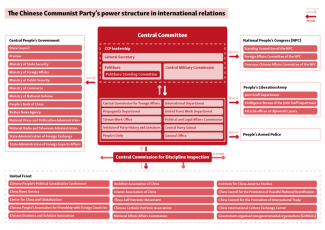
[1] A Leninist state is a form of government characterised by the absolute political authority of a leading, or vanguard, party which, in theory, acts on behalf of the working class or, more broadly, economically disadvantaged groups such as the peasantry. Its purpose is to transform a capitalist society into a socialist one and, ultimately, into a stateless, classless communist order. The defining feature of a Leninist state is the proclaimed ‘dictatorship of the proletariat’, meaning that it uses its power to suppress opposition to the rule of the vanguard party. In practice, however, a Leninist state serves as an instrument through which a relatively small group of activists exercises and maintains absolute power, having originally seized power by force under the banner of social revolution.
[2] See ‘毫不动摇坚持外交大权在党中央’, Qiushi, 25 January 2024, qstheory.cn.
[3] See ‘中国特色大国外交的中华文化基因’, Qiushi, 28 August 2020, qstheory.cn.
[4] See M. Bogusz, J. Jakóbowski, The Chinese Communist Party and its state. Xi Jinping’s conservative turn, OSW, Warsaw 2019, osw.waw.pl.
[5] Kevin Rudd, a former Prime Minister of Australia and a trained sinologist, carried out a comprehensive analysis of Xi Jinping’s worldview. He is perhaps the only Western politician who has not only met Xi Jinping on numerous occasions but has also spoken with him in Chinese. In his work, Rudd advances the novel concept of ‘Marxist nationalism’. Its introduction appears unnecessary, however, for two reasons. First, the worldview and practices of the CCP fall comfortably within the existing concept of a left-wing national liberation movement. Second, the new term creates an impression of the uniqueness of the Chinese experience and makes comparisons with other left-wing national liberation movements, such as those in Vietnam or Cuba, more difficult. Despite evident differences, these movements have evolved in ways broadly similar to the CCP. See K. Rudd, On Xi Jinping: How XI’s Marxist Nationalism Is Shaping China and the World, Oxford University Press 2024.
[6] See D. Bandurski, ‘A New Era of Struggle’, China Media Project, 19 September 2019, chinamediaproject.org.
[7] See ‘Marxism and the National Liberation Movements’ [in:] R.J.C. Young, Postcolonialism: an historical introduction, John Wiley & Sons 2016, p. 167ff.
[8] See Suisheng Zhao, A Nation-State by Construction: Dynamics of Modern Chinese Nationalism, Stanford University Press 2004.
[9] See A. Jones, ‘Changing the Past to Serve the Present: History Education in Mainland China’ [in:] E. Vickers (ed.) History Education and National Identity in East Asia, Routledge 2005, pp. 65–100.
[10] See F. Dervin, R. Machart (eds), Intercultural Communication with China: Beyond (Reverse) Essentialism and Culturalism?, Springer Singapore 2017.
[11] See J. Townsend, ‘Chinese Nationalism’, The Australian Journal of Chinese Affairs, no. 27, January 1992, pp. 97–130.
[12] See Xiaotong Fei, ‘The formation and development of the Chinese nation with multi-ethnic groups’, International Journal of Anthropology and Ethnology 2017.
[13] See M. Künstler, Języki chińskie, Wydawnictwo Dialog 2000.
[14] See Wenfang Tang, B. Darr, ‘Chinese Nationalism and its Political and Social Origins’ [in:] Suisheng Zhao (ed.), Construction of Chinese Nationalism in the Early 21st Century, Routledge 2014, pp. 1–16.
[15] See ‘中共中央办公厅印发《关于加强新时代马克思主义学院建设的意见》’, People’s Daily, 21 September 2021, people.com.cn.
[16] ‘习近平:举旗帜聚民心育新人兴文化展形象 更好完成新形势下宣传思想工作使命任务’, Xinhua, 22 August 2018, xinhuanet.com.
[17] See M. Bogusz, ‘Sino-Russian “Weltanschauung”’, Choice, 31 July 2025, chinaobservers.eu.
[18] The book was first published in 1993 and subsequently revised several times, most recently in 2016. The 2004 edition is used here: Wang Huning (ed.), 政治的逻辑:马克思主义政治学原理, Shanghai People’s Publishing House.
[19] Ibidem, p. VI.
[20] For an English translation of the full speech, see T. Greer, ‘Xi Jinping in Translation: China’s Guiding Ideology’, Palladium, 31 May 2019, palladiummag.com. The Chinese version was published in Qiushi, the journal jointly published by the CCP Central Committee and the Central Party School in Beijing. See ‘关于坚持和发展中国特色社会主义的几个问题’, Qiushi, 1 April 2019. qstheory.cn.
[21] The document was leaked to foreign media in the summer of 2013. See ‘Document 9: A ChinaFile Translation. How Much Is a Hardline Party Directive Shaping China’s Current Political Climate?’, ChinaFile, 8 November 2013, chinafile.com.
[22] See Lien Xiaotong, ‘“内外有别”原则的传统、困境与未来’, Today Media, 21 December 2016, people.com.cn.
[23] See Taehwa Hong, ‘China Doesn’t Compartmentalize’, Foreign Policy, 17 August 2023, foreignpolicy.com.
[24] See ‘党政军民学、东西南北中,党是领导一切的’, Qiushi, 13 January 2020, qstheory.cn.
[25] ‘要冷静、冷静、再冷静,埋头实干,做好一件事,我们自己的事’, CCP, 19 August 2013, cpc.people.com.cn.
[26] H. Paulson, Dealing with China: an insider unmasks the new economic superpower, Grand Central Publishing 2015, p. 240.
[27] ‘《胡锦涛文选》第二卷主要篇目介绍’, Guangming Daily, 22 September 2016, after: xinhuanet.com.
[28] K. Clipper, ‘China’s Transition to Power: The Decline of Deng’s Dictum and the Emergence of China’s Assertive Foreign Policy’, St Antony’s International Review vol. 17, no. 1, December 2022, pp. 26–39.
[29] See Li Meng, ‘专家:习近平重塑“韬光养晦有所作为”’, Today Media, 15 August 2015, politics.people.com.cn.
[30] See Resolution of the CPC Central Committee on the Major Achievements and Historical Experience of the Party over the Past Century, State Council of the PRC, 11 November 2021, gov.cn.
[31] Full text of Xi Jinping’s speech on the CCP’s 100th anniversary, Asia Nikkei, 1 July 2021, asia.nikkei.com.
[32] See M. Bogusz, J. Jakóbowski, The Chinese Communist Party and its state..., op. cit., pp. 25–26.
[33] Full text of Xi Jinping’s speech..., op. cit.
[34] Wang Yi, ‘Implementing the Guiding Principles of the Central Conference on Work Relating to Foreign Affairs and Breaking New Ground in Major-Country Diplomacy with Chinese Characteristics’, Qiushi Journal, 11 March 2024, en.qstheory.cn.
[35] Xi Jinping, ‘Report to the 19th National Congress of the Communist Party of China’, Xinhua, 18 October 2017, xinhuanet.com.
[36]‘ 构建人类命运共同体是习近平外交思想的核心理念’, Qiushi, 9 December 2024, qstheory.cn.
[37] The Five Principles of Peaceful Coexistence (和平共处五项原则) are the PRC's declared principles of foreign relations. They were first set out in the 1954 Sino-Indian Agreement.
[38] See Wang Yi, ‘Implementing the Guiding Principles...’, op. cit.
[39] ‘中华人民共和国国民经济和社会发展第十四个五年规划和2035年远景目标纲要’, State Council of the PRC, 13 March 2021. gov.cn.
[40] See M. Bogusz, ‘China after the 20th CCP Congress: a new stage in Xi Jinping’s revolution’, OSW Commentary, no. 475, 7 November 2022, osw.waw.pl.
[41] See A. Roth, A Hierarchical Vision of Order: Understanding Chinese Foreign Policy in Asia, Bristol University Press 2023.
[42] See R. Pszczel, New horizon. Implications for Poland’s security of NATO’s approach to Indo-Pacific, OSW, Warsaw 2024, osw.waw.pl.
[43] See M. Bogusz, The silicon shield. Taiwan amid the superpowers’ rivalry, OSW, Warsaw 2023, osw.waw.pl.
[44] See O. Gazis, ‘CIA Director William Burns: “I wouldn't underestimate” Xi’s ambitions for Taiwan’, CBS News, 3 February 2023, cbsnews.com; ‘Taiwan defense drills identify 2027 for potential China invasion for first time’, The Japan Times, 19 March 2025, japantimes.co.jp.
[45] L. Chen, G. Torode, ‘China maintains defence spending increase at 7.2% amid roiling geopolitical tensions’, Reuters, 5 March 2025, reuters.com.
[46] Qiang Zhi, M. Pearson, ‘China’s Hybrid Adaptive Bureaucracy: The Case of the 863 Program for Science and Technology’, Governance vol. 30, no. 3, July 2017, pp. 407–424.
[47] See Dan Wang, Breakneck: China’s Quest to Engineer the Future, Norton & Company 2025.
[48] 总体国家安全学习纲要, Office of the National Security Commission of the CC and the Propaganda Department of the CC 2022.
[49] Ibidem: Section III – Safeguarding Technological Security (维护科技安全), Chapter 7 – Upholding the Coordinated Development of Security Across All Sectors (坚持统筹推进各领域安全).
[50] Xi Jinping, ‘Advancing New Quality Productive Forces Is Essential and a Key Priority for Fostering High-Quality Development’, Theory China, 2 December 2024, en.theorychina.org.cn.
[51] See Rui Yang, ‘China’s Removal of English from Gaokao’, International Higher Education no. 75, March 2014, pp. 2–13.
[52] See Su Changhe, ‘中国政治学自主知识体系的国际传播’, Guangming Daily, 7 July 2023, after: theory.people.com.cn.
[53] Jian Xu, Qian Gong, ‘‘Telling China’s Story Well’ as propaganda campaign slogan: International, domestic and the pandemic’, Media, Culture & Society, no. 46(5), pp. 1064–1074.
[54] See ‘习近平:以中国式现代化推进中华民族伟大复兴’, Qiushi, 7 September 2022, qstheory.cn; Xi Jinping, ‘中国式现代化是中国共产党领导的社会主义现代化’, Qiushi, 31 May 2023, qstheory.cn; Xi Jinping, ‘开创我国高质量发展新局面’, State Council of the PRC, 15 June 2024, gov.cn.
[55] See ‘Full text of Xi Jinping's keynote address at the CPC in Dialogue with World Political Parties High-level Meeting’, State Council of the PRC, 16 March 2023, gov.cn.
[56] See ‘中国式现代化带给世界新机遇’, China Diplomacy, 23 June 2025, cn.chinadiplomacy.org.cn.
[57] See L. Maizland, ‘Is China Undermining Human Rights at the United Nations’, Council on Foreign Relations, 9 July 2019, cfr.org; T. Piccone, China’s long game on human rights at the United Nations, Brookings, September 2018, brookings.edu; T. Lee-Smith, J. Cosic, ‘At the UN, China is deploying a growing army of puppet organizations to monitor and intimidate human rights activists’, International Consortium of Investigative Journalists, 28 April 2025, icij.org.
[58] See ‘What to know about whole-process people’s democracy in China’, Xinhua, 6 March 2025, gov.cn.
[59] For more on the party-state relationship see M. Bogusz, J. Jakóbowski, The Chinese Communist Party and its state..., op. cit.
[60] There is also a state Central Military Commission, but it is identical to the CCP Central Committee’s Central Military Commission and is a purely nominal institution, created solely for procedural and propaganda purposes.
[61] See Clyde Yicheng Wang, ‘Changing Strategies and Mixed Agendas: Contradiction and Fragmentation within China’s External Propaganda’, Journal of Contemporary China vol. 32, no. 142, 2023, pp. 586–601.
[62] Wang Jianhua, ‘中国共产党自我革命的实践品格与时代特色’, People’s Daily, 1 May 2024, paper.people.com.cn.
[63] See M. Dimitrov, The Adaptability of the Chinese Communist Party, Cambridge University Press 2024.
[64] See R. Mehta, ‘China’s Social Sector and the Emergence of GONGOs’, Organisation for Research on China and Asia, 1 November 2022, orcasia.org
[65] Alongside so-called covert Party members, the CCP also has so-called special members (特别党员), whose identities are known only to a small number of senior Party leaders and are kept secret, with communication conducted through a single intermediary. These are individuals placed in the leadership or authorities of hostile organisations or states, whose identities are protected even more rigorously than those of covert Party members.
[66] See ‘Xi Jinping wants a spot in your inbox’, The Economist, 2 October 2025, economist.com.
[67] See ‘How Chinese state media are quietly targeting “elites” via Substack’, Substack (user Whiplin), 7 August 2025, substack.com.
[68] See Q. Genaille, ‘How to evaluate the Chinese interference in the EU: mapping China’s influence strategy in Brussels’, Monde chinois no. 60 (4), 11 June 2020, pp. 47–63.
[69] T. Lee-Smith, J. Cosic, ‘At the UN, China is deploying a growing army of puppet organizations to monitor and intimidate human rights activists’, International Consortium of Investigative Journalists, 28 April 2025, icij.org.
[70] The literal translation is: “crossing the river by feeling for the stones”. See ‘邓小平与“摸着石头过河”’, People’s Daily, 9 July 2024, cpc.people.com.cn.
[71] Chu Yin, ‘Vigor and Vitality: The Secret of the CPC’s Success’, China Today, 30 June 2016, chinatoday.com.cn.
[72] ‘共筑“健康丝绸之路”成效初显’, Xinhua Silk Road, 24 February 2017, imsilkroad.com.
[74] See N. Rolland, The Health Silk Road: A Branch of China’s Belt and Road Initiative, National Bureau of Asian Research, 4 December 2024, nbr.org.
[75] J. Leahy, H. Lockett, ‘Brazil’s Lula calls for end to dollar trade dominance’, Financial Times, 13 April 2023, ft.com.
[76] C. Osborn, ‘U.S.-Brazil Feud Could Speed Up De-Dollarization’, Foreign Policy, 24 July 2025, foreignpolicy.com.
[77] See S. Azimi, ‘The Story Behind China’s Role in the Iran-Saudi Deal’, Stimson, 13 March 2023, stimson.org.
[78] B. Bostock, ‘MBS threatened to move Saudi Arabia closer to Russia and China to punish Biden for ostracizing him, report says’, Business Insider, 20 April 2022, businessinsider.com.
[79] See E. Hale, ‘Can China replace the US in the Middle East?’, Al Jazeera, 25 April 2023, aljazeera.com.
[80] See E. Hashem, ‘Saudi-Iran agreement a win-win-win-win deal that breaks the Carter Doctrine’, Global Times, 12 March 2023, globaltimes.cn; ‘One year after Saudi-Iranian reconciliation, China’s dedication to peace still resonates in Middle East’, Xinhua, 10 March 2024, english.news.cn.
[81] Joint Communiqué on the Establishment of Diplomatic Relations, Taiwan Documents, taiwandocuments.org.
[82] ‘中华人民共和国和美利坚合众国关于建立外交关系的联合公报’, Ministry of Foreign Affairs of the PRC, mfa.gov.cn.
[83] See Bei Hu, A. Pym, ‘Constructive ambiguity and risk management in bilingual foreign-affairs texts. The case of “One China”’, Asia Pacific Translation and Intercultural Studies vol. 6, no. 1, May 2019, pp. 3–16.
[84] ‘中华人民共和国和美利坚合众国联合公报 (“上海公报”)’, State Council of the PRC, gov.cn.
[85] See ‘台湾问题与中国的统一’, Ministry of Foreign Affairs of the PRC, August 1993, mfa.gov.cn.
[86] For more on the ‘One China’ principle see M. Bogusz, The silicon shield. Taiwan amid the superpowers’ rivalry, OSW, Warsaw 2023, p. 15, osw.waw.pl.
[87] The actual title of this book is Quotations from Mao Tse Tung. The ‘mass line’ is discussed in chapter 11. See Quotations from Mao Tse Tung, Peking Foreign Languages Press 1966.
[88] See ‘Tackling online disinformation’, European Commission, ec.europa.eu; ‘Fighting the Invisible Enemy: Countering Disinformation & Misinformation’, European Movement International, europeanmovement.eu; ‘Dealing with propaganda, misinformation and fake news’, Council of Europe, coe.int.
[89] See ‘Telling China’s Story Well’, China Media Project, 16 April 2021, chinamediaproject.org.
[90] Ichihara Maiko, ‘China’s Expanding Influence Operations: Online Propagandists Play the Long Game’, Nippon, 16 February 2024, nippon.com.
[91] See J. Lovell, Maoism: A Global History, Knopf 2019, p. 63ff.
[92] See Tsai Wen-Hsuan, ‘Enabling China’s Voice to Be Heard by the World: Ideas and Operations of the Chinese Communist Party’s External Propaganda System Series’, Problems of Post-Communism, October 2016, vol. 64, no. 3–4, pp. 203–213.
[95] See Beijing’s Global Media Influence 2022, Freedom House 2022, freedomhouse.org.
[96] Mindy Su, Angel Yen, ‘China’s Digital Propaganda Machinery: How Beijing is Reshaping the Global Discourse in the 2020s’, Kategalan Media, 31 March 2025, ketagalanmedia.com.
[97] See ‘Foreign Interference Threats to Canada's Democratic Process’, Government of Canada, July 2021, canada.ca; S. Cooper, ‘Canadian intelligence warned PM Trudeau that China covertly funded 2019 election candidates’, Global News, 7 November 2022, globalnews.ca; N. Jarvis, ‘China-linked foreign interference campaign targeted Chrystia Freeland’, True North, 11 February 2025, tnc.news; ‘CSIS documents reveal Chinese strategy to influence 2021 election’, The Globe and Mail, 12 February 2023, theglobeandmail.com.
[98] See D. Bandurski, ‘Backyard Furnaces of Propaganda’, China Media Project, 15 July 2025, chinamediaproject.org.
[99] See The CCP’s Digital Charm Offensive: How TikTok’s Search Algorithm and Pro-China Influence Networks Indoctrinate GenZ Users in the United States, Network Contagion Research Institute, 6 August 2024, networkcontagion.us; D. Leonhardt, ‘TikTok’s Pro-China Tilt’, The New York Times, 24 April 2024, nytimes.com; Yenting Lin, ‘Digital Propaganda: How China Uses Short-Form Videos to Target Taiwan’s Youth’, Small Wars Journal, 6 July 2025, smallwarsjournal.com.
[100] See P. Martin, China’s Civilian Army: The Making of Wolf Warrior Diplomacy, Oxford University Press 2021; Yaoyao Dai, Luwei Rose Luqiu, ‘Wolf Warriors and Diplomacy in the New Era’, The China Review vol. 22, no. 2, pp. 253–283.
[101] B. Doherty, H. Davidson, ‘Chinese envoy walks out of meeting after row with Nauru president amid ‘bullying’ claims’, The Guardian, 5 September 2018, theguardian.com.
[102] ‘How Sweden copes with Chinese bullying’, The Economist, 20 February 2020, economist.com.
[103] B. Doherty, S. Chanel, H. Davidson, L. Kuo, ‘Taiwan official in hospital after alleged ‘violent attack’ by Chinese diplomats in Fiji’, The Guardian, 19 October 2020, theguardian.com.
[104] ‘Australia demands China apologise for posting ‘repugnant’ fake image’, BBC, 30 November 2020, bbc.com.
[105] ‘France to summon Chinese envoy over threats, insults’, Reuters, 22 March 2021, reuters.com.
[106] S. McCarthy, ‘Chinese ambassador sparks European outrage over suggestion former Soviet states don’t exist’, CNN, 25 April 2023, cnn.com.
[107] See Duan Xiaolin, Liu Yitong, ‘The Rise and Fall of China’s Wolf Warrior Diplomacy’, The Diplomat, 22 September 2023, thediplomat.com.
[108] Measuring a state’s ‘success’ or ‘failure’ in the field of foreign influence or strategic communication is inherently difficult. It can, however, be assessed by evaluating outcomes against the intended objective, target audience, time frame and the counterfactual scenario (‘what would have happened had these activities not been undertaken?’). As the CCP’s spending on strategic communication is also far less transparent than that of the United States or EU member states, only estimates rather than official budgetary figures are available. Nevertheless, since Xi Jinping came to power, the CCP’s annual expenditure on external propaganda has been estimated to be at least $10 billion (see S. Cook, Special Report 2020. Beijing’s Global Megaphone, Freedom House, freedomhouse.org). This is nearly ten times the level of US spending. In 2024, the budget of the U.S. Agency for Global Media amounted to just under $867 million (see FY 2024 Agency Financial Report, USAGM 20, 15 November 2024, usagm.gov). By contrast, the latest survey by the Pew Research Center shows only a modest increase in favourable views of China worldwide (see L. Silver et al., International Views of China Turn Slightly More Positive, Pew Research Center, 15 July 2025, pewresearch.org). Moreover, it can be assumed that this is at least partly the result of the deterioration in the United States’ image under Donald Trump, rather than necessarily being a consequence of China’s own efforts.
[109] He Qinglian, 紅色滲透: 中國媒體全球擴張的真相, Gusa Publishing 2019, p. 57ff.
[111] See ‘新形势下海外侨务工作形势分析与展望’, People’s Daily, 1 February 2021, people.com.cn.
[112] See J.-P. Cabestan, ‘Party-to-Party Relations and Political Training’ [in:] N. Rolland (ed.), Political Frontlines. China’s Pursuit of Influence in Africa, National Bureau of Asian Research 2020.
[113] P. Nantulya, ‘Grand Strategy and China’s Soft Power Push in Africa’, Africa Center for Strategic Studies, 30 August 2018, africancenter.org.
[114] ‘Parties and Organizations the CPC Has Relations With’, International Department of the Central Committee of the CCP, 2 November 2014, idcpc.org.cn.
[115] ‘China Exports One-Party Model Via Schools’, Africa Defense Forum, 1 October 2024, adf-magazine.com.
[116] See L. Benabdallah, Ties that Bind. China’s Party-to-Party Diplomacy in Africa, Konrad Adenauer Stiftung, October 2021, pp. 3–4, kas.de; Yang Zeyi, ‘Massive Leak Shows How a Chinese Company Is Exporting the Great Firewall to the World’, Wired, 8 September 2025, wired.com.
[117] See C. Hackenesch, J. Bader, ‘Pragmatic, Strategic and Wide-Reaching: The CCP’s Party Diplomacy in Africa’, Megatrends Afrika, Policy Brief 29, October 2024, megatrends-afrika.de.
[118] Mao Zedong, ‘Speech At The Tenth Plenum Of The Eighth Central Committee’, Marxist Internet Archive, marxist.org.
[119] See H. Harvey, ‘China’s Quest for Blockbuster Soft Power’, Oxford Political Review, 24 November 2023, oxfordpoliticalreview.com.
[120] See ‘US Hegemony and Its Perils’, Ministry of Foreign Affairs of the PRC, 20 February 2023, mfa.gov.cn; ‘Think tank report exposes U.S. mind colonization’, Xinhua, 7 September 2025, english.news.cn.
[121] See ‘How China Is Taking Control of Hollywood’, The Heritage Foundation, heritage.org; R. Carle, ‘How China Is Taking Over Hollywood’, Public Discourse, 3 April 2022, thepublicdiscource.com; China’s Starring Role in Hollywood, Council on Foreign Relations, 6 January 2021, cfr.org; A. Werth, ‘Are Filmmakers Finally Standing Up to Chinese Censorship?’, The Objective Standard, 12 December 2022, theobjectivestandard.com; B. Gertz, ‘Hollywood spreading China propaganda: Report’, The Washington Times, 1 March 2023, washingtontimes.com.
[122] Ibidem.
[123] ‘大变局 | 为中国正言:为何中国与“新殖民主义”无关?’, China Diplomacy, 28 December 2023, cn.chinadiplomacy.org.cn.
[124] See Xi Jinping, ‘纵深推进全国统一大市场建设’, Qiushi, 15 September 2025, qstheory.cn.
[125] See Wang Junyan, ‘Rosa Luxemburg’s Chinese Career’, Rosa Luxemburg Stiftung, 13 January 2013, rosalux.de.
[126] See Zhang Wu, ‘罗莎·卢森堡范式:从帝国主义到全球化’, Journal of Peking University (Philosophy and Social Sciences), vol. 57, no. 2, March 2020, journal.pku.edu.cn.
[127] Xi Jinping, ‘国家中长期经济社会发展战略若干重大问题’, Xinhua, 31 October 2020, xinhuanet.com. For an English translation of the speech see ‘Certain Major Issues for Our National Medium- to Long-Term Economic and Social Development Strategy’, CSET, cset.georgetown.edu.
[128] A. Brown, A. Mischer, ‘German carmakers are placing a risky bet on China’, MERICS, 10 December 2024, merics.org.
[129] B. Wehrmann, ‘German car industry suppliers see “uncatchable lead” by Chinese competitors on key EV technologies’, Clear Energy Wire, 10 June 2025, clearenergywire.org.
[130] ‘German carmakers pivot to China amid tariff impact’, China Daily, 12 August 2025, chinadaily.com.cn.
[131] See A. Fulda, Germany and China: How Entanglement Undermines Freedom, Prosperity and Security, Bloomsbury 2024.
[132] See Sujin Cha, ‘Chinese aid and corruption in African local governments’, Journal of International Development, vol. 36, no. 1, 5 September 2023, pp. 587–605.
[133] See K. Ashta, A. Sawhney, D. Ahlawat, P. Malhotra, ‘China’s Expanding Influence in the UN System’, Gateway House, 27 May 2021, gatewayhouse.in.
[134] ‘Agenda 2063: The Africa We Want’, African Union, au.int.
[135] See B. Jili, ‘Africa’s Demand for and Adoption of Chinese Surveillance Technology’, Atlantic Council, 15 May 2023, atlanticcouncil.org.
[136] See ‘Position Paper of the People’s Republic of China for The Summit of the Future and the 79th Session of The United Nations General Assembly’, Ministry of Foreign Affairs of the PRC, 19 September 2024, fmprc.gov.cn.
[137] ‘以习近平外交思想为指引深入推进中国特色多边主义’, Qiushi, 25 October 2019, qstheory.cn.
[138] The PRC maintains a total of 274 diplomatic missions worldwide. The United States ranks second with 271 missions, followed by Turkey with 252. See Global Diplomacy Index, Lowy Institute, globaldiplomacyindex.lowyinstitute.org.
[139] See ‘The Signing Ceremony of the Convention on the Establishment of the International Organization for Mediation Successfully Held in Hong Kong’, Ministry of Foreign Affairs of the PRC, 30 May 2025, fmprc.gov.cn.
[140] ‘Global AI Governance Action Plan’, Ministry of Foreign Affairs of the PRC, 26 July 2025, fmprc.gov.cn.
[141] See M. Bogusz, ‘Open code, closed system: the role of open-source in China’s technological rivalry with the United States’, OSW Commentary, no. 674, 24 June 2025, osw.waw.pl.
[142] The publication of China’s plan came just a few days after the United States unveiled its own AI action plan, suggesting that the Chinese document is primarily an instrument of technological competition.
[143] Full text of Xi’s statement at the General Debate of the 76th Session of the United Nations General Assembly, State Council of the PRC, 22 September 2021, gov.cn.
[144] The initiative’s formal name is the Silk Road Economic Belt and the 21st-Century Maritime Silk Road Development Strategy (丝绸之路经济带和21世纪海上丝绸之路发展战略).
[145] See Wang Manqian, ‘全球发展倡议为全球可持续发展注入新动力’, Qiushi, 14 October 2024, qstheory.cn.
[146] See Resolution of the UN General Assembly A/RES/70/1: Transforming our world: the 2030 Agenda for Sustainable Development, United Nations, 21 October 2015, un.org.pl.
[147] Xue Er Shi Xi, ‘六个坚持,总书记提出全球发展倡议’, Qiushi, 23 September 2021, qstheory.cn.
[148] ‘UN Fund for South-South Cooperation and Global South-South Development Centre Design Next Project Phase’, UNOSSC, 29 February 2024, unsouthsouth.org.
[149] See ‘China launches on-site first aid training initiative in Sierra Leone’, Xinhua, 11 September 2025, english.news.cn.
[150] See ‘China’s Proposal for Solving Security Challenges’, China Diplomacy, 21 April 2022, en.chinadiplomacy.org.cn.
[151] See ‘Implementing the Global Security Initiative to Build a World of Lasting Peace and Universal Security’, Ministry of Foreign Affairs of the PRC, 28 March 2024, mfa.gov.cn.
[152] ‘全球安全倡议概念文件 (全文)’, State Council of the PRC, 21 February 2023, gov.cn.
[153] ‘Xi attends CPC-world political parties dialogue, proposes Global Civilization Initiative’, People’s Daily Online, 16 March 2023, en.people.cn.
[154] See Full text of Xi Jinping’s keynote address at the CPC in Dialogue with World Political Parties High-level Meeting, China Daily, 15 March 2023, chinadaily.com.cn; Liang Zhonghe, ‘以古典学践行全球文明倡议’, Qiushi, 20 November 2024, qstheory.cn.
[155] See ‘US seeks to extend hegemony to outer space by hyping unfounded ‘China threat’ claim’, Global Times, 8 September 2025, globaltimes.cn.
[156] See ‘Concept Paper on the Global Governance Initiative’, Ministry of Foreign Affairs of the PRC, 1 September 2025, fmprc.gov.cn.
[157] Xi Jinping, ‘推动落实全球发展倡议、全球安全倡议、全球文明倡议、全球治理倡议’, Qiushi, 15 October 2025, qstheory.cn.
[158] Initiatives such as the European Critical Raw Materials Act, adopted in March 2023, are too limited in scope, lack sufficient political and financial backing and, above all, came too late. See Critical Raw Materials Act, European Commission, ec.europa.eu.