Ukraine: an unrealistic budget for 2026
The budget for next year, signed by President Volodymyr Zelensky on 10 December, provides for revenues of 2.9 trillion hryvnias (approximately $68.7 billion) and expenditures of 4.8 trillion hryvnias (approximately $113.8 billion). As in the past three years, the largest item on the expenditure side is defence and national security, for which 2.8 trillion hryvnias are planned ($66.3 billion, 27.2% of GDP). This is followed by the servicing of public debt, which is expected to cost 513 billion hryvnias ($12.2 billion).
Unlike in previous years, a decision has been taken to increase certain non-military expenditures. In particular, spending on education will rise to 279 billion hryvnias ($6.6 billion) – an increase of 80 billion, of which 55 billion will be allocated to 30% pay rises for teachers – while 259 billion hryvnias will be earmarked for healthcare (an increase of 39 billion). By contrast, the budget of the State Agency for Reconstruction and Development of Infrastructure has been reduced from 45 billion to 28 billion hryvnias ($0.66 billion). According to estimates by Ukraine’s Ministry of Finance, in 2026 the state will require 2.08 trillion hryvnias (approximately $49.3 billion) in external financial support.
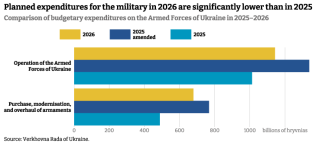
Total budgetary expenditure for next year is slightly higher than in the revised version of the 2025 budget. This does not apply, however, to spending on the Ministry of Defence, which has been reduced from 2.2 trillion to 1.9 trillion hryvnias ($45 billion). The level of funding for other structures linked to the war, such as the security services, has not changed. This suggests that in the coming months, a far-reaching adjustment aimed at increasing expenditure will most likely prove necessary.
Commentary
- The 2026 budget is significantly underestimated with regard to defence spending, especially expenditure falling under the responsibility of the Ministry of Defence. The 2025 budget law was amended three times (most recently in October), mainly due to rising defence outlays, above all those related to maintaining the armed forces, including soldiers’ pay. While from January to March 2025 these expenditures amounted to around 110 billion hryvnias per month, by September–October they were already around 20 billion hryvnias higher (nearly $500 million). Meanwhile, in the 2026 budget, funds allocated to maintaining the operation of the armed forces were reduced by 195 billion hryvnias, and spending on the purchase and modernisation of armaments by 89 billion hryvnias (see Chart). It cannot be ruled out, however, that this underestimation reflects calculations by the authorities, who may be counting on some form of ceasefire or a reduction in the intensity of hostilities.
- Spending on the remaining security structures has been kept at this year’s level (after amendment) or slightly reduced. This applies, for example, to the National Guard, the Security Service of Ukraine, military intelligence (HUR), the State Border Guard Service, and the police. A similar situation occurred in 2024 and 2025, and on each occasion the authorities were forced to revise the budget to provide for a substantial increase in allocations for these structures. It can be assumed with a high degree of probability that the same will occur next year.
- The civilian part of Ukraine’s budget for next year is entirely dependent on foreign support. Unlike the 2025 budget, however, there is no certainty regarding the sources of financing for the full range of needs. It is unclear what portion of the required external financing of $49.3 billion (43% of expenditure) the country can currently count on, and the situation is further complicated by the likely increase in spending during the year, as occurred in previous years. According to Ukraine’s Ministry of Finance, the financing gap in 2026–2027 is expected to amount to $60.8 billion. The ministry’s estimates are close to those of the International Monetary Fund (IMF), which calculates that unfunded needs over this period will reach $63 billion. Part of these funds may be provided by the IMF itself: on 26 November, a preliminary (staff-level) agreement was reached between the Fund and Ukraine on a new 48-month assistance programme under the Extended Fund Facility, worth $8.1 billion. This still requires approval by the IMF’s Executive Board, which is expected to take place in January. The greatest hope for Kyiv, however, lies in the European Commission’s proposal for a so-called reparations loan of up to €165 billion, based on frozen assets of the Russian central bank. These funds would be intended to cover both Ukraine’s civilian and military needs.