Russia is expanding the area under its control around Vovchansk. Day 1525 of the war

Russian forces continued their offensive on all main fronts in the Donbas and in the eastern part of Zaporizhzhia Oblast. However, their minor territorial gains did not result in any significant change in the overall situation. According to some sources, the Russians crossed the Donets–Donbas Canal directly east of Kramatorsk, coming within 11 km of the city. The situation has calmed down somewhat in the western part of Zaporizhzhia Oblast, where the Ukrainian counter-offensives of recent weeks have lost momentum.
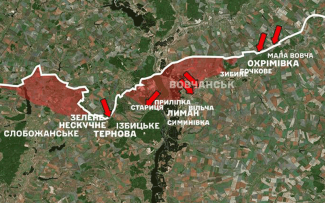
Russian forces have deepened and expanded the area under their control in the Vovchansk region of Kharkiv Oblast. They have most likely driven the Ukrainians from their last strongholds between the border and the Vovcha River, which runs parallel to it; this area is currently under Russian control or – mainly in its eastern part – in a grey zone. They have also made further advances in several other border regions of the Kharkiv and Sumy oblasts, as well as in the Kupiansk area east of the Oskil River. Russia is reported to have resumed operations aimed at capturing this town, using pipelines to move covertly. According to the defenders, all attempts made so far have been repelled.

On 25 April, the Russians carried out another massive air strike on Ukraine. Dnipro was the hardest hit, with strikes continuing for over 20 hours. A total of five people were killed there, and over 50 were injured. Residential buildings, industrial facilities and fuel depots were damaged. As a result of the massive attack, damage to energy, industrial and transport infrastructure also occurred in Bila Tserkva, Kharkiv, Kherson and smaller towns in the Cherkasy, Chernihiv and Zaporizhzhia oblasts. In Odesa Oblast, port infrastructure in the Danube Delta and a ship were damaged. According to reports from the Ukrainian Air Force Command (UAFC), Russia deployed a total of 619 drones, including 400 ‘Shahed’ strike drones, and 47 missiles. Ukraine reported that it had neutralised 580 unmanned aerial vehicles and 30 cruise missiles. However, they failed to shoot down any ballistic missiles, which, according to the UAFC, is the most significant consequence of the shortage of interceptor missiles for the Patriot systems.
Port infrastructure in Odesa Oblast remained one of the main targets of the strikes. Further elements of quay equipment were damaged, as were ships flying the flags of Saint Kitts and Nevis (24 April), Panama (25 April), Palau (26 April) and Nauru (27 April). On 26 April, a tank containing 6,000 tonnes of oil was hit in Chornomorsk, resulting in an oil spill into the sea. The destruction also affected industrial facilities and residential buildings in Odesa. On 24 April, two people were killed and 17 injured, whilst three days later 14 people were injured, including two children.
The Russians continued to destroy railway and energy infrastructure – with particular intensity in frontline areas. Further damage to facilities and rolling stock was reported in Zaporizhzhia (22 and 24 April), Kryvyi Rih (23 and 24 April), Korosten (23 and 26 April) and smaller towns in the Sumy (24 and 26 April) and Poltava (27 April) oblasts. Damage to energy infrastructure, mainly substations and transmission lines, occurred daily in all frontline and border regions. As a result of these repeated attacks, it is impossible to stabilise energy supplies in these areas. On 22, 23 and 26 April, Dnipro was targeted by Russian drones. In the second of these attacks on the city, three people were killed and 13, including two children, were injured. According to Ukrainian data, from the evening of 21 April to the morning of 28 April, Russia deployed a total of 1,457 drones (including 950 ‘Shahed’ drones) and 52 missiles, including the massive attack on 25 April. Ukraine claimed to have neutralised 1,297 unmanned aerial vehicles and 30 of the aforementioned cruise missiles.

On 28 April, Ukrainian drones struck the Tuapse refinery in Krasnodar Krai once again, causing a fire. The Russians are still dealing with the aftermath of previous attacks on the facility (most recently on 20 April), including an oil spill into the sea. On 26 April, a refinery in Yaroslavl was attacked, where, according to the Ukrainian General Staff, oil distillation facilities were damaged, and on 23 April, the Gorky pumping station near Kstovo in Nizhny Novgorod Oblast (satellite images confirmed a fire in two tanks) and an industrial facility in Novokuybyshevsk in Samara Oblast. On 25 April, Ukrainian drones attacked Chelyabinsk and Yekaterinburg in the Urals, 1,750 km away. Although they did not hit their targets (the wreckage of one of the drones damaged a residential building in Yekaterinburg, injuring nine people), they nevertheless confirmed that Ukraine is systematically increasing its ability to strike at the enemy’s rear. The first Ukrainian strike on a target 1,750 km away took place in February this year. The target at that time was Ukhta in the Komi Republic.
On 26 April, the Ukrainians carried out one of the largest air raids on Sevastopol since 2022. According to the local administration, over 200 facilities of various kinds were damaged, including energy and railway infrastructure (electric train services on the route to Inkerman were suspended), one person was killed and four were injured. Russian air defences reported that 71 drones attacking the city had been neutralised. According to a statement by the SBU, its subordinate ‘Alpha’ Special Operations Centre struck the landing ships “Yamal” and “Filchenkov” (the correct name of the vessel is the “Nikolai Filchenkov”), the reconnaissance vessel “Ivan Khurs”, a radar station and a MiG-31 fighter at Belbek airfield near Sevastopol. This information has not yet been confirmed, nor have reports from the Ukrainian General Staff regarding the effects of the attacks on Crimea on 22 and 23 April.
The Ukrainians continued their attacks on energy infrastructure in Russia’s immediate rear, mainly in the occupied parts of the Kherson and Zaporizhzhia oblasts. Substations in the Melitopol and Belgorod areas were hit once again. There was a significant reduction in drone activity on 27 April, and their use was hampered by strong winds blowing over Ukraine, which themselves contributed to damage to energy infrastructure (mainly transmission lines) on both sides of the front line.

The aim of further Russian operations remains the destabilisation of the internal situation in Ukraine. The Russians are organising, among other things, attacks on security service officers using recruited locals. Those most often persuaded to cooperate are young, uneducated people of low economic status. The arrest on 21 April by the Security Service of Ukraine (SBU) of a 17-year-old resident of Kremenchuk in the Poltava Oblast is a recent example; on Russia’s orders, he was allegedly preparing a double terrorist attack near a police station. He was arrested after planting explosives at the site of the planned attack. A day later, the SBU announced the arrest of a collaborator with the Russian services and the subsequent foiling of an assassination attempt on the commander of a Ukrainian Armed Forces (UAF) unit in Odesa. The woman in custody had been passing on the location data of the Ukrainian officer, which was to be used by a hired assassin. On 23 April, the Zakarpattia regional police reported the arrest of a Zaporizhzhia resident suspected of poisoning a UAF soldier on the orders of the Russian secret services.
The main tool used by Russian services for recruitment is social media (primarily Telegram), where potential collaborators are enticed to cooperate with promises of financial benefits. Two teenagers, who were planning attacks on schools in the Kirovohrad and Odesa oblasts but which were foiled by the SBU on 23 April, were reportedly lured by the prospect of quick money. Meanwhile, on 28 April in Cherkasy Oblast, the SBU detained an IT specialist who was allegedly creating recruitment channels for Ukrainian residents on behalf of the Russian secret services. The man was recording telephone numbers from Ukrainian operators, which were then used to set up fake social media accounts for recruitment operations.

On 21 April, Belgium announced that it would purchase and supply 15 Gepard self-propelled anti-aircraft guns to Ukraine. It also announced a contribution of €100 million under the mechanism for the procurement of US armaments – the so-called Prioritised Ukraine Requirements List (PURL).
On 22 April, during a visit to Kyiv, Spanish Defence Minister Margarita Robles announced that Madrid would provide Ukraine with 100 VAMTAC armoured tactical vehicles and a consignment of 155 mm artillery shells.
Also on 22 April, the Italian Council of Ministers published its annual report on arms exports for 2025, which stated that Ukraine was the fourth-largest recipient of Italian arms and military equipment (AME). The document does not disclose detailed data on the types of AME, but states that the total value of export licences granted to Kyiv amounts to €349 million.
On 23 April, the Council of the EU officially approved a €90 billion loan for Ukraine, of which €60 billion is to be allocated to military support in 2026–2027. Kyiv intends to spend these funds, among other things, on the purchase of 100–150 Swedish JAS-39 Gripen fighters and up to 100 French Rafale fighters, along with 600 AASM Hammer glide bombs, and eight SAMP/T medium-range air defence batteries, along with Aster 30 Block 1 NT missiles designed to counter ballistic missiles.
On 27 April, the Norwegian and Ukrainian defence ministries announced the signing of an agreement under which facilities producing unmanned strike systems with a range of 50–200 km for the Ukrainian Armed Forces will be established on Norwegian territory and will be funded by Norway.

Andriy Shvets, Head of the Main Investigation Department of the SBU, announced on 22 April that the service is conducting 116 criminal investigations into the execution of 306 Ukrainian prisoners of war by Russian soldiers. He stated that such cases of extrajudicial killings are systematic in nature and are sanctioned by the Russian authorities.
On 24 April, the General Staff of the Armed Forces of Ukraine announced the dismissal of the commander of the 14th Separate Mechanised Brigade and the demotion of the commander of the 10th Army Corps. Colonel Taras Maksimov has been appointed the new commander of the 14th Brigade, and General Artem Bohomolov the new commander of the 10th Corps. These personnel changes are the result of an investigation by the Land Forces Command into the commanders of these units concealing the true picture of the situation at the front, facilitating a lack of rotation for many months, and restricting food rations for soldiers serving on one section of the defence line. Photographs of starving Ukrainian soldiers, published by the soldiers’ families, caused a significant stir both at home and abroad. In connection with the case, the Commander-in-Chief of the Armed Forces of Ukraine, General Oleksandr Syrskyi, ordered an inspection of the supply of troops operating on the front line.
In an interview published on 23 April, Deputy Minister of Justice Yevhen Pikalov stated that over 12,000 individuals with legally binding convictions had joined the Ukrainian army. The period of service corresponds to the remaining portion of their sentence, and in the event of injury or upon the end of martial law, the soldier is released from further serving their sentence. Former convicts receive the same pay as other military personnel and may maintain contact with their families, but they remain under strict supervision and are not permitted to leave the area where they are carrying out their duties.
According to a report published on 27 April by the Stockholm International Peace Research Institute (SIPRI), in 2025 Ukraine rose to seventh place in the world in terms of military expenditure. Spending rose by 20% compared to the previous year, reaching $84.1 billion, which corresponds to 40% of GDP and places Ukraine in first place in terms of the ratio of military expenditure to GDP. Russia’s military expenditure in 2025 amounted to approximately $190 billion and increased by 5.9%. This represents approximately 7.5% of Russia’s GDP.

On 24 April, Ukraine and Russia carried out the 73rd exchange of prisoners of war on a 193-for-193 basis. Most of the Ukrainian prisoners had been held illegally in Chechnya. The exchange was to be carried out due to the mediation of the US and the United Arab Emirates.

On 24 April, the English-language news website, the Kyiv Independent, published an investigative report accusing the coordinators of a covert programme supporting the resistance movement in the occupied territories of failing to ensure adequate operational security. According to the journalists, this programme, funded by Western countries, was implemented between 2022 and 2024, and its participants were encouraged to engage in high-risk activities despite reports of arrests, torture and the deaths of activists.