Estonia: presidential election in the shadow of a political crisis
On 2 September, parliament elected Ülle Madise President of Estonia. Her candidacy was supported by 71 of the 101 MPs, with 68 votes required for election. Madise will take office on 12 October after being sworn in before the Riigikogu. The president has limited powers in Estonia’s political system. These include approving the appointment of the country’s most senior officials and the right to veto legislation, though that veto can be overridden by a simple majority. Internationally, the president serves as a representative. The office enjoys a high level of public trust and carries sufficient prestige to help moderate public sentiment, particularly when its holder is charismatic.
The election of the new head of state took place without public debate and resulted from behind-the-scenes negotiations involving politicians from both the current governing coalition (the Reform Party and Estonia 200) and the opposition (the Social Democrats and Isamaa (Fatherland)). Ülle Madise is not widely known among the general public, and her political views have not featured prominently in public debate. However, she has many years of experience in state institutions. This was probably the decisive factor in her election, while the political agreement helped limit the costs of another dispute in Estonian politics.
Commentary
- Madise will cooperate with the government on both foreign and domestic policy. Her priority will be domestic affairs, with which she is much more familiar. Her presidency can be expected to focus on safeguarding the constitutional order, protecting civil rights and freedoms, press freedom and the rule of law. In representing Estonia internationally, Madise will work in close coordination with the government, primarily because of her lack of experience and expertise in this area.
- The presidential election took place at a politically turbulent time for the government; Prime Minister Kristen Michal is grappling with a crisis within the coalition as well as growing pressure from the opposition and public discontent. In August, MPs Kalev Stoicescu (Estonia 200) and Meelis Kiili (Reform Party) announced their decision to leave the coalition (the Social Democrats had already left in March 2025). Consequently, the two-party government lost its fragile parliamentary majority and now has the support of 50 of the 101 MPs. The prime minister is also facing low public approval of his government. Norstat polling from late August shows that 35% of respondents rate the government positively (‘very well’ or ‘fairly well’), while as many as 60% assess its performance negatively. Approval of the prime minister himself is even lower, at 25%. Meanwhile, a June survey by Turu-uuringute found that only 4% of Estonian residents wanted Michal as prime minister, compared with 20% who preferred opposition leader Urmas Reinsalu of the right-wing Isamaa party. Opinion polls on support for political parties also continue to show an unfavourable trend for the coalition, with only around 12–14% of respondents currently prepared to vote for the governing parties.
- Passing the budget will represent the most important challenge facing Michal’s minority government. The economic recovery in the first two quarters of this year, following years of stagnation (GDP growth in 2025 stood at 0.6%), has been driven by favourable conditions in the manufacturing, agricultural and construction sectors. This may point to favourable prospects for the adoption of next year’s budget. However, it does not resolve longer-term problems, including the persistent budget deficit (expected to reach 4.5% of GDP this year), partly due to high defence spending. This year’s military expenditure is estimated at 5.4% of GDP (€2.4 billion), with a larger share allocated to purchases abroad than to domestic investment. This means that, in adopting the budget, the government will have to consider cuts in other areas. The political cost of this decision will be compounded by a scandal that emerged in early September and led to the defence minister’s resignation, involving irregularities in €70 million worth of arms procurement carried out by the Ministry of Defence.
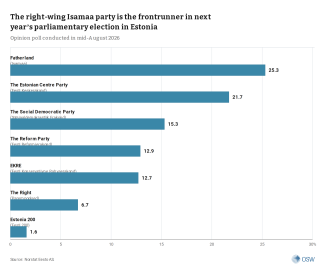
- The parliamentary election in March 2027 will result in an opposition victory. Polling trends, evident since at least the beginning of 2024, point to a victory for the right-wing Isamaa party, whose support remains at around 25% and whose considerable coalition-forming potential is evident. The governing parties have been on a strong downward trend for some time. The Reform Party has lost its image as a party with expertise in economic and security affairs and has also lost a significant share of its electorate to Isamaa. Estonia 200 has been polling below the 5% electoral threshold for many months.
APPENDIX
Profile of Ülle Madise
Ülle Madise (born 1974) is a lawyer, academic and civil servant. She began her career in the state administration in the late 1990s at the Ministry of Justice, before working for the Constitutional Committee of the Estonian parliament (Riigikogu) and the National Audit Office. From 2009 to 2015, she served as legal adviser to Estonian President Toomas Hendrik Ilves. He subsequently nominated her as Chancellor of Justice, an office combining the roles of ombudsman for civil rights and children’s rights with oversight of the constitutionality of legislation. From 2005 to 2016, she taught at the University of Tartu, from which she graduated, and at Tallinn University of Technology. The future president’s political outlook is not entirely clear, although she is sometimes described as a conservative liberal. Madise is married to lawyer Lauri Madise, a judge at the Court of Justice of the European Union in Luxembourg.